
Zest mood is one of those slang phrases that sounds light and playful, but it can carry more meaning than people expect.
Meer looking at it, zest mood sounds bright, cheerful, and full of energy. In simple terms, zest means excitement, energy, or lively enjoyment, while mood is used online to mean a feeling, vibe, or state that feels relatable. Put them together, and the phrase usually points to a lively, playful, or extra energetic kind of energy.
But slang is rarely that simple. In some online spaces, zesty can also carry a coded meaning when it is used to describe a man as flamboyant, effeminate, or queer coded, sometimes in a mocking way. That is why context matters so much here. The phrase can sound cute in one chat and loaded in another.
So today, let us break it down in a way that actually makes sense. What does zest mood mean in slang? Why does it sound so catchy? When can it be harmless, and when should you read it more carefully?
Table of Contents
Quickly
- Zest means energy, enthusiasm, and lively enjoyment in standard English.
- Mood in internet slang means something relatable or a feeling that matches your vibe.
- Zest mood is not a fixed dictionary phrase, but it is often understood as a lively, energetic vibe.
- In some online spaces, zesty can also be used as a coded or mocking label, so tone and context matter a lot.
So What Does Zest Mood Mean?
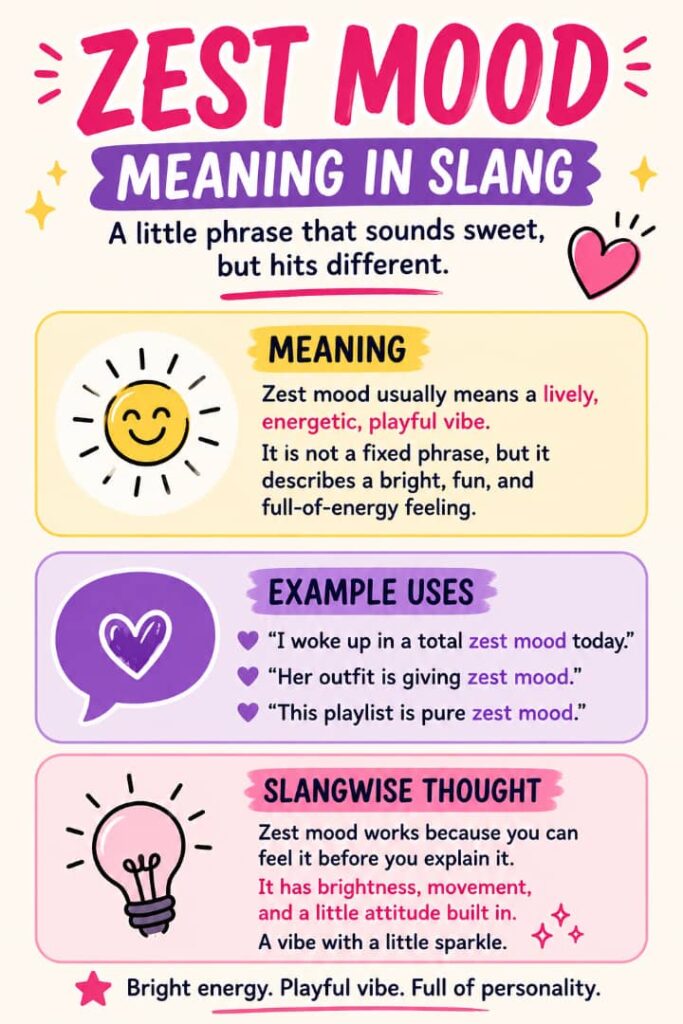
Zest mood is not one of those standard slang terms that every dictionary agrees on. Instead, it acts more like an internet phrase built from two separate ideas. Zest means energy or lively enjoyment, and mood means a relatable feeling or vibe.
That means most people would understand zest mood as a way of saying someone is in a bright, playful, or extra energetic state. It can describe a person, a caption, a reaction, or even the energy of a post.
In that sense, it is close to saying good vibes, fun energy, or feeling very alive today. That reading is an interpretation, but it fits the usual meanings of the two words.
You can think of it as a mood with a little sparkle to it. Not just happy. Not just excited. More like noticeably awake, playful, and full of personality.
Example uses:
- “I woke up in a total zest mood today.”
- “Her outfit is giving zest mood, and I love it.”
- “This playlist is pure zest mood.”
READ ALSO: Shelfing Meaning in Slang: The Sneaky Social Move That Keeps People Waiting
Why the Phrase Feels So Catchy
Part of the appeal is the sound of it. Zest already feels lively because it is tied to sharp flavor, energy, and enthusiasm in standard English. Then mood does the internet slang work.
On social platforms, people use mood to say, “that is so me,” or “this perfectly describes how I feel.” That is why phrases like “big mood” became so common.
So when you combine zest with mood, you get something that sounds instantly usable in a caption, reply, or playful post. Honestly, that is how a lot of slang grows. People mix a familiar emotion word with a vibe word, and suddenly the phrase feels newer than it really is.
That observation is an interpretation, but it matches how online language often works.
The Important Context Behind Zesty Language
Here is the part people should not skip. In some online communities, zesty has developed a second, more loaded slang meaning. Some slang sources and modern word trackers show uses where the word is applied to men who are seen as flamboyant, effeminate, or queer coded, sometimes in a mocking or insulting way.
That does not mean every use of zest mood is offensive. It does mean the phrase can sit near a tricky edge of internet slang. If somebody uses it to mean energetic and playful, it may be harmless. If somebody uses it to mock how a person talks, moves, or presents themselves, the tone changes completely.
So the safest way to understand zest mood is this: it usually points to lively, fun energy, but it can also pick up extra coded meaning depending on who says it and where it is said.
READ ALSO: Hop On and Hop Off Meaning in Slang: The Two Tiny Phrases That Keep Conversations Moving
How Zest Mood Works in Real Life
When people use the phrase casually, they are usually talking about someone who feels bright, expressive, and playful. It might describe an outfit, a photo, a caption, a reaction, or a whole attitude. Since mood already functions as shorthand for a relatable feeling, the phrase sounds most natural in captions and casual chat.
Here are a few natural examples:
- “This whole outfit is zest mood.”
- “Your energy today is pure zest mood.”
- “Not me entering the party in full zest mood.”
These examples are original phrasing, but they follow the way zest and mood are used in contemporary English and internet slang.
What Zest Mood Usually Looks Like
Zest mood can feel obvious or subtle. The obvious kind is easy to spot because it sounds cheerful, animated, and fun. The subtle kind is more about tone. It might show up in a caption, a comment, or a reply where the speaker is describing something bright and full of personality without saying it directly.
Here are a few common signals:
- The phrase is being used to describe lively energy.
- The tone feels playful or stylish.
- The context suggests a vibe rather than a literal definition.
- The speaker is leaning into internet style language.
Once you get the rhythm of it, the phrase becomes easier to read. It is less about a strict definition and more about the feeling it creates.
SEE ALSO: 40 Most Popular Internet Catchphrases of 2026 (Updated)
Slangwise Thought
One thing about internet slang is that the best phrases are usually the ones that sound like a feeling before they sound like a definition.
Zest mood works because you can almost feel it before you explain it. It has brightness, movement, and a little attitude built into the words themselves.
How to Use Zest Mood Naturally
If you are using it in a light, friendly way, it works best as a vibe phrase. You can use it for a friend who is acting extra cheerful, for a photo that feels bright, or for a moment that feels playful and energetic.
Since mood already functions as a shorthand for a relatable feeling, the phrase sounds most natural in captions and casual chat.
A few natural examples:
- “This whole outfit is zest mood.”
- “Your energy today is pure zest mood.”
- “Not me entering the party in full zest mood.”
These examples are my own phrasing, but they follow the way zest and mood are used in contemporary English and internet slang.
SEE ALSO: Gen Z vs Gen Alpha Slang in 2026: What the Newest Internet Words Really Mean
The Bigger Picture
Zest mood is more than just a cute phrase. It is also a reminder that internet language often carries more than one layer. Some uses are playful and harmless. Some are coded. Some depend entirely on tone, community, and context.
That does not mean you should be afraid of the phrase. It simply means you should read it carefully. Slang changes fast, and a word can feel sweet in one space while feeling sharp in another.
That is the fun and tricky part of slang. A phrase can sound cute, sharp, or coded all at once.
Wrapping It Up
Zest mood usually means a lively, energetic, playful vibe. It is not a fixed dictionary phrase, but it makes sense when you combine the normal meaning of zest with the internet meaning of mood.
At the same time, because zesty can also be used in a coded or mocking way online, the phrase should be read carefully and used with awareness of context.
In everyday slang, the phrase is a neat way to describe bright energy and expressive vibes. Once you know how to read it, the meaning becomes much easier to catch. And with zest mood, the vibe is doing most of the talking.
READ ALSO: 72 Most Popular Gen Z Slang Words of 2026 – Rizz, Delulu, Skibidi etc., And What They Secretly Mean Online
Frequently Asked Questions
It usually means a lively, energetic, playful vibe, though it is not a fixed dictionary phrase. That meaning is inferred from the standard meanings of zest and mood.
Not really. It appears more like a niche or stylistic internet phrase than a widely established slang term.
It can, depending on context. The word zesty has online uses that are coded or mocking toward effeminate or queer coded behavior.
Use it only when the tone is clearly playful and the people involved understand it as a vibe phrase, not as an insult.