There is a moment I keep running into when I decode a new slang term: I understand the word, but I still do not understand why anyone is saying it. That difference is important.
It is the same reason catchphrases such as brain rot can sound strange until you understand the culture around them.
Take “6 7”. Try to translate it like an ordinary word and you can spend ten minutes looking for a definition that is not really there. Understand the meme, gesture, and joke behind saying it at random moments, and suddenly it makes sense. That is modern slang.
I have spent a lot of time studying slang by looking beyond the surface definition. I pay attention to where a term appears, who uses it, what joke surrounds it, and whether the meaning changes across online communities. That is the approach I am bringing to this guide.
Gen Z and Gen Alpha are not separated by a neat slang border. Generation labels vary by source, and slang crosses those borders even faster.
Pew Research Center uses 1997 as the starting point for Gen Z, while Gen Alpha is less standardized, so I use the labels here as cultural shorthand rather than rigid rules.
And that is the promise of this article: I want to show you the pattern behind the words, introduce newer 2026 examples, and help you recognize what feels Gen Z, Gen Alpha, or shared.
In Short
- Gen Z slang often leans on irony, reactions, social situations, and phrases that work well in chats, captions, and comments.
- Gen Alpha slang increasingly pulls from memes, gaming, livestreams, short videos, number jokes, and intentionally absurd internet culture.
- The overlap is huge. A slang term can spread across generations, get remixed, and change tone without asking permission.
- Newer 2026 terms worth knowing include 6 7, aura farming, unc, cooked, lock in, glazing, lore, tuff, rage bait, and several meme expressions that are more about shared context than fixed definitions.
- Want to test yourself? Take the Ultimate Internet Slang Quiz and grab the free 270+ Internet Slang Dictionary and Ebook from SlangWise.
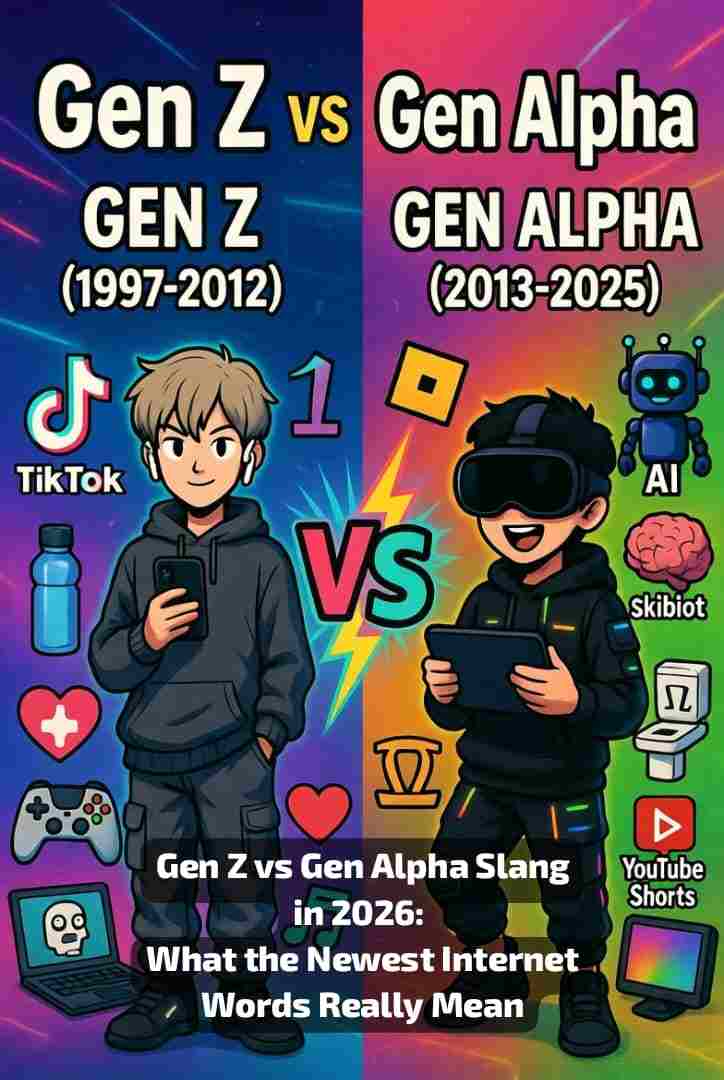
Here is my list of 30 word Gen Z vs Gen Alpha comparison for 2026.
| # | Gen Z leaning | Gen Alpha leaning | Meaning |
|---|---|---|---|
| 1 | IYKYK | 6 7 | Insider reference vs ambiguous meme |
| 2 | It’s giving | Aura farming | Describes a vibe vs building coolness |
| 3 | Rent free | Unc | Stuck in your thoughts vs teasing someone as old |
| 4 | Stan | Cooked | Devoted fan vs in trouble, exhausted, or finished |
| 5 | Soft launch | Lock in | Reveal gradually vs focus completely |
| 6 | Caught in 4K | Glazing | Caught with evidence vs excessive praise |
| 7 | Understood the assignment | Lore | Did it exactly right vs backstory or context |
| 8 | Be so for real | Tuff | Calling for honesty vs cool or impressive |
| 9 | Situationship | Rage bait | Undefined relationship vs provocative content |
| 10 | Vibe check | 41 | Assessing mood vs number based meme |
| 11 | Lowkey | Aura points | Slightly or secretly vs imaginary coolness points |
| 12 | Touch grass | What the sigma? | Spend less time online vs playful disbelief |
| 13 | Big yikes | Skibidi | Strong awkward reaction vs intentional nonsense |
| 14 | Living rent free | Fanum tax | Stuck in your mind vs taking someone else’s food as a joke |
| 15 | Ghosted | Ohio | Suddenly ignored vs weird or chaotic |
| 16 | Hits different | Brain rot | Feels unusually satisfying vs repetitive internet content |
| 17 | ICL | NPC | I can’t lie vs background character behavior |
| 18 | Pressed | Yap | Bothered vs talking excessively |
| 19 | Cringe | W aura / L aura | Embarrassing vs gaining or losing coolness |
| 20 | Main character energy | Clanker | Confident presence vs insult for a robot or AI |
| 21 | For real for real | Lock in | Strong emphasis vs intense focus |
| 22 | Say less | 67 gesture | No more explanation needed vs 6 7 gesture |
| 23 | Plot twist | Cooked | Unexpected turn vs jokingly being done for |
| 24 | Side eye | Rage baiter | Skepticism vs deliberate provocation |
| 25 | No thoughts, head empty | Aura farming | Playful blankness vs manufacturing coolness |
| 26 | It’s not that deep | Unc coded | Do not overthink it vs jokingly old fashioned |
| 27 | Real | Six seven | Strong agreement vs spoken 6 7 meme |
| 28 | Core memory | Aura | Memorable moment vs perceived coolness |
| 29 | Canon event | 67 meme | Unavoidable life moment vs 6 7 participation |
| 30 | Chronically online | Brainrot slang | Deeply immersed online vs absurd internet expressions |
🧠 Think You Know Your Internet Slang? Test your knowledge with our Ultimate Internet Slang Quiz featuring 25 easy questions! From popular Gen Z slang to everyday internet abbreviations, discover how well you understand the language of the internet.🎯 Can you answer all 20 questions correctly? [Take the Slang Quiz]

Quick takeaway
The table gives you the vocabulary, but the real difference becomes clearer when you watch how the words behave. Gen Z expressions often carry a recognizable social meaning even when they are ironic.
Newer Gen Alpha expressions can sometimes be intentionally unstable, where the shared joke matters more than a precise definition.
DISCOVER: 72 Most Popular Gen Z Slang Words of 2026 – Rizz, Delulu etc., And What They Secretly Mean Online.
What I notice when I study Gen Z slang
When I decode Gen Z slang, one thing stands out: the phrase usually does a job.
IYKYK creates a little circle of people who understand the reference. You do not explain the joke. The whole point is that the right people already know. It’s giving works differently, but it is equally efficient. It lets someone describe the overall feeling of a photo, room, post, or situation without giving a long explanation.
Then there is rent free. Something is living in your head without paying any mental rent. A person, song, embarrassing moment, argument, or meme can all live rent free in someone’s mind.
I like these terms because slang can be a faster, more expressive way to package an idea.
That is why Gen Z slang can feel easier for adults to decode. You may never have used caught in 4K, but the meaning becomes obvious once you know the context.
Older Gen Z expressions such as rizz, delulu, periodt, ghosting, and hits different also show how a short phrase can carry a surprisingly specific social feeling.
What makes Gen Alpha slang feel different in 2026
Now we reach the part that confuses people most.
Gen Alpha slang often feels less like a vocabulary lesson and more like entering the middle of an inside joke that started somewhere on the internet and spread before anyone wrote down the rules.
6 7 is the clearest example. Know Your Meme traces the meme from Skrilla’s “Doot Doot” into basketball edits, TikTok clips, livestream culture, gestures, and wider youth internet culture.
The important part is that the phrase does not need one neat definition to work. Saying it can simply signal that you know the reference.
Then there is aura farming. Slang.net describes it as deliberately cultivating a cool or admired image through curated behavior or appearance.
The phrase combines “aura,” meaning perceived coolness or presence, with “farming,” a term borrowed from the logic of games and collecting value. Slang.net’s aura farming guide is a useful reference for the slang and its context.
And then we have cooked. Someone can be cooked because an exam is going badly, because they are exhausted, because they made a mistake, or because the situation simply looks impossible.
Lock in is almost the opposite mood: focus, stop getting distracted, and take the task seriously.
Glazing adds another layer. If someone keeps praising a celebrity, athlete, creator, or friend far beyond what seems reasonable, another person may accuse them of glazing. The meaning works because the exaggeration itself is the joke.
These terms show how a short word can sit inside a surprisingly complicated culture.
READ MORE: 80 Most Popular Gen Alpha Slang Words You’ll Hear In 2026 (updated).
The slang that crosses the line between generations
Aura is a perfect example. People talk about aura points as if coolness were a game, and “aura farming” means deliberately cultivating that image. Slang.net describes aura farming as trying to build a cool or admired presence through curated behavior or appearance.
6 7 shows the other side. Know Your Meme traces the meme from Skrilla’s “Doot Doot” into basketball edits, TikTok clips, gestures, and wider youth internet culture. Its appeal comes partly from shared recognition rather than one stable definition.
A key clue: sometimes the context is the meaning. Brain rot, NPC, and rage bait also cross age groups. A word can start in one community, spread to another, and return with a new tone.
READ ALSO: Millennial Slang vs Gen Alpha Slang in 2026: 45 Words That Show How Internet Language Changed.
The biggest difference is really the internet era
I would be careful about saying, “Gen Z says this, Gen Alpha says that,” as though there is a hard wall between the two.
There is not.
A teenager can use a phrase from an older creator, while a younger child can pick up a word from a streamer. Then adults repeat it ironically and the tone changes again.
So I compare the generations by looking at the internet environments that shaped the slang.
Gen Z grew up while social media, memes, texting culture, fandoms, and short form content were becoming everyday communication. Gen Alpha has grown up with those systems already embedded, alongside livestreams, gaming communities, feeds, and constant remix culture.
That helps explain why newer slang can feel more fragmented. A phrase can explode, become overused, turn ironic, and fade before everyone outside the culture learns it.
That is why I do not treat slang as a frozen list. Ask where you heard it, what was happening, who was saying it, and whether the person was serious.
How to tell whether slang is serious or a joke
The word alone is not enough. When I decode a phrase, I look for context, audience, and intent.
“That is so cooked” might describe a genuinely bad situation, or it might be playful exaggeration. “Six seven” may not be an answer at all. The same is true for sigma, skibidi, aura, and unc. Tone often tells you more than the word.
Once you read slang this way, you stop memorizing isolated definitions and start understanding the culture around them.
Discover 70 of the most popular millennial slang words, what they really mean, and how they shaped internet culture, texting, and everyday conversations.
SlangWise Thought
After studying slang for a long time, the biggest mistake I see is treating internet language like a vocabulary test.
It is not.
Slang is social. It carries tone, timing, humor, identity, community, and sometimes deliberate nonsense. That is why a person can understand a word technically and still use it in a way that sounds completely wrong.
My rule is simple: learn the meaning, then learn the vibe.
You do not need to force yourself to use every trending term you learn. Sometimes understanding the joke is more useful than repeating it.
And when a term becomes popular enough to reach everyone, remember that the original online community may already be using it differently.
Verdict
- Gen Z slang often revolves around reactions, social situations, identity, irony, and compact expressions.
- Gen Alpha slang increasingly mixes memes, gaming language, livestream culture, number jokes, and absurd references.
- 6 7, aura farming, unc, cooked, lock in, glazing, lore, and tuff are useful 2026 examples because they show how quickly the newer slang layer is evolving.
- The line between the generations is blurry. Shared platforms mean vocabulary crosses age groups constantly.
- The smartest way to decode slang is to study context as well as definition.
Conclusion
Gen Z vs Gen Alpha slang is not really a battle between two completely different languages. It is more like watching internet language evolve in real time.
Gen Z helped build a style of communication where a short phrase could carry an entire reaction. Gen Alpha is inheriting that system and pushing it toward faster memes, stranger references, remix culture, gaming influence, and expressions that sometimes work precisely because they are difficult to define.
That is why newer terms such as 6 7, aura farming, cooked, lock in, glazing, unc, and tuff can feel so different from older internet slang.
But remember the most important lesson: slang does not always belong to one generation. It travels. It gets borrowed. It gets remixed. Sometimes a younger group picks up a phrase from older users, changes the tone, and gives it a new life.
So the next time you hear a mysterious slang word, do not just ask, “What does that mean?” Ask, “What is happening here, and why is this phrase funny in this moment?” That question will take you much closer to the real meaning.
Gen Z Attraction Slangs: 25 Slang Words People Use When They Are Into Someone.
FAQs
Yes, but not in a strict way. Gen Alpha uses much of the slang popularized by Gen Z while adding more meme based, gaming influenced, and intentionally absurd expressions. The biggest difference is often context and tone rather than ownership of a word.
6 7, also written as 67 or six seven, is a viral meme expression that often has no fixed literal meaning. It became popular through online videos, basketball edits, and repeated meme use. The joke is often in saying it and recognizing the reference rather than translating it into one exact definition.
Aura farming means deliberately doing or presenting something in a way that builds an image of coolness, confidence, or charisma. It can be used sincerely or as a joke when someone appears to be trying very hard to look effortlessly cool.
Cooked usually means someone is in trouble, exhausted, overwhelmed, or unlikely to recover from a situation. It is often used humorously, such as saying someone is cooked after forgetting to prepare for something important.
Gen Alpha slang spreads through short videos, livestreams, gaming communities, memes, and algorithm driven feeds. A phrase can become popular very quickly, get repeated everywhere, and then lose its freshness just as quickly.
Table of Contents