
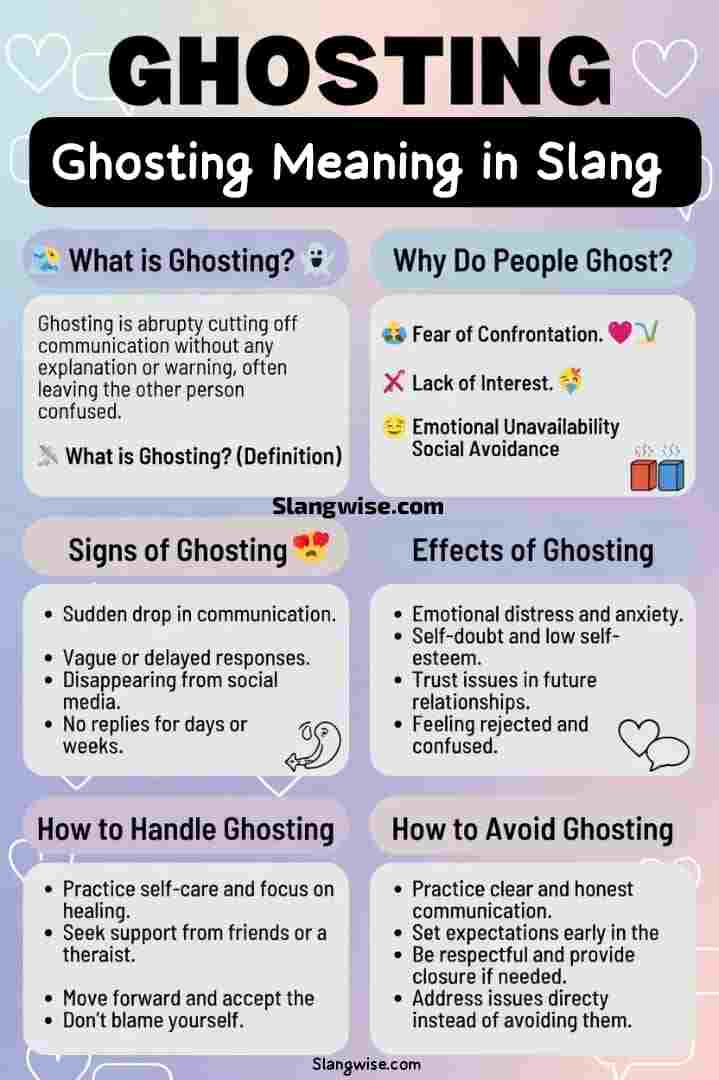
- Ghosting in dating means suddenly cutting off communication without giving an explanation or clear ending.
- It can happen after texting, flirting, matching on a dating app, going on a date, or even developing an ongoing connection.
- Slow replies alone do not automatically mean ghosting. The bigger clue is a complete or repeated disappearance with no meaningful explanation.
- People ghost for different reasons, including conflict avoidance, loss of interest, emotional discomfort, or simply poor communication habits.
- The healthiest response is to recognize the pattern, avoid endlessly chasing an answer, and protect your time and emotional energy.
Table of Contents
Ghosting Meaning in Dating: What Does It Really Mean?
You know that strange moment when a conversation feels promising, the replies are flowing, and then suddenly the other person disappears?
No argument. No “I am not interested anymore.” No awkward goodbye. Just silence.
That is ghosting.
After studying slang and tracking how internet language changes the way people describe everyday behavior, one thing becomes obvious about the word ghosting: it works because the image behind it is so easy to understand. Someone does not simply reply late. They seem to disappear from your life like a ghost.
In dating, ghosting can be especially confusing because there may have been genuine conversation before the silence. You might have exchanged messages every evening, shared inside jokes, talked about meeting up, or even gone on a few dates. Then suddenly, the communication drops off a cliff.
And that is where the overthinking usually begins.
Was the conversation too much? Did they meet somebody else? Did you misunderstand the connection? Or did they simply lose interest?
Slangwise tip: Ghosting can make you analyze every message you sent, but silence is not automatically evidence that you did something wrong. Often, it tells you more about the other person’s communication style than your value.
What Does Ghosting Mean in Dating?
Ghosting means suddenly stopping communication with someone without explanation or a clear ending. In a dating situation, that can mean no longer replying to texts, ignoring calls, disappearing from an app conversation, or abruptly ending communication across several platforms.
The important part is the disappearance.
Everyone gets busy. Someone may take a day to respond because of school, work, family responsibilities, travel, or simply needing some time away from their phone. That alone is not ghosting.
Ghosting becomes much more likely when the communication suddenly changes and stays that way. A person who used to respond regularly may stop answering altogether.
Plans may be ignored rather than rescheduled. Messages may remain unanswered even though there was previously a clear pattern of communication.
In other words, ghosting is not simply delayed communication. It is communication disappearing without closure.
Where Did the Word Ghosting Come From?
The slang word ghosting became widely associated with modern dating and online communication as texting, social media, and dating apps changed how people met and maintained relationships.
The metaphor is straightforward. A ghost appears and disappears. Someone who stops communicating without explanation does something surprisingly similar in social terms: they were present, then suddenly they are gone.
What makes ghosting interesting as slang is that it does more than describe the action. It gives the behavior a memorable image. Saying “they stopped replying” explains what happened. Saying “they ghosted me” instantly communicates the idea of an unexplained disappearance.

Why Do People Ghost in Dating?
This is usually the question people ask next: Why would someone disappear instead of simply saying they are no longer interested?
There is no single answer. Ghosting can happen for several different reasons, and understanding those reasons can make the behavior easier to interpret.
One common reason is conflict avoidance. Some people find it extremely uncomfortable to tell another person, “I am not feeling this anymore.” Rather than deal with that awkward conversation, they choose silence.
Another reason is loss of interest. The person may have enjoyed the conversation at first but later realized they did not want to continue. Instead of communicating that change honestly, they simply disappear.
Some people also ghost because they become overwhelmed by dating, emotions, expectations, or the amount of communication involved. Others have developed poor digital communication habits and treat online conversations as easily disposable.
And then there is the uncomfortable truth: some people ghost because they do not know how to communicate with maturity.
That does not automatically make them a terrible person, but it does tell you something about how they handle uncomfortable situations.
Ghosting is one of the 30 most popular dating slang terms. See the remaining 29.
9 Signs You Might Be Getting Ghosted
Not every quiet period means someone is ghosting you. The pattern matters more than one unanswered message.
1. Their replies suddenly stop. Someone who normally responds within hours or the same day suddenly goes completely silent.
2. Your follow-up messages are ignored. One unanswered message could mean anything. Repeated silence after reasonable attempts to continue the conversation is more significant.
3. Plans disappear without explanation. They previously talked about meeting up, but when the day gets closer, they stop communicating instead of confirming or changing the plan.
4. The energy changes dramatically. The person who once asked questions, started conversations, and showed interest suddenly gives nothing back.
5. They stop responding after a meaningful conversation. Sometimes ghosting happens immediately after conversations become more serious or personal.
6. Their online activity continues, but your messages remain unanswered. Seeing someone active online does not automatically prove they are deliberately avoiding you, but together with prolonged silence, it can reinforce the pattern.
7. They repeatedly disappear and reappear. This is sometimes called breadcrumbing when someone gives just enough attention to keep a connection alive. It is different from straightforward ghosting, but the two behaviors can overlap.
8. There is no attempt to explain the silence. The longer the silence continues, the harder it becomes to view it as a normal delayed reply.
9. You are doing all the communication work. When every conversation, follow-up, and attempt to reconnect is coming from one side, the relationship has already become unbalanced.
The key lesson here is simple: one late reply is not ghosting, but a sustained pattern of unexplained disappearance often is.
What Does Being Ghosted Feel Like?
Ghosting is a strange kind of dating disappointment because there is often no official ending.
When someone tells you they are not interested, the message may hurt, but at least the situation is clear. Ghosting removes that clarity. Instead of an ending, you get unanswered questions.
That uncertainty is what makes ghosting so mentally exhausting. You may replay old conversations, inspect your wording, remember a joke you made, or wonder whether one particular message changed everything.
But this is where a slang decoder’s perspective is useful: the word ghosting describes a behavior, not a verdict on the person being ghosted.
You can acknowledge that someone handled a situation poorly without turning their behavior into a statement about your own worth.
Sometimes the most accurate explanation really is the simplest one: the other person decided not to continue and failed to communicate that decision directly.
Discover what stan means in slang: a term for being an over-the-top, loyal fan of a celebrity, artist, or trend. Find out how it’s used in pop culture.
How to Handle Being Ghosted
So, what should you actually do when someone ghosts you?
First, resist the temptation to send message after message trying to force an explanation. When someone has already stopped communicating, repeatedly chasing a response usually creates more frustration than clarity.
A single calm follow-up can be reasonable, especially when there is a genuine possibility that something unexpected happened. Something as simple as:
“Hey, just checking in. Haven’t heard from you. Hope everything is okay.”
That keeps things respectful without turning the conversation into an interrogation.
After that, look at the pattern rather than the possibilities. You do not need to invent ten explanations for why someone has not replied. Their continued lack of communication is itself useful information.
It can also help to stop checking the person’s online status, rereading old conversations, or searching their social media for clues. Those habits often keep the uncertainty alive long after the situation is already clear.
Most importantly, do not turn ghosting into a competition where you try to prove that you are worth replying to.
You deserve communication that does not require detective work.
How to Avoid Ghosting Someone Else
Understanding ghosting is not only useful when someone does it to you. It also helps you recognize what better communication looks like.
Suppose you have been chatting with someone for two weeks, but you realize the connection is not there. You do not owe them a dramatic explanation, but disappearing completely is usually unnecessary.
A simple message can do the job:
“I’ve enjoyed talking with you, but I don’t think we’re the right match. Wishing you the best.”
That is clear, respectful, and final.
Being honest may feel uncomfortable for a few minutes. Ghosting can leave another person wondering what happened for days or weeks. In that sense, clarity is usually the kinder choice.
Examples of Ghosting
Example 1: The dating-app disappearing act. You match with someone and spend several nights talking about music, school, hobbies, and places you would both like to visit. They seem interested and even suggest meeting sometime. You reply to their last message the next morning, but suddenly the conversation goes completely dead. A week passes with no response. That can be ghosting.
Example 2: The almost-date. You have been chatting with someone who says they are excited to meet you on Saturday. You confirm the time on Friday. Instead of replying, they disappear. Saturday comes and there is still no explanation or attempt to reschedule. That unexplained withdrawal can also be described as ghosting.
Example 3: The post-date vanishing act. You go out for coffee, the conversation feels easy, and both of you appear to have enjoyed yourselves. The next day, you send a friendly message thanking them for the time. Nothing. You wait a couple of days and send one follow-up. Still nothing. That is a much stronger example of ghosting than simply receiving a slow reply once.
Example 4: The sudden social-media silence. You have been talking consistently with someone across a dating app and social media. Then they stop replying everywhere at almost the same time. There was no disagreement and no explanation. The sudden disappearance from every channel is another situation people may call ghosting.
Ghosting vs. Being Busy: What Is the Difference?
This distinction matters because the word can easily be overused.
A person who takes a day or two to reply because life became hectic is not necessarily ghosting. A person who says, “Sorry, this week got crazy. I’ll reply properly this weekend,” is communicating. Even delayed communication can still be healthy communication.
Ghosting is more about the disappearance of communication and the absence of an explanation.
That is why context matters. Slang often becomes powerful because it gives a name to a recognizable pattern, but the label should still be used carefully.
Is Ghosting the Same as Rejection?
Not exactly.
Rejection is when someone clearly communicates that they do not want to continue. Ghosting is when that communication never happens and the person simply disappears.
Both can hurt, but ghosting often feels more confusing because you are left to interpret the silence yourself.
That is also why people use the word so frequently in online conversations. It captures a very specific social experience: being left without a clear ending.
Slangwise Take: What Ghosting Really Tells You
One of the most useful things about studying slang is seeing what new words reveal about changing social behavior. Ghosting is a perfect example.
The word exists because modern communication makes it incredibly easy to start conversations and incredibly easy to disappear from them. Dating apps can create dozens of connections in a short period, while messaging allows people to maintain relationships without being physically present.
That convenience has a downside: it can make communication feel disposable.
But the strongest lesson is not simply “people ghost.” It is that communication habits reveal a lot about compatibility. Someone who disappears whenever conversations become uncomfortable may not be offering the kind of communication style you want in a relationship anyway.
In that sense, ghosting can eventually give you useful information, even if the way that information arrives is frustrating.
Clarity is attractive. Consistency matters. Communication should not feel like solving a mystery.
Conclusion
Ghosting in dating means disappearing from someone’s communication without giving a clear explanation or ending. It has become one of the most recognizable pieces of modern dating slang because it describes a frustrating experience in one memorable word.
Understanding the meaning helps you recognize the difference between ordinary delayed replies and a genuine communication pattern. It also makes it easier to see why people ghost, how the behavior can affect the person on the receiving end, and what a healthier response looks like.
Most importantly, remember that another person’s decision to disappear does not automatically define your value. Sometimes the clearest message is the one someone never bothered to send.
When communication disappears, pay attention to the pattern, respect yourself enough to stop chasing endless explanations, and make room for people who know how to communicate clearly.
FAQs About Ghosting in Dating
Ghosting usually means someone suddenly stops communicating without explanation after an existing connection has been established. The pattern matters more than a single late reply. Prolonged, unexplained silence is a stronger sign of ghosting.
There is no exact number of hours or days that automatically equals ghosting. Consider the person’s normal communication habits, whether plans were already made, and whether your reasonable follow-up messages are being ignored. The longer unexplained silence continues, the more likely it is to be ghosting.
No. A person may have genuinely enjoyed talking to you or spending time with you and still choose to disappear later. Ghosting tells you how they handled the situation, not necessarily what every earlier interaction meant.
One calm follow-up can be reasonable, especially if you are checking whether everything is okay. Repeatedly sending messages after continued silence usually does not create the closure you are looking for, so it is healthier to recognize the pattern and step back.
Rejection involves a clear indication that someone does not want to continue a connection. Ghosting is different because the person disappears without communicating that decision directly.