
Internet slang has never been a language that sits still. A phrase can appear in one corner of TikTok, jump into comments, spread through group chats, get picked up by gamers and meme accounts, and suddenly become something people everywhere recognize.
After years of studying online slang, one pattern becomes especially obvious: the meaning of a word is rarely the whole story.
You also need to understand the tone, the community using it, the joke behind it, and whether the person saying it is being serious, ironic, playful, sarcastic, or deliberately absurd.
That is why words such as rizz, delulu, skibidi, brainrot, aura, and unc can be surprisingly difficult to decode. Sometimes they have a fairly clear definition. Sometimes they are used as a reaction. Sometimes they have become so exaggerated that the humor comes from how little literal meaning they actually carry.
This guide brings together 77 slang words, phrases, abbreviations, and internet expressions that are especially useful to recognize in 2026. Some are classic Gen Z terms that have survived several waves of internet culture.
Others have moved into the Gen Z–Gen Alpha crossover space. A few are older expressions that have been repackaged by social media and given a fresh digital life.
The goal is not to turn every sentence into a pile of slang. Real fluency works differently. You learn what a word means, notice how people actually use it, understand its tone, and then decide whether it belongs naturally in the conversation.
5 Things to Know About Gen Z Slang in 2026
- Internet slang changes incredibly fast. TikTok, Discord, Instagram, gaming communities, memes, and comment sections can transform a niche phrase into mainstream slang surprisingly quickly.
- Not every slang word is meant literally. Words such as skibidi, brainrot, and even some uses of sigma are often funny precisely because they are exaggerated, absurd, or intentionally disconnected from their original meaning.
- Gen Z slang has many different roots. Some expressions come from African American English and Black internet culture, some from gaming, music, drag culture, fandoms, memes, and older slang, while others emerge from completely new online communities.
- Context matters more than memorizing definitions. A word like “based” can mean genuine approval in one conversation and irony in another. The same expression can sound friendly between friends but rude when used toward a stranger.
- The best slang users do not force it. Recognizing slang is more important than constantly using it. One natural expression usually sounds better than five unrelated slang terms squeezed into the same sentence.
- Download the free 270+ Internet Slang Ebook to get a bigger slang dictionary packed with meanings, examples, and more popular terms.
Take the Slangwise Quiz and see if you’re actually fluent in internet slang
Think you really know Gen Z slang? Take the Slangwise Quiz before reading our 50 Top Gen Z Slangs and unlock a bonus ebook when you finish.
NOTE: LEVEL: Easy. QUESTIONS 20. TIME: 8 Mins… Only 47% of attempts passed so far. Would you?
Results
Nice work!
You passed the Easy Level and your slang game is looking solid.
You unlocked the special bonus Slangwise ebook.
Ready to level up? Proceed to the Hard Level and prove you are a true slang master.
Good try! Slang evolves fast, so missing a few is totally normal.
You still unlocked the special bonus Slangwise ebook for participating.
Want to challenge yourself? You can still try again and see how far you can go.


#1. What does SUS usually mean in Slang?
#2. If someone says they’re going to GHOST you, it means they will:
#3. DRIP usually refers to someone’s:
#4. SIMP refers to someone who:
#5. What does RIZZ mean?
#6. GLOWED UP in slang means:
#7. If a post gets RATIOED on Twitter/X, it means:
#8. If someone says a snack is BUSSIN, they mean it is:
#9. If someone says I’M DEAD, they mean:
#10. She ATE that outfit means:
#11. According to Gen Zs, If a song SLAPS, that means the song is:
#12. When someone says “this HITS DIFFERENT,” they mean:
#13. LOWKEY in internet slang means:
#14. YEET! is commonly used to:
#15. CHEUGY refers to something that is:
#16. FLEX in Gen Z Slang most often means:
#17. To STAN someone is to:
#18. If a meme is SENDING ME, it means the meme is:
#19. What’s the meaning of TEA in internet slang?
#20. When someone says BASED, they usually mean:
77 Most Popular Gen Z Slang Words of 2026 — Meanings, Origins & Examples
There is no official scoreboard that can perfectly rank internet slang from number one to number 77. Online language moves too quickly, and a term that is huge on one platform can be almost invisible on another.
So this list is better understood as a practical decoder: 77 expressions worth recognizing because they continue to appear across memes, social posts, videos, gaming communities, chats, and everyday conversations.
Some of these terms are older than Gen Z itself. Others are newer. What connects them is their usefulness in understanding contemporary internet language.
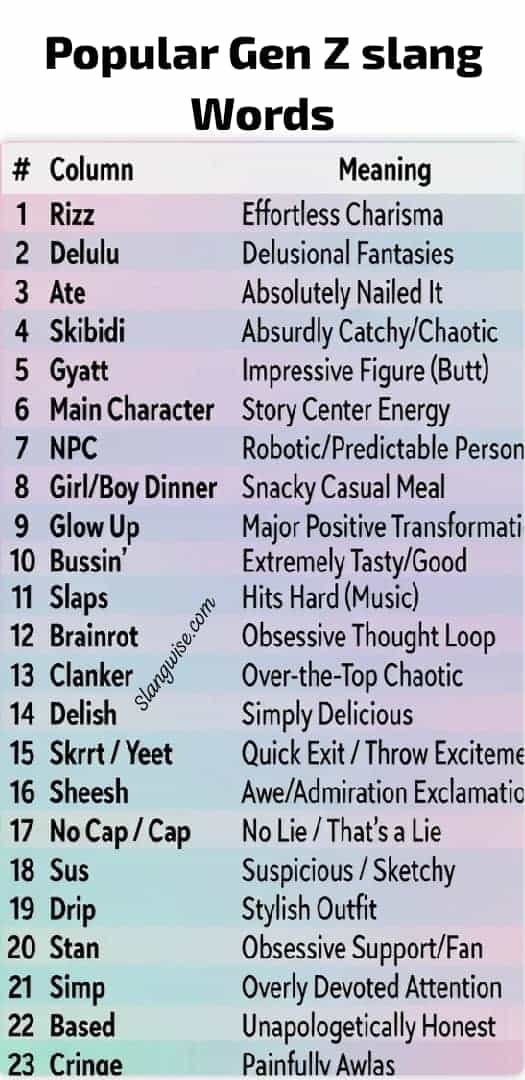
1. Rizz — What Does Rizz Mean in Gen Z Slang?
Rizz is one of those slang terms that became far too big to remain a niche internet joke. It refers to charisma, especially the ability to charm or attract someone through confidence, personality, and smooth social interaction.
One important detail often gets lost in simplified definitions: rizz is not simply “being attractive.” Someone can have plenty of rizz without looking like a celebrity.
The word usually points toward social confidence and the ability to handle an interaction naturally. Example: “He walked into the room, started talking to everyone, and somehow made instant friends: that is serious rizz.”
2. Delulu — What Does Delulu Mean in Slang?
Delulu is playful shorthand for “delusional.” Online, it is usually used when someone is entertaining an unrealistic hope or fantasy and knows, at least partly, that they are stretching reality.
The tone is important. Calling a friend delulu can be affectionate teasing rather than a serious accusation. The humor often comes from openly embracing an unrealistic idea. Example: “She thinks the singer is going to notice her comment and invite her backstage. The delulu is strong today.”
3. Ate — What Does Ate Mean in Gen Z Slang?
When someone says you ate, they are saying you did something exceptionally well. You can “ate” a performance, an outfit, a presentation, a joke, a dance, or practically anything that was executed impressively.
The word is especially effective because it is short, dramatic, and easy to drop into comments. It often appears as “you ate,” “she ate,” or “they ate that up.” Example: “That final presentation was incredible. You absolutely ate.”
4. Skibidi — What Is the Meaning of Skibidi?
Skibidi is one of the clearest examples of internet slang escaping the need for a stable dictionary definition. It became strongly associated with viral meme culture and the Skibidi Toilet phenomenon, then spread into a wider style of absurd online humor.
Today, “skibidi” can be playful nonsense, a signal of chaotic meme energy, or a deliberately ridiculous way of describing something online. It is often used because the word itself sounds funny. Example: “That entire edit was so skibidi that I have no idea what I just watched.”
5. Gyatt — What Does Gyatt Mean in Gen Z Slang?
Gyatt is an internet reaction term that is often used to comment on someone’s body, particularly their butt. Depending on context, it can function as an exclamation of surprise or as a comment about physical attractiveness.
Because it comments on appearance, this one requires more awareness than a harmless reaction word like “W.” It can easily sound disrespectful when directed at someone who has not invited that kind of comment. Example: “The comments were full of people using ‘gyatt’ after the celebrity posted the photo.”
6. Main Character — What Does Main Character Mean in Slang?
Calling someone the main character means they seem to be living as though their life is a movie and they are at the center of the story. The phrase can be genuinely complimentary, mildly teasing, or completely ironic.
Main-character energy often suggests confidence, dramatic timing, independence, or simply doing something memorable. Example: “She booked a solo trip, made a playlist for the journey, and watched the sunset from the rooftop. Maximum main-character energy.”
7. NPC — What Does NPC Mean in Slang?
Originally a gaming abbreviation for non-playable character, NPC is now widely used online for someone who seems repetitive, predictable, robotic, or lacking in independent thought.
The term can be playful, but it can also be insulting. The classic internet joke is to compare someone’s behavior to a game character repeating the same scripted line. Example: “Every time you ask him a question, he gives the exact same answer. Bro has NPC dialogue.”
8. Girl Dinner / Boy Dinner
Girl dinner and boy dinner are humorous labels for improvised meals that do not look like a conventional dinner. Think snacks, leftovers, bread, fruit, cheese, cereal, or whatever happens to be available.
These expressions are less about gender rules than about describing a certain casual approach to eating. They became part of the wider social-media conversation around low-effort meals and personal food habits. Example: “Dinner tonight is crackers, fruit, hummus, and a random cookie. Elite girl dinner.”
9. Glow Up — What Does Glow Up Mean in Gen Z Slang?
A glow up is a noticeable positive transformation. It can involve appearance, fashion, confidence, lifestyle, personal growth, career progress, or simply becoming more comfortable in yourself.
The phrase is most useful when it describes overall growth rather than treating appearance as the only measure of improvement. Example: “Her confidence after starting the new job is a serious glow up.”
10. Bussin’ — What Does Bussin Mean in Slang?
When something is bussin’, it is extremely good, especially food. The expression became strongly associated with enthusiastic reactions to meals, though it can occasionally be used more broadly for anything impressive.
One of the biggest clues that this is casual slang is the exaggerated enthusiasm behind it. Example: “This chicken is bussin’. Whoever made this absolutely knew what they were doing.”
11. Slaps — What Does Slaps Mean in Gen Z Slang?
If a song slaps, it sounds especially powerful, enjoyable, catchy, or satisfying. The word is strongly associated with music, but people also use it more broadly for something that delivers a surprisingly good experience.
You will often see it in music reviews, reaction videos, playlists, and comments. Example: “That opening beat slaps so hard I have already replayed it five times.”
12. Brainrot — What Does Brainrot Mean in Slang?
Brainrot is one of the most interesting modern internet terms because it can describe both a type of content and the mental experience of being obsessed with that content. A person might say they have “brainrot” over a meme, song, fictional character, video, celebrity, or recurring joke.
The word usually carries a humorous sense of self-awareness. You know you have watched the same clip seventeen times, and you know that is slightly ridiculous. Example: “I have severe brainrot over that soundtrack. It has been stuck in my head all week.”
13. Clanker — What Does Clanker Mean in Slang?
Clanker is a more niche meme expression and is best understood through context rather than treated as one universal slang definition. In different online communities, it can be used humorously for loud, chaotic, machine-like, or exaggerated content, particularly in meme-heavy spaces.
This is exactly the kind of slang where community context matters. A term can be obvious to one corner of the internet and confusing everywhere else. Example: “That whole robot-themed montage was peak clanker nonsense.”
14. Delish — What Does Delish Mean in Slang?
Delish is a playful shortening of “delicious.” It usually appears when someone wants to praise food in a light, casual way, though it can occasionally be used figuratively for anything especially pleasing.
It is less intense than something like “bussin’” and feels more cheerful than dramatic. Example: “That cheesecake looks absolutely delish.”
15. Skrrt / Yeet — What Do Skrrt and Yeet Mean?
Skrrt imitates the sound associated with a sudden movement or quick getaway, while yeet became famous as an energetic expression connected with throwing something or acting with exaggerated enthusiasm.
Both words have had several lives online, which is common with internet slang. Even when their popularity rises and falls, people continue to reuse them for comedic effect. Example: “The second the rain started, we skrrt-ed out of there.”
16. Sheesh — What Does Sheesh Mean in Slang?
Sheesh is an elongated reaction that communicates surprise, admiration, disbelief, or excitement. Tone does most of the work here.
You can say it after seeing an impressive outfit, an unbelievable sports play, an expensive purchase, or a surprisingly good result. Example: “Sheesh, that presentation was clean.”
17. Bet — What Does Bet Mean in Slang?
Bet is a compact way of saying “okay,” “deal,” “I agree,” or “watch me.” Depending on the situation, it can communicate agreement, confidence, acceptance, or a playful challenge.
Its simplicity is the reason it has lasted. Example: “Meet at six?” “Bet.”
18. No Cap / Cap — What Do They Mean in Slang?
No cap means someone is being truthful or completely serious, while cap means a lie, exaggeration, or questionable claim.
These expressions are often used as instant truth checks. “No cap” emphasizes sincerity, while “cap” challenges what someone just said. Example: “That was the best concert of the year, no cap.”
19. Sus — What Does Sus Stand For?
Sus is short for “suspicious.” The expression became especially famous through online gaming and Among Us, then spread far beyond gaming.
In everyday slang, it usually means something seems questionable, strange, or untrustworthy. Example: “He says he was asleep, but he posted three videos at midnight. That is sus.”
20. Drip / Sus Drip — What Does Drip Mean in Slang?
Drip refers to stylish clothing, accessories, or overall fashion sense. When someone says you have drip, they are praising your look.
“Sus drip” is more of a playful combination rather than a universally fixed slang expression, usually suggesting that someone’s outfit looks suspiciously impressive, exaggerated, or extra. Example: “The jacket, shoes, and sunglasses together are serious drip.”
21. Stan / Stanning — What Does Stan Mean in Gen Z Slang?
To stan someone means to support them very enthusiastically, usually a musician, actor, creator, fictional character, or public figure. It describes intense fandom and has become a normal part of online fan language.
The word comes from the title of Eminem’s famous 2000 song “Stan,” but the modern slang sense has expanded far beyond that original story. Example: “I have stanned this artist since the first album.”
22. Simp — What Does Simp Mean in Gen Z Slang?
Simp is usually used for someone who gives excessive attention, effort, money, or praise to a person they like. It is often thrown around jokingly between friends, but it can also be used unfairly to mock ordinary kindness.
That distinction matters. Being generous or caring does not automatically make someone a simp. Example: “He bought a huge gift for someone he had just met, and his friends immediately called it a simp move.”
23. Based — What Does Based Mean in Slang?
Based is usually praise for a confident, honest, or unapologetic opinion. It often appears when someone says something that others consider refreshingly direct or independent.
It can also become ironic, especially in meme-heavy conversations. Example: “She said the trend is overrated and explained why. Honestly, based.”

24. Cringe / Total Cringe — What Does Cringe Mean in Slang?
Cringe describes something awkward, embarrassing, painfully uncool, or uncomfortable to watch. “Total cringe” simply raises the intensity.
Among younger internet users, calling something cringe is often a quick judgment rather than a serious criticism. The term can also be used jokingly against oneself. Example: “I just reread the message I sent and wow, that was cringe.”
25. Hits Different — What Does Hits Different Mean?
When something hits different, it creates a stronger emotional or sensory reaction than expected. A song may hit different after a breakup. A childhood snack may hit different after years away from it.
The phrase is usually about subjective experience. It means the same thing feels more powerful because circumstances or emotions have changed. Example: “That movie hits different now that I understand the ending.”
26. Ratio — What Does Ratio Mean in Gen Z Slang?
To get ratioed traditionally means a post receives more engagement in its replies than in the original post, often signaling that the audience disagrees with the original opinion.
On social media, “ratio” can function as a quick warning that a person’s take is being rejected by the crowd. Example: “He posted that opinion and the replies completely ratioed him.”
27. Chef’s Kiss — What Does Chef’s Kiss Mean in Slang?
Chef’s kiss is a playful way of saying something is perfectly done. It comes from the familiar gesture of kissing the fingertips after tasting excellent food.
Online, the phrase has escaped food entirely. People use it for writing, photography, outfits, editing, jokes, design, and any detail that feels unusually polished. Example: “The final transition in the video was chef’s kiss.”
28. Deluxe / Deluxe Cringe — What Does Deluxe Mean in Slang?
Deluxe can be used as a humorous intensifier. “Deluxe cringe,” for example, means something is not merely awkward but impressively, almost comically awkward.
This is one of those forms of slang built around exaggeration. People enjoy turning ordinary criticism into increasingly dramatic labels. Example: “That fake apology was deluxe cringe.”
29. Core / Alt — What Do These Labels Mean in Slang?
Words ending in -core are generally used to describe a specific aesthetic, lifestyle, mood, or visual culture. Cottagecore, goblincore, and dozens of other variations have appeared online.
These labels are powerful because one word can summarize a whole visual world. Example: “Her room is basically cottagecore with all the plants and vintage decorations.”
30. Mood — What Does Mood Mean in Gen Z Slang?
Mood is a one-word way of saying, “That is exactly how I feel,” or “I relate to this.” It often appears underneath memes, photos, reaction images, and jokes.
The beauty of the expression is its simplicity. Example: “Picture of someone lying in bed at 3 p.m. on Monday. Mood.”
31. Vibe Check — What Does Vibe Check Mean?
Vibe check is a playful way of judging the atmosphere, energy, or social feel of a person, place, or situation.
You can “pass the vibe check” by behaving in a way that feels friendly, funny, relaxed, or appropriate to the group. Example: “The café has good music, great lighting, and friendly staff. It definitely passed the vibe check.”
32. POV — What Does POV Mean in Slang?
POV stands for “point of view.” Online, especially in short-form video, it introduces a scenario designed to place the viewer inside the situation.
The format became so common that “POV” now works almost like a storytelling command. Example: “POV: your teacher says the assignment is optional, and everyone suddenly looks happy.”
33. Girlboss / Brat — What Do These Terms Mean?
Girlboss originally carried a straightforward empowerment message, but internet culture eventually made it useful as an ironic label for hustle culture, performative confidence, or overly polished ambition. Brat can similarly be used in an exaggerated or self-aware way for someone acting demanding, chaotic, or confidently difficult.
Both terms demonstrate how quickly online communities can turn praise into irony and irony back into praise. Example: “She marched into the meeting with a spreadsheet and three backup plans. Very girlboss of her.”
34. Cheugy — What Does Cheugy Mean in Slang?
Cheugy describes something that feels outdated, overly trendy, or stuck in an earlier internet aesthetic. It became especially well known after going viral on TikTok.
One amusing twist is that slang itself can become cheugy. That is the nature of internet culture: words designed to identify what is outdated can eventually become outdated themselves. Example: “That whole decorative quote-wall aesthetic is starting to feel a little cheugy.”
35. Aesthetic — What Does Aesthetic Mean in Gen Z Slang?
Aesthetic is used online to describe a recognizable visual identity or mood. Rather than simply meaning “beautiful,” it often refers to a complete style built around certain colors, objects, clothing, imagery, music, and atmosphere.
This is why people talk about dark academia, clean-girl aesthetics, coquette aesthetics, cottagecore, cyber aesthetics, and many others. Example: “Her whole feed has a dark-academia aesthetic.”
36. Vibes / Good Vibes — What Does Vibes Mean in Slang?
Vibes describe the overall feeling or atmosphere surrounding a person, place, song, event, outfit, or moment. “Good vibes” is simply approval of that emotional atmosphere.
Unlike a highly specific slang term, “vibes” can be used almost anywhere. Example: “This playlist gives perfect rainy-day vibes.”
37. IYKYK — What Does IYKYK Mean?
IYKYK stands for “if you know, you know.” It is often used when an experience, location, reference, joke, or memory will only make sense to people who have experienced it.
The expression creates a sense of shared knowledge without explaining everything. Example: “That little restaurant near the station has the best fries. IYKYK.”
38. W — What Does W Mean in Teen Slang?
W stands for “win.” It is one of the simplest forms of modern internet approval. Someone gets a W for doing something successful, funny, impressive, kind, or simply satisfying.
The opposite is usually an L, meaning “loss.” Example: “You got the job? Huge W.”
39. FR — What Does FR Mean in Slang?
FR stands for “for real.” It adds emphasis to show that someone is serious, sincere, or strongly agreeing.
You will see it everywhere in casual texting because it is short enough to fit naturally into fast conversations. Example: “That ending was wild fr.”
40. Gaslight / Gaslighting — What Does It Mean?
Gaslighting is a serious term for a pattern of manipulation in which someone repeatedly causes another person to doubt their memory, perception, or understanding of events. Online, however, the word is often used much more loosely to describe obvious denial, spin, or disagreement.
Those meanings should not be treated as identical. Real gaslighting is more serious than simply denying that something happened. Example: “He kept insisting the conversation never happened even though there was a clear record of it.”
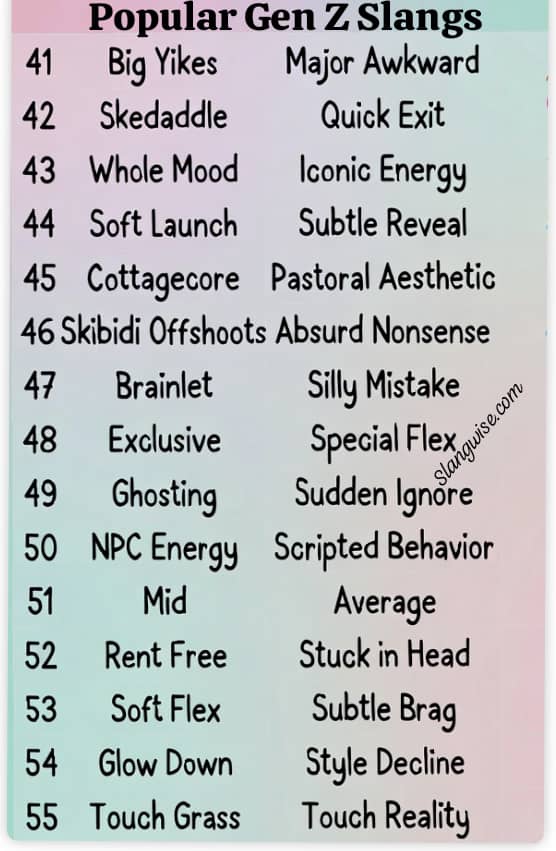
41. Big Yikes — What Does Big Yikes Mean?
Big yikes is an intensified version of “yikes.” It signals that something is particularly awkward, uncomfortable, embarrassing, or concerning.
The phrase works well because “yikes” already carries a strong emotional reaction, while “big” turns it up. Example: “He accidentally sent the private message to the group chat. Big yikes.”
42. Skedaddle / Skrrt — What Do These Mean?
Skedaddle is an older, playful way to say “leave quickly,” while skrrt is a more internet-native sound-effect style of saying someone made a fast exit.
Putting the two together shows something important about modern slang: new internet culture often revives old words and gives them a meme-like presentation. Example: “The conversation got awkward, so everyone skedaddled.”
43. Whole Mood — What Does “A Whole Mood” Mean?
Calling someone or something a whole mood means they perfectly represent a feeling, attitude, situation, or relatable energy.
It is frequently used with photos, reaction images, and short videos where the subject seems to communicate a familiar emotion without needing words. Example: “The guy drinking coffee and staring out the window at 6 a.m. is a whole mood.”
44. Soft Launch / Hard Launch — What Do They Mean?
A soft launch is a subtle reveal, often on social media. A person might show a hand, silhouette, restaurant photo, or partial image without clearly identifying who or what is being revealed.
A hard launch is the opposite: the reveal is direct and unmistakable. Example: “They posted a blurry photo together for weeks and finally hard launched the relationship with a full photo.”
45. Cottagecore / Goblincore — What Do They Mean?
Cottagecore romanticizes rural life, nature, handmade objects, gardens, vintage clothing, baking, and cozy domestic imagery. Goblincore leans more toward unusual nature objects, earthy textures, mushrooms, rocks, insects, thrifted objects, and playful messiness.
These labels are less like ordinary slang and more like cultural shorthand for internet communities and aesthetics. Example: “That outfit, wildflowers, basket, and old cottage are pure cottagecore.”
46. Skibidi Offshoots / Absurdist Meme Language
Some internet slang becomes popular precisely because it does not have a stable meaning. Skibidi-related expressions are a strong example of this style of language, where absurdity, repetition, rhythm, and recognizability matter more than literal definition.
These terms are often used as meme punctuation. The joke is sometimes simply that the words sound ridiculous together. Example: “That comment section has reached maximum skibidi nonsense.”
47. Brainlet / Brainlet Move
Brainlet is an internet insult or self-joke based on the idea of having a tiny or underpowered brain. Online, it is often used for an obvious mistake, silly decision, or moment of forgetfulness.
Because it can be self-directed, it often sounds less aggressive when someone applies it to themselves. Example: “Forgot my own password again. Brainlet move.”
48. Exclusive / VIP — What Do These Mean as Internet Slang?
Exclusive and VIP are not new slang in themselves, but online communities frequently use them as exaggerated social-status jokes. They can imply rare access, privileged information, or something that feels special.
This is often more performative than serious. Example: “Only three people know about the secret menu. VIP information.”
49. Ghosting / Orbiting — What Do They Mean?
Ghosting means abruptly ending communication without explanation. Orbiting describes someone who stops directly communicating but continues watching stories, liking posts, or otherwise appearing around the person’s online life.
These expressions became especially useful because digital relationships created behaviors that needed new labels. Example: “He ghosted me but still views every story. That is textbook orbiting.”
50. NPC Energy — What Does NPC Energy Mean?
NPC energy is a more specific way of saying someone appears to be acting like a non-playable video-game character.
It may describe repetitive speech, predictable behavior, or someone who seems completely on autopilot. Example: “He gives the same answer every single time. Pure NPC energy.”
51. Mid — What Does Mid Mean in Gen Z Slang?
Mid means average, mediocre, underwhelming, or not as good as the hype suggested. It is a compact way of saying something was not terrible but definitely did not live up to expectations.
That middle ground is what makes the expression so useful. Example: “Everyone told me that movie was amazing, but honestly? Mid.”
52. Rent Free — What Does Rent Free Mean?
Rent free describes something that remains in your thoughts constantly without you intentionally thinking about it. A meme, person, song, embarrassing moment, or catchphrase can all live “rent free” in your mind.
The imagery is simple: the thought is occupying mental space without paying rent. Example: “That commercial has been living rent free in my head all week.”
53. Soft Flex — What Does Soft Flex Mean?
A soft flex is a subtle brag. Instead of openly announcing an achievement, someone casually reveals it and allows everyone else to notice.
The humor often comes from pretending not to brag while obviously bragging. Example: “She casually mentioned that she spent the weekend in Paris. That was a serious soft flex.”
54. Glow Down — What Does Glow Down Mean?
Glow down is commonly presented as the opposite of glow up. It refers to an apparent decline in style, confidence, energy, or appearance after a period when someone seemed to be thriving.
It is usually used casually or jokingly, but it can become hurtful when directed at someone’s appearance. Example: “After three all-nighters, the glow down is real.”
55. Touch Grass — What Does Touch Grass Mean?
Touch grass is a humorous way of telling someone to disconnect from the internet and reconnect with real life. It often appears after someone spends too much time arguing online, obsessing over drama, or getting deeply invested in an internet controversy.
Example: “You have been arguing about that comment for three hours. Please go touch grass.”
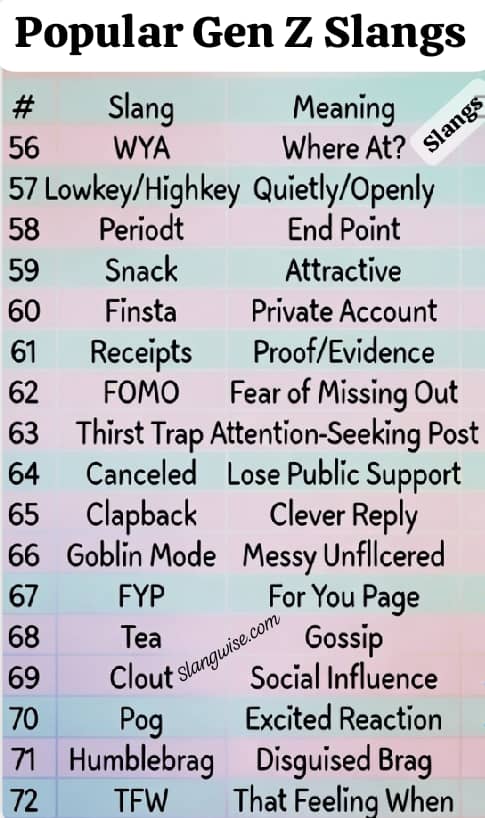
56. WYA — What Does WYA Stand For?
WYA means “where you at?” It is a straightforward texting abbreviation used when asking where someone is or checking whether they have arrived.
This is a practical example of why internet slang is not always about jokes. Sometimes the goal is simply speed. Example: “WYA? We are already inside.”
57. Lowkey / Highkey — What Do They Mean?
Lowkey means quietly, somewhat, secretly, or without drawing much attention. Highkey works in the opposite direction, signaling that something is obvious, intense, strong, or openly expressed.
These words are useful because they modify emotional intensity without requiring a long explanation. Example: “I lowkey want to go home, but I highkey need some fresh air.”
58. Periodt — What Does Periodt Mean?
Periodt is an emphatic spelling of “period,” used to signal that a statement is final, confident, or not open for debate.
It is often paired with a strong opinion or declaration. Example: “That was the best performance of the night, periodt.”
59. Snack — What Does Snack Mean in Slang?
Snack is a playful way to describe someone as attractive or appealing. It compares the person to something desirable to eat.
Because it comments on someone’s appearance, it is best understood as casual slang rather than something automatically appropriate in every situation. Example: “That outfit looks great on him; the post called him a snack.”
60. Finsta — What Is a Finsta?
Finsta traditionally means a “fake Instagram” account, usually a private or secondary account where someone shares more casual posts with a smaller audience.
The term became especially useful during the era when people maintained a polished public account and a more relaxed private account. Example: “The silly photos went on her finsta instead of her main account.”
61. Receipts — What Does Receipts Mean in Slang?
Receipts means proof. Online, that proof is often a screenshot, saved message, old post, video, or other digital record that supports someone’s claim.
“Show the receipts” is one of the most recognizable challenge phrases in internet arguments. Example: “They said they never posted it, but the receipts are right there.”
62. FOMO — What Does FOMO Mean in Gen Z Slang?
FOMO stands for “fear of missing out.” It describes the uneasy feeling that other people are enjoying an experience, opportunity, event, or social moment without you.
Social media can intensify FOMO because users constantly see snapshots of what other people are doing. Example: “Everyone posted pictures from the concert, and now I have major FOMO.”
63. Thirst Trap — What Does Thirst Trap Mean?
A thirst trap is a social-media post designed to attract attention, compliments, admiration, or flirtatious reactions. It often relies on carefully chosen photos, poses, styling, or presentation.
The phrase describes the intention behind the post more than the exact content. Example: “That carefully staged photo was clearly meant to get everyone’s attention — definitely a thirst trap.”
64. Canceled / Cancel Culture — What Does Canceled Mean?
Canceled describes someone who has lost public support after controversial behavior, comments, or actions. Cancel culture refers more broadly to online or public efforts to criticize, reject, or withdraw support from individuals or organizations.
It is worth remembering that the phrase can be politically and culturally loaded, so context matters. Example: “The old clip resurfaced and sparked a major debate about whether the creator should be canceled.”
65. Clapback — What Does Clapback Mean?
A clapback is a sharp, quick, or witty response to criticism, disrespect, or an insult. The strongest clapbacks are often short enough to become memes themselves.
Online, a good clapback is frequently judged by how quickly it changes the tone of a conversation. Example: “Someone criticized her outfit, and her response became the perfect clapback.”
66. Goblin Mode — What Does Goblin Mode Mean?
Goblin mode describes a state of being messy, lazy, unfiltered, or completely uninterested in maintaining polished social behavior. It is often used humorously when someone embraces comfort instead of trying to look productive or presentable.
The appeal is the honesty. Example: “The weekend plan is sweatpants, snacks, and absolutely no productivity. Full goblin mode.”
67. FYP — What Does FYP Mean?
FYP stands for “For You Page,” especially referring to TikTok’s personalized content feed. Creators often talk about a video “hitting the FYP” when it begins receiving significant exposure.
Because the phrase became so associated with algorithmic discovery, it also became part of everyday creator vocabulary. Example: “That video finally reached the FYP and the views exploded.”
68. Tea — What Does Tea Mean in Slang?
Tea means gossip, inside information, news, or an interesting story. “Spill the tea” means asking someone to reveal the details.
The expression is now deeply established in online culture, especially around celebrity news and social drama. Example: “Okay, spill the tea. What actually happened at the party?”
69. Clout — What Does Clout Mean in Gen Z Slang?
Clout means influence, status, popularity, or social attention. Online, someone may be called a clout chaser if they appear to do things mainly to gain visibility or social influence.
The term can be complimentary when someone genuinely has influence or critical when their behavior feels attention-seeking. Example: “He joined the trend mostly for clout.”
70. Pog / Poggers — What Does Pog Mean in Slang?
Pog and poggers are excited reactions associated strongly with gaming and streaming culture. They are used after something impressive, surprising, or successful happens.
The expressions became part of Twitch and broader gaming vocabulary before spreading through internet communities. Example: “You actually pulled off that move? Poggers.”
71. Humblebrag — What Does Humblebrag Mean?
A humblebrag is a disguised brag that is presented as though it were a complaint, inconvenience, or modest observation.
The classic example is someone complaining about having too many amazing opportunities. Example: “I am exhausted from all these free flights and conference invitations.” That is a humblebrag.
72. TFW — What Does TFW Mean in Slang?
TFW usually means “that feeling when.” It introduces a relatable emotional or situational moment, often alongside a meme or reaction image.
It became popular in meme culture because it compresses an entire relatable experience into three letters. Example: “TFW you finish all your work and realize tomorrow is a holiday.”
73. Aura — What Does Aura Mean in Gen Z Slang?
Aura has always existed as an ordinary English word describing a distinctive atmosphere or quality surrounding someone or something. Online youth culture gave it another layer: a person’s perceived coolness, presence, charisma, or star power.
Someone with “aura” seems effortlessly impressive. Just as importantly, someone can lose aura through an awkward mistake. That makes the term especially entertaining because people can jokingly treat charisma as though it were a measurable resource. Example: “He walked onto the stage completely calm while everyone else was nervous. Bro has aura.”
74. Aura Farming — What Does Aura Farming Mean?
Aura farming describes deliberately doing things that make someone look cool, confident, mysterious, impressive, or effortlessly stylish. The “farming” part comes from gaming language, where players repeatedly perform actions to accumulate resources or points.
The joke is that the person may appear completely unbothered while very clearly creating a moment that will look incredible on camera. Example: “Walking into the room slowly with the sunglasses on was pure aura farming.”
75. Unc — What Does Unc Mean in Gen Z Slang?
Unc is short for “uncle,” and online it is often used humorously for someone perceived as older, out of touch, or showing unmistakably older-person behavior. It can be teasing rather than genuinely hostile, and in Black English it has longstanding uses connected with older male relatives or respected older men.
Internet users may call someone “unc,” “old head,” or say they have reached “unc status” when they start displaying habits associated with being older. Example: “You are complaining about loud music at 9 p.m. Unc status unlocked.”
76. Crash Out — What Does Crash Out Mean in Gen Z Slang?
Crash out has become an especially useful internet expression for describing someone losing their composure or reacting extremely strongly to frustration. The phrase can be used for genuinely serious situations, but online it is also frequently used in an exaggerated or humorous way for comparatively minor frustrations.
Context decides how serious the expression sounds. Someone can jokingly say they are “about to crash out” over a disappointing order, while the same phrase can describe a much more intense emotional reaction. Example: “The website crashed just before I submitted the form and I nearly crashed out.”
77. It’s Giving — What Does “It’s Giving” Mean in Gen Z Slang?
It’s giving is a flexible phrase used to say that something strongly reminds you of a particular style, mood, person, era, character, or overall energy.
The expression is powerful because you do not always need to finish the sentence. “It’s giving luxury.” “It’s giving 2000s.” “It’s giving villain energy.” The listener is expected to understand the vibe being suggested. Example: “That outfit with the boots and sunglasses? It’s giving old-school movie star.”
Why These 77 Slang Words Are Not All the Same
One of the biggest mistakes people make when learning slang is putting every term into the same box. They are not all doing the same job.
Some are reactions. Words such as “sheesh,” “W,” “ate,” “big yikes,” and “poggers” can function almost like emotional punctuation.
Some are descriptions. “Mid,” “cheugy,” “sus,” “NPC,” and “drip” describe a person, thing, behavior, style, or situation.
Some are abbreviations. WYA, FOMO, FYP, FR, TFW, and IYKYK exist partly because online communication rewards speed.
Some are community markers. Terms such as “stan,” “Poggers,” “Finsta,” and “core” connect to particular internet subcultures and communities.
Others are deliberately absurd. Skibidi and many meme expressions demonstrate that online language does not always need a precise literal meaning to become socially useful. Sometimes the point is simply recognition: everyone knows the reference, and that shared recognition becomes the joke.
Where Gen Z Slang Actually Comes From
There is no single factory producing Gen Z slang. Modern internet vocabulary is more like a giant mixing bowl.
Gaming contributes words such as NPC, sus, poggers, and numerous pieces of meme vocabulary. Social media contributes abbreviations, reaction phrases, relationship terminology, and aesthetic labels. Music contributes new expressions and helps older slang spread into mainstream culture.
A particularly important point is the influence of African American English and Black cultural expression. Terms such as “no cap,” “periodt,” “unc,” and many other expressions have histories that predate their current viral internet usage.
When slang crosses communities and becomes mainstream, its roots should not disappear from the story.
The internet is also extremely good at recycling language. An older word can return with a new meaning. A phrase can become ironic. A serious expression can become a meme. A meme can then become ordinary speech.
That constant recycling is one of the most fascinating parts of studying slang. The same word may have a history stretching back decades while taking on a completely different social life online.
How to Use Gen Z Slang Without Sounding Like You Memorized a Dictionary
- Learn the context before using the word. Knowing the definition is only half the job. Watch how real people use the term.
- Do not stack slang unnecessarily. Saying “That outfit ate, has aura, is bussin, and is giving main character” all at once usually sounds forced.
- Pay attention to tone. “Unc,” “simp,” “NPC,” and “cringe” can be funny among friends and insulting in the wrong setting.
- Respect where slang comes from. A term can become mainstream without losing the cultural history of the community that shaped it.
- Let slang appear naturally. The most convincing use is usually the simplest one.
The Biggest Slang Mistake: Assuming Every Viral Word Is Still Cool
There is another lesson that becomes obvious after following slang for years: popularity and freshness are not the same thing.
A word can remain recognizable long after its peak cultural moment has passed. “Cheugy” is a perfect example. The word became popular partly because it was useful for identifying outdated trends, but eventually the term itself became old enough to be used ironically.
The same cycle happens constantly. A phrase explodes, brands start using it, headlines start explaining it, adults start asking what it means, and then the original community quietly moves on to something else.
That does not necessarily make the old slang useless. It simply changes its cultural flavor. A word may shift from trendy to ironic, from everyday speech to meme language, or from active slang to a nostalgic reference.
Why Context Matters So Much With Internet Slang
Consider “rizz.” In one conversation it is genuine praise. In another it can be ironic. In a meme it can be deliberately exaggerated. In a sarcastic post, someone can describe an obviously awkward interaction as having “infinite rizz.”
The word did not change. The context did.
The same thing happens with “unc,” “NPC,” “based,” “simp,” “cringe,” and even “aura.” You need the surrounding conversation to understand what the speaker actually intends.
This is why true slang fluency is not really about memorizing hundreds of definitions. It is about developing an ear for tone. The people who understand slang best are often the people who notice how a word is being used, not just what a dictionary says it means.
A Final Note on AAVE, Culture, and Responsible Slang Use
Modern internet slang does not come from nowhere. Many expressions that are now treated as universal Gen Z vocabulary originated in Black communities, LGBTQ+ communities, music scenes, gaming circles, fandoms, regional dialects, and other subcultures.
That history matters.
It is possible to enjoy internet slang while also recognizing that the people who popularize a word online are not always the people who created it. A term can move from a specific community to mainstream social media within months, while the original context becomes almost invisible.
The safest rule is simple: understand the origin, understand the current meaning, and understand the setting. Slang works best when it communicates connection rather than disrespect.
Final Thought
Gen Z slang in 2026 is less like a fixed dictionary and more like a living ecosystem. Some words are straightforward.
Some are cultural shorthand. Some are abbreviations designed for speed. Some are recycled expressions with new meanings. And some are gloriously meaningless meme words that survive because people enjoy saying them.
That is what makes studying slang so interesting. You are not simply learning new vocabulary. You are watching culture move in real time.
One month, everyone is talking about rizz. Then aura takes over the conversation. Someone reaches “unc status.” Someone else has a crash-out moment. A completely random meme phrase appears and suddenly everyone understands the joke.
The important thing is not to chase every word the moment it becomes viral. Learn the language, understand the context, notice the history, and use the expressions that genuinely fit.
And that is the real secret of slang fluency: you do not need to sound like the internet. You just need to understand it.
Frequently Asked Questions About Gen Z Slang in 2026
What is the most popular Gen Z slang word in 2026?
There is no universally reliable number-one slang word because popularity changes by platform, community, country, and age group. Rizz, aura, delulu, brainrot, skibidi, W, and several others remain highly recognizable, but online slang moves too quickly for one permanent winner.
What is the newest Gen Z slang?
New slang appears constantly, which makes any “newest word” list temporary. Terms such as aura farming, unc, and crash out show how quickly expressions can move from niche communities into wider internet vocabulary.
Is Skibidi still Gen Z slang?
Skibidi is strongly associated with younger internet culture and the Gen Z–Gen Alpha crossover. By 2026, its meaning is often as much about absurd meme energy as any literal definition.
What does aura mean in Gen Z slang?
In current internet slang, aura refers to someone’s coolness, charisma, presence, or perceived star power. People may jokingly say someone gained or lost “aura points” depending on what happened.
What does unc mean in Gen Z slang?
Unc is short for “uncle.” Online, it is commonly used as a humorous label for someone who seems older, out of touch, or particularly “uncle-like,” though it can also carry affectionate or respectful meanings depending on context.
What does crash out mean in slang?
Crash out usually describes losing composure or reacting extremely strongly to frustration. Online, it is also used humorously for smaller moments of annoyance or emotional overreaction.
How can someone learn Gen Z slang quickly?
The most useful approach is to learn slang in context. Read comments, watch how people use phrases in conversations, learn where important terms come from, and pay attention to tone. Memorizing a list is helpful, but real understanding comes from seeing the words used naturally.
Slangwise Tip
Never assume that knowing a slang definition means you automatically know how to use it. Slang has tone, history, community, timing, irony, and context. The best slang decoder pays attention to all of them.
Table of Contents