
Some slang phrases are easy to understand the moment you hear them. Others sound simple but carry a lot more meaning than you first expect. Hop on and hop off are good examples of that.
In everyday talk, hop on can mean joining in quickly, jumping into a call, or getting involved right away. Hop off can mean backing off, leaving someone alone, or stepping out of a chat or call. That is why these phrases show up so often in texts, group chats, gaming, and casual online conversation.
Once you understand the vibe, both phrases become very easy to use. They are short, fast, and sound just like the way people naturally talk online.
Table of Contents
In a Nutshell
- Hop on usually means join quickly or take part right away.
- Hop off usually means back off, leave me alone, or leave a call or chat.
- Both phrases are casual and common in texting, gaming, and online chat.
- The tone matters, because the same phrase can sound friendly in one moment and rude in another.
What Hop On Means in Slang
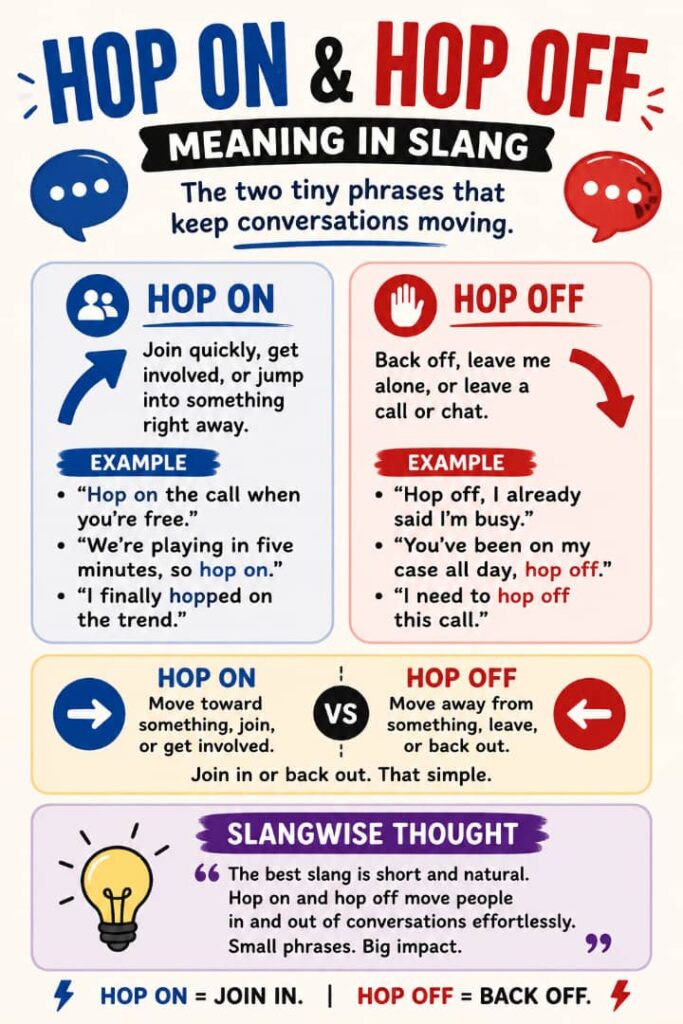
Hop on has a very quick and lively feel to it. In slang, it usually means to join something fast, without overthinking it. You might hear someone say, “hop on the call,” “hop on the game,” or “hop on the trend.” In each case, the message is simple, come in, join now, and be part of it.
That is what makes the phrase so useful. It does not sound stiff or formal. It sounds like something you would actually say to a friend when you want them to jump in right away. It gives off a sense of movement, speed, and casual energy.
In everyday conversation, hop on is basically a relaxed way of saying join, but with more personality. It feels lighter and more natural than saying something like, “please participate.”
READ ALSO: Zest Mood Meaning in Slang: The Viral Little Phrase That Sounds Sweet, But Hits Different
Example Uses
“Hop on the call when you are free.”
“We are playing in five minutes, so hop on.”
“Everybody is talking about that new app, and I finally hopped on.”
What Hop Off Means in Slang
Hop off is the matching opposite in a lot of casual conversation. In slang, it usually means go away, leave me alone, or back off. It can be used when someone wants space, wants a conversation to stop, or simply wants the other person to ease up.
It also works as a casual exit phrase. For example, somebody might say, “I need to hop off now,” when they are leaving a call or ending a chat. So the same phrase can either set a boundary or signal that someone is stepping away.
That is why hop off can feel a little sharp depending on how it is said. In a joking conversation, it may sound playful. In a serious moment, it can sound blunt.
Example Uses
“Hop off, I already said I am busy.”
“You have been on my case all day, hop off.”
“I need to hop off this call in a minute.”
READ MORE: OK Boomer and OK Boomerette Meaning in Slang: The Gen Alpha Clapbacks Turning Older Gen Z Into “Ancient History”
Why These Phrases Feel So Natural
One reason hop on and hop off work so well is that they are very visual. You can almost picture someone stepping in and stepping out. The word hop itself already sounds quick, light, and active, which fits the way people talk in fast moving online spaces.
They also sound friendly and easy. Hop on feels softer than saying “join this meeting.” Hop off feels shorter than saying “please stop bothering me.” That kind of short, natural rhythm is exactly what makes slang stick.
And that is the real reason people use these phrases so much. They save time, sound casual, and fit neatly into everyday conversation without making the moment feel heavy.
Hop On vs Hop Off
The easiest way to remember the difference is this:
Hop on means move toward something, join something, or get involved quickly.
Hop off means move away from something, leave something, or back out of the conversation.
So if your friend says, “Hop on the call,” they want you to join them. If someone says, “Hop off,” they want space or they are done with the conversation. That simple contrast is what makes the two phrases feel like a pair.
READ ALSO: IDTS Meaning in Slang: The Sneaky Little Text That Sounds Soft, Smart, and Slightly Shady
Slangwise Thought
One thing about slang is that the best phrases are often the smallest ones. Hop on and hop off are not flashy, but they are efficient. They move people in and out of conversations without much effort, and that is exactly why they feel so natural in real life.
Final Thoughts
At the end of the day, hop on is a friendly, fast way to say join in, get on the call, or jump into the action. Hop off is the matching exit phrase, meaning back off, leave me alone, or step out of the call. Both expressions are informal, conversational, and easy to use once you get the tone.
So the next time somebody says, “Hop on,” you will know they want you to join. And when you hear, “Hop off,” you will know somebody wants space or is ready to leave. That is the beauty of slang. A tiny phrase can carry the whole mood.
DISCOVER: 68 Most Popular TikTok Slang Words of 2026 – Quick Meaning and Examples
Frequently Asked Questions
It usually means to join quickly, especially a call, game, or trend, or to get involved right away.
Pretty much, in casual use. It is a lighter, faster way of saying join in or participate.
It can be. In a joke with friends, it may sound playful. In a serious moment, it can sound blunt or dismissive.