
Internet slang has a funny way of aging people in real time. One minute you are using the newest phrase, and the next minute somebody younger is calling it old news. That is exactly the kind of energy behind OK boomer and OK Boomerette.
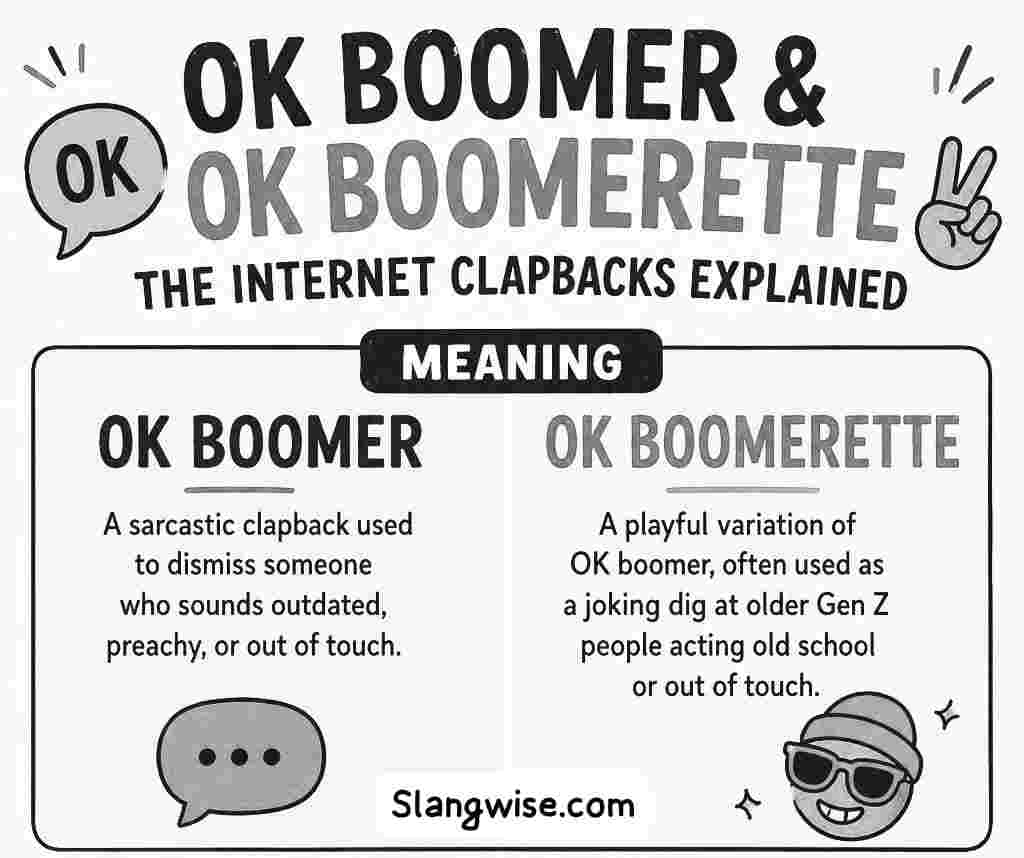
At first glance, these phrases look simple. But the meaning is deeper than just “you are old.” In slang, OK boomer is a sarcastic way of brushing off someone who sounds outdated, preachy, or out of touch.
OK Boomerette is a newer, playful twist often used as a Gen Alpha style dig at older Gen Z people who already seem a little too set in their ways.
That is why these phrases spread so quickly. They are short, funny, and slightly disrespectful in the exact way internet slang likes to be. They also tap into a bigger truth: every generation eventually becomes “the older one” in somebody else’s joke.
Table of Contents
In a Nutshell
- OK boomer is a sarcastic clapback used when someone sounds outdated or out of touch.
- OK Boomerette is a playful variation, often aimed at older Gen Z in a teasing way.
- Both phrases are less about age and more about vibe.
- They work best in jokes, online banter, and meme culture.
- Tone matters a lot because both can sound rude outside casual settings.
What OK Boomer Means in Slang
Let us start with the original.
OK boomer is a sarcastic phrase used to dismiss a comment that feels old fashioned, condescending, or disconnected from modern life. It is not always meant literally. Most of the time, it is a way of saying, “I am not taking that opinion seriously.”
For example, if someone says young people are lazy, overdramatic, or too sensitive, “OK boomer” is the kind of reply that shuts the conversation down with very little effort. That is the whole point. It is not a debate starter. It is a clapback.
What makes it powerful is its simplicity. It sounds calm, but the meaning is sharp. It can carry mock politeness while still saying, “That take is outdated.”
You also do not have to be an actual boomer for the phrase to apply. In slang use, it can be aimed at anybody giving off strong old school energy, especially if they are acting like the internet has not changed anything.
READ ALSO: Broke Girl Era Meaning in Slang: Why Everyone Is Joking About Being Broke Right Now
Example Uses
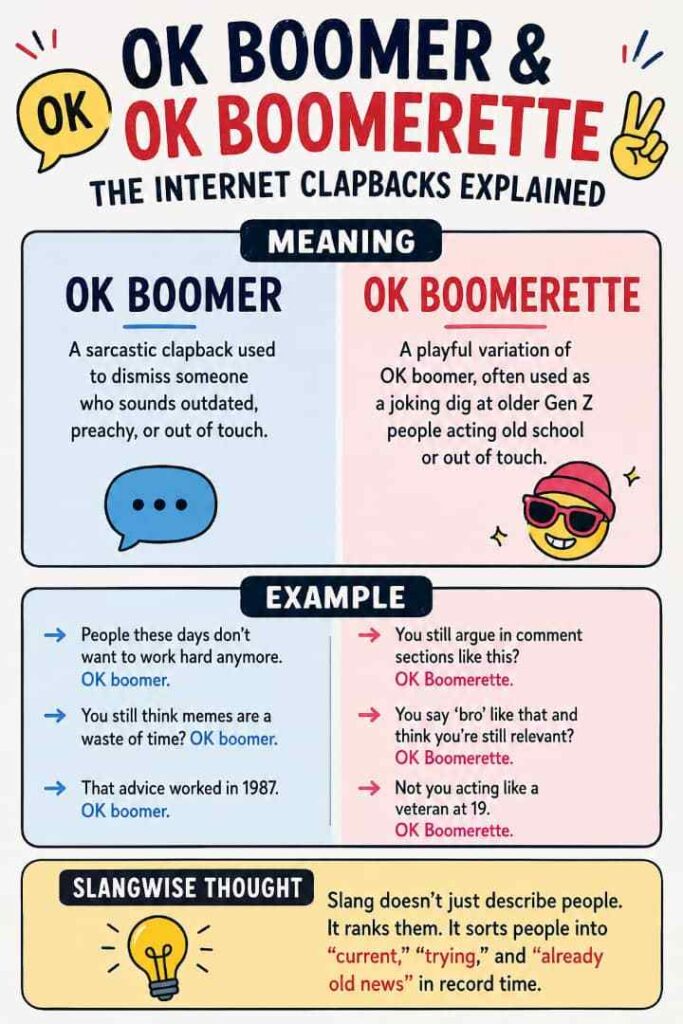
“People these days do not want to work hard anymore. OK boomer.”
“You still think memes are a waste of time? OK boomer.”
“That advice worked in 1987. OK boomer.”
What OK Boomerette Means in Slang
Now for the newer one.
OK Boomerette is a playful spin on the original phrase. In current online use, it is often read as a Gen Alpha style tease aimed at older Gen Z people who are starting to look a little uncool, overly serious, or surprisingly out of touch.
The word itself feels intentionally funny. It sounds like “boomer” with a smaller, more playful twist, almost like the internet is shrinking somebody into retirement energy before their time. That is part of the joke.
Unlike OK boomer, OK Boomerette is not a long established mainstream slang phrase. It feels more like a meme born from internet culture, where younger users invent new labels fast and use them to roast people who still think they are the cool generation.
So the meaning is less “you are a boomer” and more “you are starting to sound old already.”
That is why it often lands as a dig at older Gen Z people. To Gen Alpha, even a few years can be enough to make somebody seem ancient. A person can be only slightly older and still get treated like they missed the new wave.
Example Uses
“You still argue in comment sections like this? OK Boomerette.”
“You say ‘bro’ like that and think you are still relevant? OK Boomerette.”
“Not you acting like a veteran at 19. OK Boomerette.”
SEE ALSO: Hop On and Hop Off Meaning in Slang: The Two Tiny Phrases That Keep Conversations Moving
Why These Phrases Hit So Hard
The reason these phrases work is because they are not really about age alone. They are about vibe, attitude, and internet timing.
When somebody sounds too certain, too preachy, or too disconnected from what younger people care about, a quick slang comeback feels satisfying. It lets the speaker say, in one tiny phrase, “You are not the authority here.”
That is why these terms became so meme friendly. They are easy to repeat, easy to remix, and easy to attach to almost any situation where someone seems like they are talking from a different era.
With OK boomer, the target is usually older people or boomer coded behavior.
With OK Boomerette, the target is usually older Gen Z energy that Gen Alpha thinks is already slipping into “old person online” territory.
That is the funny part. Internet culture moves so fast that even young people can become the joke very quickly.
The Difference Between OK Boomer and OK Boomerette
These two phrases are related, but they do not feel exactly the same.
OK boomer is broader and more established. It is the classic dismissive response to old fashioned thinking.
OK Boomerette is more specific, more playful, and more niche. It has a more meme driven feel and sounds like a generational roast made for people who are not quite old, but already acting like they are.
Think of it this way:
- OK boomer says, “Your opinion is outdated.”
- OK Boomerette says, “You are still young, but you are already giving old energy.”
That difference is small, but in slang, small differences carry a lot of meaning.
SEE ALSO: 40 Most Popular Internet Catchphrases of 2026 (Updated)
When to Use Them and When to Avoid Them
These phrases are funny, but they are not for every situation.
They work well in casual conversations, meme replies, group chats, and joke filled online spaces. They are especially effective when everyone already understands the playful tone.
They are not great choices in serious conversations, family discussions, school settings, or anywhere respect matters more than humor. If the other person does not know you are joking, the phrase can come off as rude very quickly.
So the safest way to use them is with people who already understand your tone and your humor.
Why Gen Alpha Likes This Kind of Slang
Gen Alpha loves slang that feels fast, funny, and slightly disrespectful in a harmless way. That is part of the culture. They are growing up in a world where trends move incredibly fast, so part of the fun is assigning “old” status to people almost immediately.
That is why OK Boomerette makes sense. It sounds like the kind of phrase younger internet users would invent to tease older Gen Z users who think they are still fully current, but are already starting to sound a little dated.
It is not just about calling somebody old. It is about saying they are no longer the freshest voice in the room.
And honestly, that is classic internet behavior.
READ ALSO: 72 Most Popular Gen Z Slang Words of 2026 – Rizz, Delulu, Skibidi etc., And What They Secretly Mean Online
Slangwise Thought
One thing I have noticed is that slang does not just describe people. It ranks them. It sorts people into “current,” “trying,” and “already old news” in record time. That is why phrases like OK boomer and OK Boomerette spread so fast. They are not only funny. They are social shortcuts.
Final Thoughts
At the end of the day, OK boomer is the original clapback, a sarcastic way to dismiss out of touch or preachy comments. OK Boomerette is the newer, more playful spin, often used as a Gen Alpha roast for older Gen Z people who are starting to sound like they belong to a different internet era.
Both phrases live in the same space of online humor, generational teasing, and quick shutdowns. The biggest thing to remember is this: the meaning is not only in the words. It is in the vibe, the timing, and the relationship between the people using it.
That is what makes slang interesting. It is never just language. It is attitude with punctuation.
READ MORE: GOLF Meaning in Slang: The Viral Compliment That Says Your Real Life Is Actually Amazing
Frequently Asked Questions
Yes. These phrases are more about vibe and attitude than actual age.
It is a sarcastic phrase used to brush off someone who sounds outdated, condescending, or out of touch.
It is a playful variation of OK boomer, often used as a joking dig at older Gen Z people who are acting old school or disconnected from current trends.
Not really. It is more niche and internet coded than OK boomer, which is much more widely known.
It can be. In casual online jokes, people use it playfully. In serious situations, it can sound disrespectful.