

- In slang, “out of pocket” usually means someone is being wild, rude, inappropriate, or saying something way too far.
- The phrase is older than the slang use; it also has normal meanings around paying with your own money and being unavailable or unreachable.
- In everyday conversation, people often use it to call out behavior, not just words: “That comment was out of pocket.”
- The phrase has become especially common in online and younger speech, where it carries a strong “that was not okay” vibe.
Table of Contents
What “Out of Pocket” Means in Slang
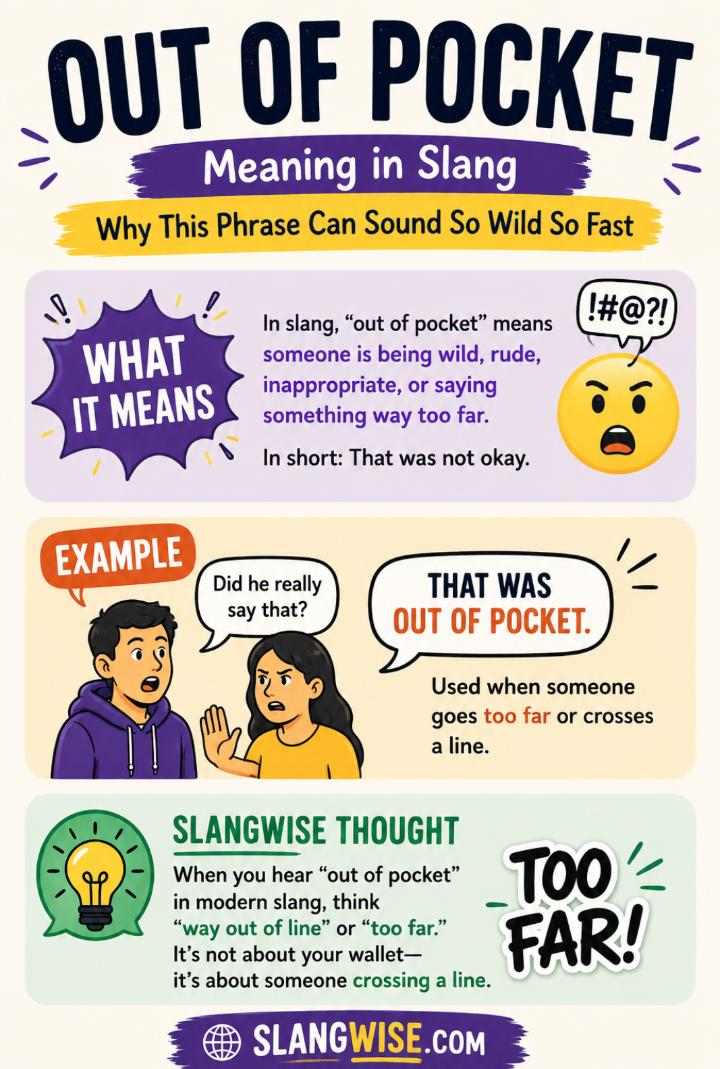
If you hear someone say, “That was out of pocket,” they are usually not talking about money. In slang, the phrase means someone has gone too far, acted in a rude or inappropriate way, or said something so unhinged that it crosses the line. In plain English: it is a quick way of saying, “That was not cool.”
That is the version most people mean on social media, in group chats, and in everyday conversation. The phrase can apply to a joke, a comment, an action, or even a post online. If the moment feels shocking, disrespectful, or completely unnecessary, calling it “out of pocket” fits.
DISCOVER: 25 Gen Z Slang Terms for Money You’ll Actually Use in 2026
Slangwise Take on Out of Pocket
Take note: when you hear “out of pocket” in modern slang, think “way out of line” or “too far.” It is not about your wallet in that moment; it is about someone’s words or behavior crossing a social line.
Here is the easiest way I explain it: out of pocket = behavior that went beyond the boundary. It is not always the same as “mean,” and it is not always the same as “crazy.” It sits in that messy middle where something is bold, off-color, awkward, or just plain too much.
That is why the phrase works so well. It is short, sharp, and loaded with attitude. You can use it when someone makes a disrespectful joke, when a post is too explicit for the moment, or when a person acts in a way that makes everyone in the room pause.
How People Use It
The phrase usually appears in sentences like these:
“Did he really say that? That was out of pocket.”
“This tweet was so out of pocket I had to reread it.”
“Bro, that joke was out of pocket.”
The tone changes a little depending on who says it, but the message is usually the same: the person or the comment crossed a boundary. In that sense, the phrase is less about literal meaning and more about social judgment.
One reason this phrase feels so flexible is that English already had older meanings for it. Long before the slang sense became popular, “out of pocket” could mean you were paying for something yourself, or that you were unavailable and hard to reach. Those older meanings still exist today, which is why context matters so much.
READ ALSO: 15 Popular Millennial Slangs for Money That Still Pop Up Everywhere
Where It Came From
The money meaning is the oldest one: if you pay out of pocket, you are covering the cost yourself instead of someone else paying for you. That sense has been around for a long time. The unavailable/unreachable sense also goes back decades, with records from the early 1900s.
The newer slang sense grew out of that same phrase, but it shifted from money and absence into behavior. In modern use, it can describe someone acting in a way that feels out of control, way off base, or socially unacceptable.
That is why younger speakers often use it when someone says something shocking or crosses a line online.
What It Does Not Always Mean
This is where a lot of people get confused. “Out of pocket” does not always mean “unavailable,” even though that is still a real meaning. And it does not always mean “I paid for it myself,” even though that is the classic money meaning. In slang conversations, context decides everything.
So if someone texts, “I was out of pocket all afternoon,” they probably mean they were unreachable. But if they say, “That guy is out of pocket,” they are probably criticizing his behavior. Same phrase, different lane.
READ ALSO: Boomerasking Meaning: The Sneaky Conversation Habit Everyone Is Talking About
Conclusion
In my view, “out of pocket” is one of those phrases that survived because it is so useful. It can cover rude behavior, shocking comments, and over-the-top actions in just three words.
That is why it shows up so often in casual speech and online reactions. If you remember only one thing, remember this: in slang, “out of pocket” usually means someone went too far.
It is a perfect example of how English keeps changing. A phrase that once described money or being unreachable can later become a sharp reaction to someone acting foolish, disrespectful, or bizarre. Language does that all the time, and this phrase is a great example.
Frequently Asked Questions
No. In slang, it often means rude, wild, or inappropriate, but the phrase also has older meanings related to money and being unreachable. Context tells you which one is being used.
Yes. It is common in casual conversation. A sentence like “That comment was out of pocket” sounds natural in informal speech.
Not exactly. “Crazy” is broader, while “out of pocket” usually points to something being too far, disrespectful, or socially off.
Start with the situation. If someone is talking about money or being absent, use the older meanings. If the person is reacting to behavior or a comment, the slang meaning is probably the one they mean.