
William Shakespeare is often described as the man who “invented” hundreds of words. That popular claim needs a little decoding.
After looking closely at the history of slang, vocabulary, and everyday expressions, one pattern becomes impossible to miss: Shakespeare was not simply a word inventor.
He was an extraordinary language experimenter. He picked up existing language, reshaped it, combined words in clever ways, changed meanings, and sometimes gave a word its first surviving appearance in written English.
That distinction matters. The Shakespeare Birthplace Trust notes that his works provide the first recorded use of more than 1,700 words, while also explaining that he may have invented or introduced many of them himself.
Modern lexicography is even more cautious because the first recorded use is not always the same thing as the true moment a word was invented.
So this list takes the expert route rather than repeating the familiar myth. These are 18 words that are strongly associated with Shakespeare, appear in his works, or were popularized by his writing, and many still sound completely normal in modern conversation.
Some are ordinary English. Some have developed modern slang meanings. Others sound surprisingly contemporary once you understand what Shakespeare was doing with them.
Slangwise thought: Language does not stay frozen. A word can survive for centuries while its vibe, context, and social meaning keep changing.
Table of Contents
18 Shakespeare Words You Still Use Today
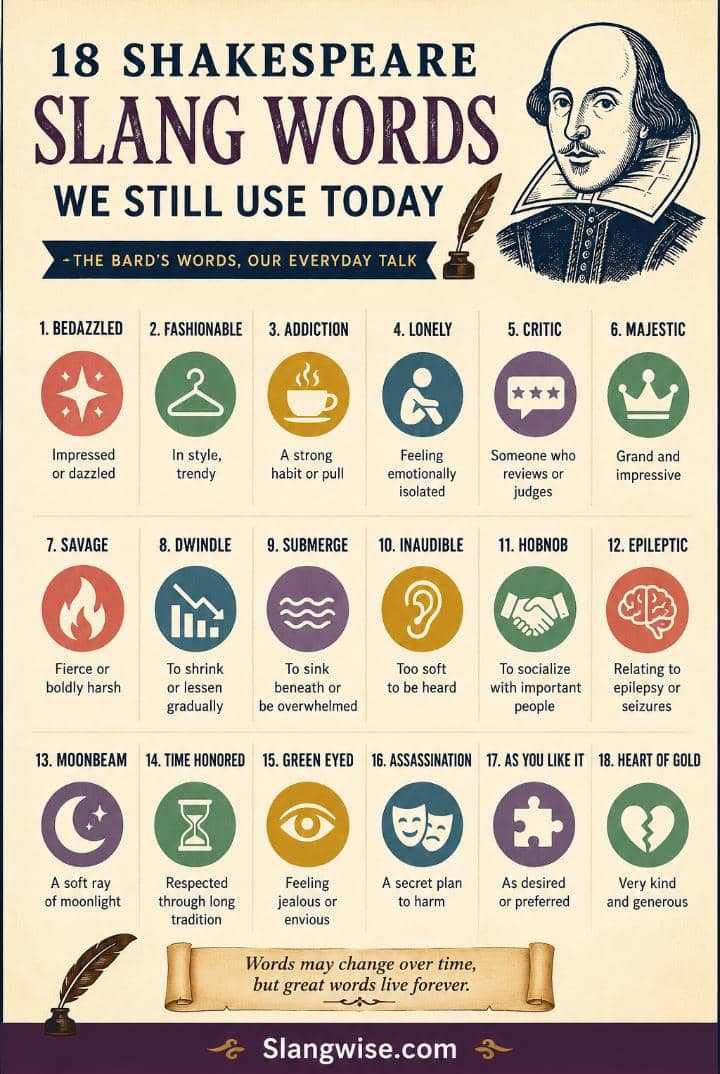
One important decoder note: “Shakespeare invented” is used loosely online. In several cases below, earlier examples exist outside Shakespeare’s work. The more accurate description is Shakespeare-attributed, popularized by Shakespeare, or first recorded in Shakespeare’s surviving works. That is the historically responsible way to tell the story.
1. Bedazzled
Shakespeare connection: The Taming of the Shrew
“Bedazzled” is one of the words most frequently credited to Shakespeare, although historical evidence shows that bedazzle was already in use before his play. Shakespeare nevertheless helped preserve the word in literary English, and its modern meaning still feels remarkably close to the original idea of being overwhelmed or dazzled.
Today, “bedazzled” can describe being amazed, enchanted, or visually overwhelmed. In casual speech, it often has a playful tone: something is so impressive that your brain seems to pause for a second.
In short: Amazed, dazzled, or strongly impressed.
Modern example: The concert’s opening visuals had the whole audience completely bedazzled.
2. Fashionable
Shakespeare connection: Troilus and Cressida
“Fashionable” is a perfect example of a word that sounds so ordinary today that its Shakespeare connection is easy to miss. The Shakespeare Birthplace Trust lists it among words whose first recorded use is associated with his works.
The word still describes something shaped by current taste or trends. But its social meaning has expanded. Fashionable can refer to clothes, restaurants, neighborhoods, technology, opinions, lifestyles, or even ways of speaking.
In short: Stylish, trendy, or accepted as desirable at a particular time.
Modern example: That little café became one of the most fashionable spots in the neighborhood.
3. Addiction
Shakespeare connection: Othello
“Addiction” has a fascinating history because its older meaning was broader than the strongly medical sense many people associate with it now.
In modern everyday conversation, people also use it casually to describe an intense habit or something they keep coming back to. That is why phrases such as “I’m addicted to this game” or “She’s addicted to that series” can sound completely normal even when no clinical diagnosis is being discussed.
The important language lesson is that the word’s emotional core survived even as its precise usage became more specialized.
In short: A powerful attachment, habit, or dependence; the exact meaning depends on context.
Modern example: He joked that he was addicted to checking his favorite team’s updates.
READ ALSO: Slangs That Survived Ages : 27 Slang Terms we still use from centuries ago.
4. Lonely
Shakespeare connection: Coriolanus
“Lonely” is another word commonly associated with Shakespeare’s writing. The Shakespeare Birthplace Trust lists it among words for which his works provide an early recorded use.
What makes the word powerful is the difference between being physically alone and feeling emotionally disconnected. Modern usage has preserved that emotional dimension almost perfectly.
You can be in a crowded room and still feel lonely. You can also spend an afternoon alone and feel perfectly content. That contrast is exactly why the word remains so useful.
In short: Feeling emotionally isolated or lacking meaningful companionship.
Modern example: She felt lonely after moving to a new city where she had not made friends yet.
5. Critic
Shakespeare connection: Love’s Labour’s Lost
“Critic” has become completely ordinary in modern English, but it is listed by the Shakespeare Birthplace Trust among Shakespeare’s well-known word associations.
Today, a critic can review films, books, food, music, fashion, games, or almost anything else that can be evaluated. The modern internet has also made everyone a potential amateur critic.
That is an important semantic shift. The word once belonged more strongly to formal judgment and literary evaluation. Now someone can casually say, “Be a critic for a minute—does this design work?”
In short: A person who evaluates and gives an informed opinion about something.
Modern example: The food critic praised the restaurant’s creativity but questioned the portion sizes.
6. Majestic
Shakespeare connection: Associated with Shakespeare’s dramatic vocabulary and often linked to The Tempest.
“Majestic” carries one of those meanings that has hardly lost its force. It describes something grand, impressive, elevated, or worthy of admiration.
The modern word works especially well because it can describe both nature and human achievement. A mountain can be majestic. So can architecture, music, a ceremony, or a carefully performed piece of art.
In short: Grand, impressive, dignified, and awe-inspiring.
Modern example: The view from the mountain lookout was so majestic that everyone stopped talking.
READ MORE: 7 Popular Slangs with Royal Backstories That Still Rule the world today.
7. Savage
Shakespeare connection: Othello
“Savage” did not begin as the internet slang term many people know today. Its older sense was connected to wildness, fierceness, or behavior considered uncivilized.
Modern slang gave the word a dramatic upgrade. Calling something “savage” can now mean that it was brutally direct, fearless, unexpectedly sharp, or impressively bold.
This is one of the best examples of slang evolution: the basic idea of something fierce survives, but the emotional direction can change from criticism to admiration.
In short: Fierce or brutally bold; in slang, sometimes impressively ruthless or direct.
Modern example: Her one-line response was so savage that the group chat went completely quiet.
8. Dwindle
Shakespeare connection: Henry VIII
“Dwindle” is a wonderfully visual word. It describes something becoming gradually smaller, weaker, or less significant.
It works for physical things, such as supplies or water, but it also works for abstract things such as enthusiasm, attention, patience, or opportunities.
In short: To become gradually smaller, weaker, or less abundant.
Modern example: Our weekend plans began to dwindle once everyone realized how busy they would be.
9. Submerge
Shakespeare connection: Associated with The Tempest.
“Submerge” sounds formal today, but its core image is wonderfully simple: something goes beneath the surface.
Modern English also uses the word metaphorically. A student can be submerged in assignments. A company can be submerged in problems. Someone can feel submerged by responsibilities.
That figurative flexibility is typical of language that survives: the original physical picture becomes a tool for describing emotions and situations.
In short: To push or place beneath a surface; figuratively, to become deeply overwhelmed.
Modern example: By Friday afternoon, the team was submerged in unfinished projects.
DISCOVER: The Lost 1980s Skatepark Slang That’s Suddenly Dominating Boardrooms
10. Inaudible
Shakespeare connection: All’s Well That Ends Well
This is another case where the popular “Shakespeare invented it” claim needs a correction. Earlier evidence for inaudible exists, so Shakespeare should not automatically be named as its inventor. Merriam-Webster specifically identifies inaudible as one of the words wrongly credited to the Bard.
Still, the word belongs on this list because Shakespeare’s surviving text contains it, and its meaning has remained remarkably stable.
In short: Too quiet or unclear to be heard.
Modern example: The first few seconds of the voice note were almost inaudible because of the background noise.
11. Hobnob
Shakespeare connection: Twelfth Night
“Hobnob” is one of the most characterful words in the group. It usually means socializing casually, especially with people who are considered influential, well connected, or socially important.
There is a distinctly old-school flavor to it, yet it remains perfectly understandable today. You can hobnob at a professional event, a film festival, a conference, or any gathering where people mingle and build connections.
In short: To mix socially or chat casually, especially among prominent people.
Modern example: The young designer spent the evening hobnobbing with established creators.
12. Epileptic
Shakespeare connection: King John
“Epileptic” belongs to a very different category from slang. It is a medical term associated with epilepsy, and it is best treated with precision rather than as a casual insult or joke.
Its inclusion here is interesting because it demonstrates something important about Shakespeare’s vocabulary: his influence extends far beyond playful expressions. His language touched everyday speech, literature, social description, and terminology that remained in use long after his lifetime.
In short: Relating to epilepsy, a neurological condition involving seizures.
Modern example: The medical team explained the importance of understanding her epilepsy and following her treatment plan.
13. Moonbeam
Shakespeare connection: A Midsummer Night’s Dream
“Moonbeam” feels poetic even when you hear it outside Shakespeare. It combines two simple words into an image that instantly works: a beam or ray of moonlight.
This is exactly the kind of word construction Shakespeare handled beautifully. Instead of relying on a long explanation, the compound word creates a picture in the reader’s head almost immediately.
In short: A ray or patch of moonlight.
Modern example: A thin moonbeam slipped through the curtains and lit the floor.
14. Time-honoured
Shakespeare connection: Associated with Troilus and Cressida and Shakespeare’s historical vocabulary.
This phrase describes something respected because it has survived for a long time. It is especially useful when talking about customs, traditions, methods, recipes, ceremonies, and practices passed from one generation to another.
Modern usage has not changed the basic idea very much. What has changed is where you are likely to see it: today it appears in everything from food writing to advertising and cultural commentary.
In short: Respected because it has existed successfully for a long time.
Modern example: The festival still follows a time-honoured tradition passed down through generations.
READ ALSO: The 38 most iconic slang terms of the past 50 years
15. Green-eyed
Shakespeare connection: Othello
Now we reach one of Shakespeare’s most recognizable contributions to emotional language: green-eyed.
Its fame comes from Shakespeare’s vivid association between jealousy and the “green-eyed monster.” Even though the exact phrase is literary rather than modern internet slang, the underlying expression has become part of everyday English.
When someone is described as green-eyed today, the message is usually simple: jealousy has entered the conversation.
In short: Jealous or envious.
Modern example: He tried to act casual, but you could tell he was getting a little green-eyed about his friend’s success.
16. Bedroom
Shakespeare connection: A Midsummer Night’s Dream
“Bedroom” is such an everyday word that most people never stop to consider how modern it sounds. Yet the Shakespeare Birthplace Trust lists bedroom among the words whose first recorded appearance is in Shakespeare’s works.
It is a classic example of Shakespeare’s ability to combine familiar words into a compact new expression. “Bed” plus “room” instantly tells you what the word means.
In short: A room used for sleeping.
Modern example: She turned the spare room into a quiet bedroom for visiting family.
17. Swagger
Shakespeare connection: A Midsummer Night’s Dream
“Swagger” is one of the most interesting Shakespeare-to-modern-slang connections on the entire list. Shakespeare used the word, but historical evidence shows that it existed before his appearance of it, so calling him the sole inventor is too strong.
What makes the word fascinating is how successfully it crossed centuries. “Swagger” can describe an arrogant walk, exaggerated confidence, bold self-belief, or a style that makes someone stand out.
Modern culture also softened the word in some contexts. Someone can have swagger without necessarily being obnoxious. It can simply mean confidence, presence, and unmistakable style.
In short: Bold confidence, distinctive style, or an arrogant way of carrying yourself.
Modern example: The player walked onto the court with so much swagger that everyone noticed.
18. Lacklustre
Shakespeare connection: As You Like It
“Lacklustre” is a brilliant example of Shakespeare making a compound word do emotional work. Literally, it suggests a lack of luster or brightness. Figuratively, it came to describe something dull, unimpressive, weak, or missing energy.
That meaning remains almost unchanged today. When someone calls a performance “lacklustre,” they usually mean it failed to generate excitement, quality, energy, or memorable impact.
And that is why the word still feels useful. Instead of simply saying “bad,” you can say “lacklustre” and communicate something more precise: it was there, but it did not shine.
In short: Dull, unimpressive, or lacking energy and excitement.
Modern example: The sequel looked promising, but the final result was surprisingly lacklustre.
Why Shakespeare’s Words Still Feel Modern
The most impressive part of Shakespeare’s linguistic legacy is not simply the number of words connected with his writing. It is the flexibility of those words.
Think about swagger. A word used centuries ago can now appear in conversations about fashion, sports, music, confidence, personality, and internet culture.
Think about savage. The word moved from describing something wild or fierce to becoming a modern slang compliment for a devastatingly bold response.
Think about addiction. The word developed into a much more specific term while still retaining a looser everyday use.
This is how living language behaves. Words are not museum pieces. Communities grab them, remix them, shorten them, exaggerate them, turn them into jokes, and sometimes give them an entirely new social flavor.
Shakespeare Was a Language Hacker
From a slang-decoder perspective, Shakespeare’s real genius becomes clearer when you stop imagining him as someone who simply sat down and invented hundreds of random dictionary entries.
He was constantly experimenting.
He could combine familiar words, shift a noun into a verb, create a vivid compound, alter a word’s emphasis, borrow from other languages, or use a familiar expression in a fresh way.
The Shakespeare Birthplace Trust explains that he used more than 20,000 words across his plays and poems and that his works contain the first recorded use of more than 1,700 words. It also stresses that “first recorded use” should not automatically be confused with proof of invention.
That is a much more interesting story than the simple myth that Shakespeare invented an enormous chunk of English by himself.
4 Hidden Lessons About Language From These Words
- Words can outlive their creators. Centuries later, “bedazzled,” “swagger,” and “bedroom” still sound perfectly natural.
- Meaning can evolve without disappearing. “Savage” is a great modern example of a word that developed a new social tone while keeping some of its original force.
- First recorded use is not always invention. Historical dictionaries continue to uncover earlier examples, which is why serious language research avoids absolute claims when the evidence is uncertain.
- Slang often works the same way. A community may use a word long before dictionaries, journalists, or popular culture record it. Shakespeare’s period was not fundamentally different from ours in that respect.
Key Takeaway
- Shakespeare’s influence is real. His surviving works preserve an enormous number of words and expressions that continue to shape English.
- The “invented” label needs context. Some words were genuinely innovative; others were already circulating but appear especially early in Shakespeare’s works.
- Modern slang keeps proving the same point. Words can cross centuries because people continually reinvent their tone and social meaning.
- The best language stories are the nuanced ones. Shakespeare’s achievement is not smaller because he did not personally invent every word attributed to him. In many cases, his real achievement was recognizing, reshaping, and popularizing language with extraordinary skill.
Discover: 65 Most Popular TikTok Slang Words of 2026
Conclusion
Shakespeare’s greatest linguistic trick may be that many of his words no longer feel Shakespearean.
You can say “bedroom” without thinking about Elizabethan theatre. You can describe someone’s confidence as “swagger.” You can call a performance “lacklustre,” a response “savage,” or a breathtaking view “majestic.”
That is what linguistic survival looks like.
The words leave the original play, lose their historical costume, and become part of ordinary life. Some change meaning. Some gain slang uses. Some simply keep doing the same job for hundreds of years.
And one final decoder rule is worth remembering: when someone says, “Shakespeare invented this word,” check the evidence before repeating it.
Historical language is messier, and much more fascinating, than a neat viral list makes it look. The Shakespeare Birthplace Trust and modern dictionaries both make that distinction clear.
Four centuries later, Shakespeare’s words are still alive. They are not trapped on a stage in Stratford or inside an old book. They are sitting in everyday conversations, headlines, captions, reviews, group chats, and modern slang.
Reference: Folger Shakespeare Library, Oxford English Dictionary, and the Shakespeare Birthplace Trust.