
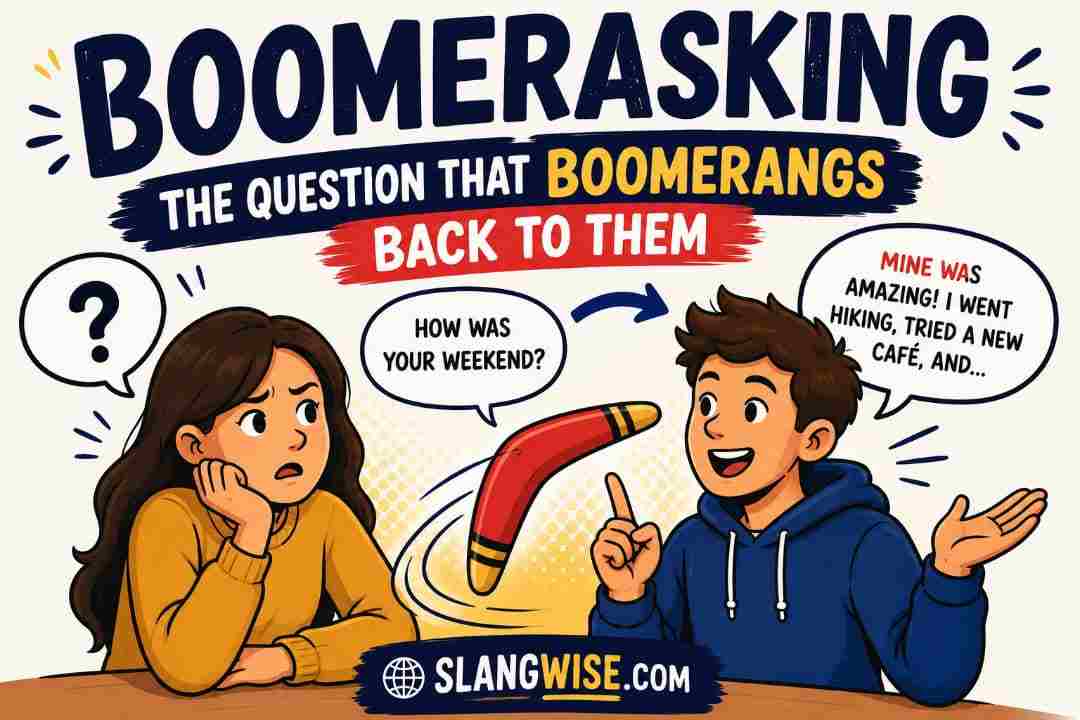
- Boomerasking is when someone asks a question mainly so they can turn the conversation back to themselves.
- It is usually not meant to be cruel, but it often feels fake, self-centered, or performative.
- The behavior commonly shows up in three forms: ask-bragging, ask-complaining, and ask-sharing.
- The best fix is simple: ask a real question, listen to the answer, and follow up before switching back to your own story.
Table of Contents
What boomerasking really means
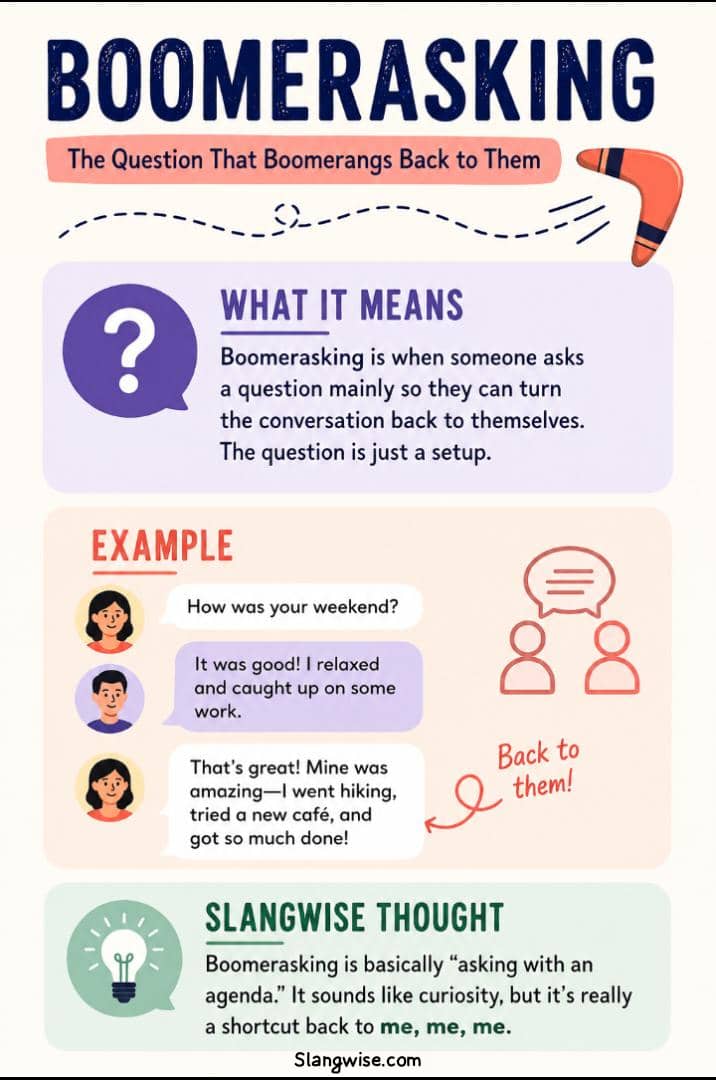
Boomerasking is a slang term for a conversation move where someone asks you a question, but not because they genuinely want your answer. They are using the question as a launchpad so they can bring the spotlight back to themselves.
In other words, the question “boomerangs” right back to the speaker. The term combines the idea of a boomerang with asking, and it has nothing to do with baby boomers as a generation.
That is why boomerasking can feel so off. On the surface, it looks friendly and curious. But under the hood, it often feels like the person is only pretending to care long enough to get their own turn.
Researchers and language writers describe it as a subtle form of conversation hijacking, and many people find it worse than someone simply being direct about wanting to talk about themselves.
READ ALSO: Bazaright Meaning in Slang: The Weird Little Word That Sounds Made Up, But Isn’t
The meaning in plain English
Here is the easiest way to understand it: a boomerask is a question that is not really a question. It is a conversational setup. The speaker asks, waits for your answer, then quickly pivots into their own brag, complaint, or story.
That is why the term feels so modern and so accurate. It names a habit many people have noticed for years, but never had a clean label for until recently.
The behavior usually falls into three common patterns.
First is ask-bragging, where the person asks something like “Have you been working out?” and then immediately uses your answer as a bridge to brag about their own progress.
Second is ask-complaining, where they ask about your day and then turn the moment into a rant about their own problems.
Third is ask-sharing, where they ask a personal question and then jump in with their own matching story. Those patterns are the ones people notice most in real-life conversations and online clips.
Slangwise Thought: boomerasking is basically “asking with an agenda.” It sounds like curiosity, but it is really a shortcut back to me, me, me.
Why people Boomerask
The interesting part is that boomerasking is not always malicious. A lot of people do it because they think asking questions makes them seem warm, polite, or socially skilled.
In their mind, they are keeping the conversation balanced. The problem is that the other person often does not feel balanced at all. They feel interrupted, overlooked, or used as a setup line.
That gap between intention and impact is the whole story. The speaker may think, “I asked about you, so I was being nice.” The listener hears, “You only asked so you could talk again.”
That is why boomerasking can damage trust even when no one meant harm. Conversation works best when both people feel heard, not when one person is secretly waiting for their turn to jump back in.
SEE ALSO: Trendjacking Meaning Explained: The Sneaky Social Media Move Brands Use to Hijack Viral Moments
Examples you will recognize immediately
Boomerasking shows up everywhere: in office small talk, school chats, casual texting, and social media posts. It often sounds like this: “How was your weekend?” followed by the other person’s answer, then an immediate pivot to “Mine was actually amazing because…”
That pivot is the giveaway. If the question disappears as soon as the answer starts, you are probably dealing with boomerasking.
Online, it can be even easier to spot. Someone might ask followers a question, then instantly answer it themselves with “I’ll go first.” That version feels more like a content strategy than a conversation, but the same pattern is there: question first, self-focus second. The term has spread because people instantly recognize the move once they see it named.
How to avoid sounding like a boomerasker
The fix is surprisingly simple. Ask a question because you actually want the answer. When the other person replies, stay with their answer for a moment. Ask one follow-up. Reflect on what they said.
Only then should you share your own story, and even then, keep it connected instead of hijacking the whole exchange. That is the difference between real curiosity and performative curiosity.
A good rule is this: if you can already answer the question yourself, slow down and listen harder. If you cannot wait to jump in with your own story, consider starting there instead of pretending the question was for the other person.
Directness often feels better than fake interest, and genuine follow-up questions usually make people feel respected.
DISCOVER: 45 Popular Gen X Slang Words That Will Take You Straight Back to the 80s and 90s
Final take
Boomerasking is one of those modern slang words that sounds funny at first, but turns out to describe something very real. It names that awkward moment when a question is used as bait for self-promotion, self-pity, or self-focus.
Once you know the term, you start spotting it everywhere. And honestly, that is the power of good slang: it gives everyday behavior a sharper name.
Frequently Asked Questions
Not always, but it often describes a rude-feeling habit. The term is usually used to point out self-centered conversation, even when the speaker does not mean any harm.
No. Small talk is normal and friendly. Boomerasking is when the question is mostly a setup for the speaker to take over the conversation.
No. The word comes from “boomerang” and “asking,” not from the baby boomer generation.
A simple, calm follow-up works well. You can answer their question, then gently bring the conversation back by asking something specific about their reply or changing the pace. That keeps things polite without letting the chat become one-sided.