
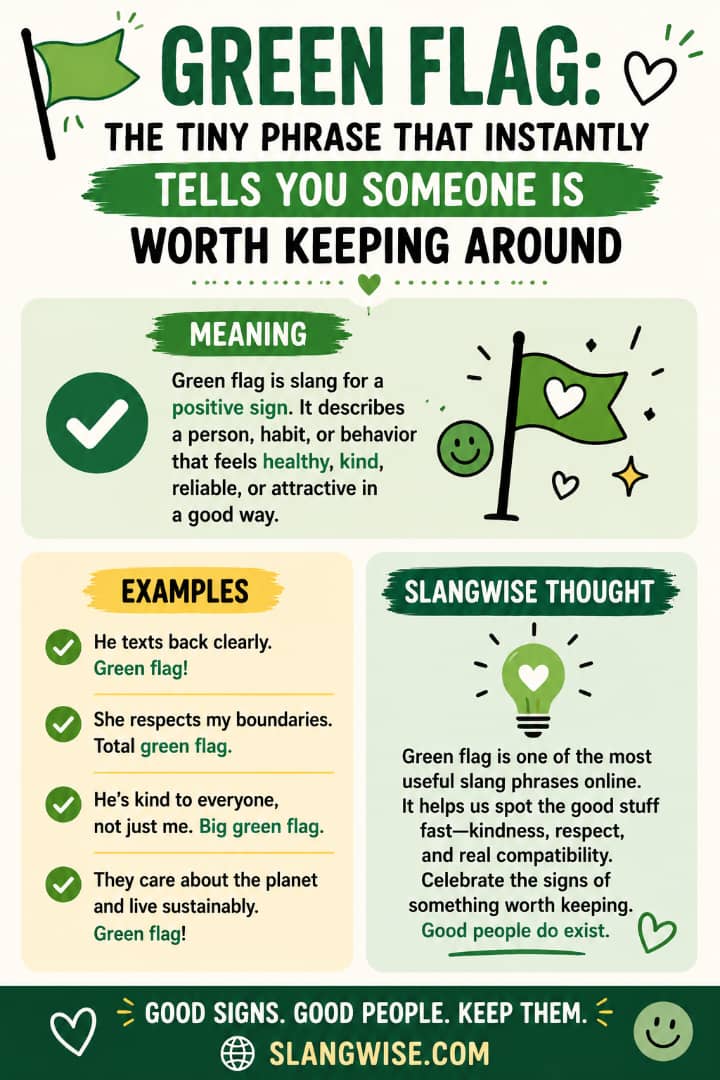
- Green flag is slang for a positive sign. It usually points to a person, habit, or behavior that feels healthy, kind, reliable, or attractive in a good way.
- It is mostly a Gen Z dating phrase, with millennial crossover. The slang is especially common in modern relationship talk, though older age groups also use it now.
- It comes from the opposite of a red flag. The whole idea is based on color coded signals, where red means warning and green means encouragement or approval.
- It is used far beyond dating now. People use it for friends, work behavior, online personalities, and even eco conscious habits when they want to signal something is genuinely good.
Green Flag Meaning in Slang
If someone calls a person, habit, or message a green flag, they are saying it is a good sign.
In slang, green flag usually means a trait or behavior that makes someone seem kind, emotionally healthy, trustworthy, attractive in a practical sense, or simply worth paying attention to. It is the internet’s quick way of saying, “Yes, this looks promising.”
The phrase is most often used in dating, but it is not locked there anymore. People also use it for friendships, workplace behavior, and general life choices.
If someone listens well, respects boundaries, remembers details, or treats other people kindly, those can all be called green flags. In other words, it is a shorthand for “this person is giving the right signals.”
READ ALSO: 25 Aesthetic Slangs You Need to Know: From Brat Summer to Aura Farming
Where did the phrase come from?
Green flag is built on the same color logic as red flag. Red has long been used as a warning sign, while green has long meant go, approval, or safety. The slang version follows that same pattern, only now it is being used to talk about people and relationships rather than traffic or warning signs.
That is why the phrase feels so natural. You do not need a long explanation to understand it. If red flag means “something might be wrong here,” then green flag obviously means “something looks good here.”
The internet loves expressions that are instantly readable, and this one is one of the cleanest examples of that.
What counts as a green flag?
A green flag can be small or big. Someone being polite to service workers, showing emotional maturity, being clear about intentions, remembering what matters to you, or not playing weird mind games can all count.
In dating, people often use the phrase to describe behavior that suggests stability and respect. The point is not perfection. The point is that the person’s actions make you feel safe, seen, or encouraged.
Recently, the phrase has even expanded into values based dating talk. There is active discussion about eco conscious behavior being a green flag, especially among younger daters.
In that context, habits like car sharing, reusing items, or caring about the environment can be treated as signs that someone is thoughtful and aligned with your values.
Read Also: Mewing Meaning in Slang: The Viral Trend Teens Keep Using to Show Off, Shush, and Flex Their Jawline
Why people love saying green flag
People love green flag because it is positive without being cheesy. Instead of saying, “That is nice,” they can say, “That is a green flag,” and instantly sound current, playful, and a little more specific.
It also fits modern social media where people like to classify behavior quickly. One comment can sum up an entire impression.
The phrase also lets people talk about healthy behavior in a very simple way. That matters because dating talk can get confusing fast, but green flag keeps it clean. It says, “This is a good sign,” without needing a whole speech about compatibility. That simplicity is a big reason it stuck.
Green flag in everyday use
You will see the phrase used in a lot of casual ways online. Someone might say, “He texts back clearly, green flag,” or, “She respects my time, total green flag.”
People also use it outside dating for friends, coworkers, pets, and even online behavior. If a person gives off trustworthy, supportive, or thoughtful energy, the label fits.
A good way to think about it is this: if red flag makes you go, “Hmm, careful,” then green flag makes you go, “Okay, that is promising.” It is not about worshipping someone. It is about recognizing a habit or quality that makes them seem decent, healthy, and worth more attention.
SEE ALSO: Gen Z vs Gen Alpha Slang in 2026: What the Newest Internet Words Really Mean
Is green flag always about romance?
No, not anymore. Romance is where the phrase became popular, but the meaning has widened. People now use it in friendships, family dynamics, social media behavior, and even lifestyle choices.
If a friend checks in on you, gives honest advice, or does not pressure you, that can absolutely be described as a green flag.
That expansion is one reason the phrase still feels fresh. It is not trapped in one conversation. It travels well from dating apps to group chats to comment sections because the core meaning stays the same: a signal that something is good, safe, or encouraging.
Slangwise take on the slang
My read on green flag is that it is one of the most useful slang phrases in modern online conversation. It is short, practical, and emotionally clear. Instead of making everything dramatic, it gives people a quick way to notice goodness, maturity, and compatibility when they see it.
That is why it works so well in dating culture, where people are constantly trying to figure out whether a person is a yes, a maybe, or a no.
It also shows how internet slang can stay simple and still feel smart. The phrase borrows from an old color signal idea, but it now carries a whole modern social meaning.
That is the magic of slang when it really lands. It feels obvious the moment you hear it, and then it keeps being useful over and over again.
DISCOVER: 80 Most Popular Gen Alpha Slang Words You’ll Hear In 2026 (updated)
Conclusion
So, in plain English, green flag means a positive sign. In slang, it is usually used to describe a person or behavior that feels healthy, respectful, trustworthy, or attractive in a good way.
It is mostly a Gen Z phrase, with plenty of millennial use and some Gen Alpha exposure through social media. It started in dating language, but now it shows up everywhere people want to point at something genuinely good.
Frequently Asked Questions
It means a positive sign or good quality in a person, situation, or behavior. It often suggests someone is kind, emotionally healthy, or trustworthy.
Yes. It is most strongly associated with Gen Z dating and relationship talk, though millennials also use it regularly.
No. People also use it for friendships, family behavior, coworkers, online personalities, and lifestyle choices.
Because green traditionally means go, approval, or safety, so it works as the positive opposite of a red flag.
Table of Contents