
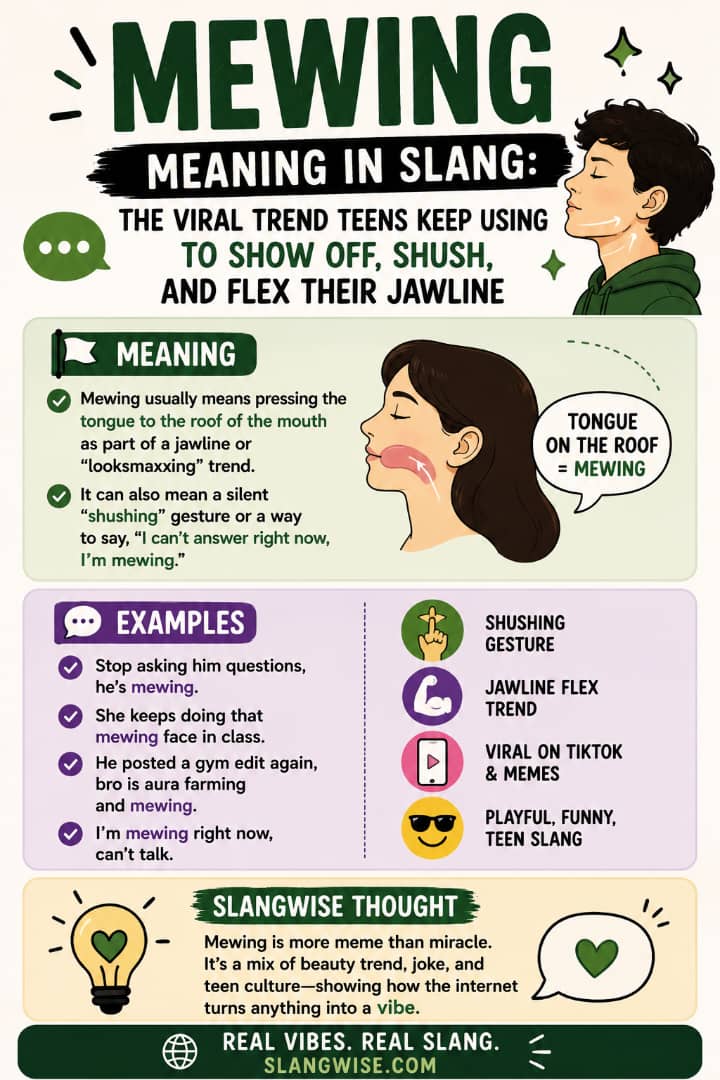
- Mewing in slang usually means pressing the tongue to the roof of the mouth as part of a jawline or “looksmaxxing” trend, even though experts say there is no scientific proof it reshapes the face.
- The slang is most associated with Gen Alpha, with some Gen Z crossover. Recent parenting and trend coverage frames it as a teen and Gen Alpha classroom and social media trend.
- On TikTok and in classrooms, “mewing” can also mean a silent “shushing” style gesture or a way of saying, “I cannot answer right now, I am mewing.”
- The term grew from looksmaxxing and internet meme culture after being linked to British orthodontist John Mew and later spread through short form video and youth slang spaces.
What does “mewing” mean in slang?
If you have seen people online talking about mewing, they are usually not talking about a cat sound. In Gen Alpha Slang slang, mewing refers to placing the tongue against the roof of the mouth, usually as part of a trend where people believe it can help define the jawline or make the face look more attractive.
The slang meaning became popular through online looksmaxxing culture and spread widely on TikTok and meme pages. The word has also taken on a second, more playful social meaning among teens.
In classrooms and teen social spaces, “mewing” can be used as a silent gesture or a way of saying someone is too busy “mewing” to talk, often paired with a shushing motion and a finger pointing toward the jawline. That makes the word part beauty trend and part joke.
READ ALSO: Lowkenuinely Meaning in Slang: The Tiny TikTok Word That Sounds Made Up but Somehow Says Exactly What You Mean
Where did mewing come from?
The term is tied to British orthodontist John Mew and to content around orthotropics, a controversial idea about facial growth and posture.
Online explanations note that the word later spread through looksmaxxing spaces, where people talk about improving appearance through posture, grooming, and other “maxxing” habits.
In other words, mewing started as a posture related idea, then became a meme, then became teen slang. That path is very typical of internet language. A niche term gets shared by influencers, turned into a joke, and finally becomes a word that kids use without caring much about the original source.
Why did mewing get so popular?
Mewing took off because it sits right at the crossroads of beauty culture, meme culture, and teen humor.
On the beauty side, it promises a sharper jawline. On the meme side, it is easy to turn into a joke because it looks funny when someone silently points at their jaw or pretends they are too committed to mewing to answer a question.
It also spread because the internet loves transformation language. Words like looksmaxxing, aura, sigma, and mewing all fit the same general vibe, where self image gets treated like a game, a status system, or a meme.
Once a word enters that ecosystem, it can move fast, especially on TikTok and short form video.
READ MORE: We’re So Back Meaning in Slang: The Internet’s Loudest Way to Say a Comeback Just Hit
Does mewing really work?
The short answer is that the jawline changing claim is not scientifically proven. Current explanations note that the practice is promoted as a way to improve facial appearance, but the American Association of Orthodontists, as relayed in recent parent coverage, says there is no scientific evidence that it works as advertised.
That matters because some people hear the slang and assume it is a legit beauty hack. In reality, the online hype is much bigger than the evidence.
So when people joke about mewing, they are usually referring to the meme version of the trend, not a medically established method for changing the jaw.
What does mewing look like in real life?
A typical mewing pose is simple: the tongue is held flat against the roof of the mouth, and sometimes the face is angled in a way that tries to highlight the jawline.
In meme culture, people may also trace their jaw with a finger or silently shush someone while implying they are mewing.
That is why the word can show up in comments like, “Bro is mewing,” or, “I am mewing right now,” even when the speaker is joking.
The phrase does not always mean the person is seriously trying to change their face. Sometimes it is just a funny way to say, “I am being quiet, focused, or weirdly committed to this bit.”
DISCOVER: Clip Farming Meaning in Slang: The Viral Internet Trick That Makes Every Stream Feel Like a Trap for Clippable Moments
How to use “mewing” in a sentence
Here are a few natural examples of mewing:
- “Stop asking him questions, he is mewing.”
- “She keeps doing that mewing face in class.”
- “Everyone in the comments was joking about mewing.”
- “He found out what mewing was and immediately started doing it for the camera.”
These examples show the two main uses clearly: the literal tongue posture idea and the joking social gesture. In both cases, the tone is usually playful, a little dramatic, and very online.
Why people keep talking about it
Part of the reason mewing keeps showing up is that it gives people something visual to react to. A word like “mewing” is easy to turn into a meme because it is not only a concept, it is also a pose, a joke, and a sign of belonging to a certain internet age group.
It also has that perfect teen slang energy where adults hear it and immediately know they are not the target audience.
Parents and teachers have been writing about it because it appears in classrooms, in family conversations, and in videos where younger people use it to signal humor, attitude, or silence.
SEE ALSO: Coworker Core Meaning in Slang: The Weirdly Funny Internet Label for Taste That Feels So Office Break Room
Slangwise Thought on the slang
My read on mewing is that it is one of those slang words that escaped its original niche and became much bigger than the idea behind it.
It started as a tongue posture trend tied to jawline talk, then turned into a meme, and now it lives as a Gen Alpha friendly joke with some Gen Z familiarity too. That is a very internet kind of evolution.
What makes it stick is that it is easy to recognize and easy to mock. The word sounds odd enough to be memorable, the pose is visual enough to imitate, and the context is broad enough to fit beauty, humor, and classroom behavior all at once. That combination is exactly why slang takes off.
Conclusion
So, in plain English, mewing means holding the tongue against the roof of the mouth, usually as part of a jawline or looksmaxxing trend, and in slang it can also mean a silent, joking gesture associated with being too busy “mewing” to talk.
It is mostly a Gen Alpha term now, though many Gen Z users know it too. The hype around it is bigger than the science behind it, which is why it works so well as both a trend and a meme.
DISCOVER: 68 Most Popular TikTok Slang Words of 2026 – Quick Meaning and Examples
FAQs About Mewing
It usually means holding the tongue against the roof of the mouth as part of a jawline or looksmaxxing trend, and it can also be used as a joking teen gesture.
It is more Gen Alpha than Gen Z in current classroom and social media use, though older teens and many Gen Z users understand it too.
Current explanations say there is no scientific evidence that it works as a reliable jawline shaping method.
Because it looks funny, sounds meme friendly, and has become a visual way to joke about silence, confidence, and teen internet culture.
Table of Contents