
- Clip farming is slang for intentionally creating moments designed to be clipped and shared online. It is most common in livestreaming and creator culture.
- The goal is usually to generate viral short-form content. Streamers or creators may exaggerate reactions, drama, or humor to produce shareable clips.
- It is often viewed as slightly inauthentic or performative. People use the term when content feels “too staged” for attention rather than naturally happening.
- It reflects how modern internet fame works. A single viral clip can matter more than a full livestream, so creators sometimes optimize for highlight moments.
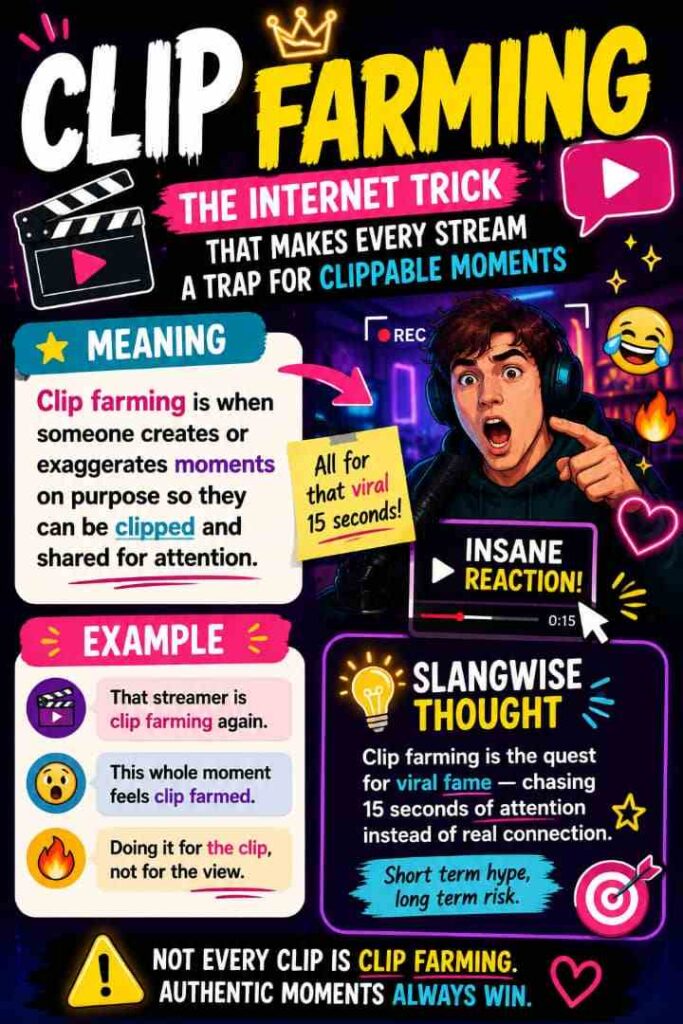
If you spend enough time around livestream culture, short video culture, or meme spaces, you definitely must have run into the phrase clip farming. It sounds a little strange at first, but the meaning is actually pretty easy to grasp once you see how people use it.
In slang, clip farming usually means deliberately doing or saying something dramatic, outrageous, funny, or shocking so other people will clip it, share it, and spread it online.
It is basically the live content version of clickbait, only the “bait” happens in real time.
What clip farming really means
The phrase is most closely tied to streaming culture, especially Twitch and similar live platforms. A streamer may exaggerate a reaction, stage a dramatic moment, or lean hard into shock value because they want a clip to go viral after the stream ends.
The focus is not just the live audience in the moment. The focus is the little 15 second highlight that people will repost later on TikTok, Shorts, or other fast moving platforms.
That is why the word farm matters here. It suggests repeated effort, like trying to grow something on purpose. In this case, what is being “grown” is attention.
The term is built from clip, meaning a short section of video, and farm, used in the internet sense of grinding or repeatedly producing something for a result. That etymology lines up with the way the word is used online.
READ ALSO: Coworker Core Meaning in Slang: The Weirdly Funny Internet Label for Taste That Feels So Office Break Room
Why people call it clip farming
People use the phrase when they think someone is trying too hard to manufacture virality. The reaction might be real, but the timing can feel suspiciously perfect.
Someone says something wild, overreacts to a small event, or stages a conflict that feels designed to be replayed later. That is why the term is often used in a critical or teasing way. It can imply that the creator is not being fully authentic, even if the content is entertaining.
The slang is especially common in streamer talk because live creators are constantly chasing memorable moments.
A strong reaction, a funny mistake, a heated argument, or a shocking statement can all become the kind of thing that gets clipped and pushed around the internet. Some sources describe it as a growth hack, while others treat it as a shortcut that may hurt credibility over time.
Where clip farming came from
The word did not appear out of nowhere. It fits a broader internet pattern where people describe attention grabbing behavior with “farm” language, much like other terms built around social media growth and content grinding.
The current usage has become much more visible in the streaming world, and recent dictionary style writeups have treated it as a fresh expression tied to creator culture.
By 2025 and 2026, the phrase was being described in mainstream explanations as a debated streaming tactic.
In those explanations, clip farming is the act of intentionally engineering a moment that will travel well as a short clip, rather than simply hoping a natural highlight gets noticed. That is the big difference between a genuine viral moment and a clip farmed one.
FIND OUT: Fambushing Meaning in Slang: The Wildly Funny Trend Where Kids Turn Location Sharing Against Their Parents
What kinds of content get called clip farmed
A clip farmed moment is usually something made to trigger a reaction fast. Think over the top rage, fake leaks, staged drama, public confrontation, or a huge theatrical response to something tiny.
The content does not need to be obviously fake for people to call it clip farming. If it feels engineered for replay value, the label may get attached anyway.
That said, not every clipped moment is clip farming. A lot of the best clips come from real spontaneity. A genuine laugh, an unexpected mistake, an amazing play, or a natural reaction can all become popular without anyone forcing it.
The distinction is simple: natural highlights happen because the stream is interesting, while clip farming happens because the clip itself is the goal.
Is clip farming always negative
Not always, but it is often treated with suspicion. Some creators see it as smart marketing, because short clips can help a stream reach people who would never sit through a long live broadcast.
Others see it as shallow, because it can reward exaggerated behavior instead of genuine community building. Recent guides on the topic point out that it may bring quick visibility, but that visibility does not always turn into long term loyalty.
That tension is why the phrase is so useful. It names a real creator strategy, but it also carries a built in judgment.
When people say someone is clip farming, they are often hinting that the person is trying to farm engagement in a way that feels forced, repetitive, or inauthentic.
SEE ALSO: Gen Z vs Gen Alpha Slang in 2026: What the Newest Internet Words Really Mean
Why the term blew up online
The reason clip farming spread so quickly is that everybody online understands the basic game now. Short form content rewards strong hooks, fast emotion, and repeatable moments.
Livestreams, in particular, are full of opportunities for people to manufacture those moments on purpose. Once a community has a name for that behavior, the name starts sticking to almost anything that feels strategically dramatic.
There is also a second meaning floating around in some spaces, where clip farming refers to uploading or re uploading attention grabbing clips that are designed to pull views through exaggerated reactions or controversy.
That version still revolves around the same basic idea: using short video as a tool to collect attention, whether by staging moments live or by packaging clips to look irresistible afterward.
How to use clip farming in a sentence
People might say things like, “That streamer is clip farming again,” or “This whole moment feels clip farmed.”
In both cases, the speaker is usually saying the content seems designed for virality rather than being naturally funny or interesting. The tone can be playful, annoyed, or openly critical depending on the situation.
DISCOVER: 72 Most Popular Gen Z Slang Words of 2026 – Rizz, Delulu, Skibidi etc., And What They Secretly Mean Online
Slangwise take on the slang
To me, clip farming is one of those phrases that captures a very specific internet feeling in just two words. It describes the moment when content stops feeling like content and starts feeling like a setup for screenshots, reposts, and reaction videos.
That is why the term is so sticky. It gives people a quick way to call out behavior that feels too deliberate, too performative, or too eager to go viral.
At the same time, it also reveals how modern attention works. In today’s creator economy, one tiny clip can travel farther than a whole livestream, so it makes sense that people build streams around moments that can be cut down and shared.
Clip farming is basically the internet naming that strategy out loud, with just enough sarcasm to keep it interesting.
So, in plain language, clip farming means making or exploiting a moment so it can be clipped, shared, and pushed for attention. It is often linked to streamers, sometimes used as a growth tactic, and often said with a little side eye. That is the whole vibe.
FAQs About Clip Farming
It means deliberately creating or exaggerating moments during a livestream or video so they can be clipped and shared online for attention.
It depends. Some see it as smart content strategy, while others see it as fake or overly performative.
It is most commonly associated with streamers, content creators, and influencers who rely on viral short clips for growth.
Because creators are “farming” attention by repeatedly producing moments that can be turned into viral video clips.
Table of Contents