
Have you noticed how one little word can flip a vibe? Say “cheeky” in the right moment and people laugh and forgive. Say it in the wrong one and you get an awkward silence.
One thing I’ve learned after decoding slang across chats and comment threads is this, cheeky is a tiny social tool that does heavy social work when you use it well.
Take a quick slack test before you read on. Think of the last time you called something cheeky. Did the other person laugh, or did they bristle? Keep that reaction in mind. It will help you place the examples below.
Table of Contents
Cheeky meaning in a nutshell
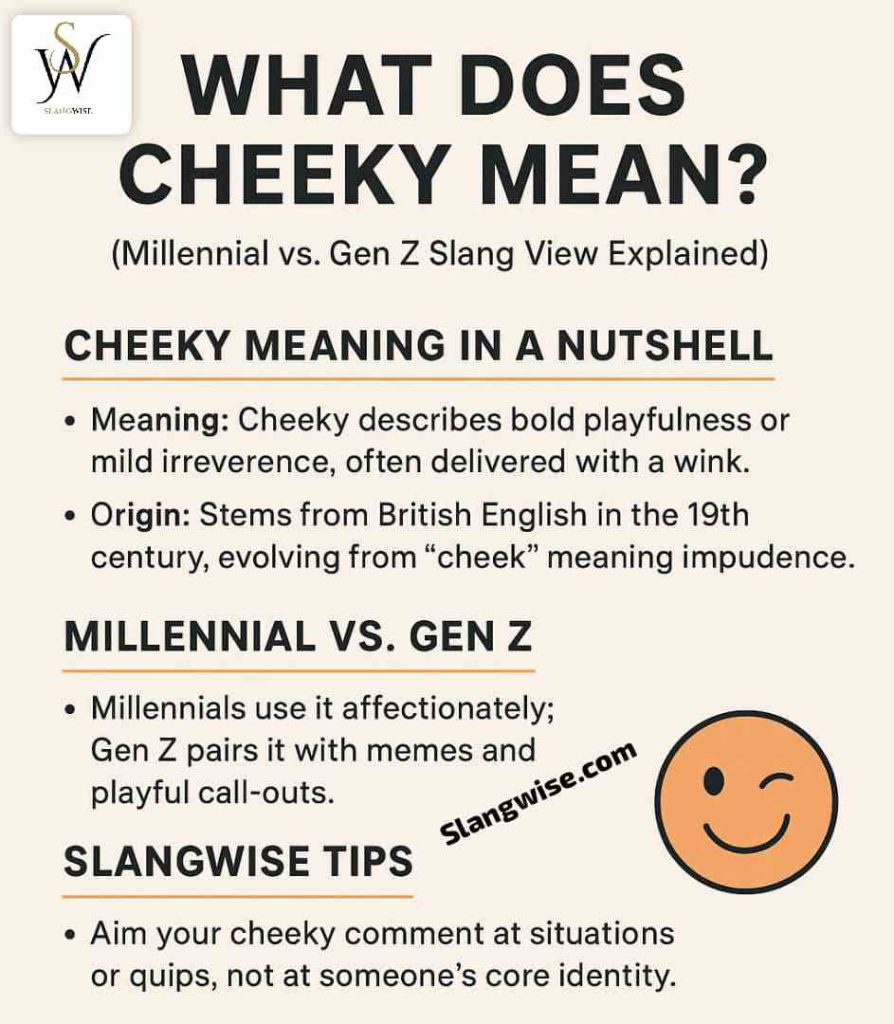
- Meaning: playful boldness or mild irreverence delivered with a wink.
- Origin: came from British English cheeks meaning impudence but softened over time.
- Variants: Cheaky is a spelling you will see sometimes, especially in casual or regional use. Both mean roughly the same thing.
- Tone check: cheeky targets acts and moves not identities.
The Cheeky Test
Here is the idea that will make you click share. I call it the Cheeky Test. Next time you want to label a joke cheeky, run these three little checks in your head first.
- Would I laugh if the joke were about me?
- Is this about something someone can change or is it about who they are?
- Will this land the same in public as in private?
If your answers are yes yes yes, you are in cheeky territory. If you answered no to any, maybe skip it. Try the test on the examples below and see how you score.
How cheeky evolved and why it still works
Cheeky started off British and a little sharper. Back then cheeky could mean insolent or bold in a rude way. Over time it softened into charm. Today cheeky sits between compliment and roast. It signals you are taking a risk but you do not want to escalate into real heat.
Why it sticks around? Because cheeky gives people permission to poke without burning bridges. In an era where everyone is watching, cheeky is a social safety valve.
Dr. Luna Reyes, sociolinguist at UCLA, points out that cheeky bridges sincerity and sarcasm: it lets speakers be bold without burning bridges.
Millennial versus Gen Z: two cheeky styles
Both generations use it to soften risk. The difference is Millennials often mean sincere mischief while Gen Z adds a self aware wink.
- Millennials tend to use cheeky like a friendly nudge. Think cheeky pint or cheeky message meaning a spontaneous but harmless move.
- Gen Z layers irony on top of cheeky. They might call a meme cheeky when the joke has a sly twist or when the creator flips expectations.
Real life Cheeky Examples
Try these in chat or captions. I included the likely reaction so you can practice tone.
Text to a friend — playful accept
“You rewired the playlist? Cheeky move but I love it.”
Reaction: laugh and approve
Instagram caption — flirty nudge
“Cheeky filter made my photos look expensive, not gonna lie”
Reaction: playful likes and comments
Public reply on X — risky, use with caution
“That take was cheeky, but also pretty wrong”
Reaction: could spark debate or defensiveness
Work Slack — not recommended
“Cheeky idea to change the deadline mid sprint”
Reaction: may read as passive aggressive. Explain the issue instead.
Think you know Gen Z? 👀 Wait till you see the 50 slang words everyone’s using nowadays, you’ll be shocked at how many you’ve missed!
Cheaky meaning slang note
I’ve seen some people write cheaky instead of cheeky. That spelling is common in casual texts or in places where the accent drops the hard e sound.
Emoji and cheeky combos that change tone
A single emoji can make cheeky land as playful or mean. Pair cheeky with these to tune your vibe.
- cheeky + 😂 or 😉 = playful tease
- cheeky + 🤭 = surprised playful
- cheeky + 🙃 = ironic or sarcastic
- cheeky + 😒 = might read as shade
Pro tip: if you want the joke to be clearly playful, add laugh emoji or an extra line that shows you are joking.
When cheeky crosses the line
Cheeky becomes a problem when it targets identity, vulnerability, or serious topics. Here are quick rules to avoid awkwardness.
- Aim at actions not people. Say cheeky move not cheeky you.
- Avoid cheeky in public criticisms of someone who is already upset.
- If you sense tension, switch to a clarifying sentence: I meant that as playful not hurtful.
From my experience, humour that punches up is safer than humour that punches down. Use that principle when you flirt with cheeky.
Little interactive moment
Think about what each line communicates. Which one would you use for a boss, which for your best friend, which for a crush? Drop your answers in the comments or save this post to try later.
Ready for a one line practice? Pick one:
A: “That was cheeky and brilliant”
B: “Cheeky, but also questionable”
C: “Cheeky move, teach me”
Quick Cheaky Overview
- Cheeky means playful boldness not insult.
- Cheaky is a valid casual variant.
- Use cheeky for actions not for identities.
- Add emoji to clarify tone.
- When unsure, explain one sentence after your cheeky remark.
Discover what GGG and GGGG mean in dating, gaming, and boxing. Examples, origins, and explanations to help you use the term correctly.
Examples of cheeky in culture
Because cheeky is flexible you can use it in a compliment or a roast depending on tone. That is both its power and its risk.
- Cheeky pint — British phrase for a spontaneous drink.
- Cheeky edit — an online remix that teases the original.
- Cheeky grin — that knowing smirk we all recognize.
Final thought
Cheeky is not just a word it is a social move. When you want to be playful, short sharp and clear is your friend. One thing I always tell people who ask me about slang is this, choose your target carefully then wink with clarity. That is how cheeky stays charming and not cruel.
FAQs on Cheeky Slang
Gen Z often use cheeky to describe clever, mischievous, or unexpectedly bold actions. On social media, it can refer to a funny meme, a sly edit, or someone making a playful move that breaks the usual rules.
In British slang, cheeky traditionally describes someone who is slightly rude or bold but in a humorous or charming way. Phrases like “a cheeky pint” or “a cheeky snack” often mean doing something spontaneous and fun.
In text messages, cheeky usually means someone is being playfully bold, teasing, or slightly mischievous. For example, a “cheeky message” might be a flirty joke, a playful dare, or a witty comeback.
People use cheeky to describe playful actions or jokes. For example:”That was a cheeky move stealing the last slice of pizza.”It signals that the action was bold but still funny rather than rude.
Cheeky is the correct and traditional spelling. Cheaky appears in casual texting, search queries, or regional typing habits. Both usually refer to the same playful slang meaning online.
Most of the time, cheeky is meant as a light compliment. It suggests someone is witty, playful, or confidently mischievous. However, tone matters. Without humor or context, it can sometimes sound slightly disrespectful.
In slang, cheeky describes someone being playfully bold or slightly mischievous in a fun way. It usually refers to harmless teasing, clever humor, or a small rule breaking moment meant to make people smile.