
Table of Contents
Cheeky Meaning in a Nutshell
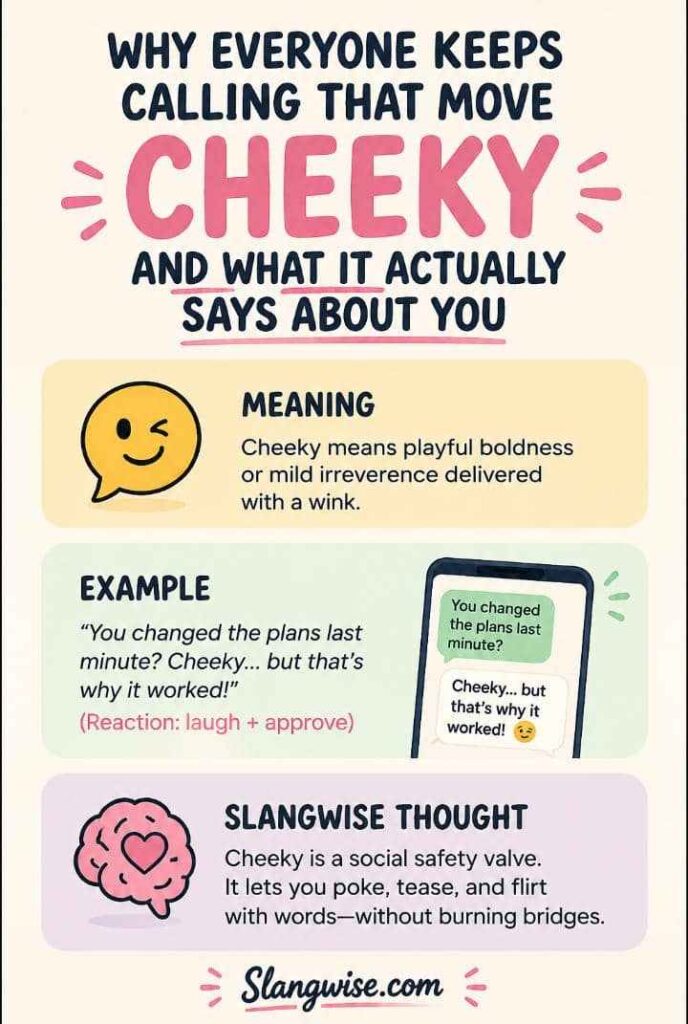
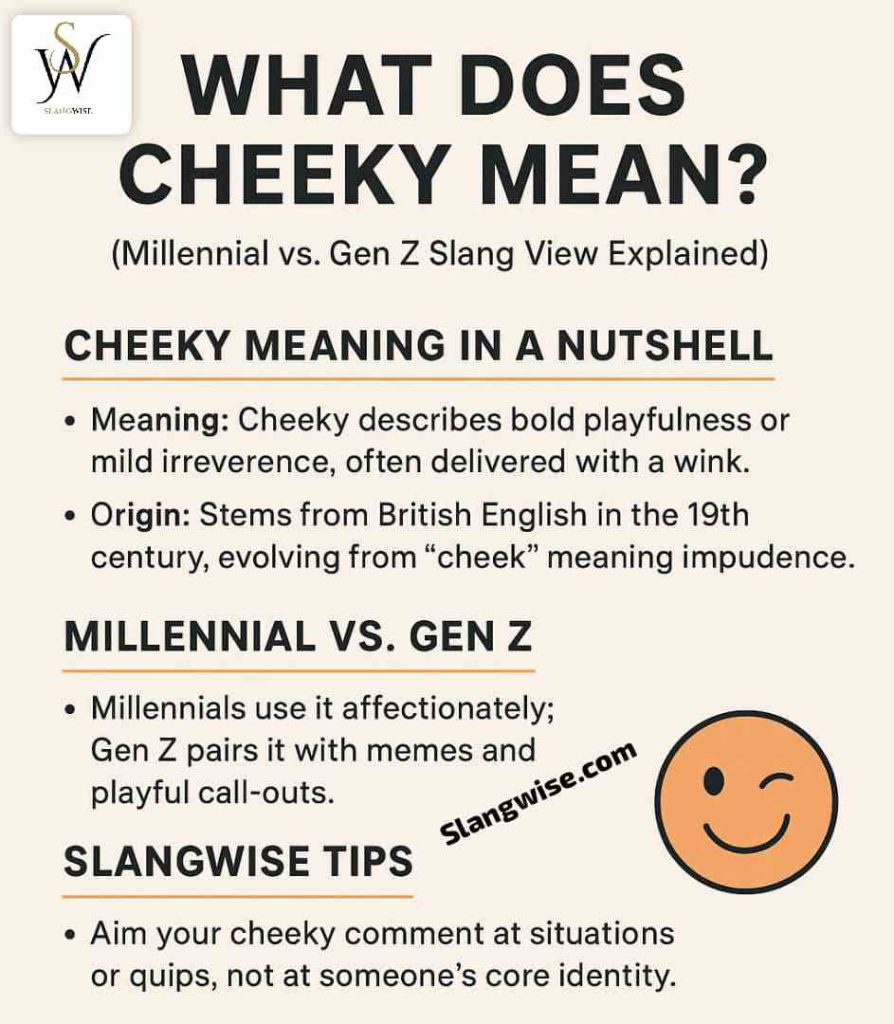
- Meaning: Cheeky describes something playfully bold, mischievous, slightly rude, or unexpectedly daring without necessarily being offensive.
- Tone: It can sound affectionate, funny, sarcastic, or critical depending on the situation, relationship, and delivery.
- Modern use: Online, people often use cheeky for jokes, comments, edits, captions, and small acts of harmless boldness.
- Spelling: Cheeky is the standard spelling. Cheaky appears online as a casual misspelling, but it is not the traditional form.
- Best rule: A cheeky comment usually feels like a wink rather than an attack, but context decides whether that wink lands.
What Does Cheeky Actually Mean in Slang?
After years of decoding slang and watching how words shift between group chats, comment sections, memes, and everyday conversation, I could say cheeky stands out because it can carry several meanings at once.
At its core, cheeky describes behavior that is a little bold, mischievous, or disrespectful in a relatively lighthearted way.
That distinction matters.
Calling someone cheeky can mean:
“Nice try. That was bold.”
It can also mean:
“You are being a little naughty.”
And sometimes it means:
“That was funny, but you definitely pushed it.”
That flexibility is exactly why the word survives across generations. The same action can feel charming in one setting and irritating in another.
One useful rule has emerged repeatedly while studying slang: cheeky usually describes the move, comment, joke, or behavior more safely than it describes the person.
The Cheeky Test: Will It Actually Land?
Before calling something cheeky, run it through three quick questions.
- Would the joke still be funny if it were aimed at you?
- Are you teasing an action rather than attacking someone’s identity or vulnerability?
- Would the comment still sound playful if other people saw it?
A yes across the board usually means the word is doing its job.
For example:
“You changed the group playlist without asking? Cheeky move.”
That sounds playful.
Compare it with:
“You’re so cheeky.”
That could still be friendly, but without tone or context, it is much easier to misunderstand.
The difference is subtle, and that subtlety is a big part of how slang works.
DISCOVER: 270 Most Popular Internet Slang Words of 2026: The Ultimate Gen Z & Gen Alpha Dictionary
How “Cheeky” Evolved
Cheeky is strongly associated with British English and traditionally referred to someone who was impudent, bold, or slightly disrespectful.
Over time, the word developed a softer and more humorous edge.
That is why modern expressions such as “cheeky comment,” “cheeky grin,” or “cheeky move” do not automatically sound insulting. The speaker can acknowledge that someone crossed a tiny social line while still suggesting that the behavior was amusing.
In modern internet language, that quality has become even more useful.
Online conversations are full of irony, teasing, exaggerated reactions, and playful rule-breaking. Cheeky gives people a compact way to describe that energy without making the situation sound seriously hostile.
It sits in the space between clever, mischievous, bold, and slightly inappropriate.
That is why one word can replace an entire sentence.
Millennial vs. Gen Z: Is “Cheeky” Used Differently?
Both Millennials and Gen Z understand cheeky as playful boldness, but the surrounding style can differ.
Millennial usage often carries the older British-influenced sense of harmless mischief. A person might call an unexpected purchase, joke, or spontaneous decision cheeky.
Gen Z usage often adds a layer of irony. Something can be described as cheeky because it is deliberately clever, slightly unserious, or knowingly outside the expected norm.
For example:
Millennial-style:
“That was a cheeky little shortcut.”
Gen Z-style:
“That edit was kinda cheeky.”
The second example does not necessarily mean rude. It can suggest that the edit was sly, unexpected, or cleverly played.
Real-Life Examples of “Cheeky”
Here are some newer examples that show how the word changes with context.
Group chat:
“Cheeky move dropping the spoiler and disappearing.”
Reaction: Usually playful annoyance rather than genuine anger.
Comment section:
“That was a cheeky plot twist.”
Meaning: The twist was clever, unexpected, or slightly mischievous.
Friend-to-friend:
“You really took the last cookie? Cheeky.”
Meaning: A harmless callout with a joking tone.
Social media caption:
“Cheeky little upgrade.”
Meaning: A small improvement or change presented with playful confidence.
Gaming chat:
“That was a cheeky shortcut.”
Meaning: The player used a clever or slightly sneaky tactic.
Work conversation:
“That is a cheeky way to move the deadline.”
Meaning: The speaker thinks the decision is bold or questionable.
That last example shows why tone matters. In a workplace, cheeky can sound funny among close colleagues but passive-aggressive in a formal discussion.
Cheeky + Emojis: How the Tone Changes
A single emoji can completely change how cheeky is interpreted.
- Cheeky + 😂 = obviously joking or teasing
- Cheeky + 😉 = playful, knowing tone
- Cheeky + 🤭 = mischievous or mock-shocked
- Cheeky + 🙃 = ironic or slightly sarcastic
- Cheeky + 😒 = much more likely to sound annoyed or critical
This is one reason text-based slang can be tricky. In face-to-face conversation, tone of voice and facial expression do part of the work. In a message, the reader has to reconstruct that tone.
A small emoji, extra sentence, or clearer context can make the difference between “funny” and “why are you being rude?”
Cheaky Meaning: Is It the Same as Cheeky?
You may see cheaky in searches, comments, captions, and casual messages.
However, cheeky is the standard spelling.
Cheaky is best treated as a misspelling or informal variation rather than a separate slang word with its own established meaning.
So if someone writes:
“That was a cheaky move.”
They almost certainly mean:
“That was a cheeky move.”
The meaning comes from the context, not from a different definition of cheaky.
When Does Cheeky Cross the Line?
The biggest mistake is assuming that calling something cheeky automatically makes it harmless.
It does not.
A cheeky comment can become insulting when it targets someone’s identity, appearance, insecurity, serious situation, or personal vulnerability.
Compare:
“Cheeky move changing the rules halfway through.”
with:
“You’re cheeky because that’s just how you are.”
The first targets behavior.
The second labels the person.
That distinction can make a huge difference.
In slang, one of the most reliable tone rules is to focus playful criticism on what happened, not on an unchangeable characteristic of the person involved.
Context matters too. A joke that works privately between friends may feel completely different in a public comment section.
A Quick Cheeky Challenge
Which sentence sounds most naturally cheeky?
A. “That was cheeky and brilliant.”
B. “Cheeky, but I’m not convinced.”
C. “Cheeky move. How did you even think of that?”
All three can work, but they send different signals.
A is openly approving.
B is more skeptical and can sound sarcastic.
C feels impressed while still acknowledging that the move was unconventional.
That is the real power of cheeky: the word does not decide the mood on its own. The surrounding language does.
Why “Cheeky” Still Works So Well
Slang changes quickly, but cheeky has something many newer internet terms do not: flexibility.
It can describe a joke, a clever decision, a mischievous comment, an unexpected twist, or a mildly rebellious action.
It also gives speakers a way to soften criticism.
Calling something cheeky can communicate:
“That was bold, but I am not treating it like a serious offense.”
That makes the word useful in conversations where being completely serious would sound too harsh, but saying nothing would miss the moment.
From a slang-decoder perspective, that middle ground is exactly what makes cheeky so durable.
Slangwise Tip
When you hear cheeky, do not focus only on the dictionary definition.
Listen for the social intent.
Is the speaker amused? Impressed? Teasing? Annoyed?
That reaction usually tells you more than the word itself.
And remember: cheeky is strongest when the boldness is small enough to laugh about.
Think playful mischief, not personal attack.
Think “nice try” rather than “you’re a terrible person.”
That is the line that keeps cheeky charming.
Think you know Gen Z? 👀 Wait till you see the 50 slang words everyone’s using nowadays, you’ll be shocked at how many you’ve missed!
Final Verdict: What Does “Cheeky” Say About You?
Using cheeky does not automatically say that someone is rude, rebellious, or sarcastic.
It usually says they noticed a little bit of boldness and chose to frame it playfully.
That is why the word can feel warm in one conversation and irritating in another.
The safest interpretation is simple:
Cheeky = slightly bold, mischievous, or irreverent, usually with a playful edge.
The context determines whether that edge feels charming or annoying.
And that is the part worth remembering when decoding slang: words carry meanings, but people carry the tone.
Discover what GGG and GGGG mean in dating, gaming, and boxing. Examples, origins, and explanations to help you use the term correctly.
FAQs on Cheeky Slang
Cheeky in slang usually means playfully bold, mischievous, slightly rude, or unexpectedly daring. It often suggests that someone crossed a small social line but did so in a humorous or lighthearted way.
People call something cheeky when it feels bold, clever, mischievous, or mildly inappropriate without being seriously offensive. The word often softens criticism by making it sound more playful.
In British English, cheeky traditionally describes someone or something that is slightly impudent, bold, or disrespectful in a humorous way. Modern usage can also suggest harmless spontaneity or mischief.
In text messages, cheeky usually signals playful teasing, boldness, or mischief. For example, calling a friend’s unexpected shortcut a ‘cheeky move’ can mean the shortcut was clever and slightly sneaky.
Cheeky can be either, depending on tone and context. It is often a playful compliment when someone is being witty or mischievous, but it can sound critical when the speaker is genuinely annoyed.
No. Cheeky is the standard spelling. Cheaky appears online as a casual misspelling or informal spelling, but it is not generally treated as a separate slang word with a different meaning.
Gen Z may use cheeky online for clever jokes, unexpected edits, playful comments, or mildly rebellious actions. The word often carries an ironic or self-aware tone, especially in memes and social media conversations.