

I have learned that some slang terms announce themselves. They arrive loudly, trend on social media, and suddenly everyone seems to be using them.
FWIW is different. It is the quiet acronym that slips into a text, comment, email, or group chat almost unnoticed.
I remember seeing FWIW in a conversation where someone was giving advice, and at first I focused more on the three letters than on what they were actually doing in the sentence.
Once I understood the tone behind it, though, it suddenly made sense. The person was not trying to take over the conversation. They were offering their perspective while leaving the final decision to someone else.
That little distinction is exactly why FWIW is more interesting than it looks.
In this guide, I want to go beyond simply telling you what FWIW stands for. I will show you when it sounds natural, when it sounds awkward, how its tone can shift between friends and coworkers, and the mistake I see people make most often when using it.
FWIW Meaning
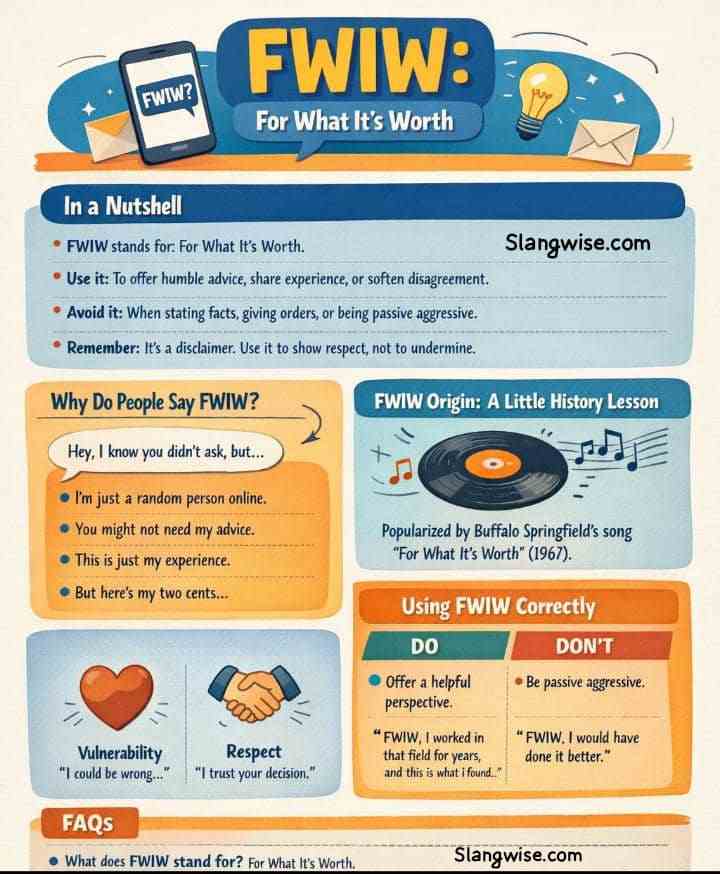
FWIW stands for “For What It’s Worth.”
It is usually used before an opinion, observation, recommendation, or piece of personal experience that the speaker thinks might be useful to the other person.
One reason FWIW can be confusing is that it is not really a slang word in the same way as something like “rizz” or “sus.” It is better understood as an informal acronym or initialism that has become common in texting, online conversation, forums, social media, and casual professional communication.
READ ALSO: LOL Meaning in Text: Why This Tiny Acronym Still Shapes Online Chat
What Does FWIW Actually Do in a Conversation?
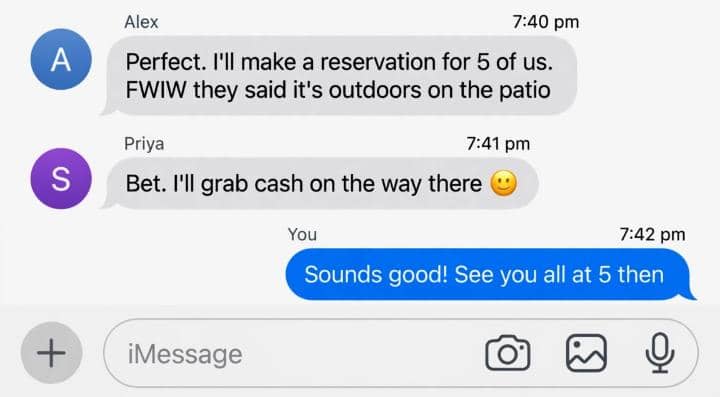
This is the part I think people miss.
FWIW is not just there to make a sentence shorter. It changes the way the information is presented. Instead of sounding like, “This is what you should do,” the speaker is closer to saying, “Here is something worth considering, but you decide what to do with it.”
I use that distinction when I explain internet slang because tone matters just as much as the literal expansion of an acronym. FWIW can signal humility, uncertainty, personal experience, or respectful disagreement.
Think about the difference:
- “You should take the earlier flight.”
- “FWIW, I took the earlier flight last month and it was much less stressful.”
The second version does not force the listener to agree. It simply puts another data point on the table.
FWIW Origin: An Older Phrase in a Newer Form
Here is another reason FWIW has lasted: the acronym did not invent the phrase. “For what it’s worth” has long existed in everyday English, while the shortened FWIW version fits neatly into digital communication.
The phrase also became widely recognizable through the 1960s song “For What It’s Worth” by Buffalo Springfield. The song and the modern acronym are not using the phrase in exactly the same conversational way, but the wording itself clearly existed long before people started dropping FWIW into group chats.
That is common with internet slang. The internet often does not invent the language from scratch. Instead, it compresses familiar language into forms that are quicker to type and easier to repeat.
DISCOVER: Sksksk Meaning: Why Sksksk Is the Screechy Sound Everyone’s Secretly Using
How People Commonly Use FWIW
After looking at FWIW across texting, online discussions, and everyday communication, I find that it usually falls into a few simple patterns.
1. Sharing Personal Experience
This may be the most natural use of FWIW.
“FWIW, I used that study app for a few weeks and found the practice tests more useful than the flashcards.”
The speaker is not claiming their experience is universal. They are simply adding something they personally observed.
2. Offering a Different Opinion
FWIW can make disagreement feel less confrontational.
“FWIW, I actually preferred the original version. The newer one looks better, but I found the first one easier to use.”
Notice what happened there. The person disagreed, but they did not turn the conversation into a competition.
3. Giving Unsolicited Advice Carefully
This is where FWIW becomes especially useful.
“FWIW, I would keep a copy of those files before deleting anything from your old laptop.”
The advice is there, but the wording gives the other person room to accept it or ignore it.
4. Adding a Helpful Detail Online
You will also see FWIW in Reddit discussions, forums, comment sections, and other online communities.
“FWIW, I bought the smaller version last year, and it has been enough for my needs.”
It works well here because online discussions often contain many competing opinions. FWIW helps frame a comment as one person’s perspective rather than the final word.
Are You Using FWIW Wrong?
Probably not, but there is one common mistake worth knowing.
People sometimes use FWIW as if it simply means “by the way,” “also,” or “just so you know.” That is where the acronym starts sounding unnatural.
For example:
Awkward: “FWIW, the movie starts at 7:30.”
That sentence is understandable, but FWIW does not add much because there is no personal perspective or opinion being offered.
More natural: “FWIW, I went to the 7:30 showing last week, and it was almost empty.”
Now the acronym has a purpose. You are sharing something based on your own experience that might help the other person decide.
Slangwise Tip: Before using FWIW, ask yourself, “Am I adding a perspective, experience, opinion, or useful observation?” If the answer is yes, it probably fits.
FWIW in Texting, Work, and Social Media
One of the reasons FWIW shows up everywhere is that it adapts easily to different settings.
In a text conversation, it can sound personal:
“FWIW, I think you handled that situation better than you realize.”
In a work chat, it can sound collaborative:
“FWIW, the version we tested last quarter had fewer customer complaints.”
On social media, it can introduce a personal take:
“FWIW, I think the criticism is missing the point of the original post.”
I would still be careful in highly formal writing. In a legal document, academic paper, or serious official statement, writing the phrase out is usually clearer than dropping in an acronym.
FWIW Can Also Sound Passive Aggressive
This is where tone becomes important.
FWIW is often used to soften a comment, but softening a sentence does not automatically make the sentence kind.
Consider this:
“FWIW, I finished the assignment hours ago.”
Depending on the conversation, that could sound completely neutral. Or it could sound like, “Just so we’re clear, I did my part and you did not.”
That is why I always tell readers to pay attention to context. An acronym cannot rescue a sentence that is already carrying an attitude.
FWIW can soften disagreement, but it can also disguise criticism. Your relationship with the person, the subject being discussed, and even punctuation can change how it lands.
SEE ALSO: GG Dịch Meaning: Why Internet Users Say GG Instead of Google Translate
FWIW vs. FYI vs. IMO
These acronyms can appear together online, but they are doing different jobs.
- FWIW = For What It’s Worth. Usually introduces a perspective, opinion, or experience.
- FYI = For Your Information. Usually introduces information you want someone to know.
- IMO = In My Opinion. Directly labels what follows as your opinion.
For example, “FYI, the meeting starts at nine” is simply information. “FWIW, I think the nine o’clock meeting works better” adds a personal judgment.
In a Nutshell: FWIW Cheat Sheet
- FWIW means: “For What It’s Worth.”
- Use it when: You are adding an opinion, personal experience, recommendation, or useful observation.
- Its tone: Usually humble and conversational, but it can become passive aggressive depending on context.
- Do not use it as: A simple replacement for “by the way” or “also.”
- Remember: FWIW gives people another perspective. It does not automatically make your opinion more important.
Why FWIW Still Works So Well Online
What I find interesting about FWIW is that it solves a very modern communication problem with very simple language.
Text removes a lot of the signals we normally rely on in conversation. People cannot hear your voice, see your expression, or always tell whether you are being helpful or judgmental. A tiny phrase like FWIW can help establish the speaker’s intention before the opinion arrives.
That does not mean every FWIW is perfectly polite. I have seen it used sincerely, casually, and occasionally with a little attitude hiding underneath. That range is what makes internet language so interesting to me. Meaning lives in context, not just in the letters themselves.
LEARN MORE: IMO and IMHO Meaning: What IMO and IMHO Mean in Text, Chats, and Online Conversation
Conclusion: FWIW Is More About Tone Than the Acronym
FWIW may only be four letters, but it can completely change how an opinion lands.
Used naturally, it tells someone, “Here is something I think may be useful, but I am not trying to make the decision for you.” That makes it especially useful when sharing personal experience, disagreeing politely, or offering advice that was not directly requested.
The biggest lesson I would take away is simple: do not use FWIW just because you have seen other people use it. Use it when the sentence genuinely benefits from that little layer of perspective and humility.
And honestly, that is why I think this acronym has stayed around. It does not simply save typing. It helps people manage tone.
FAQs
FWIW means “For What It’s Worth.” In texting, it usually introduces an opinion, personal experience, recommendation, or observation that the speaker thinks may be useful.
An example is: “FWIW, I tried that restaurant last weekend and the lunch menu was much better than the dinner menu.”
No. FYI means “For Your Information” and usually introduces information, while FWIW means “For What It’s Worth” and usually introduces a perspective, opinion, or personal experience.
Yes. FWIW often sounds polite or humble, but context matters. It can sound passive aggressive when it is used to deliver criticism, prove someone wrong, or remind them that your approach was better.
FWIW is mainly informal, but it can appear in casual or semi professional emails, workplace chats, and online discussions. In highly formal writing, spelling out the phrase is usually clearer.
For reference, Slang.net’s FWIW explanation also identifies the acronym as “For What It’s Worth” and describes its use before sharing an opinion or perspective.
Table of Contents