
SEO Title: IMO vs. IMHO Meaning: The Tiny Slang Acronyms That Can Change the Whole Tone of a Message
Meta Description: Learn what IMO and IMHO mean in text, chats, and online conversations, plus how to use them naturally, politely, and with the right tone.
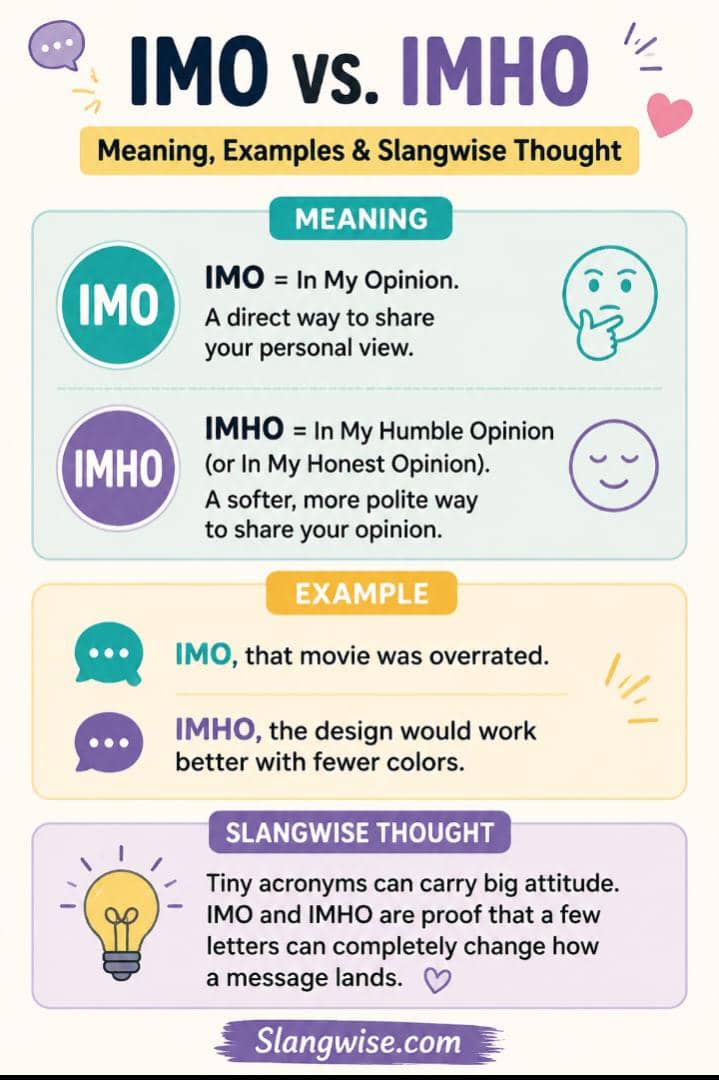
IMO meaning and IMHO meaning are two of the easiest ways to signal that you are sharing a personal view, not a hard fact. IMO stands for “in my opinion,” while IMHO usually means “in my humble opinion” and is sometimes used as “in my honest opinion.”
These two slang acronyms do more than save space. They soften a statement, shape the tone, and help the reader understand that what follows is a viewpoint, not a universal truth.
Used well, IMO and IMHO can make online conversations feel more thoughtful, more respectful, and less confrontational across comment sections, forums, social media, messaging apps, and workplace chats.
Table of Contents
In a Nutshell
- IMO meaning: “In My Opinion.” A direct way to show that a statement is personal and subjective.
- IMHO meaning: “In My Humble Opinion” or sometimes “In My Honest Opinion.” It adds a softer, more modest tone.
- Main job: Both acronyms label a thought as an opinion and not a fact.
- Best use: They work well when you want to sound clear, calm, and conversational online.
- Tone effect: IMO sounds more direct. IMHO can feel more polite, more careful, or even slightly ironic depending on context.
- Where you will see them: Reddit, Twitter/X, Discord, Slack, group chats, forums, and casual DMs.
Slangwise thought: Tiny acronyms can carry big attitude. IMO and IMHO are proof that a few letters can completely change how a message lands.
Origins and evolution of IMO and IMHO
IMO and IMHO grew out of early internet culture, when people needed fast ways to write clearly in chat rooms, message boards, and email threads. Online conversations moved quickly, so short forms became a natural fit.
IMO became the simple, stripped down version: a clean marker that says, “this is just my take.” IMHO appeared as a softer variation, often used to sound more polite, modest, or socially aware.
Over time, IMHO picked up extra layers of meaning. In some spaces, it sounds genuinely humble. In others, it can feel playful, dramatic, or even a little sarcastic, depending on the speaker, the punctuation, and the conversation around it.
IMO meaning in practice
IMO is one of the clearest ways to tag a statement as personal opinion. It keeps the message direct while making room for disagreement.
That is why IMO shows up so often in debates, reviews, recommendations, and casual argument threads. It lets the speaker share a strong view without pretending to speak for everyone.
Used naturally, IMO can make your message feel confident without sounding too aggressive.
Examples:
- “IMO, that album is overhyped.”
- “The app was easier to use before the update, IMO.”
In both examples, the acronym helps the speaker keep the statement personal rather than absolute.
IMHO meaning in practice
IMHO works in a similar way, but it usually adds a softer edge. The word humble makes the phrase feel more careful, more diplomatic, or slightly more self-aware.
That is why IMHO is often used when someone is offering feedback, correcting a point gently, or sharing a view in a group where they want to avoid sounding blunt.
It can also be used with a little irony. In online culture, IMHO does not always mean the speaker is actually being humble. Sometimes it is used with a wink, especially when the person is being very confident while pretending to be modest.
Examples:
- Capitalization: IMO and IMHO look more direct and standard. imo and imho can feel more casual and relaxed.
- Punctuation: A period can make the message feel neat and controlled. Exclamation marks can make it sound stronger or more emotional.
- Emoji: A small emoji can soften the tone and make the opinion feel playful rather than sharp.
- Placement: At the start, the acronym frames the whole sentence as an opinion. At the end, it works more like a quick afterthought.
- Reddit & forums: Very common. They help keep opinions labeled in long or debate-heavy threads.
- Twitter/X: Handy for short posts where space is limited and tone needs to stay readable fast.
- Discord & Slack: Good for casual feedback, especially when you want to avoid sounding too blunt.
- Email & professional docs: Usually too informal. It is better to write the phrase out or use clearer, evidence-based wording.
- Debate thread: “IMO, the policy should be revised.”
- Product feedback: “IMHO, the signup flow feels too long for first-time users.”
- Casual chat: “Movie was actually pretty good, imo.”
READ ALSO: ASAP Meaning: What ASAP Mean in Text, Chats, and Professional Communication?
Tone, punctuation, and nuance
IMO and IMHO are simple on the surface, but small changes in style can shift how they feel. That is where the real slang skill comes in.
Here is how the tone can change:
In short, the acronym is only part of the message. The full meaning comes from the surrounding tone.
When to use IMO vs. IMHO
Use IMO when you want to sound clear, simple, and direct. It is the better choice when the focus is on speed and the setting is informal.
Use IMHO when you want to sound a little gentler, more polite, or more thoughtful. It fits especially well when you are giving critique, disagreeing softly, or speaking in a group where tone matters.
In formal writing, both can feel too casual. If the situation matters, spelling out “in my opinion” is stronger. If the point is important, supporting it with evidence is even better.
Platform-specific tips
Different platforms give IMO and IMHO slightly different personalities. The same acronym can feel friendly in one space and sharp in another.
Examples of IMO and IMHO that show the difference
These examples make the distinction easier to feel in real conversation:
Conclusion
IMO and IMHO are small acronyms, but they do a lot of heavy lifting in online conversation. They mark subjectivity, soften tone, and help people understand that a statement is a personal view rather than a universal claim.
IMO feels cleaner and more direct. IMHO carries a little more softness, humility, or irony, depending on the context. Once you start noticing how people use them, you will see that these two slang shortcuts are really about social tone as much as language.
Use them carefully, use them naturally, and when the conversation matters, give your opinion a little support. That is how a tiny acronym becomes a smarter message.
FAQs
What does IMO mean?
IMO means “In My Opinion.” It shows that the speaker is sharing a personal view rather than a fact.
What does IMHO mean?
IMHO usually means “In My Humble Opinion,” though some people use it as “In My Honest Opinion.” Either way, it signals a personal viewpoint.
Is IMHO always humble?
No. In internet slang, IMHO can sound humble, polite, playful, or even sarcastic depending on the tone of the message.
Which is more common, IMO or IMHO?
IMO is generally more common because it is shorter and more direct. IMHO is still widely understood, especially in forums and chat spaces.
Should I use IMO or IMHO in professional writing?
Usually no. In professional settings, it is better to write out “in my opinion” or use clear supporting evidence instead of abbreviations.