
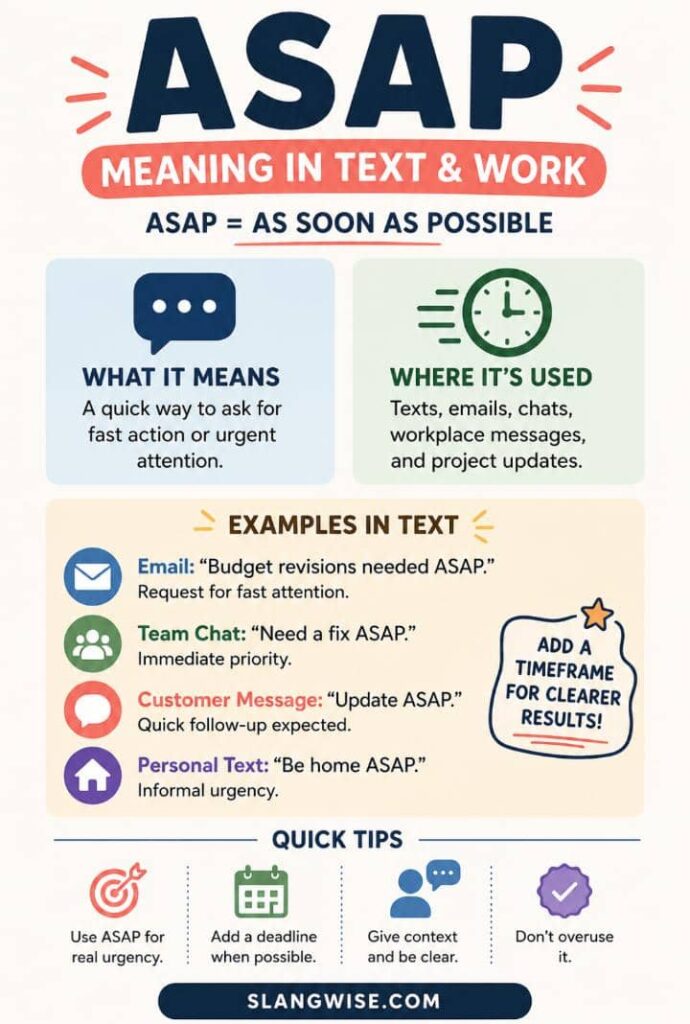
- ASAP full form: As Soon As Possible.
- What it means: a request for fast action, quick follow up, or immediate attention.
- Where people use it: texts, emails, group chats, workplace messages, and project updates.
- Why it matters: it saves time and makes urgency easy to understand at a glance.
- Best use: pair ASAP with a clear deadline when timing really matters.
- Bonus for slang lovers: take the internet quiz and grab the free 270+ Internet Slang Dictionary Giveaway to test how many online terms you really know.
ASAP meaning is one of the clearest shorthand expressions in modern communication: ASAP stands for “as soon as possible.” It is a compact way to show urgency, request a quick response, or signal that something needs attention without wasting words. That slang acronym is used everywhere from texts and team chats to emails and meeting notes.
In everyday language, ASAP has become one of those abbreviations people understand almost instantly. It works because it is simple, direct, and easy to recognize, whether the message is casual or professional.
Before we get deeper into the meaning, here is the simplest way to think about it: ASAP is not fancy, not complicated, and not mysterious. It is just a fast, familiar way to say that something should happen quickly.
Table of Contents
What does ASAP really mean and where did it come from?
When people ask what does ASAP mean, the answer is straightforward. It is an abbreviation for as soon as possible, and it is used to communicate urgency in a short and efficient way.
The phrase has long been useful in business, military, and office communication because it keeps messages short while still making the priority clear. Over time, it moved into everyday texting and online conversation, where it became a common part of digital language.
That is why ASAP feels familiar in so many spaces. It works in formal settings, but it also shows up in casual chats, where people use it to keep conversations moving.
ASAP meaning in text: practical examples
ASAP meaning in text depends on context, but the core idea stays the same: someone wants something done quickly. The tone can sound polite, urgent, demanding, or casual depending on how it is used.
Here are a few common examples:
- Email subject line: “Budget revisions needed ASAP” means the document needs fast attention.
- Team chat: “Server down, need a fix ASAP” signals immediate priority.
- Customer message: “Please send an update ASAP” asks for a quick response.
- Personal text: “I am on my way ASAP” means the person is coming as quickly as they can.
Helpful tip: whenever possible, add a time frame to ASAP. “ASAP, by 3 PM” or “ASAP, within the hour” is much clearer than ASAP alone.
DISCOVER: The Ultimate List of 250 Most Popular Internet Slang Words of 2026
How ASAP works in everyday slang
ASAP is not really slang in the playful, trendy sense the way some internet phrases are. It is more of a widely accepted abbreviation that has crossed into slang use because people say it constantly in chats and texts.
That is what makes it so useful. It is short, widely understood, and easy to drop into nearly any conversation. Even when it sounds casual, it still carries a strong sense of urgency.
It also helps people avoid long explanations. Instead of writing, “please do this quickly because it is important,” one small abbreviation gets the message across.
Tone, etiquette, and when to use ASAP
ASAP is useful, but it works best when the message is clear and respectful. Used well, it keeps communication efficient. Used too often, it can sound vague or impatient.
- Use it for real urgency. If a task is not actually time sensitive, a clear normal deadline may be better.
- Be specific when you can. “Please send this by 5 PM” is clearer than “Please send this ASAP.”
- Add context. A quick reason can make the message sound more thoughtful, such as “ASAP, needed for client review.”
- Do not overuse it. If everything is marked ASAP, nothing feels urgent anymore.
In professional communication, clarity matters just as much as speed. A short phrase is helpful, but a short phrase plus a deadline is even better.
Using ASAP in workplace communication
In the workplace, ASAP is common because it is efficient. Still, smart communication means using it in the right place and with the right level of detail.
Here is how it usually shows up:
- Email: Best for urgent messages, especially when paired with a deadline or explanation.
- Project tools: Works well with priority labels, due dates, and task owners.
- Meeting notes: Better when attached to a clear action item and timeline.
- Customer support: Useful when someone needs fast help, but a timestamp is usually better for tracking.
In short, ASAP can help keep work moving, but it should never replace clear instructions. When the stakes are high, details matter.
EXPLORE:12 Popular Slangs with Royal Roots That Still Rule The Room
Related shorthand and variations
A few other expressions often appear around ASAP in chats and professional spaces:
- STAT: often used in medical or emergency settings to mean immediately.
- High priority: a more formal way to signal urgency in work systems.
- ASAP ASAP: an informal way of adding emphasis, though it is best avoided in polished writing.
- ASAP-ish: a playful or relaxed version that suggests urgency without exact pressure.
How to respond when someone asks for something ASAP
If someone sends you an ASAP request, the best response is calm, clear, and practical. You do not need to panic. You just need to keep the conversation moving.
- Acknowledge the request. Let the person know you saw it.
- Give a realistic timeline. If you can do it quickly, say when.
- Ask for clarification if needed. If the request is vague, confirm what matters most.
- Offer an alternative when necessary. If you cannot finish immediately, suggest the earliest possible time.
That approach keeps communication respectful and effective, even when the message is urgent.
Origin of ASAP
The origin of ASAP is tied to efficiency. It became useful in environments where people needed to communicate quickly and clearly, especially in business and structured work settings.
As email, text messaging, and instant chat became normal, ASAP spread even further. Today, it is one of the most recognizable abbreviations in digital communication.
That long life is part of why ASAP still feels strong. It is simple enough for everyday use, but serious enough to carry real urgency.
READ MORE: What Does Motion Merchant Mean in Slang? The Viral Meaning Behind the Phrase Everyone Is Using
Conclusion
ASAP remains one of the most useful abbreviations in modern communication because it is fast, clear, and instantly understood. In texts, chats, and professional messages, it tells the reader that time matters.
The smartest way to use ASAP is with context. Add a deadline when needed, keep the tone respectful, and use it only when urgency is real. That way, the phrase keeps its power instead of losing impact through overuse.
For slang lovers and internet language fans, ASAP is a classic example of how a short acronym can shape the way we communicate online and offline.
FAQs about ASAP
ASAP means “as soon as possible.” In text messages, it usually means someone wants a quick response or fast action.
The full form of ASAP is “As Soon As Possible.”
Not always. It depends on tone and context. When used with respect and clarity, it can be perfectly fine. Adding a deadline or reason often makes it sound better.
That depends on the situation. In urgent work settings, it can mean immediate attention. In casual messages, it may simply mean “when you can, but soon.”
ASAP shows urgency, but it does not give a fixed time. A real deadline gives a specific moment, such as 2 PM or Friday afternoon.
No. The artist’s name comes from the A$AP Mob collective, where A$AP stands for “Always Strive And Prosper.” That is different from the common phrase “as soon as possible.”