
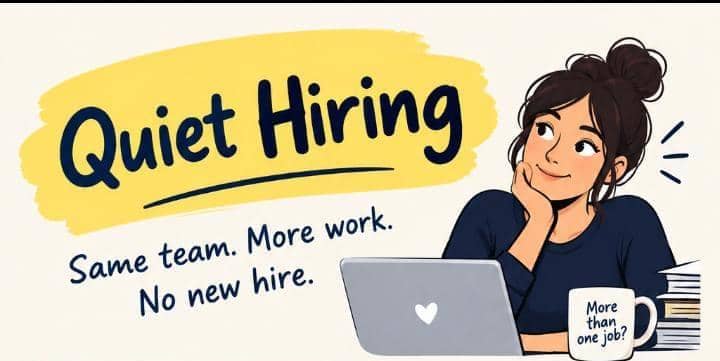
Your job description can change without anyone officially changing your job title. One week you’re handling your usual responsibilities, and the next you’re managing a project, covering an empty position, or taking on work that clearly belongs to someone else.
And then your manager says something like, “It’s a great opportunity for you.”
Maybe it is. Or maybe you have just been quiet hired.
I find Quiet Hiring especially interesting because it sits right at the intersection of workplace culture and modern slang.
The practice itself is not new, but the phrase gave employees and employers a catchy way to describe something that happens when companies need more skills or coverage without immediately bringing in a new full-time employee.
In this guide, I will break down exactly what Quiet Hiring means, where the expression came from, how people use it in real conversations, and perhaps most importantly, how to tell the difference between a genuine growth opportunity and simply getting more work for the same pay.
Table of Contents
What Does Quiet Hiring Mean?
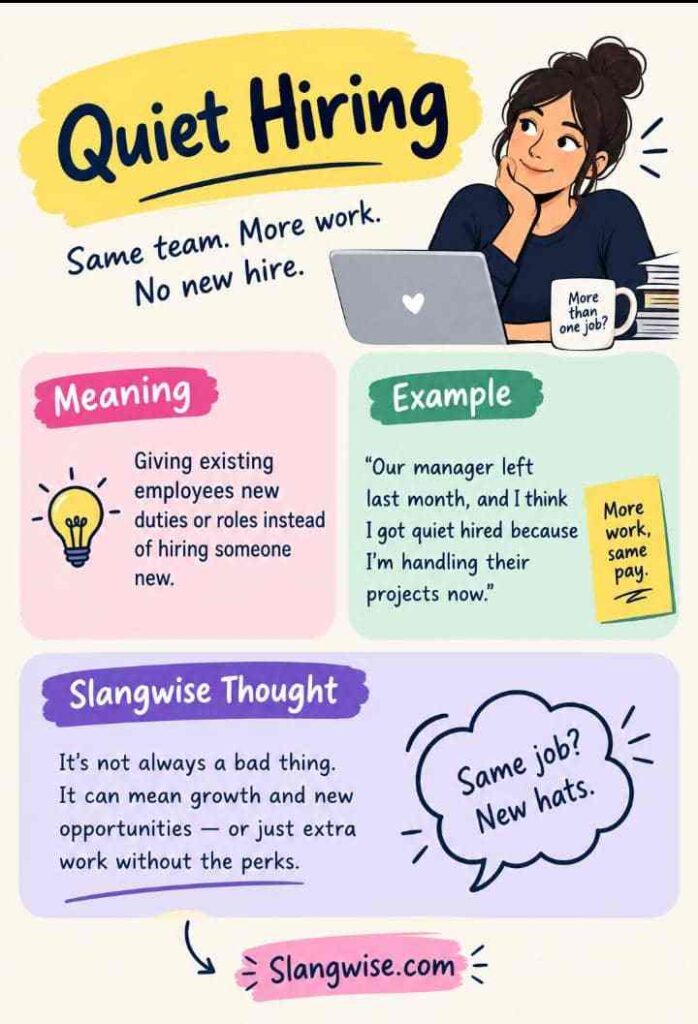
Quiet Hiring means filling a business need by using existing employees, internal talent, or sometimes outside contractors instead of immediately making a traditional full-time hire.
For an employee, this can look like being given responsibilities from an open position, taking on a stretch assignment, temporarily covering another role, or moving into a different area of the business without going through a normal external recruitment process.
Indeed notes that the term is largely associated with Gartner analyst Emily Rose McRae and describes quiet hiring as companies asking existing workers to handle responsibilities beyond their usual roles or using contractors and freelancers to fill gaps.
READ ALSO: Girlboss Meaning in 2026: How Gen Z Turned a Millennial Power Word Into Irony
Why Is It Called Quiet Hiring?
The interesting part is that nobody is necessarily being “hired” in the traditional sense.
The word quiet suggests that the change happens without the familiar public signs of recruitment. There may be no job advertisement, no long interview process, and no new employee arriving to take over the work.
Instead, the company quietly rearranges its existing talent.
That is why the expression became so useful. In my experience analyzing workplace slang, the words that spread fastest are often the ones that give a memorable name to something people have already experienced.
Quiet Hiring does exactly that.
A Simple Quiet Hiring Story
Picture this.
A company’s marketing manager leaves. Instead of immediately hiring a replacement, the company asks a senior content specialist to coordinate campaigns, attend management meetings, review budgets, and supervise freelancers.
Three months later, the content specialist is still doing most of the manager’s responsibilities.
There is no new title yet. No clear salary adjustment either.
That employee might jokingly tell a friend:
“I thought I was getting a promotion. Turns out I got quiet hired.”
That little joke captures why the slang works so well. It can describe an opportunity, but it can also expose the gap between more responsibility and more reward.
How People Use Quiet Hiring in Slang
Unlike traditional HR language, people often use quiet hired casually, humorously, or even sarcastically.
- “My team lead resigned and guess who got quiet hired into the role?”
- “They gave me the new project’s responsibilities with my old title. Quiet hiring is crazy.”
- “Honestly, getting quiet hired helped me prove I was ready for management.”
- “They keep saying it’s development, but I’m basically doing two jobs. That’s quiet hiring.”
- “I was quiet hired into a role I actually wanted, so I’m not complaining.”
Notice the pattern. The phrase can be positive, negative, or somewhere in between. Context tells you how the speaker feels about it.
READ MORE: 60 WhatsApp Chat Slang Words You Need to Know Before Your Next Group Chat Gets Confusing
Is Quiet Hiring Good or Bad?
This is where I think people sometimes oversimplify the term.
Quiet Hiring is not automatically good or bad.
If an employee is given meaningful responsibilities, training, mentorship, visibility, and a realistic path toward promotion, the experience can be valuable.
Forbes has highlighted quiet hiring as a way companies can develop existing employees and fill important skill gaps, particularly through internal moves and stretch assignments.
But there is another side.
If someone keeps absorbing additional responsibilities indefinitely without recognition, support, a title change, or appropriate compensation, it is easy to understand why employees use the phrase with frustration.
Indeed also points out that extra responsibilities do not always come with additional pay, making the length and sustainability of the arrangement important.
Quiet Hiring vs Quiet Quitting
These two phrases are often mentioned together because they describe opposite sides of workplace conversations.
Quiet quitting generally refers to employees doing the duties required by their jobs without going far beyond them.
Slang.net describes it as doing the minimum requirements of a job rather than constantly going above and beyond. Slang.net’s explanation of quiet quitting shows how these “quiet” workplace expressions became part of everyday slang.
Quiet Hiring, meanwhile, describes the employer side: expanding responsibilities, shifting people internally, or using alternative talent arrangements to fill needs without making a conventional hire.
One thing I have noticed about workplace slang is that these phrases spread because they turn complicated workplace dynamics into language people can use instantly. That is precisely why terms like quiet quitting and quiet hiring became so recognizable.
READ AA%LSO: Tush Push Meaning in Slang: The Real Meaning, Origin, and How People Use It Today
Why Did Quiet Hiring Become So Popular?
The phrase became especially visible during a period when employers were dealing with changing labor conditions, hiring uncertainty, skill shortages, and pressure to control costs.
Gartner has continued to discuss quiet hiring as an approach to building teams internally and addressing talent gaps.
Social media then did what social media does best: it turned corporate language into something ordinary workers could joke about.
Suddenly, “I have more responsibilities now” became:
“I got quiet hired.”
Slangwise Tip
When you hear someone say they were quiet hired, don’t automatically assume they are complaining.
Listen for what comes next.
If they mention learning new skills, preparing for promotion, or moving into a role they actually wanted, it may be a positive use of the phrase.
If they talk about doing two people’s jobs for months with no recognition, the tone is probably sarcastic or frustrated.
In a Nutshell
- Quiet Hiring means filling workplace skill or staffing needs without making a traditional new hire.
- It can involve giving existing employees new responsibilities, moving them into different roles, or using contractors and freelancers.
- The phrase can describe a genuine career opportunity or a frustrating increase in workload.
- People often use quiet hired casually or sarcastically in workplace conversations and on social media.
- The most important clue is what comes with the extra responsibility: growth and recognition, or simply more work without meaningful reward.
SEE THIS: 27 Gen Z Slang Terms for Money You’ll Actually See and Use in 2026
Final Thought on Quiet Hiring
Quiet Hiring is a great example of how modern workplace language becomes slang.
The underlying practice is not entirely new. What changed was the language people use to talk about it.
I think that is what makes this term so useful. It gives employees a quick way to describe that awkward moment when their job suddenly becomes bigger than the position they originally accepted.
So, the next time someone says, “I’ve been quiet hired,” pay attention to the context. They might be celebrating a career opportunity, joking about a new responsibility, or quietly pointing out that their workload has grown without their paycheck following it.
And now you know exactly what they mean.
Frequently Asked Questions
Quiet Hiring is workplace slang for filling a staffing or skill gap by giving existing employees new responsibilities or moving them into different roles instead of immediately making a traditional new hire.
Not necessarily. Quiet Hiring can lead to a promotion, but it may also mean taking on additional responsibilities without receiving a new title or salary increase.
Companies may use Quiet Hiring to fill skill gaps, respond to staffing needs, develop internal talent, or avoid some of the time and cost involved in a traditional external hire.
Yes. It can help employees gain new skills, demonstrate leadership, explore a different role, and position themselves for future career growth when the opportunity comes with proper support and recognition.
You could say, “My manager gave me most of the responsibilities from the open position, so I guess I got quiet hired.”
Quiet Hiring describes employers filling staffing needs through existing workers or alternative talent arrangements, while Quiet Quitting describes employees limiting their work to the duties they are required to perform.