
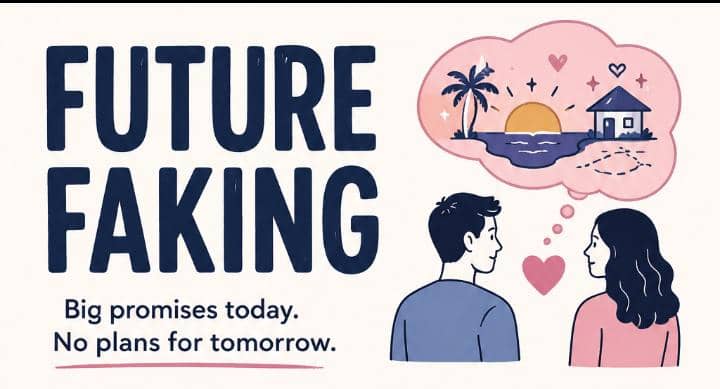
- Future faking is when someone talks about a beautiful future with you but has no real intention of making it happen.
- It usually shows up in dating, but people also use it in friendships, work, and family situations.
- The tactic works because it creates hope, emotional attachment, and a feeling of closeness before any real commitment exists.
- The easiest way to spot it is simple: watch actions, not dreamy speeches. Consistency matters more than promises.
- Try the Slang Quiz to see how well you’re versed in today’s internet slang and see how many terms you can guess correctly.
- Download the free 270+ Internet Slang Ebook to get a bigger slang dictionary packed with meanings, examples, and more popular terms.
What Does Future Faking Mean?
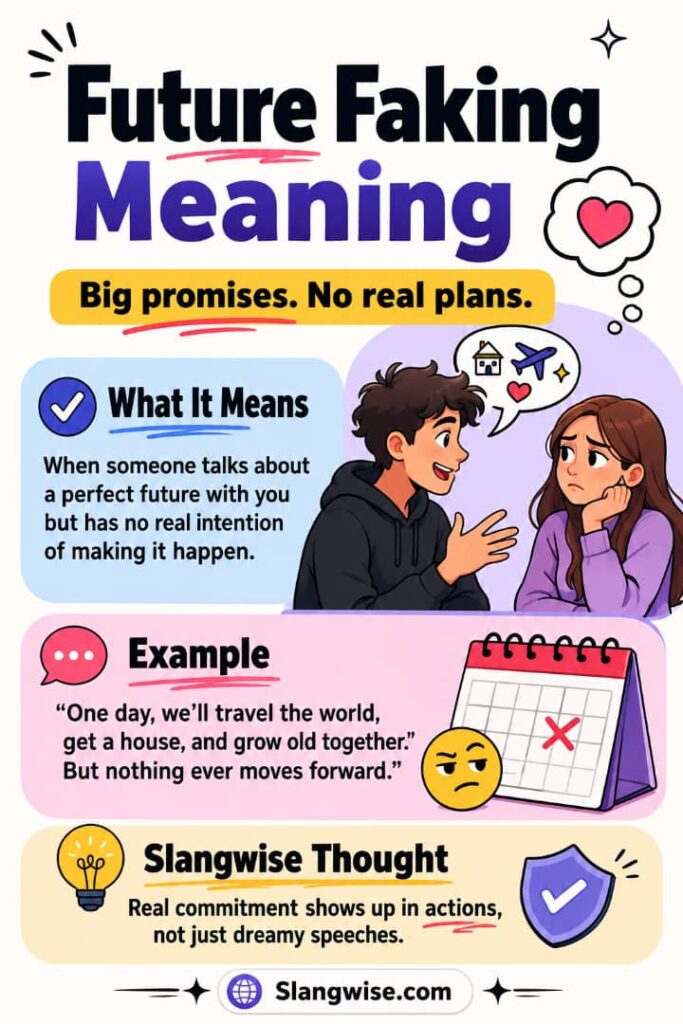
Future faking is a slang term for when someone paints a shiny picture of the future to keep you emotionally hooked, but they do not actually plan to follow through.
They may talk about moving in together, marriage, trips, a business, children, or some “someday” life that sounds exciting in the moment.
The problem is not future talk itself. The problem is the gap between the promise and the intention behind it.
In plain language, it is when somebody sells you the idea of tomorrow to get something from you today. That “something” might be attention, patience, money, emotional energy, access, or simply control over the relationship.
This is why future faking is often described as manipulative rather than just careless.
READ ALSO: Floodlighting Meaning in Slang: The Dating Trend That Feels Like Emotional Overload
Slangwise Thought on Future Faking
Here is the part people learn the hard way: real commitment does not need to be marketed like a movie trailer. When someone genuinely wants a future with you, their behavior starts showing up in the present.
Future faking is loud in words but thin in proof. Real effort is usually quieter, steadier, and easier to verify. That is why the smartest question is not “What are they promising?” but “What are they consistently doing?”
Where Future Faking Comes From
The phrase became especially visible in modern dating culture, and several sources connect its rise to the 2010s and the app era, when fast chatting, quick bonding, and big romantic talk became more common.
It is not an ancient slang word. It is a modern relationship label for an old behavior: making promises to keep someone attached.
That is why the term feels so familiar now. People hear it and immediately recognize the pattern: the big plans, the intense emotional talk, the beautiful “we” language, and then the missing follow-through. The language is modern, but the tactic itself has been around for a long time.
READ MORE: Paperclipping Meaning in Slang: The Annoying Ex Behavior That Keeps Popping Back Up
Why Future Faking Works So Well
Future faking works because it taps into hope. A person can feel special, chosen, and deeply connected just from hearing the right promises.
That emotional rush can make it harder to notice that nothing concrete is actually changing. Some explanations describe it as a form of manipulation that creates false intimacy and keeps someone invested in a relationship that is not truly progressing.
It can also work because the promises are often aimed at something the other person really wants.
One person hears the future they have been dreaming about, while the other person gets what they want in the present. That mismatch is the heart of the tactic.
Signs You May Be Seeing Future Faking
The classic signs are not hard to spot once you know what to look for. The person talks big, but the timeline keeps drifting.
They make lovely promises, but there is always a reason now is not the right time. They may sound deeply invested, yet their actions stay vague, inconsistent, or absent.
A future faker may also use very specific future language early on: “We should buy a house,” “I can see us married,” “Next year we will be doing this,” or “I want all of that with you.”
Those words are not automatically bad. What matters is whether the behavior matches the dream. Without follow-through, the dream becomes a hook.
EXPLORE: 30 Popular Dating Slang Terms of 2026 That’ll Have You Laughing, Ghosting, and Rizzing…
How to Respond Without Getting Trapped
The best response is calm, not dramatic. Slow things down. Ask for clarity. Look for patterns, not speeches.
If somebody keeps painting a future that never becomes real, take that as information, not confusion. Healthy connection should feel steady, not like an endless teaser trailer.
A good rule is simple: trust repeated behavior over one charming conversation. If the future keeps getting bigger while the present keeps getting emptier, that is a sign to step back. Real care does not depend on pressure, fantasy, or constant verbal performance.
Conclusion
Future faking is one of those slang terms that sounds casual, but it points to something emotionally serious. It describes a pattern where promises of a shared future are used to keep someone engaged, hopeful, and available, even when the promise is not meant to be kept.
The biggest takeaway is simple: do not fall in love with a speech when the behavior tells a different story.
Real future building shows up in consistency, effort, and follow-through. Future faking shows up in fantasy without proof. And once you learn the difference, the whole pattern becomes much easier to spot.
SE ALSO: Soft Ghosting Meaning: The Sneaky Dating Move That Leaves You Confused
FAQs About Future Faking
No. Dating is where people talk about it most, but the same pattern can appear in friendships, work relationships, and family situations when someone makes promises they do not intend to keep.
It overlaps with lying, but it is more specific. Future faking is usually about using future promises as a way to get something in the present.
Hope becomes trust when actions match words. Future faking keeps talking about a future but never builds anything real in the present.
When the promises are big, emotional, and exciting, but the follow-through is always delayed, vague, or missing, that is the clearest warning sign.
Table of Contents