
- Floodlighting means sharing very personal or emotional details too early in a relationship.
- It often happens on dates when someone tries to speed up intimacy or test how the other person reacts.
- The term was popularized through Brené Brown’s work on vulnerability, then picked up in modern dating conversations online.
- It can create a false sense of closeness before trust has actually been built.
- Popular Dating Slang Terms can help you understand more modern relationship words like this one.
- Take the Slang Quiz to see how well you’re versed in today’s internet slang and see how many terms you can guess correctly.
- Download the free 270+ Internet Slang Ebook to get a bigger slang dictionary packed with meanings, examples, and more popular terms.
Floodlighting is one of those dating slang terms that sounds dramatic because the behavior itself can feel overwhelming.
It describes what happens when someone shares too much too soon in a new relationship or early dating stage, often with the effect of pushing intimacy before trust has been built.
The details may be deeply personal, emotional, or even traumatic, but the main issue is timing. Instead of letting a connection grow naturally, floodlighting jumps straight into intense territory.
That is what makes the term useful. It gives people a clear label for a situation where openness starts to feel less like connection and more like pressure.
Table of Contents
What Does Floodlighting Mean in Slang?
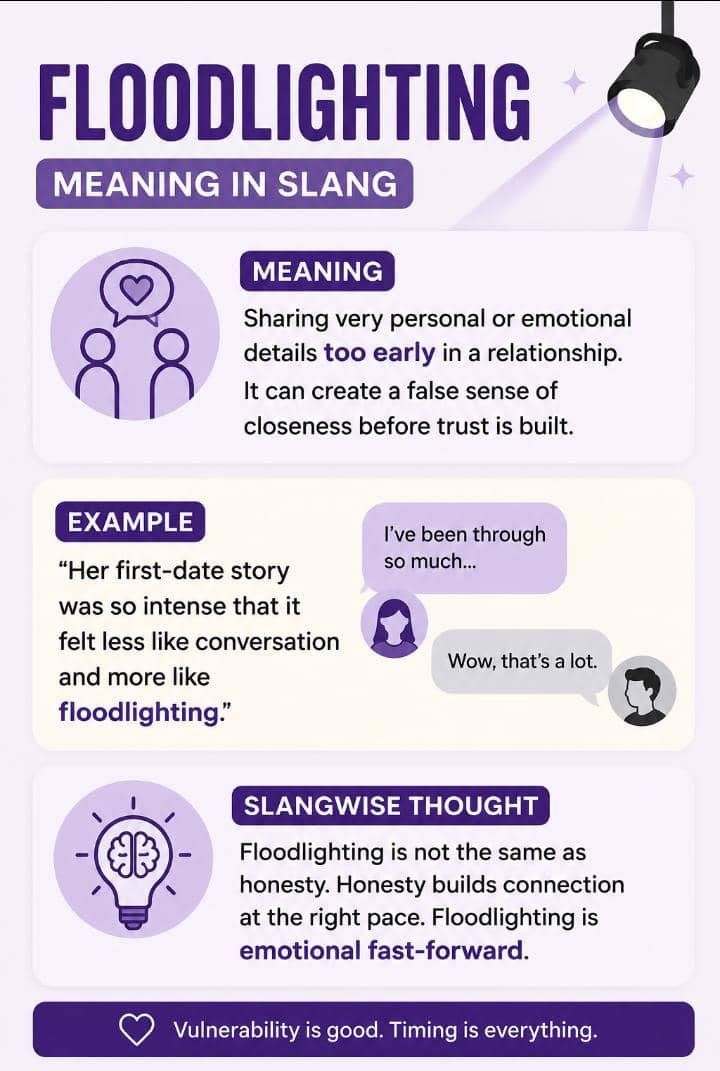
In dating slang, floodlighting is when someone dumps a lot of deeply personal information, trauma, or emotional detail on another person very early in dating or a new connection.
The key idea is not simply being open. It is opening up so intensely, so fast, that the other person can feel overwhelmed or pushed into intimacy before the relationship is ready for it.
That is why the word feels so visual. A floodlight is bright, wide, and hard to ignore. In dating, floodlighting works the same way: it shines a huge amount of emotional attention on the other person all at once. The result can feel intense, but not always in a healthy way.
What makes floodlighting different from normal vulnerability is timing and intensity. Healthy vulnerability grows gradually as trust grows.
Floodlighting skips that process and jumps straight to the deepest material, sometimes before both people have even built basic comfort.
READ ALSO: Soft Ghosting Meaning: The Sneaky Dating Move That Leaves You Confused
Slangwise Thought on Floodlighting
My take is simple: floodlighting is not the same as honesty. Honesty builds connection when it arrives naturally and at the right pace. Floodlighting can feel more like emotional fast-forward, where someone is trying to force closeness instead of letting it develop. That is why the term has become such a useful dating label.
Why People Use Floodlighting
People floodlight for different reasons, and not all of them are malicious. Some people do it because they want to feel seen quickly. Others are testing whether the other person will accept their flaws.
Some may even be trying to protect themselves by revealing everything first, so they do not have to risk being vulnerable slowly.
That is part of what makes the term interesting. Floodlighting can look like courage, but it can also be a kind of shield. Instead of true openness, it can become a strategy for controlling the pace of the relationship or seeing whether the other person can handle them.
In modern dating, that distinction matters a lot. A first date is not therapy, and a new connection is not automatically a safe container for every painful memory.
When the emotional volume is too high too soon, the other person may feel pressure to comfort, reassure, or reciprocate before they are ready.
How to Spot Floodlighting
Floodlighting usually has a few telltale signs. One is very early disclosure of highly personal details, especially when the conversation is still new.
Another is an uneven exchange, where one person is unloading intensely while the other is being pulled into a fast emotional role they did not choose. A third sign is the feeling that the conversation is trying to force instant closeness.
You may also notice that the interaction becomes oddly intense very quickly. Instead of natural back and forth, it can feel like a spotlight has been switched on.
The mood shifts from getting to know each other to emotional pressure, and that can leave one person feeling drained, confused, or responsible for holding too much too soon.
It is also helpful to separate floodlighting from trauma dumping. They can overlap, but they are not always identical. Floodlighting is usually about oversharing in a dating or relationship context in a way that tries to speed up intimacy or test acceptance.
SEE ALSO: Cookie Jarring Meaning in Slang: The Dating Red Flag That Feels Sweet at First
How to Use Floodlighting in a Sentence
Here are a few natural examples:
“Her first-date story was so intense that it felt less like conversation and more like floodlighting.”
“I like openness, but floodlighting on the first night is a lot.”
“He kept floodlighting every time they talked, and the connection started to feel forced.”
That is the tone of the word. It usually sounds cautionary, because it describes emotional intensity that comes too fast for comfort.
Further Examples of Floodlighting
Example 1: You are on a first date and the person immediately starts talking about painful past relationships and family trauma.
Example 2: They share a huge emotional story very early, then seem to expect deep reassurance right away.
Example 3: The conversation becomes so intense so quickly that it feels less like getting to know someone and more like emotional pressure.
Example 4: They reveal extremely private details before there is any real trust, comfort, or mutual connection.
Example 5: They keep using oversharing to speed up the relationship instead of letting things grow naturally.
READ MORE: Roaching Meaning in Slang: The Sneaky Dating Term Everyone Keeps Misunderstanding
Conclusion
Floodlighting is one of those modern slang terms that sounds dramatic because the behavior itself feels dramatic. It describes the kind of oversharing that arrives too early, too hard, and with too much emotional force.
While vulnerability is important in any relationship, floodlighting skips the natural buildup of trust and tries to create closeness on demand. That is why it often leaves people feeling more overwhelmed than understood.
The reason the term has caught on is that it names something many people have experienced but did not have a clean label for. It helps people recognize when a conversation feels less like mutual getting to know you and more like emotional pressure.
In plain English, floodlighting is not just being open. It is turning the emotional volume way up before the relationship has earned that level of trust.
Frequently Asked Questions
No. Vulnerability builds trust gradually, while floodlighting is usually too much, too soon, and can feel overwhelming or strategic.
Not always. Some people do it out of anxiety, fear, or a desire to connect quickly, but the effect can still be uncomfortable or unhealthy.
The biggest red flag is emotional intensity that arrives before trust, safety, or mutual comfort has been built.
The healthiest move is to slow the pace, set a boundary, and notice whether the relationship can grow more naturally instead of being forced.
Honest sharing usually feels mutual and timed well. Floodlighting usually feels rushed, overwhelming, and too intense for the stage of the relationship.
SEE ALSO: Paperclipping Meaning in Slang: The Annoying Ex Behavior That Keeps Popping Back Up