
If you’ve been scrolling through social media or listening to workplace conversations lately, you’ve probably come across the phrase quiet firing.
At first, I thought it sounded like someone secretly getting fired. But after seeing it used repeatedly, I realized it means something much more subtle.
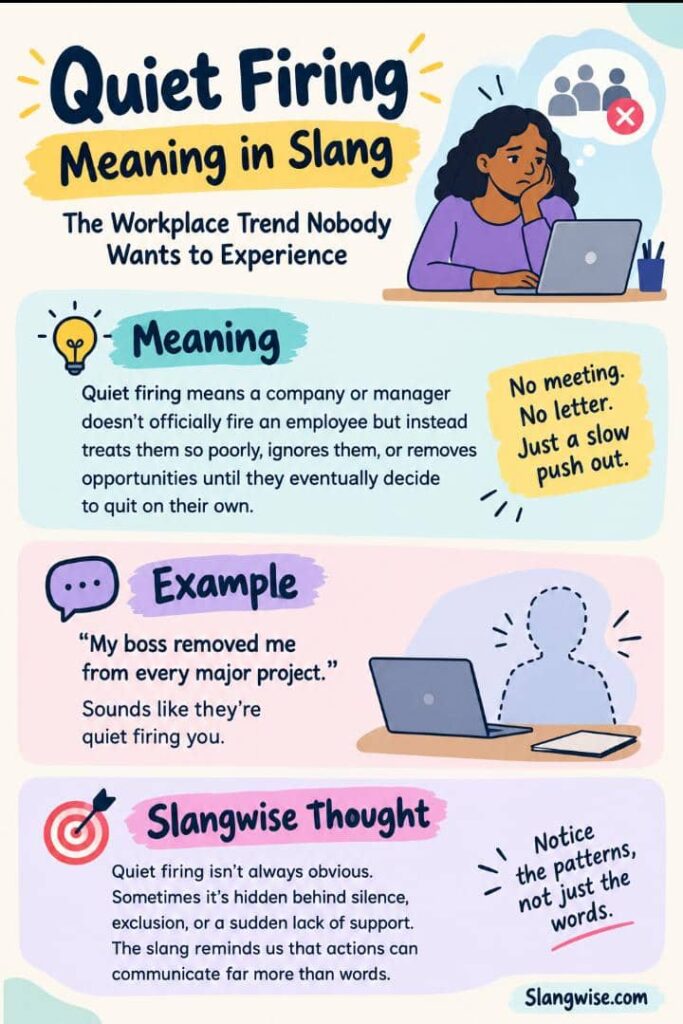
In slang, quiet firing describes a situation where a company or manager doesn’t officially fire an employee but instead treats them so poorly, ignores them, or removes opportunities until they eventually decide to quit on their own.
It’s less about a formal dismissal and more about creating an environment where leaving feels like the only option.
Unlike traditional firing, there’s usually no meeting, no termination letter, and no dramatic announcement. Instead, the employee slowly feels pushed out.
Table of Contents
Slangwise Tip
Quiet firing isn’t always obvious. Sometimes it’s hidden behind silence, exclusion, or a sudden lack of support. The slang reminds us that actions can communicate far more than words.
Quiet Firing Meaning in Slang
In modern slang, quiet firing means:
A passive way of pushing someone out by making their work experience increasingly unpleasant instead of directly firing them.
The phrase is often used when talking about workplaces where employees suddenly stop receiving important projects, promotions, recognition, or communication.
People also use it casually outside work.
For example:
“My friends basically quiet fired me from the group chat.”
Here, nobody literally fired anyone. They’re using the slang humorously to describe being gradually excluded.
Quiet Hiring is yet another interesting workplace slang people say today. Check out what it means.
Where Did Quiet Firing Come From?
From what I’ve observed over the years studying internet slang, workplace expressions often grow out of shared experiences.
After phrases like quiet quitting became popular, people naturally began talking about the opposite side of the relationship.
Instead of employees doing the bare minimum, conversations shifted toward employers who quietly stopped investing in their workers.
That’s how quiet firing gained momentum.
The term spread because many people recognized the behavior immediately. They had experienced it but never had a simple phrase to describe it.
That’s one thing I find fascinating about slang. It often gives a name to feelings people have struggled to explain for years.
How Do People Use Quiet Firing?
People use this slang whenever someone feels they’re being pushed aside without officially being dismissed.
You might hear it in conversations like these:
Example 1
Alex: “My boss removed me from every major project.”
Jordan: “Sounds like they’re quiet firing you.”
Slangwise Thought
One of the biggest clues behind quiet firing is consistency. Everyone gets left out occasionally, but when exclusion becomes a pattern, people naturally begin describing it with this slang.
Example 2
“I haven’t been invited to team meetings for weeks. I honestly feel like I’m being quiet fired.”
Slangwise Thought
Feeling invisible at work can affect confidence just as much as direct criticism. That’s why this slang resonates with so many people.
Example 3
“They didn’t reduce my salary, but they stopped giving me meaningful work.”
Slangwise Thought
Quiet firing isn’t always loud or dramatic. Sometimes it’s the absence of opportunities that speaks the loudest.
Example 4
“My manager suddenly stopped responding to my messages and gives all the exciting projects to everyone else.”
Slangwise Thought
When communication disappears without explanation, employees often start questioning themselves. In many conversations, that’s exactly when the phrase quiet firing appears.
Example 5
“Our gaming squad basically quiet fired me after they kept playing without inviting me.”
Slangwise Thought
Slang evolves quickly. Even though quiet firing started as a workplace phrase, people now jokingly use it for friendships, clubs, gaming groups, and social circles whenever someone feels gradually excluded.
READ ALSO: Maycember Meaning in Slang: The Busy, Chaotic “Almost-Summer But Not Quite” Feeling Everyone Keeps Talking About
Common Signs People Associate With Quiet Firing
Although every workplace is different, people commonly use the slang when they notice things like:
- Being excluded from meetings.
- Receiving fewer responsibilities.
- Losing growth opportunities.
- Little or no feedback from managers.
- Being ignored during discussions.
- Feeling invisible despite doing good work.
- Having communication suddenly become cold or inconsistent.
Of course, one sign alone doesn’t always mean quiet firing is happening. Sometimes businesses restructure or priorities change. But when several of these happen together over time, people often describe the situation using this slang.
Is Quiet Firing Always Intentional?
Not necessarily.
This is something I’ve learned from watching how language develops.
Sometimes managers are simply overwhelmed, poor communicators, or focused elsewhere.
Other times, employees genuinely feel they’re being pushed out because communication has broken down.
That’s why the slang describes how the situation feels, not necessarily what someone’s intentions are.
It’s an expression built around perception and experience.
Why Has Quiet Firing Become So Popular?
I think this slang exploded because it captures something many workers have quietly experienced.
Before the phrase existed, people often struggled to explain why they felt unwelcome at work.
Now, instead of saying:
“I don’t know…everything just feels different.”
People simply say:
“I think I’m being quiet fired.”
That’s the power of slang.
It condenses a complicated emotional experience into just two memorable words.
Quiet Firing vs Quiet Quitting
Although they sound similar, they describe opposite situations.
Quiet Quitting
The employee does only what’s required and avoids going beyond their basic responsibilities.
Quiet Firing
The employer gradually withdraws opportunities, support, or engagement, making the employee feel pushed toward leaving.
One focuses on employee behavior.
The other focuses on perceived employer behavior.
Why Understanding This Slang Matters
Language reflects culture.
Quiet firing isn’t just another trendy internet phrase.
It’s become a shortcut for discussing workplace communication, leadership, inclusion, and employee wellbeing.
Even if someone isn’t literally being pushed out, the slang opens conversations about respect, transparency, and healthy work relationships.
That’s one reason I believe the term has staying power.
People instantly understand the feeling behind it.
Slangwise Tip
Before assuming you’re being quiet fired, take a step back and look for patterns rather than isolated moments. Good communication often clears up misunderstandings, while repeated exclusion is what gives this slang its meaning.
Discover: 30 Must Know Creator Slang Words That Influencers Use All The Time
Summary
- Quiet firing is slang for making an employee want to quit without officially firing them.
- It usually involves being ignored, overlooked, or stripped of opportunities.
- The term has become popular on social media and in workplace conversations.
- Quiet firing doesn’t always mean someone is about to lose their job, but it often signals an unhealthy work environment.
- Understanding this slang can help you recognize workplace behavior before it affects your confidence.
Conclusion
Quiet firing has quickly become one of the most recognizable workplace slang terms in recent years.
In simple terms, it describes the feeling of being gradually pushed toward quitting without being officially fired.
Whether it’s fewer opportunities, less communication, or ongoing exclusion, the phrase gives people a concise way to describe an experience that many already understood but couldn’t easily explain.
As with many slang expressions, its popularity comes from how accurately it captures real emotions and everyday experiences.
Whether you hear it in the office, on social media, or even jokingly among friends, you’ll now know exactly what people mean when they talk about quiet firing.
FAQs
It began as internet slang, but many people now use it seriously to describe feeling gradually pushed out of a workplace without being officially dismissed.
No. The phrase reflects how someone experiences workplace treatment. Feeling ignored doesn’t automatically mean termination is coming.
Yes. People sometimes jokingly use the phrase when they feel excluded from friend groups, clubs, gaming teams, or online communities.
It’s called “quiet” because there’s usually no formal firing. Instead, the person feels subtly encouraged to leave through ongoing exclusion or reduced opportunities.