
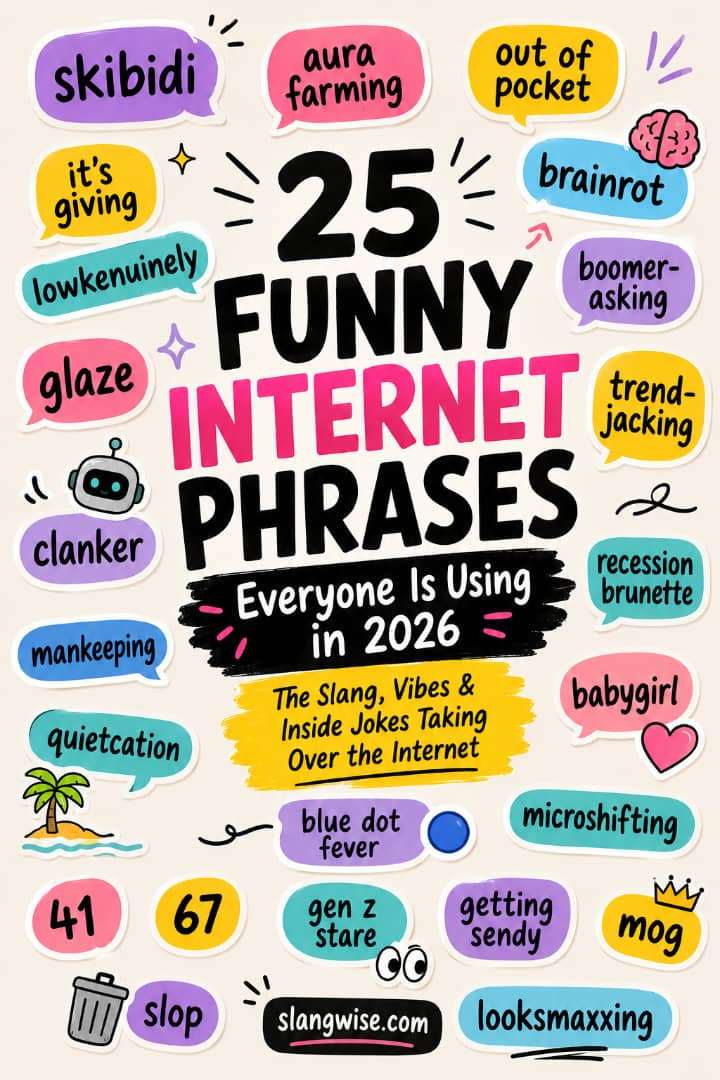
Internet slang in 2026 is doing what it always does best, making people laugh, confuse their parents, and compress a whole mood into just a few words.
The current wave of slang is a mix of nonsense terms, vibe words, AI jokes, workplace slang, and social callouts, which is a pretty good snapshot of how online language is evolving right now.
This post expands the earlier roundup with six more current phrases, trendjacking, boomerasking, brainrot, out of pocket, recession brunette, and babygirl, alongside the newer slang already showing up in 2026 coverage.
Some of these are late 2025 or early 2026 entries that are still active now, which is normal for internet language because slang tends to spill over from one year into the next.
The funny part is that these phrases do not all play the same role. Some are pure nonsense, like skibidi, 41, and 67. Some are social commentary, like reading, glaze, and mankeeping.
Others are just very specific labels for modern life, like microshifting, quietcation, and blue dot fever. That mix is what makes 2026 slang feel so entertaining.
Table of Contents
Why these phrases catch on so fast
A lot of the funniest internet phrases become popular because they are easy to repeat, easy to meme, and easy to use in a joke. The best ones also say something people already feel but never had a neat word for.
That is why terms like out of pocket, brainrot, and boomerasking spread so quickly, they name behaviors people recognize instantly.
Another big reason is that online culture loves labels. If a phrase can turn a random mood, awkward interaction, or ridiculous habit into one compact expression, the internet will usually keep it. That is exactly what is happening with 2026 slang, from clanker for AI and robots to quietcation for a calm, unplugged vacation.
1. Skibidi
Skibidi is one of the clearest examples of internet nonsense becoming a real cultural marker. It is a meaningless, flexible slang term that can stand in for cool, bad, weird, or almost anything else, which is exactly why it works as a joke online. If someone says, “That is so skibidi,” the point is usually the absurdity itself.
It is funny because it is deliberately unhelpful, yet everyone sort of understands the vibe anyway. That is a very 2026 kind of joke.
READ ALSO: 20 Skibidi Slang Terms Explained: From Skibidi Toilet to Skibidi Rizz
2. Aura farming
Aura farming means doing things with deliberate coolness, confidence, or mystique in order to look effortlessly impressive. It is a way of making even ordinary actions look stylish, almost like someone is curating their own coolness in public.
The phrase is funny because it sounds slightly strategic, as if coolness were a crop you could grow on purpose. People use it when someone is clearly trying to look smooth, even if the effort is part of the joke.
LEARN MORE: Aura Farming: The Viral Slang Everyone Is Using to Look Cool Without Trying
3. Lowkenuinely
Lowkenuinely is a casual blend word used by Gen Z and Gen Alpha to mean something sincere, genuine, or quietly honest.
It has a very internet shaped feel because it sounds like two words got mashed together mid thought, then somehow became a usable adjective. That messy little hybrid is exactly why people remember it.
4. Reading
Reading is a pointed, witty way of calling out someone’s flaws, contradictions, or behavior. It originated in Black and Latine LGBTQ+ communities and is often used in a sharp but clever way, similar to roasting, though usually with more precision.
It is funny because it sounds formal, like you are about to teach a lesson, but the actual meaning is social shade. That contrast is part of the joke.
5. Glaze
Glaze is slang for excessive praise, especially when the praise feels insincere or over the top. It is usually negative, since the person doing the glazing sounds like they are trying too hard to flatter someone.
The phrase is entertaining because it flips something normally positive into something a little suspect. It is the perfect word for that friend who is praising someone just a bit too much.
6. Slop
Slop refers to low quality digital content made by AI, including junky images, videos, posts, or even whole books that feel rushed or synthetic. It is the kind of content that fills feeds without much human care behind it.
It is funny in a dark, internet way because the word sounds messy, and that is exactly the point. People use it when they want to call out online content that feels cheap, repetitive, or artificial.
7. Looksmaxxing
Looksmaxxing is the pursuit of maximizing one’s physical appearance, often through grooming, fashion, exercise, or more extreme methods. It is an online slang term tied to appearance optimization culture.
It is funny because it sounds a little like a business strategy, but the goal is just to look better. The term became popular because internet culture loves turning self improvement into a meme.
8. Chopped
Chopped is a blunt slang insult meaning unattractive or uncool. It is used by teens to put others down, usually for appearance or social status.
The word is funny in the same way a sudden insult can be funny, sharp, fast, and a little too direct. It sounds almost casual, which makes the burn land even harder.
DISCOVER: Why Is Everyone Saying Chopped and Choppelganger Right Now? The Meaning Might Surprise You
9. Microshifting
Microshifting is the practice of reshaping the workday into smaller, flexible blocks rather than sticking to a rigid nine to five schedule. It means logging on at different times or breaking work into focused sprints that better fit personal routines.
It is one of the funnier internet phrases on this list because it sounds almost too corporate to be slang, yet it became a social media term anyway. People like it because it names the very modern habit of working around life instead of the other way around.
10. Clanker
Clanker is a derogatory term for robots and AI systems that do jobs once handled by humans. It exploded in popularity with the rise of AI and is used both as a joke and as a serious complaint about machines replacing human labor.
It is funny because it sounds old fashioned and rude at the same time, almost like a sci fi insult from a movie. That rough sound helps it stick in your head.
11. Blue dot fever
Blue dot fever refers to the large number of unsold seats shown as blue dots on ticketing websites for live events. It is most often linked to concerts, though it can show up in sports too.
The phrase is funny because it sounds like a medical condition, but it is really just about ticket sales. That little bit of dramatic language makes online event chatter more entertaining.
12. 41
41 is a viral number slang term used mostly by tweens and younger teens as a playful inside joke. It is largely nonsensical, something that can show up in school chatter, captions, and random responses.
The joke is that it often means almost nothing and still somehow means enough for people “in the know.” That kind of shared nonsense is a big part of modern internet humor.
13. 67
67 is another viral number slang term that has become an inside joke, especially among Gen Alpha and younger teens. It is intentionally ambiguous and often used in a way that is more about being part of the meme than about having a fixed meaning.
It is funny because it can function like a social password. If someone gets it, they are inside the joke. If not, the whole exchange becomes even more ridiculous.
14. It’s giving
It’s giving is a quick way to describe the vibe, energy, or look of something. It can be used to compliment a bold outfit or to point out a strong mood, and it can even stand alone as a reaction.
This phrase is funny because it is so flexible. You can use it for a compliment, a joke, or a subtle read, and the same words still work.
15. Gen Z stare
The Gen Z stare describes a vacant, expressionless look that is said to appear when a response seems warranted but never comes. The phrase is often used in customer service and social situations where someone expects a chatty response and gets silence instead.
It is funny because it turns a very specific awkward face into a named cultural phenomenon. Once a look gets a name, the internet will absolutely run with it.
16. Getting sendy
Getting sendy means going all out. The phrase builds on sendy and send it, older action sports slang for committing enthusiastically, and it became a TikTok style hype phrase with a goofy dramatic feel.
The phrase is funny because it sounds like an energy boost in words. It works especially well when someone is about to do something bold, silly, or exaggerated on purpose.
17. Quietcation
A quietcation is a vacation focused on silence, calm, and unplugging from noise and screens. It is a quieter kind of travel, often involving remote stays, digital detox time, or intentionally peaceful activities.
It is funny because the word sounds soothing even before you know what it means. People like it because it turns a lifestyle choice into a neat little label.
18. Mankeeping
Mankeeping refers to the unpaid emotional and social labor some women take on to manage the lives of men. It can involve nudging men to remember birthdays, call friends, plan events, or deal with emotions they might otherwise avoid.
It is a funny sounding word for a serious social idea, and that contrast is why it gets attention online. The phrase names a behavior people often noticed long before they had a word for it.
19. Mog
To mog someone is to be noticeably superior to them in appearance or performance. It can be self directed or used by onlookers to describe one person clearly outmatching another.
The word is funny because it sounds like something out of a fantasy game, yet people use it for everyday comparisons. It is very internet, very blunt, and very meme ready.
20. Trendjacking
Trendjacking is when brands, companies, or influencers jump into viral topics to gain visibility, engagement, or cultural relevance. It can involve meme moments, awards show chaos, political discourse, or anything already taking over feeds.
This one is funny because it sounds like a business term that accidentally wandered into internet slang. It is the kind of phrase people use when a company is clearly trying a little too hard to seem relevant.
21. Boomerasking
Boomerasking is when someone asks you a question, then quickly boomerangs the conversation back to themselves. It is the awkward pattern of seeming curious while really waiting for a chance to talk about your own story.
It is funny because most people have met at least one boomerasker, even if they never had a word for it. Once you know the term, you start spotting it everywhere.
22. Brainrot
Brainrot describes the effects of being perpetually online and consuming lots of low value internet content, and it can also mean an obsessive preoccupation with a specific fandom or idea. It works as both a noun and a verb, which makes it especially useful in meme culture.
It is funny because it is self aware. People use it to joke about the exact kind of internet overload that is causing the joke in the first place.
23. Out of pocket
Out of pocket can mean a person is unreachable, paying for something themselves, or acting in a wild, inappropriate, or off character way. Younger people often use the phrase for behavior that is especially shocking or bizarre.
This is one of those phrases that became more fun because the meaning expanded. In online conversation, it is often the perfect label for a comment that was just a little too much.
24. Recession brunette
Recession brunette describes the trend of people returning to darker, more natural hair colors to save money on salon maintenance. The phrase became especially popular on social media because of rising costs and the desire to cut down on bleaching and frequent touch ups.
It is funny because it sounds like an economic headline, but it is really about hair. That mismatch is what makes internet language feel so clever sometimes.
25. Babygirl
Babygirl is a slang phrase used for an attractive man, often one who seems cute, sensitive, or vulnerable. It can also be used humorously when the man being described is not especially cute or vulnerable at all.
It is funny because it turns a sweet, soft sounding word into a meme worthy compliment for men. That contrast is exactly the sort of thing the internet loves to remix.
How to use these phrases without sounding forced
The easiest way to use internet phrases naturally is to match the tone to the moment. A phrase like it’s giving works well when reacting to a look or vibe, while brainrot fits better in a joke about being stuck on one meme too long.
The goal is not to cram in every trendy word, but to pick the one that fits the moment best.
It also helps to notice whether a phrase is playful, critical, or purely absurd. Glaze and reading can sound sharp, quietcation and microshifting sound more descriptive, and 41 or 67 are mostly about inside joke energy. Once you know the mood, the phrase becomes much easier to use correctly.
Slangwise Note
If you are skimming, the big takeaway is simple. 2026 internet slang is packed with nonsense jokes, vibe words, social callouts, AI jokes, and oddly specific labels for everyday behavior.
That is why terms like skibidi, aura farming, brainrot, out of pocket, and blue dot fever can feel so funny and so current at the same time.
The six new add ons, trendjacking, boomerasking, brainrot, out of pocket, recession brunette, and babygirl, help round out the list with phrases that are still very relevant in today’s online conversations.
Conclusion
Funny internet phrases work because they give people a faster, more creative way to describe the internet itself. They let you point at a vibe, a joke, a weird habit, or a social pattern without writing a whole paragraph.
That is why these words keep spreading, and why 2026 slang feels so lively, strange, and memorable all at once.
What makes this year especially interesting is the mix. Some phrases are nonsense, some are commentary, some are workplace jokes, and some are social media reactions. Put together, they show exactly how internet language keeps evolving in real time.