
- Mutuals usually means two people who follow each other back on social media.
- The word often carries a sense of familiarity, comfort, or online friendship, not just a technical follow.
- It shows up a lot on platforms like TikTok, X, Instagram, and Tumblr, especially in creator and fandom spaces.
- Some people shorten it to “moots.”
- In everyday slang, “mutuals” is less about numbers and more about connection, recognition, and vibe.
- Take the Slang Quiz to see how well you’re versed in today’s Gen Z and Gen Alpha slangs and see how many terms you can guess correctly.
- Download the free 270+ Internet Slang Ebook to get a bigger slang dictionary packed with meanings, examples, and more popular terms.
What Does Mutuals Mean in Slang?
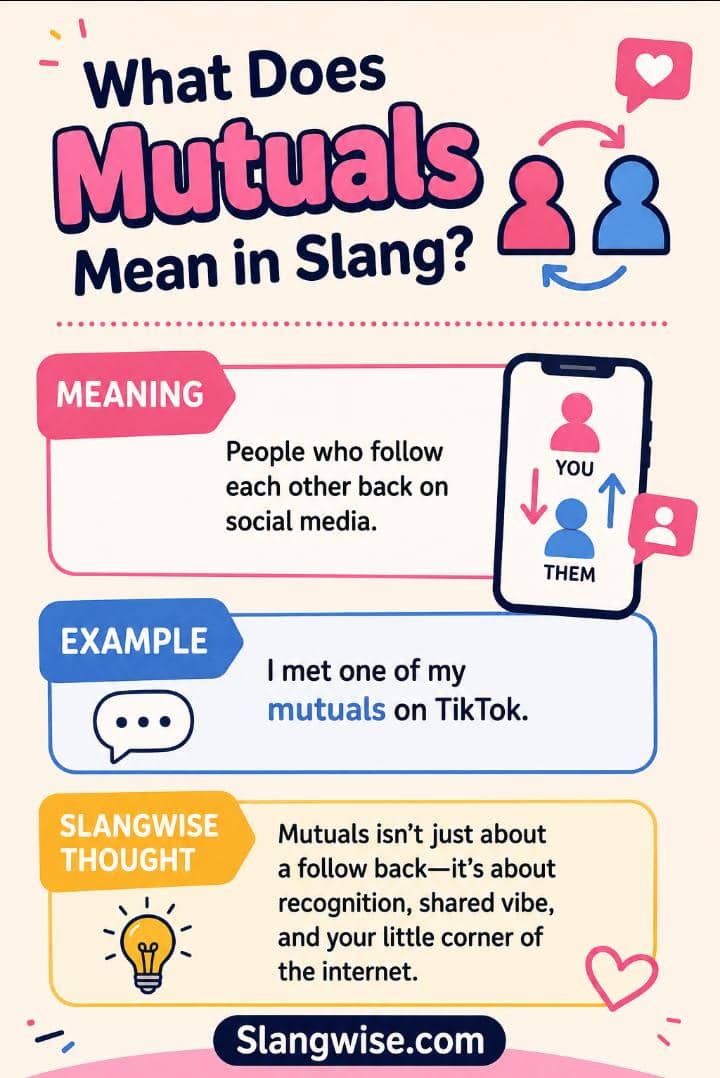
In slang, mutuals means people who follow each other on social media. If you follow someone and they follow you back, you are mutuals. That is the most common meaning people use online, especially in casual chats, bios, replies, and fandom spaces.
The term can also appear as mutual follower or simply mutual, depending on the platform and the speaker.
But the word is not just a cold technical label. In real online use, “mutuals” often implies a little more than a follow-back.
It can suggest that two people know each other’s content, recognize each other in comments, and share some level of online comfort or community. In other words, it is part relationship word, part social-media shorthand.
That is why someone might say, “My mutuals loved that post,” or “We became mutuals last month.” In those cases, the word is doing more than describing a network connection. It is describing a tiny digital bond.
READ ALSO: What Does Corecore Mean in Slang? The Weird, Beautiful Internet Trend Everyone Is Feeling
Slangwise Thought
Here is the interesting part: mutuals is one of those slang words that sounds simple but feels social. It is not just about who pressed follow.
It is about who sees you, who notices your posts, and who exists in your little corner of the internet. That is why the word feels warmer than plain “follower” and less formal than “contact.” In online culture, that difference matters a lot.
Where People Use It Most
You will hear or see mutuals most often on platforms built around personal feeds and ongoing interaction. It is common on TikTok, X, Instagram, Tumblr, and similar social spaces, especially where users care about community, fandom, aesthetics, and recurring engagement.
It is also common in fan communities, where mutuals can mean people who share the same interest and actively interact with one another’s content.
That fandom angle is important. In those spaces, mutuals are not always close friends in the offline sense. Sometimes they are more like familiar internet neighbors: people you know through replies, reblogs, likes, stitches, duets, or shared posts.
The relationship is often built through repeated online presence rather than formal introductions.
Mutuals vs Followers: What Is the Difference?
This is where many people get confused. A follower is simply someone who sees your content. A mutual is someone who follows you back, so the connection goes both ways. That reciprocity is the whole point of the slang term.
So if 10,000 people follow you, those are your followers. But if 25 of those people also have you in their own feed and you follow them back, those 25 are your mutuals.
The difference sounds small, but socially it feels big, because mutuals often imply a more balanced and personal online connection.
READ MORE: Zombieing Meaning in Slang: The Creepy Dating Move That Comes Back From the Dead
What About “Moots”?
“Moots” is simply a shortened, casual version of mutuals or mutual followers. People use it the same way, just in a faster, more playful internet style.
If someone says, “My moots are hilarious,” they usually mean the people they follow and who follow them back.
This kind of shortening is very normal in online language. Social slang loves speed, rhythm, and informality, so words get trimmed, clipped, and reshaped until they sound more natural in chat. “Moots” fits that pattern perfectly.
How to Use Mutuals in Conversations Naturally
You can use the word in a few easy ways:
- “I met one of my mutuals on TikTok.”
- “My mutuals always understand my posts.”
- “We are mutuals now.”
- “That account is one of my mutuals.”
The tone is usually casual, friendly, and online-native. It works best when the conversation already has a social-media context.
In everyday offline conversation, people may still understand it, but it sounds more natural when you are talking about online life, content, or fandom spaces.
Why People Like This Word
People like “mutuals” because it feels more personal than “followers” and less formal than “friends.” It suggests a shared space, a little bit of trust, and a mutual nod between two accounts. That makes it one of those words that does a lot of social work in very few letters.
It also reflects how online relationships have changed. Not every internet connection is a deep friendship, and not every online interaction is random.
Mutuals sits neatly in the middle: familiar, responsive, and community-based without being overly serious.
DISCOVER: 250 Most Popular Internet Abbreviations of 2026 Explained for Easy Texting
Conclusion
So, the meaning of mutuals in slang is simple on the surface: people who follow each other on social media.
But the deeper meaning is richer. It points to recognition, shared taste, online comfort, and the small communities people build inside apps and fandom spaces. That is why the word has stayed popular. It captures a whole relationship in one neat slang term.
In everyday internet language, mutuals are not just accounts. They are part of your online circle, your feed culture, and sometimes your digital friendships too. That is a big job for one little word.
Frequently Asked Questions
Not exactly. Mutuals usually means you follow each other online, but that does not automatically mean you are close friends offline. Sometimes the relationship is just casual online familiarity.
No. It is used across several social platforms, especially places where people build ongoing online communities and follow each other back.
Moots” is a shortened slang form of “mutuals,” and it means mutual followers.
Yes. In casual speech, people may say “a mutual” to refer to one person in that mutual-follow relationship, even though “mutuals” is also widely used.
Table of Contents