
- Zombieing is when someone who ghosted you suddenly reappears after a long silence. They may text, like your posts, or act casual like nothing happened.
- The term comes from the idea of someone “rising from the dead” after disappearing from your life.
- It usually shows up in dating, but the pattern can also happen in other relationships where someone vanishes and then resurfaces without explanation.
- The biggest red flag is not just that they came back. It is that they return without accountability, clarity, or real change.
- Take our Slang Quiz and put your internet slang knowledge to the test. See how many popular slang terms you can identify correctly.
- Download our free 270+ Internet Slang Ebook and explore an even bigger slang dictionary packed with meanings, real-life examples, and hundreds of popular internet slang terms.
What Does Zombieing Mean?
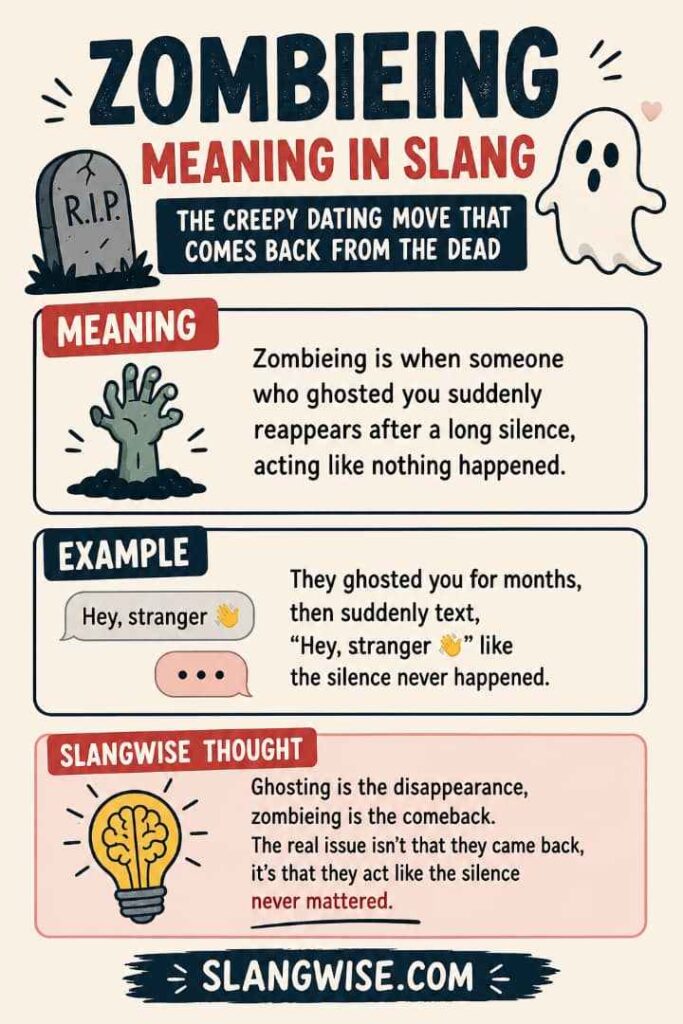
Zombieing is slang for when someone disappears from your life, usually by ghosting you, and then later shows back up as if the silence never happened.
They may send a random text, react to your stories, call you out of nowhere, or slide into your DMs after weeks, months, or even years of no contact. The whole vibe is very much “I vanished, but now I am back.”
What makes zombieing so irritating is that the return often comes without explanation. There is no clear apology, no honest conversation, and no sign that the person really understands the impact of disappearing in the first place. That is why many people see it as one of the more annoying modern dating behaviors.
DISCOVER: 30 Popular Dating Slang Terms of 2026 That’ll Have You Laughing, Ghosting, and Rizzing…
Slangwise Thought
Here is the simplest way to think about it: ghosting is the disappearance, and zombieing is the comeback. The comeback is not the problem by itself.
The problem is the pretending. If someone truly wants to reconnect, they should acknowledge what happened instead of acting like a long silence was just a small pause. That difference matters a lot.
Where the Term Comes From
The slang works because the image is obvious. A zombie is someone who comes back from the dead, and in dating slang, a zombieing person is someone who comes back from silence.
The phrase became popular in internet dating culture because it captures that eerie feeling of an old connection resurfacing out of nowhere.
Some writers also place zombieing in the same family as other modern dating terms like ghosting, breadcrumbing, orbiting, and haunting.
These words all describe confusing behavior in the age of apps and social media, where people can vanish, reappear, and keep a digital trace without ever having a real conversation.
READ ALSO: Love Bombing Meaning in Slang: The Intense Relationship Red Flag That Feels Like a Dream at First
Why People Zombie
There are a few possible reasons someone may zombie. Sometimes they are bored, lonely, curious, or simply wondering whether they can still get a response. Other times, they may have had a change of heart and are testing the waters.
But even when the motive is not obviously cruel, the behavior can still feel disrespectful because it ignores the history of the ghosting.
In more cautionary takes, zombieing is treated as part of a broader pattern of emotionally messy dating behavior where someone wants access without accountability. That is why the word often gets used with a slightly sarcastic or warning tone.
It is not just “someone came back.” It is “someone came back after disappearing and wants to skip the uncomfortable part where they explain themselves.”
Common Signs You Are Being Zombieed
The signs are usually pretty obvious once you know what to watch for. The person may return with a very casual message like “Hey” or “What’s up?” after months of silence.
They may like old posts, comment on your stories, or act as though the long gap never existed. The return may look small on the surface, but the emotional effect can be big.
Another clue is the lack of context. A genuine reconnection usually includes some kind of acknowledgment: “I disappeared, and that was wrong,” or “I should have communicated better.”
Zombieing usually skips that part entirely. The person just pops back in and expects the conversation to continue where it left off.
SEE ALSO: Pocketing Meaning in Slang: What It Really Means and Why It Feels So Hurtful
How to Respond Without Getting Pulled In
A calm response is usually best. You do not have to be rude, dramatic, or impressed. You can ask direct questions, or you can simply choose not to reopen the door at all.
The right choice depends on what feels healthy for you, but the key is not to let surprise turn into automatic trust.
If the person really means well, they will be able to explain the disappearance and respect your boundaries.
If they dodge the question, act entitled to your attention, or try to resume things with no accountability, that tells you plenty. Zombieing is less about the message itself and more about the attitude behind it.
Conclusion
Zombieing is one of those modern slang terms that sounds funny until it happens to you. It describes the moment a ghoster suddenly reappears and tries to reconnect like nothing ever happened.
The word is popular because it captures both the weirdness and the annoyance of that experience so well.
The best way to read zombieing is simple: a return is not the same thing as repair. Someone coming back does not automatically mean they have changed, grown, or become more serious.
What matters is whether they can acknowledge the past, respect your boundaries, and show consistent behavior moving forward. Without that, it is just a comeback, not a connection.
SEE ALSO: Future Faking Meaning: What It Really Means in Slang and Why It Feels So Real
FAQs on Zombieing
No. Ghosting is when someone disappears and cuts off contact. Zombieing is when that same person comes back later after the silence.
There is no strict time rule. It can be weeks, months, or even years later, as long as the person vanished first and then resurfaced unexpectedly.
Not always, but it is still a pattern worth questioning. Even if the person is lonely or curious, the lack of explanation can still feel disrespectful.
Do not rush to trust the comeback. Look for accountability, clarity, and real change before giving the connection another chance.
Table of Contents