
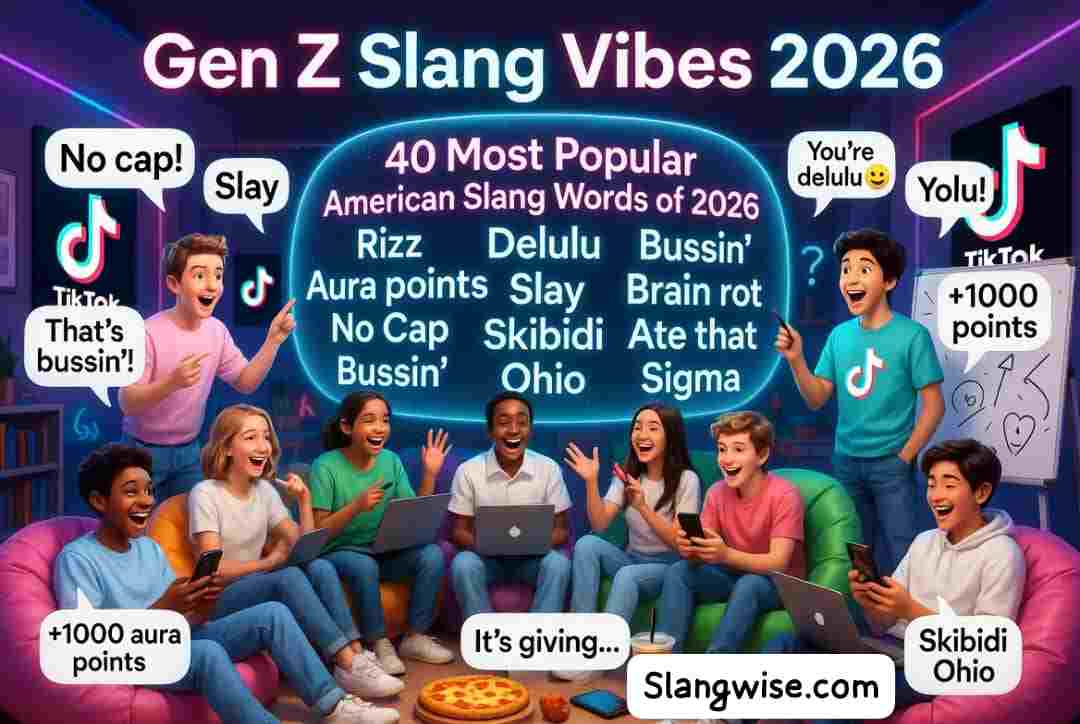
American slang has always had a talent for moving faster than formal language. One week, a word feels completely unavoidable; a few weeks later, the same expression can sound like it came from an entirely different internet era.
That speed is especially obvious in 2026. Scroll through TikTok, YouTube Shorts, Instagram comments, gaming chats, group texts, or even ordinary conversations between friends, and you’ll hear expressions that can sound ridiculous until you understand the cultural logic behind them.
Someone might respond with “6-7” to a completely unrelated question. Another person may say they just gained “+500 aura” after doing something impressive.
A friend might call a strange situation “Ohio,” accuse someone of “glazing,” or jokingly label an older person “unc.” Then, somewhere between the memes, you’ll hear much older American slang such as “deadass,” “hella,” or “y’all” being used right alongside the newest internet vocabulary.
That mix is what makes American slang so fascinating.
American slang isn’t simply a collection of trendy words. It reflects regional identity, music, Black American speech, LGBTQ+ culture, sports, gaming, television, memes, and the peculiar way social media turns tiny phrases into nationwide expressions.
Some terms are genuinely new. Others are much older than people realize and have simply been repackaged by younger speakers.
That distinction matters. Understanding slang isn’t about memorizing a dictionary and then forcing the newest word into every conversation. Real understanding comes from knowing the tone, the context, and the cultural history behind the expression.
So this guide takes a more useful approach. Instead of treating slang like a random pile of internet words, it looks at what these expressions actually communicate, how Americans use them, and why some have lasted while others are already starting to feel dated.
Think of it as a 2026 field guide to American informal language: part slang dictionary, part cultural decoder, and part reality check for anyone who has ever stared at a comment and thought, “Wait… what does that even mean?”
Ready? Let’s decode the 55 American slang words and phrases worth knowing in 2026.
Think you can tell your “rizz” from your “aura points”? Test your 2026 slang IQ with our quick, fun quiz before diving into the guide! ✨
[Take the Quiz →]
(It only takes a few minutes, and we promise; no cap, it’s fun! 😉 Don’t worry if you bomb it; this guide has all the answers.)
Results
Nice work!
You passed the Easy Level and your slang game is looking solid.
You unlocked the special bonus Slangwise ebook.
Ready to level up? Proceed to the Hard Level and prove you are a true slang master.
Good try! Slang evolves fast, so missing a few is totally normal.
You still unlocked the special bonus Slangwise ebook for participating.
Want to challenge yourself? You can still try again and see how far you can go.


#1. When someone says “this HITS DIFFERENT,” they mean:
#2. If a post gets RATIOED on Twitter/X, it means:
#3. What does SUS usually mean in Slang?
#4. YEET! is commonly used to:
#5. CHEUGY refers to something that is:
#6. She ATE that outfit means:
#7. When someone says BASED, they usually mean:
#8. FLEX in Gen Z Slang most often means:
#9. If someone says a snack is BUSSIN, they mean it is:
#10. What does RIZZ mean?
#11. GLOWED UP in slang means:
#12. NO CAP in Gen Z Slang means:
#13. If a meme is SENDING ME, it means the meme is:
#14. PERIODT is used to:
#15. If someone says they’re going to GHOST you, it means they will:
#16. According to Gen Zs, If a song SLAPS, that means the song is:
#17. SIMP refers to someone who:
#18. LOWKEY in internet slang means:
#19. Calling someone an NPC online usually means:
#20. To STAN someone is to:
55 Most Popular American Slang Words & Phrases of 2026
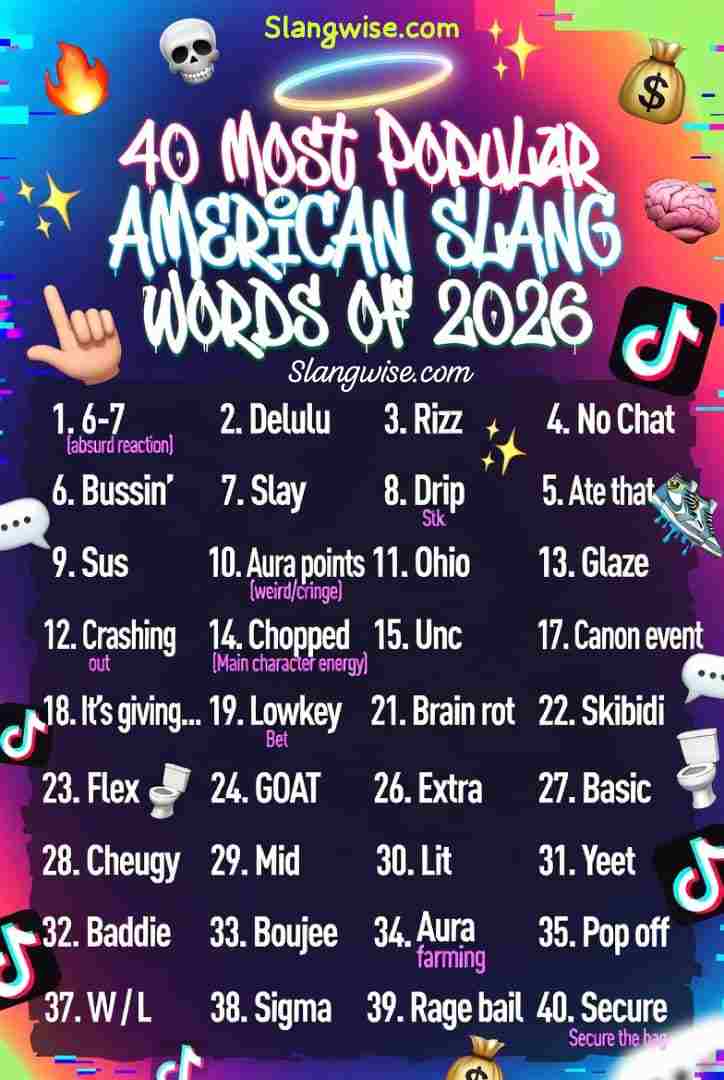
One important note before we jump in: “popular” is not a permanent ranking. Slang changes constantly, and popularity can vary by age, region, platform, and community. The list below brings together expressions that are especially recognizable, widely used, or culturally significant in American online and everyday conversation.
1. 6-7 (or 67)
Few recent slang expressions demonstrate internet absurdity better than 6-7. Its appeal comes partly from the fact that it doesn’t behave like a normal word. Depending on the context, it can act as a joke, a reaction, a chant, or simply a deliberately meaningless interruption.
The important thing is not to search too hard for a fixed dictionary definition. Much of the humor comes from its randomness and from recognizing the reference. In other words, understanding the joke is sometimes more important than understanding the “meaning.”
Example: “The squirrel just stole somebody’s sandwich.” “6-7!”
2. Aura / Aura Points
Aura is slang for someone’s overall vibe, presence, coolness, or social energy. The phrase aura points turns that idea into a fictional scoring system.
Do something impressive and you gain aura. Do something embarrassingly awkward and you lose it. The joke is that everyday life gets treated like a video game in which your social performance supposedly changes your score.
Example: “He remembered everyone’s coffee order. That’s at least +500 aura.”
3. Rizz
Rizz is one of the clearest examples of slang moving from internet culture into mainstream vocabulary. It refers to charm or the ability to attract, impress, or confidently interact with someone, particularly in a romantic or flirtatious context.
What makes rizz interesting is that it is not necessarily about looks. Someone can have rizz because of their confidence, timing, humor, conversational skills, or ability to stay calm in an awkward situation.
Example: “He walked into the room, introduced himself, and immediately made everyone laugh. That’s rizz.”
4. Delulu
Delulu is a playful shortening of delusional. In internet slang, it is usually used humorously to describe unrealistic optimism, wishful thinking, or an intentionally over-the-top belief.
The tone is what makes the term work. Calling yourself delulu can be a form of self-aware humor. It often signals that you know your idea may be unrealistic but you’re enjoying the fantasy anyway.
You may also encounter the phrase “delulu is the solulu,” which jokingly presents unrealistic optimism as a solution to life’s problems.
Example: “I’m manifesting front-row tickets even though they’re sold out. I’m being completely delulu.”
5. No Cap / Cap
Cap means a lie, exaggeration, or something that isn’t true. No cap means “I’m serious,” “I’m telling the truth,” or “for real.”
This phrase has proved unusually durable because it is simple, flexible, and easy to understand from context. Someone can accuse a friend of “capping,” while another person can add “no cap” to emphasize sincerity.
Example: “That was the best burger I’ve had in months, no cap.”
6. Ate / Ate and Left No Crumbs
When someone ate, they performed exceptionally well. The phrase “ate and left no crumbs” pushes the compliment even further, suggesting there was nothing left to criticize.
You’ll see it applied to fashion, performances, speeches, makeup, dance routines, creative work, and basically anything that deserves enthusiastic praise.
Example: “That presentation was incredible. You ate.”
7. Ohio
In online slang, Ohio became a joking label for something bizarre, chaotic, strange, or deeply unserious.
The joke is not actually about making a serious statement about the state of Ohio. It is a piece of meme language where a place name became shorthand for weirdness.
Example: “Why is someone doing karaoke on the subway at 7 a.m.? This is so Ohio.”
8. Crashing Out
Crashing out is used when someone is overwhelmed, extremely frustrated, emotionally exhausted, or reaching the point where they are likely to react badly to a stressful situation.
It often appears in exaggerated online storytelling, but it can also describe ordinary frustration: a terrible day, too much work, a frustrating game, or several annoying things happening at once.
Example: “After missing the bus and forgetting my assignment, I’m officially crashing out.”
9. Glaze / Glazing
To glaze someone is to praise them excessively, especially when the amount of admiration starts to feel exaggerated.
It is usually teasing rather than a literal accusation of dishonesty. In comment sections, one person may praise a celebrity over and over while another replies, “You’re glazing.”
Example: “You have mentioned that player six times today. You’re glazing at this point.”
10. Chopped
Chopped is generally a harsh way of saying that something looks bad, performs badly, or is simply not working.
It can describe an outfit, haircut, meal, photo, design, or almost anything being judged negatively. Because it can be insulting, context matters.
Example: “That first version of the logo was chopped. The redesign is much better.”
READ ALSO: American Slang vs British Slang in 2026: 55 Words That Sound Similar Until You Cross the Pond.
The Gen Alpha Slang Lexicon is your friendly, expert guide to the culture, context, and real meaning behind 130+ terms shaping how a generation talks, jokes, and connects. Stop feeling out of the loop and start connecting with confidence.
- ✓ 130+ Terms Decoded: From “Skibidi” and “Rizz” to “Ohio” and “Sigma.”
- ✓ + BONUS Ebook: 250+ Abbreviations Cheat Sheet
- ✓ Real-World Examples: See exactly how each term is used in conversations, memes, and social media posts.
- ✓ Cultural Context You Won’t Find on Google: Understand the why behind the words to truly get the joke.
- ✓ Instant Digital Access:
11. It’s Giving
It’s giving is a flexible way to describe the vibe, appearance, or energy that something communicates.
Unlike a direct comparison, it is intentionally impressionistic. You’re saying that something reminds you of a particular style or feeling.
Example: “That apartment is giving quiet luxury.”
12. Main Character Energy
Main character energy describes behaving with confidence, self-assurance, and the feeling that you’re the central character in your own story.
Sometimes it is sincere encouragement. Other times, it is playful teasing when someone seems dramatically focused on themselves.
Example: “She put on headphones, grabbed a coffee, and walked through downtown like it was the final scene of a movie. Main character energy.”
13. Brain Rot
Brain rot describes the humorous feeling that your brain has been overloaded by repetitive, low-value, highly addictive online content.
It can describe both the content itself and the mental state of spending far too long consuming it.
Example: “I’ve watched cooking clips for four hours. The brain rot is serious.”
14. Mid
Mid means average, mediocre, or underwhelming. It is rarely the strongest insult imaginable; instead, it dismisses something that was hyped as being better than it actually is.
Example: “Everybody said the sequel was incredible, but honestly? Mid.”
15. Ick
The ick is a sudden feeling of being turned off by someone’s behavior after previously finding them appealing.
It often comes from something small rather than something objectively terrible. That’s part of the concept: the reaction can feel surprisingly immediate.
Example: “He kept interrupting everyone to prove he was right. Instant ick.”
16. Sus
Sus is short for suspicious or suspect. Gaming culture helped push it into mainstream internet vocabulary, especially through Among Us, and it now appears in ordinary conversations too.
Example: “Your explanation changed three times. That’s sus.”
17. Salty
Salty means bitter, irritated, annoyed, or resentful, particularly when the reason is relatively minor.
The word is useful because it often carries a playful sense of calling someone out without making the accusation overly serious.
Example: “He’s still salty because his team lost by one point.”
18. Extra
Extra describes someone who is being dramatically excessive, overly elaborate, or simply doing more than the situation requires.
The word can be negative, but it can also be affectionate when someone’s over-the-top behavior is part of their personality.
Example: “She brought a full picnic to a 20-minute park meetup. She’s extra.”
19. Based
Based is generally a positive reaction to a confident, unapologetic statement or opinion. It often means something like “respect” or “that’s a bold and authentic take.”
Context is important because the word can be used sincerely, ironically, or simply as internet shorthand for approving of someone’s confidence.
Example: “He said he’d rather buy fewer things and keep them for years. Based.”
20. Basic
Basic describes something mainstream, predictable, heavily influenced by popular trends, or lacking originality.
Like many slang terms, it can be teasing rather than genuinely hostile. Someone may call a familiar movie choice, fashion trend, or drink order “basic” without meaning anything serious.
Example: “My weekend plan is coffee, a bookstore, and a comfort movie. Completely basic, and I’m fine with it.”
21. Secure the Bag
Secure the bag means to achieve an important goal, especially one involving money, work, success, or opportunity.
The “bag” is figurative. It represents whatever valuable outcome someone is trying to obtain.
Example: “She landed the internship she’s been chasing all year. She secured the bag.”
22. Pop Off
Pop off can mean doing extremely well, becoming unexpectedly successful, getting excited, or energetically reacting to something.
Its meaning depends heavily on context. A song can “pop off,” a person can “pop off” in an argument, or someone can tell a friend to “pop off” as encouragement.
Example: “That small creator’s latest video really popped off.”
23. Flex
Flex means to show off something, whether that’s money, clothing, achievements, possessions, skills, or status.
The word can be sincere bragging, humorous self-promotion, or even an ironic joke about showing off something ordinary.
Example: “Not trying to flex, but I finally finished the project I’ve been working on for months.”
24. Touch Grass
Touch grass is advice for someone who seems too absorbed in internet arguments, gaming, social media, or online drama.
The phrase works because it reduces an enormous online argument to a very simple message: step away from the screen and reconnect with real life.
Example: “You’ve been debating this fictional character for two hours. Go touch grass.”
25. Ghost
To ghost someone means to suddenly stop responding or communicating without giving an explanation.
The term is especially common in conversations about friendships, dating, work opportunities, and online communication.
Example: “They said they’d call back, then disappeared for two weeks.”
26. Ship
Ship comes from relationship. To ship two people means to support or imagine them as a couple, whether they are fictional characters or real people.
Example: “I totally ship those two characters. Their personalities work perfectly together.”
27. Stan
Stan refers to an extremely devoted fan. As a verb, to stan someone means to support them very enthusiastically.
The word has traveled far beyond its original pop-culture context and now appears in discussions about musicians, actors, athletes, creators, brands, and even fictional characters.
Example: “She’s a huge fan of that author. She stans every new release.”
28. Cancel / Canceled
Cancel became a major piece of internet culture through the idea of cancel culture: publicly withdrawing support from a person, creator, brand, or organization because of something considered offensive or unacceptable.
In everyday slang, “cancelled” can also be used jokingly when someone makes a minor mistake, so context determines whether the statement is serious or playful.
Example: “You forgot my birthday? You’re cancelled.”
29. Yeet
Yeet remains one of those wonderfully flexible internet words. It can describe throwing something with force, excitement, or a complete lack of ceremony.
It can also appear as an exclamation, particularly when someone is excited about an outcome.
Example: “She yeeted the pillow across the room.”
30. Simp
Simp usually describes someone who is perceived as giving excessive attention, effort, or praise to a person they like.
The term is often thrown around jokingly, although it can also be used as an insult. As with many internet labels, context matters more than the literal definition.
Example: “He keeps doing favors for someone who barely notices him. His friends call him a simp.”
31. Drip
Drip refers to stylish clothing, accessories, footwear, or overall fashion sense.
The word is not simply about owning expensive clothes. Someone can have drip because they put together an outfit with confidence and personality.
Example: “That jacket, those shoes, and the whole outfit? The drip is serious.”
32. Bussin’
Bussin’ is especially associated with food that tastes exceptionally good, although it can be used more broadly to mean something is excellent.
Its strength comes from enthusiasm. Saying something is bussin’ is usually much more energetic than simply saying it is “good.”
Example: “These tacos are bussin’. Who made them?”
33. Slay
Slay is an enthusiastic compliment meaning someone did something extremely well, looked impressive, or handled a situation confidently.
Although it is now common online, its history runs through Black and LGBTQ+ communities and earlier forms of fashion, performance, and nightlife language. That cultural history is worth remembering when discussing how modern internet slang develops.
Example: “You handled that presentation perfectly. Slay.”
34. GOAT
GOAT stands for Greatest Of All Time. Unlike many short-lived internet expressions, this one is firmly established in American sports and entertainment language.
It is used for athletes, performers, creators, or anyone considered extraordinary within their field.
Example: “For many fans, Serena Williams is the GOAT of women’s tennis.”
35. Snack
In informal American slang, calling someone a snack is a playful way of saying the person looks very attractive.
Because it comments on someone’s appearance, it is best understood as casual slang rather than something appropriate in every setting.
Example: “Everyone agreed the actor looked like a snack in that outfit.”
36. Boujee
Boujee, sometimes spelled bougie, describes someone or something that appears fancy, luxurious, expensive, or associated with a more upscale lifestyle.
It is frequently used with irony. Someone can proudly describe an expensive dinner as boujee while clearly joking about indulging in something fancy.
Example: “We got the fancy hotel room and ordered dessert twice. Very boujee.”
37. Cheugy
Cheugy describes something that feels outdated, overly associated with an older trend cycle, or like it is trying too hard to remain fashionable.
The word became famous as a way to joke about certain millennial-era aesthetics, but its broader meaning is simply “out of touch with the current trend.”
Example: “That slogan was everywhere ten years ago. It’s starting to feel cheugy now.”
38. Sigma
Sigma is one of the strangest examples of internet terminology being transformed into a meme identity. It originally described the online archetype of a supposedly independent, self-reliant person who operates outside traditional social hierarchies.
In current meme culture, however, sigma is often much more ironic. It can be used seriously, humorously, or simply because the word itself has become part of the joke.
Example: “He went to the museum alone and had a great time. Total sigma move.”
39. Aura Farming
Aura farming is the deliberate performance of coolness, confidence, or mysterious energy in order to gain social attention or “aura points.”
It is especially useful for joking about highly calculated social-media behavior, where every pose, outfit, entrance, or dramatic moment seems designed to look effortlessly cool.
Example: “He walked into the party in slow motion with sunglasses on at night. That’s pure aura farming.”
40. Unc
Unc is short for uncle. Online, it is usually a teasing way of describing someone as older, out of touch, or unfamiliar with current youth culture.
The joke does not necessarily require the person to actually be an uncle. It is more about age-coded behavior.
Example: “You don’t know what 6-7 means? Unc, you need to catch up.”
15 More American Slang Terms You Should Know in 2026
The next 15 terms make the list more distinctly American. Some have deep regional roots, while others grew out of Black American English, New York speech, California slang, gaming culture, or today’s broader internet vocabulary. That mixture is important because there is no single “American slang.” The United States has dozens of overlapping slang traditions.
41. Bet
Bet is an informal way of saying “okay,” “sure,” “agreed,” or “sounds good.” Depending on tone, it can also mean “challenge accepted.”
Its appeal is its efficiency. Instead of replying with an entire sentence, one word communicates confidence and agreement.
Example: “Meet at 7?” “Bet.”
42. Deadass
Deadass means “seriously,” “for real,” or “I’m not joking.” It is strongly associated with New York City speech and has since spread far beyond the region.
Unlike some newer slang words, deadass isn’t a recent invention. Its documented history goes back decades, which makes it a great reminder that internet language often repackages older American slang instead of inventing everything from scratch.
Example: “Deadass, that was the funniest thing I’ve seen all week.”
43. Lowkey
Lowkey means something like “quietly,” “secretly,” “somewhat,” or “I don’t want to make a huge deal about this, but…”
It is useful when someone wants to soften a statement while still expressing a real opinion.
Example: “Lowkey, this might be the best pizza place in town.”
44. Highkey
Highkey is essentially the opposite of lowkey. It means openly, strongly, obviously, or without trying to hide the opinion.
The pair works almost like a volume control: lowkey turns the intensity down, while highkey turns it up.
Example: “Highkey, everyone should watch that documentary.”
45. Yap / Yapping
Yapping means talking a lot, especially when someone is rambling, oversharing, or continuing long after the main point has already been made.
It can be affectionate between friends, teasing in comments, or mildly insulting depending on tone.
Example: “We’ve been here for ten minutes and he’s still yapping about the same story.”
46. Opp
Opp is short for opponent and is especially associated with American street, hip-hop, and online slang. It generally refers to an enemy, rival, or person viewed as being on the opposing side.
The word can be used seriously in discussions about rivalry, but online it is also frequently used in exaggerated or joking ways.
Example: “He chose the other team just to annoy us. That’s an opp move.”
47. Rage Bait
Rage bait is content deliberately designed to make people angry enough to comment, argue, share, or react.
The term is important because modern slang doesn’t just describe people and objects; it also describes online behavior and content strategies. A deliberately outrageous opinion can be called rage bait even when the creator doesn’t genuinely believe it.
Example: “That ridiculous post is obviously rage bait. Don’t give it the engagement.”
48. Mog / Mogging
Mog or mogging refers to one person noticeably outperforming or overshadowing another person, especially in appearance, presence, confidence, or performance.
Originally associated with online appearance and status comparisons, the term has expanded into broader meme usage where someone can “mog” another person by simply being more impressive in a particular situation.
Example: “He absolutely mogged everyone during the presentation.”
49. Hella
Hella is classic American regional slang, especially associated with Northern California and the San Francisco Bay Area. It works as an intensifier meaning very, a lot, or extremely.
Unlike some of the newest social-media expressions, hella has a long history in American speech. Its survival shows how regional slang can travel across the country and remain recognizable even after leaving its original home.
Example: “That concert was hella good.”
50. Jawn
Jawn is one of the most distinctly regional American slang words on this list. It is strongly associated with Philadelphia and can refer to a thing, person, place, event, or object when the specific name doesn’t need to be stated.
That flexibility is exactly what makes jawn fascinating. One word can stand in for almost anything when the context already tells you what is being discussed.
Example: “Pass me that jawn on the table.”
51. Brick
In American regional slang, especially in New York City, brick means extremely cold.
The word is particularly expressive because it compresses an entire complaint about brutal winter weather into a single adjective.
Example: “It’s brick outside today. I’m staying indoors.”
52. Finna
Finna means “about to” or “getting ready to.” It is a well-established feature of African American English and has become widely recognizable throughout American popular culture.
Because it has a specific cultural history, it is worth understanding rather than treating it as random internet spelling. American slang frequently spreads nationally from communities that developed and shaped the expression long before it reached mainstream social media.
Example: “I’m finna head home.”
53. Y’all
Y’all is a contraction of you all and is strongly associated with the American South, although it is now widely used across the United States.
Unlike many slang expressions, y’all is not particularly new. It remains useful because American English often needs an informal plural form of “you,” and y’all fills that gap naturally.
Example: “Are y’all coming with us?”
54. Bodega
Bodega refers to a small neighborhood convenience store, particularly in New York City. The word has Spanish roots, but its modern New York usage has become a distinctive part of the city’s everyday vocabulary and identity.
A bodega is more than a dictionary definition to many New Yorkers. The word carries a strong sense of neighborhood life, convenience, and city culture, which explains why it appears so often in music, television, memes, and everyday conversation.
Example: “I’m stopping by the bodega before I head home.”
55. Pressed
Pressed means bothered, upset, irritated, or unusually affected by something.
You’ll often see it used when someone appears more emotionally invested in an issue than the situation seems to justify. It can be a playful accusation, particularly when two people are arguing online.
Example: “Why are you so pressed about a joke?”
What These 55 American Slang Words Reveal About U.S. Language
Looking at all 55 terms together reveals something more interesting than a list of trendy vocabulary: American slang is not coming from one place.
Some expressions are born on social media. Some come from gaming. Others come from music, regional communities, Black American English, queer culture, sports, or local city speech. Eventually, certain words travel beyond their original communities and become nationally recognizable.
That is why terms such as jawn, deadass, and hella belong in the same conversation as newer internet expressions such as 6-7, aura farming, and brain rot. They may have completely different origins, but all demonstrate the same fundamental truth about slang: people constantly reshape language to make communication faster, funnier, more expressive, or more culturally specific.
Why American Slang Changes So Fast in 2026
There is a simple reason slang feels faster now than it did a generation ago: distribution is instant.
A phrase that once had to travel through a neighborhood, school, workplace, radio station, music scene, or television program can now spread through a short video in a matter of hours.
But speed does not automatically mean permanence.
Some expressions become part of everyday language because they solve a genuine communication problem. Lowkey, highkey, bet, and no cap, for example, are extremely convenient. They communicate shades of meaning in a compact way.
Other terms survive because they are funny. 6-7, Ohio, and sigma demonstrate how absurdity itself can become the point.
Then there are regional terms such as jawn, hella, brick, and bodega, which carry a sense of place that generic internet slang cannot completely replace.
The Biggest Mistake People Make With Slang
The biggest mistake is assuming that knowing the definition means you automatically know how to use the word.
Slang is about tone.
You can know exactly what “rizz” means and still sound unnatural if you insert it into every sentence. You can know what “unc” means but misunderstand why someone used it. You can know that “jawn” refers to an unspecified thing and still miss the Philadelphia flavor that gives it its identity.
The smartest way to understand slang is to watch how people use it repeatedly. Notice what words appear together. Notice whether the speaker is being sincere, sarcastic, affectionate, insulting, or ironic.
That context often tells you more than the dictionary definition.
Are These Slang Words Actually “American”?
Yes, but “American slang” should not be interpreted as if every expression started in one identical place or belongs equally to every American community.
The United States has enormous regional and cultural variation. New York has its own vocabulary. Philadelphia has its own expressions. The American South has distinctive speech patterns. California has contributed slang that spread nationally. Black American English has profoundly influenced modern American informal language, especially in music, entertainment, fashion, and online culture.
Then the internet mixes all of it together.
That is why an expression can have a very specific regional or cultural history while becoming recognizable to millions of people who do not live anywhere near its place of origin.
American Slang vs. Gen Z Slang: Are They the Same?
Not exactly.
American slang is the broader category. It includes regional expressions, older colloquialisms, Black American English, sports language, city slang, internet terms, and generational expressions.
Gen Z slang is narrower. It refers to slang associated with a particular generation, although those terms can obviously spread beyond that generation.
That distinction explains why deadass, y’all, hella, and bodega can sit comfortably beside delulu, aura, and 6-7 in a guide to modern American slang. They represent different layers of the same living language.
How to Sound Natural When Using American Slang
The goal should never be to cram five slang words into a single sentence. That usually sounds forced.
Instead, pay attention to the setting. A casual text message is different from a school assignment. A conversation with a close friend is different from a formal interview. Regional words may sound completely natural to one speaker and unfamiliar to another.
A good rule is simple: understand first, use second.
Listen to how a word is used. Notice who uses it and what emotion it carries. Then use it naturally when the situation actually fits.
The Slang Categories You Can See in This List
These 55 terms can roughly be divided into a few major categories.
Approval and praise: rizz, ate, slay, GOAT, based, bussin’, drip, aura.
Insults and criticism: chopped, mid, sus, salty, extra, cheugy, pressed.
Online behavior: brain rot, rage bait, glazing, yapping, aura farming, touch grass.
Identity and social dynamics: unc, stan, simp, ship, sigma, opp.
Regional American slang: jawn, deadass, hella, brick, bodega, y’all.
Modern internet expressions: 6-7, delulu, Ohio, aura points, lowkey, highkey, mogging.
Once you see these patterns, slang becomes much easier to understand. You stop trying to memorize isolated words and start recognizing the functions they serve in conversation.
Which Slang Words Are Most Likely to Last?
This is where things get interesting.
Not every viral expression becomes permanent vocabulary. Many disappear when the meme that created them stops being funny. Others survive because people continue finding them useful.
Words such as deadass, y’all, bet, and lowkey have practical value beyond a single trend. They fit naturally into conversation.
More meme-heavy expressions such as 6-7, Ohio, and some uses of sigma are more dependent on cultural momentum. Their staying power may depend on whether people continue finding the joke entertaining.
That doesn’t make them less important. Short-lived slang still tells us a huge amount about what a generation finds funny, surprising, relatable, or culturally relevant at a particular moment.
The Final Word: American Slang Is a Moving Target
After looking across these 55 terms, one thing becomes obvious: American slang isn’t supposed to stay still.
Words disappear. Old expressions come back. Regional slang moves across the country. Internet communities remix existing vocabulary. A term can start in one neighborhood, spread through music, explode on social media, and eventually become something your parents recognize too.
That is why trying to identify one permanent list of “the latest slang” will always be a losing game.
The better approach is to understand the patterns.
When someone says “no cap,” they’re emphasizing truth. When someone says “lowkey,” they’re softening a statement. When someone says “highkey,” they’re increasing the intensity. When someone says “that’s giving…”, they’re describing a vibe. When someone says “you’re glazing,” they’re accusing someone of excessive praise. When someone says “touch grass,” they’re jokingly telling an overly online person to reconnect with reality.
And when someone throws out something completely nonsensical like “6-7” in the middle of an ordinary conversation, the correct response might be to stop searching for logic and simply understand the joke.
That is the real skill behind understanding slang: not memorizing every word, but learning to recognize the social meaning behind it.
Some of the words on this list may still be everywhere next year. Others will probably look hilariously outdated. A few may evolve into completely new meanings.
And honestly, that’s exactly what makes American slang so interesting.
Language is not a museum piece. It is something people constantly reshape to joke, connect, exaggerate, tease, praise, criticize, and express identity.
So keep listening, keep noticing context, and don’t panic when the next strange phrase appears in your feed.
You don’t need to know every new word immediately.
You just need to know where to look when someone says, “Wait… you don’t know what that means?”
American Slang FAQ
What is the most popular American slang in 2026?
Popularity changes quickly, but terms such as 6-7, aura, rizz, delulu, unc, brain rot, chopped, and aura farming are highly visible in current American internet culture. Regional expressions such as deadass and jawn remain important parts of American slang too.
What does 6-7 mean in American slang?
6-7 is largely a meme expression whose appeal comes from its absurdity and lack of a single fixed meaning. It can function as a random response, joke, or cultural reference depending on the context.
What does aura mean in slang?
Aura refers to someone’s vibe, presence, charisma, or perceived coolness. Aura points turn that idea into a humorous imaginary score that someone can gain or lose.
What does deadass mean?
Deadass means “seriously,” “for real,” or “I’m not joking.” It is strongly associated with New York City speech and is now recognized much more broadly across the United States.
What does jawn mean?
Jawn is Philadelphia slang that can stand in for a person, place, thing, event, or object when the exact noun does not need to be specified.
Is Gen Z slang the same as American slang?
No. Gen Z slang is one part of the much larger American slang landscape. American slang also includes regional vocabulary, older expressions, Black American English, sports language, city slang, and internet terms used by multiple generations.
Why does American slang change so quickly?
Social media allows expressions to spread nationally at enormous speed. Memes, short-form videos, music, gaming communities, and online creators can turn a local or niche expression into mainstream slang almost overnight.
Which American slang words are likely to last?
Terms that communicate something useful often have more staying power than words tied to one short-lived meme. Expressions such as bet, lowkey, highkey, deadass, and y’all have practical conversational uses, while heavily meme-dependent terms can change more quickly.
What is the easiest way to learn American slang?
Pay attention to context rather than memorizing definitions alone. Notice who uses a term, what emotion is attached to it, whether it is sincere or sarcastic, and what words usually appear around it.
Table of Contents