Military slang is one of the clearest windows into how service members communicate, joke, complain, encourage one another, and make sense of demanding routines. After years of studying slang across different communities, one pattern stands out: the strongest slang does more than shorten words. It captures an entire experience in a phrase.
That is especially true in military culture. A few letters can describe a chaotic situation. A nickname can reveal an entire branch’s personality. A simple expression can tell someone, without a long explanation, that a message was received, a job was done well, or the day has gone completely off the rails.
Military slang is therefore more than jargon. It is a social language built around pressure, teamwork, tradition, humor, hierarchy, and shared experience. Some expressions are decades old, while others have shifted in meaning as different generations of service members adopted them.
For civilians, some of these terms can sound like coded language. For anyone familiar with military culture, however, they can instantly bring a situation to life. Here are 50 military slang terms that reveal the humor, frustration, traditions, and everyday chaos behind service life.

Table of Contents
But First, What Is Military Slang?
Military slang is the unofficial vocabulary that grows around military life. Some terms are shortened forms of official language. Others are nicknames, jokes, acronyms, insults, compliments, or expressions that developed naturally inside units and branches.
What makes military slang fascinating is the way it blends efficiency with humor. In a world where communication often needs to be quick and unmistakable, a short phrase can save time.
At the same time, humor gives service members a way to deal with repetitive routines, frustrating bureaucracy, difficult training, and the strange situations that come with military life.
It is also important to remember that military slang is not one universal dictionary. Army slang may differ from Marine slang. Navy expressions can sound unfamiliar to someone from another branch, while Air Force terminology may have its own culture and history. Even the same phrase can carry a slightly different tone from one unit to another.
50 Military Slangs You Should Know
1. FUBAR
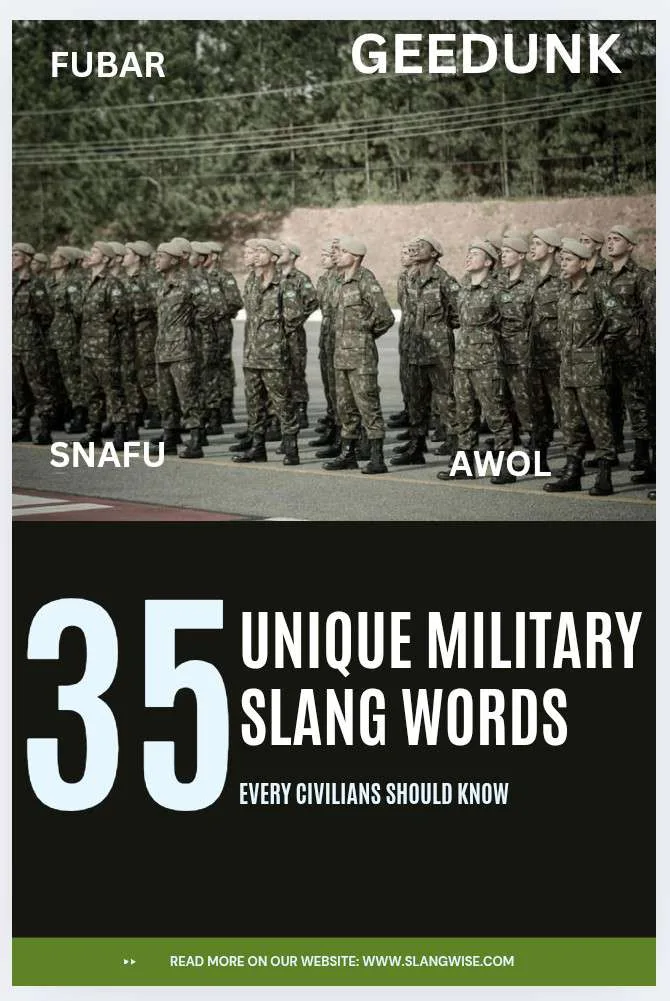
FUBAR describes something that has gone seriously wrong or become hopelessly messed up. The expression is often expanded in a cleaned-up form as “Fouled Up Beyond All Recognition.” It is classic military slang because it turns frustration into a memorable label for total chaos.
2. SNAFU
SNAFU stands for “Situation Normal: All Fouled Up.” The brilliance of the expression is its contradiction: everything may be a mess, yet somehow the mess is considered normal. It is a perfect example of military humor turning recurring problems into a shared joke.
3. AWOL
AWOL means “Absent Without Leave.” In military use, it refers to someone who is absent without the required authorization. Outside the armed forces, the expression became everyday slang for anyone who suddenly disappears, stops responding, or seems to have vanished from the group.
4. Geedunk
Geedunk refers to snacks, candy, soft drinks, or the place where such treats are sold. The word has a strongly military flavor because small comforts can become surprisingly important during long or monotonous days. A quick snack can feel like a tiny morale victory.
5. Blue Falcon
A Blue Falcon is someone who betrays a buddy, leaves teammates in trouble, or acts in a way that hurts the group. The expression comes from a deliberately crude military joke, but its practical meaning is easier to understand: nobody wants to be known as the person who lets the team down.
6. Whiskey Tango Foxtrot (WTF)
Whiskey Tango Foxtrot uses the phonetic alphabet to spell out WTF. In military-style communication, it gives speakers a playful way to express disbelief, confusion, or irritation. It has also escaped military culture and become recognizable in wider internet and texting slang.
7. Hooah / Oorah / Hooyah
These motivational calls are strongly associated with different branches and communities. “Hooah” is commonly associated with the Army, “Oorah” with the Marine Corps, and “Hooyah” with Navy communities including SEAL culture. They communicate energy, agreement, motivation, and group identity. Marine Corps sources specifically describe Oorah as a motivational call, with its history tied to reconnaissance Marines.
8. Ground Pounder
Ground Pounder is a nickname associated with personnel who spend much of their work operating on the ground rather than from a desk or aircraft. The phrase carries a sense of toughness and endurance, and it reflects the affectionate nicknames that military communities often create for different roles.
9. Chairborne Ranger
A Chairborne Ranger is a playful nickname for someone whose military role is mostly office-based. The humor comes from comparing desk work with more traditionally rugged field duties. It is usually teasing rather than a serious judgment, because administrative and support work still keeps organizations functioning.
Discover the coolest slang words that made it from streets to dictionaries, evolving language and culture. Learn the origins and meanings!
10. Mandatory Fun
Mandatory Fun is one of those expressions that almost explains itself. It describes an activity that is supposed to be enjoyable but is required rather than optional. The humor comes from the contradiction. The phrase captures a very military style of sarcasm: yes, everyone is having fun, because everyone was told to.
11. Boot
Boot refers to a newcomer or inexperienced service member, particularly someone fresh out of training. The term points to the social journey from beginner to experienced member of the group. Being called a boot often means there is still a lot to learn before earning the confidence that comes with experience.
12. Dustoff
Dustoff is military shorthand associated with medical evacuation by helicopter. The word carries a sense of urgency because it is linked to getting medical help where it is needed quickly. It has become one of the more recognizable military terms because it communicates an entire high-pressure situation with a single word.
13. Pogey Bait
Pogey bait refers to snacks and small treats, especially the kind that can make long days a little more pleasant. The expression reflects an important feature of military culture: tiny comforts can have enormous emotional value when someone is tired, bored, or far from home.
14. Soup Sandwich
Calling something a soup sandwich means it is badly organized, ineffective, or simply a complete mess. The image is deliberately ridiculous, which is why the phrase works so well. Military slang frequently creates impossible images to make frustration easier to laugh about.
15. Pop Smoke
Pop smoke can mean making a quick exit or, depending on context, calling for extraction. The phrase has roots in military signaling, but in casual speech it can simply mean leaving quickly. Someone saying, “Time to pop smoke,” is usually telling everyone that it is time to go.
16. Bravo Zulu (BZ)
Bravo Zulu means “well done” and is strongly associated with naval communication. It is concise praise for a job completed successfully or exceptionally. The expression has a long history in Navy usage and continues to appear in official naval correspondence celebrating strong performance.
Master 55 essential business terms every professional must know. Upgrade your communication, boost confidence, and speak the language of success with ease.
17. Scuttlebutt
Scuttlebutt means gossip, informal news, or the latest word circulating among people. The term has deep naval associations and shows how military vocabulary can move from a literal object or place into a social meaning. In everyday use, it often means, “What is everyone talking about?”
18. Big Green Weenie
Big Green Weenie is a humorous expression for the frustrating side of military bureaucracy. When paperwork, rules, administrative decisions, or institutional processes seem determined to make life harder, this expression becomes a sarcastic way to describe the experience without needing a long complaint.
19. No Joy
No Joy means that something expected was not found, seen, or accomplished. The expression is especially associated with aviation and operational communication, but its meaning is easy to understand outside that context: no success, no luck, no result. It is military brevity at its finest.
20. Snake Eater
Snake Eater is a colorful nickname historically associated with highly trained special-operations personnel. The term evokes endurance, fieldcraft, and survival ability. Like many military nicknames, its purpose is not only descriptive. It also creates a larger-than-life identity around the people who carry the label.
21. Deadstick
Deadstick is an aviation expression associated with an aircraft operating without engine power. Outside aviation, the word can be used more loosely to describe a difficult situation that requires careful handling. Its appeal comes from the image of having to remain calm and precise when something has suddenly gone wrong.
22. Kill Hat
In Marine recruit training, Kill Hat is a nickname for a particularly intense drill instructor. The title reflects the intimidating reputation such instructors can develop while pushing recruits through demanding training. It belongs to the broader culture of dramatic nicknames that make military training feel almost larger than life.
23. Light the Candle
Light the Candle is a colorful phrase associated with launching or beginning an operation or mission. Its wording creates an instantly visual image: something is about to start, and everyone needs to be ready. Like much military slang, the phrase makes a serious moment sound punchy and memorable.
24. Chow
Chow is simply food or a meal. Yet in military culture, that simple word carries emotional weight because mealtimes can provide a welcome break from training, duty, travel, or routine. “Chow time” can be one of the most eagerly anticipated announcements of the day.
25. Battle Rattle
Battle rattle refers broadly to being fully geared up, especially when the equipment itself makes noise while moving. The phrase captures the unmistakable feeling of being dressed and equipped for serious duty. It is another example of slang turning an ordinary sensory detail into a cultural shorthand.
26. Turret Monkey
Turret Monkey is a rough-edged nickname for personnel associated with vehicle turret positions. The term is rooted in military humor and is best understood as an example of how service communities create memorable labels for specialized roles. It is less about literal description and more about unit culture and camaraderie.
27. Cluster
When a military situation becomes a tangled mass of mistakes, confusion, and competing problems, someone may call it a cluster. The fuller form is often deliberately crude, so the shorter version lets people communicate the same frustration more discreetly. It basically means, “Everything is going wrong at once.”
28. Mickey Mouse Gear
Mickey Mouse gear describes equipment that seems cheap, outdated, awkward, poorly designed, or unnecessarily complicated. It is classic complaint slang. Rather than writing a technical report on what is wrong, someone can simply say, “This is Mickey Mouse gear,” and everyone nearby immediately understands the frustration.
80 Most Popular Gen Alpha Slang Words You’ll Hear In 2026 (updated)
29. Green Side / Blue Side
Among Navy corpsmen, Green Side and Blue Side can distinguish between assignments supporting Marines and duties in more traditional Navy settings. The contrast shows how military vocabulary can become highly specialized even within a single profession. Small phrases can instantly communicate a person’s work environment.
30. Zero Dark Thirty
Zero Dark Thirty describes an extremely early hour, especially a pre-dawn start that feels unnecessarily brutal. The phrase became widely known outside the military as well, but its appeal comes from military culture’s habit of turning absurdly early schedules into dramatic, almost cinematic language.
31. BOHICA
BOHICA is a sarcastic acronym often expanded as “Bend Over, Here It Comes Again.” It is used when another unpleasant task, unexpected order, or familiar problem arrives yet again. The expression is essentially a humorous sigh: everyone already knows what is coming, and it is not good news.
32. Fobbit
A Fobbit is a playful nickname for someone who spends most of their time at a forward operating base instead of regularly going outside the base environment. The term is built around the idea of someone who becomes almost permanently attached to the FOB, usually with a teasing tone.
33. High Speed, Low Drag
High Speed, Low Drag describes something or someone efficient, capable, streamlined, and apparently free of unnecessary complications. It can be sincere praise, light sarcasm, or both at once. Military humor often works that way: the same phrase can compliment someone while quietly reminding everyone to stay humble.
34. Squared Away
Someone who is squared away is organized, disciplined, reliable, and properly prepared. It is one of those military expressions that became useful far beyond the barracks. In everyday language, calling someone squared away is a strong compliment because it suggests competence, order, and attention to detail. The Marine Corps itself lists “square away” among its jargon terms.
35. Rack
Rack means bed. After a long duty day, “hit the rack” is a simple way of saying it is finally time to sleep. The expression survives because military life often turns ordinary comforts into landmarks: food, sleep, leave, and a few quiet minutes can feel surprisingly valuable.
36. Latrine Queen
Latrine Queen is a joking expression for someone who appears to spend an unusually long amount of time in the restroom. Like many military nicknames, it is built around observation and teasing. The humor comes from taking an ordinary behavior and turning it into an unofficial title.
37. G.I. Party
G.I. Party is associated with a group cleaning activity rather than the literal kind of party most civilians imagine. It became famous because military communities developed a humorous way of naming collective cleanup. The phrase is a perfect example of military language turning an otherwise boring task into a memorable expression.
38. POG
POG is commonly explained as “Person Other than Grunt,” referring broadly to non-infantry or support personnel. Depending on who is saying it and how it is said, the term can be playful, dismissive, self-deprecating, or proudly reclaimed. Context matters enormously with military slang.
39. Jody
Jody is the fictional character in military folklore who is imagined as enjoying life back home while a service member is away. Jody appears in marching and cadence traditions and represents a mixture of homesickness, jealousy, teasing, and humor. The character survives because military communities have always turned difficult emotions into jokes.
40. Thumper
Thumper is a historical military nickname used for a grenade launcher. The name reflects the heavy sound associated with the equipment. In slang terms, it is a good example of how military communities often give memorable nicknames to equipment based on appearance, sound, or personality rather than its official designation.
41. Roger
Roger is used to acknowledge that a message has been received and understood. It is a classic communications expression that became widely recognizable beyond the military. Unlike “yes,” which confirms agreement, Roger primarily communicates receipt: the message came through and was understood.
42. Head
Head is military and especially naval slang for a bathroom or toilet. It may sound strange to civilians, but within naval vocabulary it is completely ordinary. The word is a great example of how specialized military terms can remain in use for generations long after their original context becomes obscure.
43. Chit
A chit is a paper, authorization, receipt, or official note. In military culture, paperwork has a reputation all its own, so a tiny piece of paper can become unexpectedly important. The Marine Corps lists chit among its established jargon, showing how deeply the word is rooted in service vocabulary.
44. Klick
A klick means one kilometer. It is a compact military measurement term that makes directions and distances easier to communicate. The spelling may look unusual to civilians, but it is familiar in military culture and reflects the preference for short, easily understood communication.
45. Liberty
In military language, liberty refers to authorized time away from normal duties without using the same structure as formal leave. It is strongly associated with rest, recreation, and personal time. The term is particularly familiar in naval and Marine settings and illustrates how ordinary English words can take on specialized military meanings.
46. PCS
PCS stands for Permanent Change of Station. It refers to a service member being reassigned to a new duty location. For military families, PCS can mean packing, moving, paperwork, new schools, new neighborhoods, and starting over somewhere else. That is why this three-letter term can carry a lot of emotional weight.
47. MOS
MOS stands for Military Occupational Specialty and is especially associated with Army terminology. In simple terms, it identifies a service member’s job or occupational specialty. Someone discussing their MOS is basically telling you what professional role they perform within the military organization.
48. Mess Hall
A mess hall is a dining facility where service members eat. The phrase is one of the most familiar pieces of military vocabulary because food is such a central part of daily routine. A mess hall is not merely about meals; it can also become a place for conversation, downtime, and social connection.
49. Hatch
A hatch is a door or opening, especially aboard ships or in other specialized military environments. The word has a strong nautical feel and illustrates how military language often favors compact terms that are extremely practical. Marine Corps jargon also lists hatch as a military term for a door or doorway.
50. Police
In military jargon, police can mean to straighten, tidy, clean up, or put an area or collection of items back in proper order. The meaning surprises many civilians because it has nothing to do with law enforcement in this context. It is another excellent reminder that military slang often reuses familiar words in specialized ways.
The Ultimate List of 250 Most Popular Internet Slang Words of 2026: Decode 250 of the most popular internet slang words in one easy guide. Perfect for TikTok, chats, memes, and everyday texting. Boost your online fluency fast.
What These Military Slangs Reveal About Service Life
One of the most interesting things about military slang is how often humor appears beside seriousness. Terms such as AWOL, PCS, and Dustoff connect to real military responsibilities, while expressions such as Mandatory Fun, Soup Sandwich, and Blue Falcon add a layer of sarcasm and inside humor.
That combination is not accidental. Slang often develops strongest in communities where people share intense routines and need a quick way to describe experiences outsiders might not immediately understand.
Military vocabulary is especially rich in this respect because service members often operate within tightly structured environments where teamwork and shared context matter.
Another fascinating feature is the way ordinary words change meaning. Head becomes a bathroom. Rack becomes a bed. Police can mean tidy up. Liberty means authorized personal time. Hatch means a doorway.
These expressions may sound strange when removed from military context, but inside the culture they are perfectly natural.
Then there are the branch-specific expressions. The Marine Corps has a particularly rich slang tradition, with official Marine resources documenting terms such as Oorah, head, hatch, square away, klick, liberty, MOS, and O-Dark Thirty.
That is why decoding military slang requires more than memorizing definitions. Tone, branch, generation, situation, and speaker all matter.
A phrase that sounds insulting in one setting might be affectionate teasing in another. A term that sounds ordinary to a veteran may leave a civilian completely confused.
Why Military Slang Is So Funny
Military humor often works by exaggeration. A badly organized task becomes a “soup sandwich.” A frustrating bureaucracy becomes the “Big Green Weenie.” An absurdly early morning turns into “Zero Dark Thirty.” A required social event becomes “Mandatory Fun.”
The joke is rarely just the word itself. The real humor comes from recognition. Everyone in the group already knows the situation being described, so the slang becomes a shortcut for a shared experience.
This is one of the reasons slang remains so culturally powerful. It creates belonging. Once you understand the expression, you understand something about the community that created it.
Military Slang vs. Military Jargon: Are They the Same?
Not exactly. Military jargon can refer to formal or specialized terminology used to describe equipment, procedures, jobs, ranks, organizations, or communications. Slang tends to be more informal, creative, humorous, or culture-specific.
The two categories overlap constantly. A word can begin as an official term, become shortened by service members, and eventually develop a slang meaning. Another expression might start as a joke inside a unit and later become common across a wider military community.
That constant movement is what makes military language so interesting to study. It is not frozen vocabulary. It evolves with generations, technology, missions, media, and the cultures of individual branches.
Final Takeaway
The most revealing military slang is rarely the most complicated. Often, it is the expression that turns a difficult moment into a joke, a long explanation into two words, or an unfamiliar experience into something the whole group immediately understands.
From FUBAR and SNAFU to Bravo Zulu, squared away, scuttlebutt, Roger, and Zero Dark Thirty, these 50 expressions show how military communities use language to create efficiency, identity, humor, and connection.
For civilians, learning these terms offers a fascinating glimpse into military culture. For people familiar with service life, the vocabulary may sound instantly recognizable.
Either way, one thing becomes clear: military slang is not just a collection of funny words. It is a record of how people adapt language to the realities of life inside a demanding institution.
And that is exactly what makes slang worth studying. Behind every unusual expression is a story about the people who created it, the situations that shaped it, and the community that kept saying it.
Sources:
- Glossary – Military Jargon My Future
- Military Code Words for Writers at Nairaland
- U.S. Marine Corps Jargon
- U.S. Marine Corps Marine Jargon PDF
FAQs: Military Slang Decoded
Military slang is the informal language used by service members to describe people, situations, jobs, equipment, routines, and shared experiences. It can include acronyms, nicknames, jokes, shortened expressions, and branch-specific vocabulary.
FUBAR describes something that is badly messed up or has gone completely wrong. It is commonly expanded in a cleaned-up form as “Fouled Up Beyond All Recognition” and is one of the best-known examples of military slang built around frustration and humor.
SNAFU means “Situation Normal: All Fouled Up.” The expression humorously suggests that a chaotic or frustrating situation has become so routine that it is considered normal.
Hooah is a motivational expression strongly associated with the U.S. Army. It can communicate enthusiasm, agreement, motivation, or a general readiness to respond positively to a challenge.
Oorah is a motivational call associated with the U.S. Marine Corps. Marine Corps sources describe it as a motivational expression and connect its history with reconnaissance Marines during the Korean War era.
Bravo Zulu means “well done.” It is strongly associated with naval communication and is used to congratulate someone for a job that was completed successfully or exceptionally well.
Squared away means organized, prepared, disciplined, and properly arranged. It can describe a person, a workspace, equipment, or a situation that is under control.
POG is commonly explained as “Person Other than Grunt” and generally refers to non-infantry or support personnel. The tone can range from playful teasing to criticism, so the speaker and context matter.
Zero Dark Thirty is informal military-style language for an extremely early hour, especially a time before dawn. It is often used humorously when someone has to get up or begin work very early.
Jody is a fictional character in military folklore who represents the person imagined to be enjoying life back home while a service member is away. The character appears in cadence traditions and is often used as a humorous way to express homesickness or anxiety about relationships.
AWOL means “Absent Without Leave.” In military usage, it refers to being absent without the required authorization. In civilian conversation, it is also used informally for someone who suddenly disappears or stops responding.
Roger is used to acknowledge that a message has been received and understood. It is primarily about confirming receipt rather than expressing agreement.
PCS stands for Permanent Change of Station. It refers to a reassignment to a new duty location and can involve a major move for the service member and their family.
To hit the rack means to go to bed or get some sleep. Rack is military slang for a bed, so the phrase simply means it is time to sleep and recover.