
There are slang words that make you laugh, slang words that make you curious, and then there are words like phrogging that make you look around your own room for absolutely no reason.
The first thing I notice when I analyze an unusual slang term is how quickly the word creates an image in your mind. Phrogging does exactly that. You hear it once, learn what it means, and suddenly the idea becomes impossible to forget.
In this article, I am breaking down what phrogging means in slang, where the word appears to come from, how people actually use it, and why it has gained so much attention in online conversations and popular culture.
By the end, you will not only understand the definition, but also the subtle difference between phrogging and related terms such as squatting.
Table of Contents
What Does Phrogging Mean in Slang?
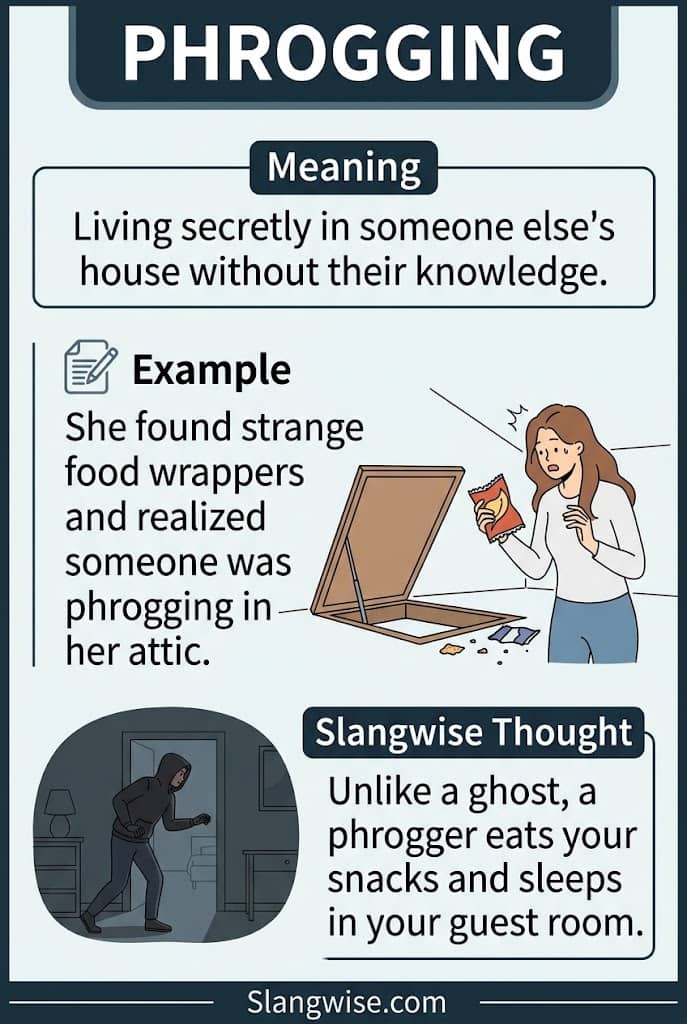
Phrogging means secretly living or staying inside someone else’s home or property without the occupants knowing or giving permission.
The important word here is secretly. This is what gives phrogging its distinctive meaning. We are not simply talking about someone entering a property or occupying an empty building.
The term usually describes a person remaining hidden in an occupied home while trying not to be discovered.
When I explain slang, I always look at the feeling a word carries as well as its literal meaning. With phrogging, the emotional layer is obvious.
The word suggests secrecy, intrusion, and the unsettling possibility that someone has been nearby without your knowledge.
Picture the Situation
Imagine coming home and noticing that something feels slightly different. A cupboard is open. Food seems to be missing. You hear an unexplained sound. Perhaps you assume it was a family member, a pet, or something completely ordinary.
Now imagine eventually discovering that another person has secretly been staying inside the property without your knowledge.
That is the kind of situation people are describing when they use the word phrogging. I think that human reaction is a big part of why the term has become so memorable. It takes an already disturbing situation and gives it a short, catchy name.
SEE ALSO: Crikey Mate Meaning: The Aussie Slang Phrase Everyone Thinks They Know
Where Did the Word Phrogging Come From?
This is where I would be careful with anyone who presents the origin as completely settled. The exact history of phrogging is not certain, although the most common explanation connects it to the word frog.
The idea is that a person engaging in phrogging may move from one hidden place to another, almost like a frog jumping between lily pads. The spelling with ph gives the word a deliberately unusual slang appearance.
Sources that discuss the term also connect its rise in public awareness to movies, television, and internet culture. The word was used as the title of an independent short film in 2014, and later became more familiar through horror and true crime entertainment.
That matters because slang often spreads beyond its original use when popular culture gives people a memorable context for it.
This is something I see repeatedly when studying slang. A word does not always become popular because everyone suddenly needs a new definition.
Sometimes a film, social media trend, or television series gives an unusual word the exposure it needs to enter everyday conversation.
For a broader look at how slang evolves, spreads, and changes meaning across communities, Language Jones is a useful linguistics and sociolinguistics resource.
How People Use Phrogging in Conversation
People generally use phrogging in serious, creepy, or story based contexts. You are more likely to see it in a discussion about a strange home incident, a crime story, a horror movie, or an unsettling internet post than in ordinary small talk.
Here are some natural examples:
- “That sounds like phrogging.”
- “I watched a documentary about phrogging and it was seriously unsettling.”
- “They thought the strange noises were nothing until they discovered someone had been secretly staying there.”
- “That story sounds like something straight out of a phrogging movie.”
Notice something interesting about these examples. Phrogging does more than describe an event. It immediately gives the event a mood. That is one of the most powerful features of slang.
Phrogging vs. Squatting
These two terms are often confused, but the distinction is important.
Squatting generally refers to occupying property without permission. Phrogging is more specific because the person is typically hiding within an occupied home while trying to remain undetected.
Think of the difference this way: squatting emphasizes unauthorized occupation, while phrogging emphasizes secrecy and hidden presence.
That does not mean every situation will fit perfectly into one category. Real situations can be complicated, and people online sometimes use slang loosely. But when someone specifically says phrogging, the hidden aspect is usually the key idea.
READ ALSO: Menty B Meaning in Gen Z Slang: The Tiny Phrase That Says a Lot
Why Is Phrogging Suddenly So Popular?
This is probably the question that brought you here in the first place.
Phrogging has a perfect combination for internet culture. It is strange, easy to remember, visually disturbing, and connected to stories that naturally attract attention.
Horror content and true crime discussions have helped make the word more recognizable, while social media gives people an easy way to share and react to unusual stories.
I also think the word has staying power because it is so compact. Instead of saying, “Someone was secretly living inside an occupied house without the residents knowing,” you can simply say phrogging.
Slangwise Thought
Phrogging is a great example of why I find slang so fascinating. A good slang term does not simply name something. It packages an entire situation into a word people can instantly recognize and remember.
What makes this one especially effective is the contrast between the strange sounding word and the disturbing meaning behind it. At first, “phrogging” sounds almost playful. Once you know what it means, that playful sound becomes part of what makes it creepy.
Phrogging In a Nutshell
- Phrogging means secretly living or staying in someone else’s home without their knowledge or permission.
- The term is commonly associated with the image of a frog moving or “hopping” between hidden places.
- The exact origin of the word is uncertain, so the frog explanation is best treated as the leading theory rather than proven fact.
- People usually use phrogging in conversations about creepy stories, crime related situations, horror entertainment, and unusual home incidents.
- Phrogging differs from squatting because secrecy and remaining hidden inside an occupied home are central to the term.
DISOVER: YouTube Slang 2026: 100 Viral Comment Terms You’ll See Everywhere
Final Thoughts
Phrogging is one of those slang words that becomes much more interesting once you understand the story behind it. It describes a very specific kind of hidden occupation, but its popularity comes from more than the definition itself.
The word has an eerie sound, a memorable image, and a strong connection to the kind of unusual stories people naturally share online.
As someone who pays close attention to how slang works, I think phrogging is a good reminder that language often grows around the situations people cannot easily describe with one ordinary word. Once a term catches on, it can turn a complicated idea into something instantly recognizable.
So when you see phrogging in a post, comment, video, or conversation, you now know exactly what it is getting at.
It is not simply another random internet word. It is a slang term built around secrecy, hidden presence, and an unsettling situation that people clearly find difficult to forget.
FAQs
Phrogging means secretly living or staying inside someone else’s home or property without their knowledge or permission.
Not exactly. Squatting generally involves unauthorized occupation, while phrogging specifically emphasizes secretly remaining hidden inside an occupied home.
It is generally pronounced like “frogging,” despite the unusual spelling.
The exact origin is uncertain, but the most common explanation connects the word to frogs and the idea of moving from place to place while staying hidden.
The term has been helped by horror, true crime, social media, and online storytelling, where unusual and unsettling situations tend to attract attention.