
Modern dating has created plenty of new dating words, but few describe an experience as perfectly as situationship. It names that frustrating, exciting, and often confusing space where two people are clearly more than friends but never quite become an official couple.
As a slang decoder, one thing stands out about situationship: the word became popular because people needed a simple label for a complicated connection.
You can talk every day, know each other’s habits, make plans, share personal details, and still have no idea what the relationship is supposed to be called.
That is exactly why this Gen Z slang term has staying power. It describes not just a type of dating, but the uncertainty that often comes with modern relationships.
Table of Contents
Situationship Meaning in a Nutshell
- Situationship meaning: An undefined romantic or emotional connection that sits somewhere between friendship and a committed relationship.
- No official label: The people involved may act like a couple without actually agreeing that they are one.
- Common signs: Frequent texting, regular dates, emotional closeness, flirting, and couple-like behavior without clear commitment.
- Why it happens: Modern dating, uncertainty, busy lifestyles, and different expectations can all create situationships.
- The biggest issue: A situationship works best when both people understand what it is. Confusion starts when their expectations do not match.
Slangwise Thought
A situationship is when the connection feels real, but the relationship status still feels like a mystery.
POOKIE ALERT! 🚨 Are You Using This Term Wrong? 😳 Find Out the 9 Surprising Pookie Meanings (Your Crush Might Be Thinking Something Different 🤔)
What Does Situationship Mean in Gen Z Slang?
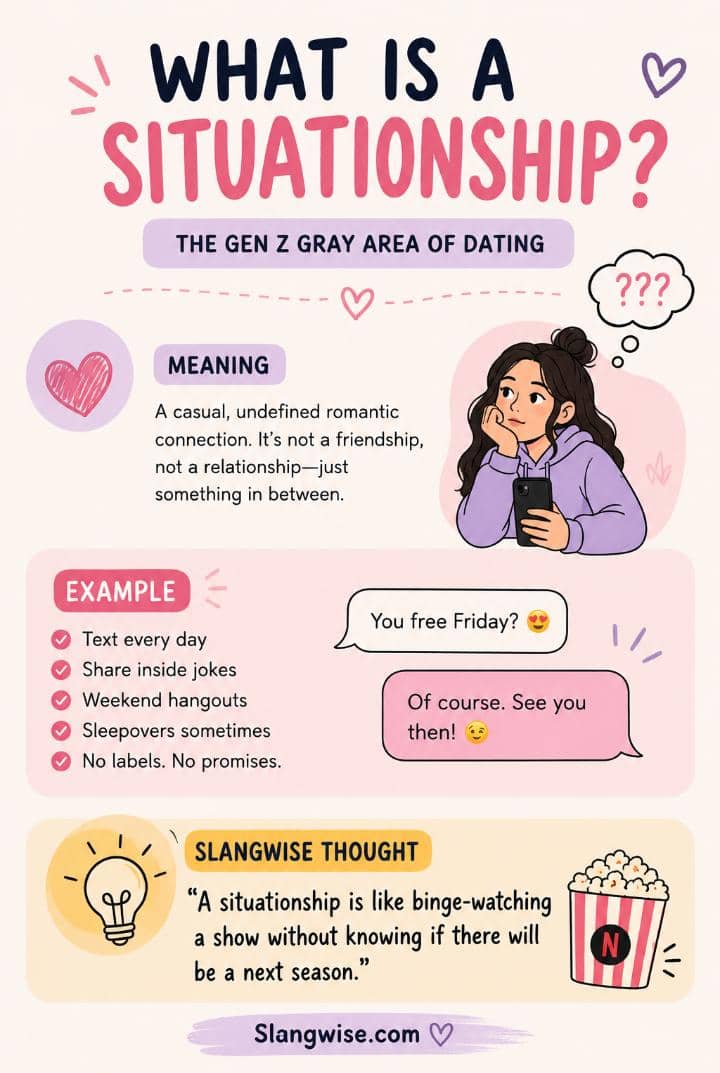
A situationship is an undefined romantic connection that is more involved than an ordinary friendship but less defined than a committed relationship.
The important word is undefined. Two people may spend a lot of time together and have genuine feelings, but they have not clearly agreed on what they are to each other.
For example, you might have someone who:
- Messages you almost every morning.
- Invites you to concerts, parties, or weekend plans.
- Remembers tiny details about your life.
- Acts affectionate and emotionally close.
- Gets noticeably bothered when you mention dating someone else.
Yet when the obvious question comes up — “So, what are we?” — there is no clear answer.
That is the situationship.
Where Did the Word “Situationship” Come From?
The word situationship combines situation and the idea of a relationship. It describes a connection whose status depends on the situation rather than a clearly defined relationship agreement.
The term existed before Gen Z popularized it, but social media and dating culture gave it much wider visibility. As dating apps, texting, social platforms, and casual dating became major parts of modern social life, people increasingly needed vocabulary for relationships that did not fit traditional categories.
That is one of the most interesting things about slang: popular words often emerge because people experience something repeatedly and need a faster way to describe it.
In that sense, situationship is more than internet slang. It is a useful label for a recognizable modern dating pattern.
WHOLE LOTTA SLANG: Looking for more modern ways to describe attraction? Explore these 18 Slang Words for Beautiful Women.
Situationship Examples
Here are some fresh examples that show how the term is actually used.
- The “Plus-One” Problem
You regularly attend events together, and everyone assumes you are dating. Your friends even call the person your partner. But neither of you has actually defined the connection. - The Daily Check-In
You wake up to their “Good morning” text, discuss your day throughout the afternoon, and end the night talking for an hour. You are emotionally close, but there is still no relationship label. - The Social Media Mystery
You appear together in each other’s stories, share inside jokes, and spend plenty of time together. Still, neither person publicly identifies the other as a boyfriend, girlfriend, or partner. - The Backup-Date Situation
You already have plans together for Friday, yet either person can technically make other romantic plans because exclusivity has never been discussed. - The “It’s Complicated” Answer
A friend asks, “Are you two together?” Instead of saying yes or no, the response is, “It’s complicated.” That answer can be a classic sign of an undefined connection.
How Do You Know You Are in a Situationship?
No single behavior proves that a situationship exists. The bigger clue is the combination of closeness and uncertainty.
- You spend time together consistently, but there is no agreed relationship status.
- You behave like a couple in private but avoid defining the connection.
- You have strong chemistry, but conversations about the future stay vague.
- You are unsure whether dating other people would count as crossing a line.
- One person keeps asking for clarity while the other keeps delaying the conversation.
That final point matters. A situationship is not automatically unhealthy. The real problem is usually mismatched expectations.
Why Are Situationships So Popular?
Modern dating gives people more choices, but more choices can also create more uncertainty.
- Less pressure: Some people enjoy getting to know someone without immediately attaching a formal label.
- Busy schedules: Work, school, social commitments, and personal goals can make traditional relationship expectations feel complicated.
- Fear of getting hurt: Keeping things undefined can feel emotionally safer for someone who is not ready for commitment.
- Dating-app culture: When meeting new people is only a swipe away, some connections naturally remain in an exploratory stage.
- Preference for flexibility: Some people genuinely prefer a connection without traditional relationship expectations.
But flexibility only works when both people are comfortable with the arrangement. One person cannot quietly treat a situationship like a committed relationship while the other treats it as completely casual and expect zero conflict.
Situationship vs. Relationship: What Is the Difference?
The difference is mainly clarity and mutual agreement.
- Situationship: The connection is romantic or emotionally close, but its status and expectations remain unclear.
- Relationship: Both people generally understand the nature of the connection and agree on important expectations such as commitment, exclusivity, or future intentions.
Not every relationship follows the same rules, so the absence of a label does not automatically mean something is wrong. The key question is whether both people know what they have agreed to.
Slangwise Tip: How to Handle a Situationship
The best approach is not to decode every text message or turn every late reply into a hidden clue. Pay attention to patterns and communicate directly.
- Know what you want: Be honest with yourself about whether you want something casual, exclusive, or more serious.
- Ask instead of guessing: A direct conversation is more reliable than trying to interpret every signal.
- Watch consistency: Someone’s regular behavior usually tells you more than one romantic message.
- Respect boundaries: Both people should understand what is and is not acceptable.
- Do not ignore your own discomfort: If the uncertainty consistently makes the connection unpleasant, clarity may be more valuable than keeping things going.
A useful question is simple: “Am I enjoying this connection as it actually is, or am I hoping it will eventually become something different?”
The Downsides of a Situationship
Situationships are not automatically bad, but their undefined nature can create problems when expectations start drifting apart.
- Confusion: You may not know where you stand.
- Unequal feelings: One person can become much more emotionally invested.
- Mixed signals: Affection and distance can create uncertainty.
- Delayed conversations: Avoiding the “what are we?” discussion can make the eventual conversation harder.
- Difficulty moving forward: An undefined connection can continue for months without becoming more clearly defined.
When Is It Time to Walk Away?
There is no universal deadline for a situationship. The better question is whether the connection still works for you.
If you have clearly communicated what you need and the other person repeatedly avoids the conversation, dismisses your boundaries, or expects you to accept something you are uncomfortable with, stepping back can be a reasonable choice.
There does not need to be a dramatic ending. Sometimes clarity simply means saying, “This situation is not working for me anymore, so I am choosing to step away.”
Remember: A situationship is a label for an undefined connection, not a requirement to stay in one.
READ ALSO: Want another popular dating term decoded? Learn what simp means in love and see how the slang is used.
Conclusion: Situationship Meaning Explained
Situationship is one of those Gen Z slang terms that became popular because it describes a real and recognizable social experience. It refers to a romantic or emotionally close connection that has not been clearly defined as a committed relationship.
The interesting part of the word is that it captures both sides of modern dating: freedom and uncertainty. Some people like the flexibility, while others eventually want a clearer direction.
From a slang-decoding perspective, the important thing is not simply knowing the definition. It is understanding how the word is used. When someone says, “We are in a situationship,” they are usually pointing to a connection that feels more significant than ordinary friendship but does not have the clarity of a formal relationship.
So, the next time someone says they are “not exactly dating, but not exactly single either,” you now know the Gen Z slang term for it: situationship.
FAQs About Situationships
A situationship is an undefined romantic or emotionally close connection that falls between friendship and a committed relationship. The people involved may spend significant time together without agreeing on a clear relationship status.
Situationship became especially popular through modern internet and dating culture and is strongly associated with Gen Z conversations about relationships, although the word has been used beyond Gen Z as well.
Yes. A situationship can become a committed relationship when both people communicate clearly, agree on what they want, and choose to move the connection forward.
No. A situationship can involve genuine affection, attraction, emotional closeness, and strong feelings. The defining feature is the lack of clear relationship status or agreed expectations.
The biggest sign is a mismatch between how close the connection feels and how clearly it has been defined. You may behave like a couple while avoiding a clear conversation about the relationship.
Yes. A situationship can work when both people genuinely want the arrangement, understand the boundaries, communicate openly, and respect each other’s expectations.
Start with a direct conversation about what each person wants. Clear communication is usually more useful than trying to interpret mixed signals or guessing what the other person means.
Not necessarily. Friends with benefits usually emphasizes friendship combined with physical intimacy, while a situationship can include emotional closeness, dating behavior, romantic feelings, or other forms of connection without a defined relationship.