

Workplace language has its own vocabulary. Spend enough time in meetings, team chats, emails, project-management platforms, or startup environments and you will quickly notice that professionals rarely communicate in plain language alone.
They ping people, run deep dives, ask whether everyone is on the same page, look for low-hanging fruit, discuss KPIs, and talk about whether a new idea is scalable.
Some of these expressions are genuine slang. Others are better described as business jargon, professional shorthand, or workplace terminology. In everyday conversation, however, they often serve the same purpose: they allow people who share a work culture to communicate complicated ideas quickly.
That is what makes workplace slang interesting.
A single phrase can carry an entire concept. Saying “let’s circle back” can mean that an issue has been acknowledged but cannot be resolved yet. Saying “I don’t have the bandwidth” can communicate that additional work is not realistic at the moment.
Saying “we need to move the needle” signals that activity alone is not enough and the team needs measurable results.
But there is another side to this language.
Workplace slang can make communication easier, but it can also make communication vague. Some expressions become so popular that people use them automatically without stopping to think about what they actually mean.
That is why understanding the language matters more than simply using it.
The 30 terms below cover common workplace slang, business expressions, abbreviations, and professional shorthand you are likely to encounter in modern workplaces.
Briefly
- Workplace slang is a form of shorthand that compresses complicated ideas into familiar phrases.
- Many expressions come from technology, sports, finance, startups, project management, and internet culture.
- Workplace language becomes useful when it improves clarity, but it becomes frustrating when it replaces specific information.
- Understanding the meaning behind these expressions helps you communicate naturally without sounding forced or relying on empty corporate jargon.
Slangwise Thought: Good workplace language should make communication faster without making meaning harder to understand.
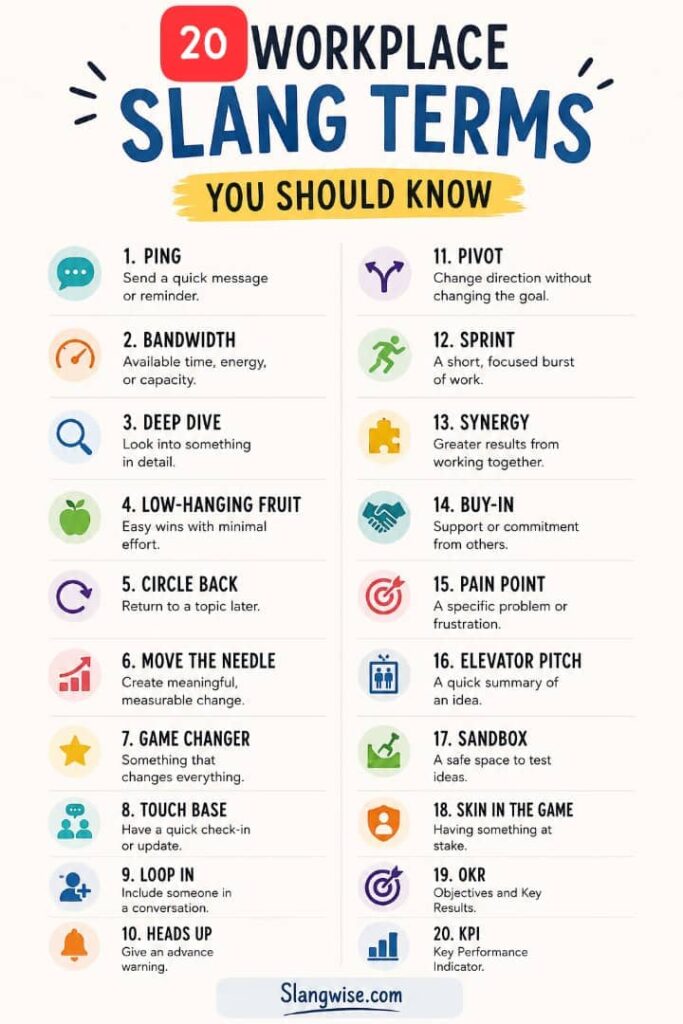
1. Ping
In workplace communication, ping means sending someone a quick message, reminder, or request. The expression originally comes from networking technology, where a “ping” checks whether another computer or device can be reached.
That technical idea eventually became a metaphor for checking whether a person is available or needs to respond.
When someone says, “I’ll ping you later,” they normally mean they will send a short message rather than schedule a long conversation. The expression feels informal and lightweight, which is why it works particularly well in chat-based workplaces.
Ping is now common across email, Slack, Teams, text messaging, project-management tools, and other professional communication channels. It is especially useful when the conversation does not require a formal meeting.
2. Bandwidth
Bandwidth is another workplace expression borrowed from technology. In networking, bandwidth refers to the amount of data a connection can carry. In professional conversation, the word became a metaphor for a person’s available time, energy, attention, or mental capacity.
When someone says they “don’t have the bandwidth,” they are generally saying they cannot take on another responsibility right now.
The expression can sound more neutral than saying, “I’m too busy,” because it frames the situation around capacity rather than personal unwillingness. It is especially common when people are discussing workloads, project priorities, deadlines, and competing responsibilities.
Bandwidth can refer to an individual, a department, or an entire organization.
3. Deep Dive
A deep dive means examining a subject in considerable detail.
The expression creates an image of moving below the surface to investigate something thoroughly. In professional environments, it is commonly used for research, data analysis, customer feedback, product reviews, financial investigations, strategy discussions, and problem solving.
A deep dive normally suggests that a quick conversation will not be enough. It implies that people will spend time examining information, identifying causes, understanding details, and considering possible solutions.
When a manager says the team needs a deep dive into declining sales, the expectation is not simply to look at one number. The team is expected to investigate what is happening and understand why.
4. Low-Hanging Fruit
Low-hanging fruit refers to something that is relatively easy to achieve or improve.
The expression comes from the obvious image of fruit that can be picked without climbing high into a tree. In business, it describes tasks or opportunities that require relatively little effort while offering a potentially useful result.
Companies often use this phrase when prioritizing projects. A team may identify several complicated improvements that require weeks of development while noticing a few simple problems that can be fixed immediately.
The phrase is popular because it captures the idea of making quick progress before tackling more difficult work.
However, something being easy does not automatically make it important. A genuinely useful low-hanging-fruit opportunity should still contribute meaningful value.
READ ALSO: 60 Business Terms That Make You Sound Like a Pro in Every Meeting
5. Circle Back
To circle back means to return to a subject later.
The expression is especially common during meetings when a topic needs attention but cannot be resolved immediately. Rather than continuing a long discussion, someone may suggest moving forward and returning to the issue after more information becomes available.
For example, a team may circle back to a budget question once finance confirms the numbers.
The phrase can therefore be useful for keeping meetings organized. At the same time, it can become frustrating when people repeatedly promise to circle back but never actually return to the subject.
In professional communication, the strongest use of the phrase normally includes some indication of when or why the discussion will resume.
6. Move the Needle
Move the needle means to create a meaningful or measurable change.
The expression comes from the image of a gauge or measuring instrument whose needle moves when something changes significantly. In workplace language, it is usually associated with performance, growth, revenue, productivity, customer satisfaction, conversions, or another measurable result.
When professionals say a project needs to “move the needle,” they generally mean that simply being busy is not enough. The work needs to make a noticeable difference.
The phrase is particularly common in marketing, sales, management, finance, and strategy discussions.
Its weakness appears when no one defines what the “needle” actually represents. A useful conversation should identify the metric or outcome being targeted.
7. Game Changer
A game changer is something that significantly changes a situation, strategy, performance level, or competitive environment.
The phrase is rooted in competitive and sporting language, where one event can dramatically alter the outcome of a game. Business culture adopted it to describe innovations, decisions, technologies, products, or strategies that have a major effect.
Because the expression sounds exciting, it is often used to generate enthusiasm around a new idea.
The problem is that overuse can make it meaningless. When every small improvement is described as a game changer, the phrase loses its original sense of significance.
A genuine game changer should produce a substantial difference rather than simply being new or interesting.
8. Touch Base
Touch base means having a brief conversation or making a quick connection.
The expression is associated with checking in and staying connected. In the workplace, it usually implies a short conversation rather than a formal meeting.
Someone may want to touch base to confirm that a task is progressing, check whether another person needs assistance, exchange updates, or clarify a small issue.
The phrase became especially common in office environments because it sounds less formal than “schedule a meeting.”
Its popularity also reflects the increasing emphasis on short, frequent communication rather than relying entirely on long formal meetings.
9. Loop In
To loop someone in means to include them in a conversation, project, email, or decision.
The expression comes from the idea of keeping someone inside a communication loop so they have the information necessary to understand what is happening.
A person may need to be looped in because they are responsible for a task, have important expertise, need to approve something, or will be affected by the decision.
The phrase is particularly common in emails and workplace chat.
Being properly looped in can prevent confusion and duplicated work, but involving too many people in every conversation can create unnecessary information overload.
10. Heads Up
A heads up is an advance warning or notice.
In a workplace context, it usually means telling someone about something before it happens so they have time to prepare.
A manager might give the team a heads-up about an upcoming deadline change. A colleague might give a heads-up that a client is likely to ask difficult questions during an upcoming meeting.
The expression is casual but widely accepted in professional settings.
It is useful because it communicates urgency or importance without necessarily demanding immediate action.
11. Pivot
To pivot means to change direction while continuing to pursue a broader goal.
The term became particularly popular through startup culture and entrepreneurship. A company may discover that its original product, market, or strategy is not producing the expected results and decide to pivot.
The important idea is that a pivot is usually not a complete abandonment of the mission. Instead, the organization changes its approach based on new evidence.
The word is now used far beyond startups. Marketing teams pivot campaigns, businesses pivot strategies, and project teams pivot after discovering new information.
Because the term sounds strategic, it can sometimes be used to make an ordinary change of plans sound more sophisticated than it really is.
12. Sprint
A sprint is a short, focused period of work dedicated to a defined objective.
The word originally describes a short burst of fast running. It became especially prominent in Agile software development, where work is organized into fixed periods during which teams attempt to complete specific tasks or features.
The expression has since spread to marketing, content creation, operations, design, sales, and many other areas.
A workplace sprint usually creates a sense of urgency and concentrated effort. The important idea is that the period is limited rather than open-ended.
A sprint works best when everyone understands what should be achieved before it ends.
EXPLORE: Shopping Slang Revealed: 65 Must Know Terms Every Smart Deal Hunter Uses to Save More
13. Synergy
Synergy describes additional value created when people, teams, systems, or organizations work together effectively.
The concept is based on the idea that collaboration can sometimes produce a result greater than what the individual parts could have achieved separately.
The expression became famous in corporate management language and is still frequently used in business discussions.
For example, two departments may have different strengths that complement each other. When those strengths are combined, the organization may achieve better results than either department could produce alone.
Synergy is one of the most recognizable examples of corporate jargon because it has been used so often that many people now associate it with vague management language.
The word itself is not meaningless. It becomes meaningless when people use it without explaining what the collaboration actually improves.
14. Buy-In
Buy-in means receiving support or commitment from people whose cooperation matters to a project or decision.
Approval and buy-in are related but not always identical. Someone may agree with a decision during a meeting without actively supporting its implementation.
Genuine buy-in suggests that the relevant people understand the idea, accept it, and are willing to help make it happen.
The expression appears frequently in discussions involving managers, executives, stakeholders, customers, employees, and project teams.
Businesses often focus on buy-in because even a strong idea can fail when the people responsible for carrying it out do not support it.
15. Pain Point
A pain point is a specific problem or source of frustration experienced by a customer, employee, team, or organization.
The expression became especially popular in sales, marketing, product development, and customer research.
Instead of simply saying customers are unhappy, a company can identify the actual pain point. Perhaps a website is difficult to navigate, a payment process takes too long, or a customer must repeatedly enter the same information.
The phrase is useful because it encourages people to identify concrete problems rather than discussing dissatisfaction in vague terms.
Understanding pain points is often an important step in improving products, services, and internal processes.
16. Elevator Pitch
An elevator pitch is a short explanation of an idea, product, service, project, or proposal.
The name comes from the imaginary scenario of having only a brief elevator ride to explain something important to another person.
The concept became popular in entrepreneurship, sales, networking, fundraising, and business development.
A good elevator pitch should communicate the most important information without overwhelming the listener. It normally focuses on the problem, the proposed solution, the value, and the reason the idea deserves attention.
The expression has become broader than its original metaphor. Today, professionals may prepare elevator pitches for projects, campaigns, products, personal brands, or even their own careers.
17. Sandbox
A sandbox is a controlled environment where ideas can be tested safely.
The term originated with the physical sandbox found on playgrounds and later became strongly associated with technology. Software developers use sandbox environments to experiment without changing the live system.
The business meaning developed from the same principle.
A company may describe a pilot program, experimental market, test product, or limited trial as a sandbox. The idea is to create enough freedom to experiment while limiting the potential damage if the experiment fails.
The phrase is common in technology, innovation, product development, finance, and business strategy.
A sandbox allows people to learn before committing to a full rollout.
EXPLORE: 15 Corporate Buzzwords That Came Straight from Prison Slang, and Why #3 Still Raises Eyebrows
18. Skin in the Game
Skin in the game means having something personally at stake in an outcome.
The expression is often associated with financial investment, where someone risks their own money in a venture. It has since developed into a broader metaphor for responsibility and commitment.
A person may have skin in the game because they invested money, accepted professional responsibility, committed significant time, or will personally experience the consequences of the outcome.
The phrase is often used when people want to discuss whether decision-makers have incentives that align with the results of their decisions.
Having skin in the game does not guarantee that someone is right. It simply means they have something meaningful to lose or gain.
19. OKR
OKR stands for Objectives and Key Results.
Unlike many expressions on this list, OKR is formal business terminology rather than slang. However, it has become common workplace shorthand, especially in technology companies, startups, and organizations that use structured goal-setting systems.
An objective describes what a team or organization wants to accomplish. Key results define measurable evidence that shows whether the objective is being achieved.
The framework is popular because it connects broad goals to measurable outcomes.
When someone asks about a team’s OKRs, they are usually asking what the team is trying to achieve and how progress will be measured.
20. KPI
KPI stands for Key Performance Indicator.
A KPI is a metric used to monitor progress toward an important objective.
Businesses use KPIs across almost every department. Sales teams might monitor revenue or qualified leads. Marketing teams may track conversion rates. Customer-service departments might monitor response times or satisfaction scores.
The important distinction is that not every number is automatically a useful KPI.
A KPI should connect to an important business or organizational priority. Otherwise, it may simply become another statistic that looks impressive without helping anyone make a better decision.
21. Scalable
Scalable describes something that can grow efficiently without its costs, complexity, or resource requirements increasing at the same rate.
The term became particularly popular in technology and startup environments because digital businesses often want to grow rapidly without constantly rebuilding their systems.
A scalable process can handle more customers, employees, transactions, or workload without requiring a proportional increase in effort.
For example, a manual process might work perfectly well for a small company but become extremely difficult when the organization grows.
The word therefore encourages people to think beyond what works today and consider what will still work when demand increases.
22. FYI
FYI means For Your Information.
It is one of the oldest and most recognizable pieces of workplace shorthand.
When someone writes “FYI,” they are normally providing information without necessarily asking the recipient to take immediate action.
For example, a colleague may share an updated policy and write “FYI” because the recipient simply needs to be aware of the change.
The expression is common because it communicates the purpose of the message almost instantly.
However, attaching “FYI” to a message does not automatically make it useful. Sending excessive information can still contribute to workplace overload.
23. ASAP
ASAP means As Soon As Possible.
The abbreviation has existed for decades and remains extremely common in workplaces.
It signals urgency, but the problem is that the phrase is subjective. “As soon as possible” might mean immediately to one person and tomorrow to another.
This makes ASAP useful for communicating general urgency but weak as a precise deadline.
When timing is critical, a specific time is usually clearer.
For example, “Please send this by 3 p.m.” communicates much more accurately than “Please send this ASAP.”
24. TL;DR
TL;DR means Too Long; Didn’t Read.
The expression originated in internet and forum culture but has gradually moved into workplace communication, especially in digital environments.
It is often used before a short summary of a longer email, document, report, or message.
For example, someone may write “TL;DR” followed by the main decision and the next step.
The phrase is popular because modern professionals often deal with large amounts of written information. A useful summary lets someone understand the key point before deciding whether to read the full document.
Although informal, TL;DR is now familiar enough to appear in many professional digital environments.
25. Action Item
An action item is a task that needs to be completed as the result of a meeting, decision, discussion, or project.
The expression is extremely common in workplace meetings because it turns discussion into responsibility.
A useful action item identifies something concrete that needs to happen. In well-organized teams, the item also has an owner and a deadline.
This prevents meetings from ending with vague statements such as “someone should look into this.”
The phrase is especially important in project management because it creates a bridge between conversation and execution.
26. Take It Offline
To take something offline means to move a discussion away from the current meeting, group chat, or public conversation.
It is often used when an issue is too detailed, sensitive, or unrelated to the main discussion.
For example, a team might decide to discuss a complicated technical problem separately rather than using the entire meeting to work through it.
The expression is useful when used responsibly because it keeps meetings focused.
However, it can also be misused to avoid transparency. If a topic affects the entire team, moving it away from everyone may create more confusion later.
DISCOVER: 270 Most Popular Internet Slang Words of 2026: The Ultimate Gen Z & Gen Alpha Dictionary
27. On the Same Page
Being on the same page means sharing the same understanding, expectations, goals, or interpretation of a situation.
It is one of the most common workplace expressions for alignment.
Teams often use it before beginning a project, making a major decision, or communicating with customers.
For example, everyone needs to be on the same page about a project’s deadline, responsibilities, and expected result.
The expression is valuable because misunderstanding can be expensive. Different people can attend the same meeting and leave with completely different interpretations of what was agreed.
28. Run It Up the Flagpole
To run something up the flagpole means to present an idea or proposal to others to see how they respond.
The expression is older than many modern workplace buzzwords and has a more traditional corporate feel.
It usually implies that the idea is not yet final. Someone is testing it with managers, colleagues, executives, customers, or another audience before moving forward.
For example, a marketing team might run a campaign concept up the flagpole to see whether senior leadership supports it.
The phrase is less common among younger professionals than expressions such as “test the idea” or “get feedback,” but it remains part of workplace vocabulary.
29. Win-Win
A win-win situation is one where multiple parties benefit.
The expression became strongly associated with negotiation, management, sales, leadership, and conflict resolution.
Instead of framing a discussion as one side winning and another side losing, professionals may describe a solution as a win-win when both sides receive meaningful benefits.
For example, an employer may adjust a work schedule in a way that helps employees while also improving operational efficiency.
The expression can be useful, but it should describe a genuine mutual benefit. Calling every compromise a win-win does not make it one.
30. Deliverable
A deliverable is a clearly defined piece of work that is expected to be completed or submitted.
The word is common in project management, consulting, marketing, design, software development, construction, and many other professional environments.
A deliverable might be a report, presentation, website, design file, prototype, financial model, research document, or completed feature.
The advantage of the term is that it focuses attention on a specific output rather than vague progress.
When a team knows its deliverables, it becomes easier to determine what must be completed, who is responsible, and whether the project is actually moving forward.
Why Workplace Slang Keeps Growing
Workplace language evolves because workplaces evolve.
Technology has introduced expressions such as bandwidth and sandbox. Startup culture popularized pivot and scalable. Project-management systems helped spread terms such as sprint, deliverable, and action item. Internet culture introduced expressions such as TL;DR into professional communication.
At the same time, companies increasingly operate across different locations, industries, generations, and communication platforms.
Short phrases make it possible to communicate complicated ideas quickly.
That is the appeal.
But shorthand only works when people understand what it stands for.
Consider the difference between these two statements:
“We need to move the needle.”
and
“We need to reduce checkout abandonment by 7% before the end of the quarter.”
The first sounds professional.
The second communicates something useful.
The strongest workplace communication often uses both: a familiar expression to frame the idea and specific information to explain it.
When Workplace Slang Becomes Corporate Jargon
There is nothing inherently wrong with words like “synergy,” “game changer,” or “move the needle.”
They become problematic when they are used to sound intelligent rather than communicate information.
For example:
“We need to leverage scalable synergies to unlock growth.”
Sounds impressive.
But it does not clearly explain:
What needs to happen?
Who should do it?
What does success look like?
Which metric matters?
When is it due?
This is where workplace slang can become corporate jargon.
Good professional language should reduce confusion, not create it.
A Simple Rule for Using Workplace Slang
The easiest way to use workplace slang effectively is to connect the phrase to something concrete.
Instead of saying:
“This will be a game changer.”
Explain what will change.
Instead of saying:
“We need more bandwidth.”
Explain when additional capacity will become available.
Instead of saying:
“Let’s circle back.”
State when the conversation will continue.
Instead of saying:
“We need more buy-in.”
Identify whose support is missing and what needs to happen to gain it.
Instead of saying:
“Let’s move the needle.”
Name the metric that needs to move.
That is the difference between workplace slang that helps and workplace slang that irritates.
Conclusion
Workplace slang is much more than a collection of trendy corporate phrases.
It reflects how professional communities create shared language.
Words travel from technology into business. Expressions move from sports into management. Internet abbreviations enter email conversations. Startup vocabulary spreads into traditional industries. Before long, phrases that once sounded unusual become completely ordinary.
That is how language works.
The 30 terms in this guide—from ping, bandwidth, and deep dive to pivot, OKR, KPI, scalable, and deliverable—show how modern professionals use language to communicate quickly.
But understanding these terms is more important than simply copying them.
A good communicator knows when shorthand is useful and when plain language is better.
The goal is never to sound more corporate.
The goal is to be understood.
Use workplace slang when it genuinely makes a message shorter, clearer, or more precise. Avoid it when the expression is only adding style without meaning.
And whenever a workplace phrase sounds impressive but strangely unclear, ask a simple question:
What specifically does this mean in practice?
That question can turn vague workplace language into clear action—and that is where professional communication becomes genuinely effective.
Frequently Asked Questions
Is workplace slang the same as business jargon?
Not exactly. Workplace slang is generally more informal, while business jargon includes specialized terminology used within particular industries or professions. The two categories often overlap, especially in modern corporate communication.
Is it bad to use workplace slang?
No. Workplace slang can be useful when everyone understands the expression and it makes communication more efficient. Problems arise when the language becomes vague, overused, or inappropriate for the audience.
Which workplace slang terms are most likely to become clichés?
Expressions such as synergy, game changer, move the needle, low-hanging fruit, circle back, and win-win are particularly vulnerable to becoming clichés because they are used so frequently.
Should workplace slang be used in professional emails?
It depends on the audience and context. Informal workplace slang can work well in internal communication, especially between colleagues who share the same workplace culture. External clients, formal reports, contracts, and other high-stakes communications often benefit from plain language.
Are OKR and KPI actually slang?
Strictly speaking, no. OKR and KPI are professional acronyms and management terminology. They are included here because they function as everyday workplace shorthand and are frequently used conversationally.
How can workplace slang be used naturally?
Use the terms only when they genuinely communicate something useful. Understanding the meaning and context is more important than trying to sound trendy. When a phrase is likely to confuse the audience, replace it with direct language.
Table of Contents