
Have you ever heard someone call a person, movie, brand, or even a joke “woke” and wondered what they actually meant? That is the strange thing about woke.
It is one of those slang words that can sound completely different depending on the speaker, the situation, and even the tone of their voice.
And here is the part many quick slang explanations miss: woke did not start out as a trendy internet word or a political insult. It has roots in Black American speech and a much older meaning connected to awareness, caution, and social injustice.
Over time, the word traveled far beyond its original community and picked up new meanings along the way.
After spending time decoding how slang changes once it moves from one community into mainstream internet culture, I have found that woke is a perfect example of language evolving in real time.
So in this guide, I will take you from the original meaning of woke, through its rise on social media, to the positive, neutral, sarcastic, and critical ways people use it today.
Slangwise Tip: Never judge the meaning of woke from the word alone. Listen to the context. That is where the real meaning usually lives.
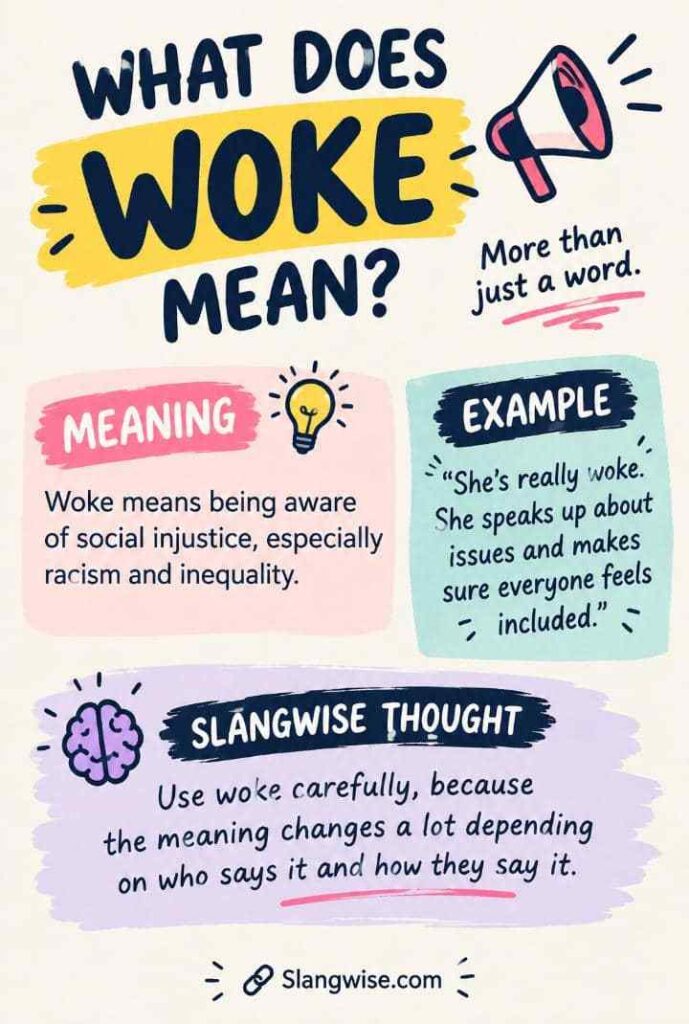
Table of Contents
Where Did Woke Come From?
First, let us clear up one common misunderstanding. Woke is not simply a newer version of the ordinary word awake. In its slang sense, it developed within Black American English as a way of describing a person who was alert to racial injustice and the realities surrounding Black life.
The phrase stay woke is especially important to the story. A well known early recorded example appears in connection with Black folk musician Lead Belly and his 1938 recording about the Scottsboro case.
His warning to stay woke carried the idea of keeping your eyes open and staying alert to possible danger and injustice.
That is why I would not describe the original sense of woke as simply “being politically correct.” That misses the history.
The older meaning was much closer to being informed, alert, and conscious of what was happening around you, particularly when race and unfair treatment were involved.
By the middle of the twentieth century, the word was also being used more broadly to mean well informed or aware.
In 1962, Black writer William Melvin Kelley even discussed woke in his famous New York Times Magazine essay, showing that the word was already established enough in Black slang to deserve serious attention.
Slang Decoder Note: This history matters because it explains why calling woke “just internet slang” is too simplistic. The internet helped spread it, but the internet did not invent it.
How Woke Became a Mainstream Word
According to Merriam-Webster, the modern use of woke originated in African American English and refers to being aware of and attentive to important issues, particularly racial and social justice.
For decades, woke remained strongly connected to Black cultural and political expression. Then the internet changed the speed at which language traveled.
In the 2000s, the phrase received another boost in popular culture, including Erykah Badu’s 2008 song Master Teacher.
A few years later, stay woke became especially visible on social media during the Black Lives Matter era and the protests surrounding police violence. By the 2010s, the word had moved well beyond its original linguistic community.
That mainstream journey changed something important. Once people from different communities started using the same word, they did not always use it with the same meaning.
For one person, being woke could mean paying attention to discrimination and social inequality. For another, it could simply mean being socially conscious.
And in another conversation, the same word could be used sarcastically to suggest that somebody was being overly political or trying too hard to appear progressive.
What Does Woke Mean Today?
Today, woke has become what I would call a high context slang word. Its dictionary style definition can give you the foundation, but the sentence, speaker, and situation usually tell you the actual intention.
At its most straightforward, woke describes someone who is aware of social problems, especially issues involving discrimination, inequality, or injustice. But that is only one layer of the word now.
In casual internet conversation, you might see woke used positively, neutrally, ironically, or critically.
- Positive: A person may call someone woke because they are knowledgeable about social issues and thoughtful about how other people are treated.
- Neutral: Someone may use woke simply to describe content that focuses heavily on social awareness or identity.
- Critical: A speaker may use woke to complain that a person, company, movie, or campaign is being overly political or performative.
This is where people get confused. Two people can use the exact same word while communicating completely different attitudes toward the subject.
Why Did Woke Become So Controversial?
Once woke entered mainstream political and cultural arguments, its meaning became much more contested. The word started appearing in debates about race, gender, education, entertainment, corporate messaging, activism, and identity.
That political use created an important shift. Woke stopped being only a description of awareness and became a label that people could use to characterize an entire attitude or worldview. In some settings it remained a positive term. In others, it became a criticism.
That is also why you should be careful with statements like “That is woke.” On its own, the sentence is incomplete. Woke in what sense? Socially aware? Inclusive? Politically progressive? Performative? Sarcastic? The context has to answer that question.
Woke, Stay Woke, Woke Washing, and Wokeism
As the word evolved, several related expressions appeared around it. They sound similar, but they are not interchangeable.
- Stay woke: A phrase built around staying alert, aware, and conscious of injustice or important social realities.
- Woke culture: A broad phrase used to talk about modern social awareness, activism, identity, or cultural debates.
- Woke washing: A criticism of a brand or organization that presents itself as socially conscious without matching that image with meaningful action.
- Wokeism: A politically charged label sometimes used to describe or criticize what the speaker sees as an excessive focus on social justice or progressive ideas.
Notice something important here: these related terms do not all carry the same emotional tone. Stay woke can be a sincere call for awareness, while wokeism is often used as a criticism. That difference is exactly why slang decoding requires more than memorizing definitions.
One thing I have learned from decoding slang: A word can keep its old meaning while gaining a completely new social meaning at the same time. Woke is one of the clearest examples of that.
New Examples of Woke in Conversation
Example 1: “My brother has become really woke about how casually people use stereotypes online.”
Example 2: “The company launched a very woke campaign, but people immediately started questioning whether it was genuine.”
Example 3: “She called the show woke because it gave attention to stories that usually get ignored.”
Example 4: “Every time that creator talks about social issues, the comments accuse him of being woke.”
Example 5: “The joke was supposed to be sarcastic, but calling it woke made the comment section even more confusing.”
Slangwise Thought: Look at how the word changes from example to example. In one sentence, woke describes awareness. In another, it describes branding. In another, it is simply a label someone throws into an argument. That is modern slang in action.
4lifer is another interesting slang term that has been trending online for a while now. Discover what 4Lifers means in slang and stay current.

WAKE UP
Show off your woke vibes! 😏 Now that you know what ‘woke’ really means, rep your social awareness with our fresh Woke Slang Merch! 👕👖 Click here to shop and level up your wardrobe game!
How to Use Woke Without Getting It Wrong
If you plan to use woke yourself, context is your best friend. The word can carry a lot of baggage, so saying exactly what you mean makes communication much easier.
- Explain what you mean. Instead of simply saying something is woke, describe the awareness or behavior you are talking about.
- Pay attention to tone. A serious statement and a sarcastic comment can use the same word but send completely different messages.
- Know your audience. People from different communities can hear very different meanings in the same slang term.
- Do not assume everyone uses it the same way. This is especially important online, where sarcasm and political arguments can blur meanings quickly.
Why Woke Still Matters
What makes woke interesting to me as a slang word is not simply that people disagree about it. It is the fact that its meaning tells us something about how language travels.
A term can begin inside a particular community, carry cultural meaning for decades, become popular through music and social media, and then be adopted by people who use it differently from the people who popularized it originally. That is exactly what happened with woke.
Today, hearing the word often tells you almost as much about the speaker’s attitude as it does about the subject being discussed. That is why one person can hear woke and think “socially aware,” while another immediately hears criticism or sarcasm.
Conclusion
So, what does woke mean? At its core, the modern slang sense points to being aware and alert to social injustice, especially racial inequality. But the word has traveled a long way from its Black American linguistic roots.
Today, woke can describe social awareness, political consciousness, inclusion, or, depending on the speaker, behavior they consider excessive or performative. That is why you cannot understand the word properly by memorizing one definition and stopping there.
The real skill is learning to read the context. Listen to who is speaking, what they are describing, and whether the tone is serious, supportive, sarcastic, or critical. Once you start doing that, woke becomes much easier to decode.
In a Nutshell
- Original meaning: Woke developed in Black American English as a term connected to awareness and staying alert to racial injustice.
- Early history: The phrase stay woke has documented roots going back many decades, including a well known 1938 recording by Lead Belly.
- Mainstream rise: Music, social media, and the Black Lives Matter era helped push the word into much wider public use during the 2000s and 2010s.
- Modern meaning: Today, woke can be positive, neutral, ironic, or critical depending on the speaker and context.
- Slangwise lesson: Understanding woke means understanding the situation around the word, not just the word itself. Keep decoding slang with us and explore our Slang Quiz and free 270+ Internet Slang Dictionary and Ebook.
FAQs
The simplest meaning of woke is being aware and informed about social injustice or inequality, especially issues involving race and discrimination. Modern usage can also carry different political or sarcastic meanings depending on context.
No. Woke existed in Black American English long before social media became popular. The internet helped spread the word widely, but it did not create the slang meaning.
Stay woke means to remain alert, informed, and conscious of important social realities, particularly injustice or discrimination. Its historical use is closely connected to Black American speech.
As the word became more mainstream, some speakers began using woke critically to describe ideas, messages, brands, or behavior they considered overly political, performative, or focused on progressive social issues.
It depends on what you are trying to communicate. Because woke can be positive, neutral, sarcastic, or critical, it is usually clearer to explain the specific behavior or idea you mean.