
- Meaning: Big yikes is a stronger way to react to something awkward, embarrassing, shocking, or seriously cringe.
- Vibe: It is playful, dramatic, and a little judgmental, but it can still feel sympathetic depending on how it is used.
- Where it shows up: You will see it in TikTok comments, Twitch chats, memes, group chats, and reaction posts.
- What it replaces: It often stands in for longer reactions like “that is awkward,” “that is rough,” or “wow, that was embarrassing.”
- Easy version: If yikes is a quick cringe, big yikes is the louder, more dramatic cringe.
- Test your slang skills: Take our Slang Quiz and see how many internet terms you can guess correctly.
- Build your slang library: Download our free 270+ Internet Slang Dictionary for more meanings, examples, and quick slang breakdowns.
Have you ever seen something so awkward that one word was enough to say everything? That is exactly where big yikes comes in.
It is the kind of phrase people use when a moment goes from mildly uncomfortable to full-on cringe. You do not need a long explanation. You just need a reaction.
In this post, we will break down what big yikes means, where it came from, how people use it today, and why it has become such a popular reaction phrase online.
What Big Yikes Really Means
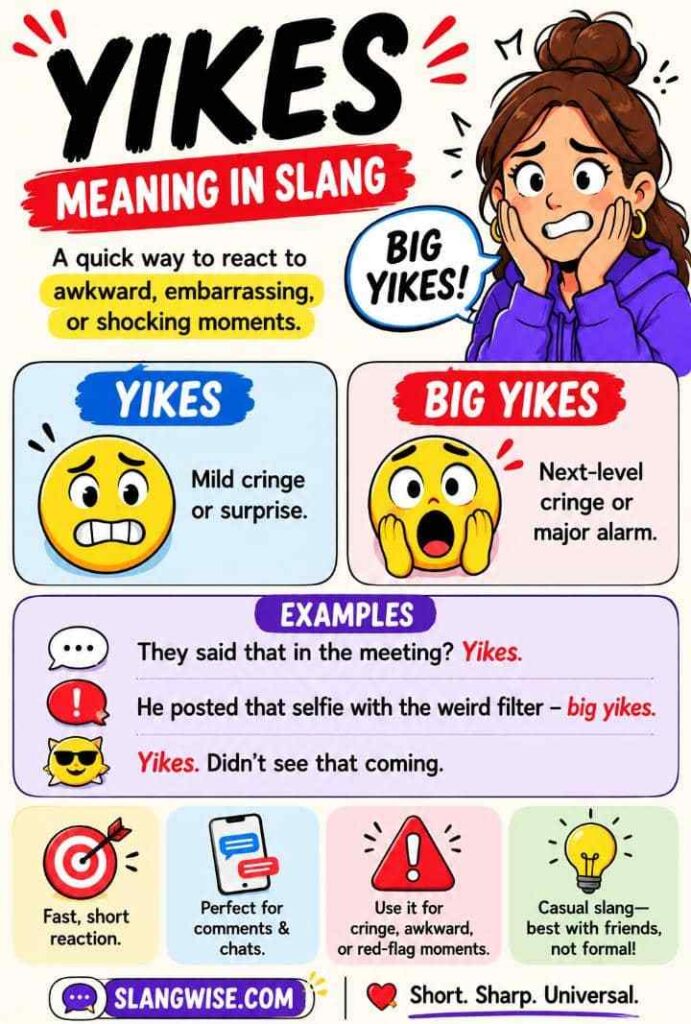
Big yikes is a stronger version of yikes. It is used when something feels extra awkward, embarrassing, alarming, or just painfully cringe.
Think of it like this: yikes is the quick gasp, while big yikes is the full reaction. It is the pause, the wince, and the “I cannot believe that just happened” feeling all in one.
People usually say it when they want to react fast to a fail, an awkward post, a bad take, or a situation that deserves a dramatic side-eye.
Example:
- Standalone reaction: “Big yikes.”
- Comment on a mistake: “That post edit? Big yikes.”
- Sympathetic reaction: “Big yikes, that must have been rough.”
Big yikes is one of the phrases that instantly tells people the moment was awkward, embarrassing, or painfully cringey. For more on the base word, Merriam-Webster defines yikes as an interjection used to express fear or astonishment.
That is part of why the phrase works so well. It is short, clear, and immediately emotional.
READ ALSO: Spill the Tea Isn’t About Tea… Here’s What People Really Mean in slang
Where Did Big Yikes Come From?
Big yikes grew out of the older word yikes, which has long been used as a quick exclamation for surprise, discomfort, or alarm.
Online, people love turning familiar words into bigger, more dramatic versions. Add big, and the reaction feels louder and more intense.
The phrase became especially popular in reaction culture on platforms like TikTok and Twitch, where people often respond in real time to awkward clips, embarrassing fails, or shocking moments.
- Start with yikes. The original word already carried shock, discomfort, or embarrassment.
- Add emphasis. Internet users made it bigger by saying big yikes.
- Spread through reaction content. Meme captions, livestream chats, and short-form videos helped it travel fast.
- Become shared language. It turned into a quick way to say, “We all saw that, and wow, that was rough.”
That is why the phrase stuck. It captures a feeling people already had and gives it a simple, repeatable name.
READ ALSO: Millennial Pause Mean On TikTok? A brief overview
How Gen Z Uses Big Yikes Today
Gen Z uses big yikes in a few different ways, but the feeling stays the same. It usually means something is awkward, embarrassing, or hard to watch.
In group chats and DMs
It is perfect for reacting to a friend’s messy story or embarrassing mistake.
Example: “I accidentally sent my boss a meme instead of the report.”
Reply: Big yikes.
In captions and memes
People use it as a short caption when they want to communicate cringe or awkward humor quickly.
Example: “When your Wi Fi dies mid livestream. Big yikes.”
In livestream chats
On Twitch and similar platforms, viewers may spam big yikes when something embarrassing or chaotic happens on screen.
In comment sections
It is also common under videos showing fails, awkward interviews, tone-deaf posts, or awkward public moments.
Example: “That plot twist was big yikes.”
Why Big Yikes Works So Well
The phrase works because it is fast, funny, and easy to understand. It gives people a simple way to react without writing a whole paragraph.
- It is clear: Everyone immediately gets the mood.
- It is flexible: It can sound playful, sympathetic, or teasing.
- It is short: Two words do all the work.
- It fits online culture: It works well in comments, captions, and reaction posts.
That is a big reason slang like this spreads so quickly. It feels natural, current, and instantly useful.
READ MORE: What Does Millennial Pause Mean On TikTok? A brief overview
Similar Catchphrases and Variants
If you have seen people stretch the phrase a little, that is normal. Online language loves variations.
- Mega yikes: A very intense cringe reaction.
- Yikes x100: A louder way to say the situation is really bad.
- Ultimate yikes: Maximum embarrassment or awkwardness.
- Big oof: A painful or unfortunate reaction phrase.
- Cringe city: A situation that feels almost unreal in how awkward it is.
Examples of Yikes in Conversations
Here are a few natural ways you might see the phrase in everyday conversation:
Friend 1: I waved at someone who was not waving at me.
Friend 2: Big yikes, that is so embarrassing.
Caption: When you realize your microphone was on the whole time. Big yikes.
Reaction: The group project presentation went completely off track. Big yikes.
Chat reply: You texted the wrong person? Big yikes, I felt that.
When Should You Use Big Yikes?
Big yikes works best in casual spaces where humor, irony, or shared embarrassment makes sense. Think friends, memes, comments, and reaction posts.
- Use it when something is awkward, embarrassing, or hilariously bad.
- Use it when you want a quick reaction instead of a long explanation.
- Use it when the tone is playful or internet friendly.
It may feel too informal for serious situations, so timing matters.
Final Thoughts

Big yikes is one of those phrases that works because it is simple, emotional, and instantly relatable. It captures that exact moment when a situation shifts from awkward to painfully cringe.
That is why it shows up so often in comments, captions, group chats, and reaction videos. It is basically shorthand for “wow, that was rough.”
If you ask me, that is the fun part of slang. It turns everyday feelings into words people can use right away.
And now you know exactly what to say the next time the internet hands you a spectacular fail.
Frequently Asked Questions
Usually not. It is often playful or teasing, but it can sound blunt depending on the situation.
Yes. It is widely understood in casual online speech, even though Gen Z helped popularize it.
Big yikes is more about cringe, embarrassment, or awkwardness. Big oof usually points to something painful or unfortunate.
Yes, it is still common in comments, chats, memes, and reaction posts because the meaning is quick and clear.
About the Author
Agboola John is the founder of SlangWise.com, dedicated to decoding internet lingo one slang term at a time. He explores how online language evolves, why certain phrases go viral, and how slang helps people connect across digital spaces.
Table of Contents