
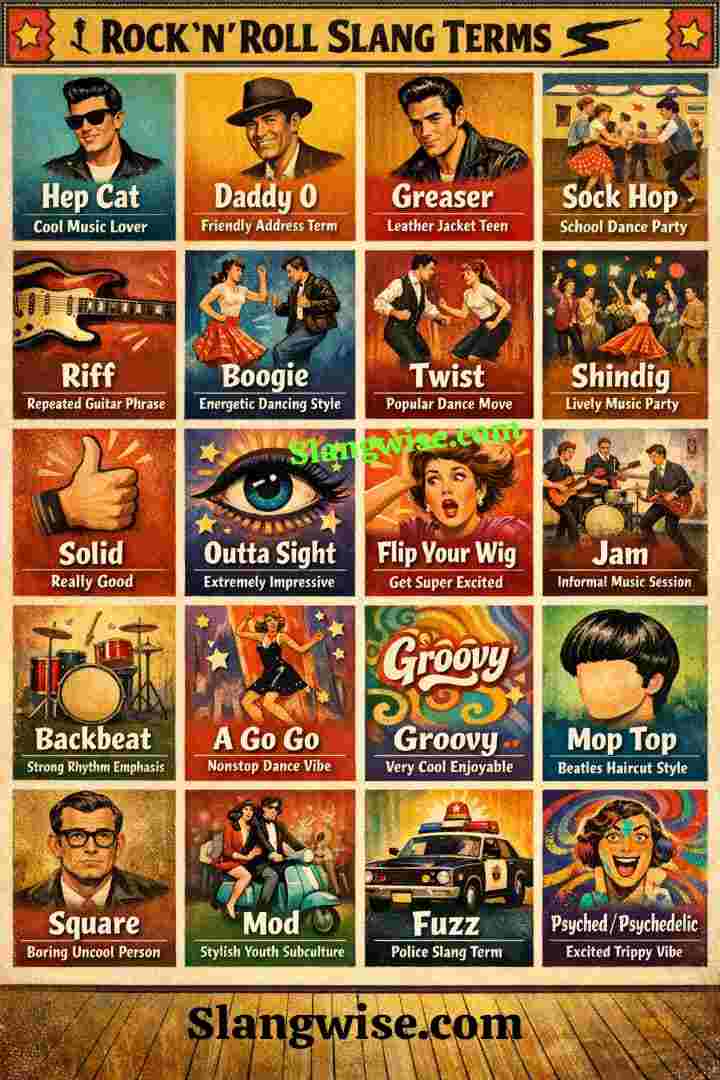
Rock and Roll Slang: 25 Words From the Golden Age of Music
Words are the secret riffs of culture. When they are spoken in tune, they electrify generations.
The golden age of rock and roll, roughly from the mid 1950s to the late 1960s, changed much more than music. It changed the way young people talked about sound, style, attitude, and belonging.
The phrase rock and roll itself had already been in circulation before the style took off as a named genre in 1952, and by the 1950s and 1960s youth slang was pulling from jazz talk, African American vernacular, and dance floor speech to describe anything that felt fresh, bold, and alive. (etymonline.com)
From my research into early DJ broadcasts, oral histories, and old magazine coverage, I keep coming back to the same idea. Rock and roll did not just give people a soundtrack.
It gave them a vocabulary. If you were a teen in a sock hop, hanging out by a jukebox, or listening to a late night radio show, these words helped you sound like you belonged to the moment.
So let us step back into that world together. Some of these expressions are playful. Some are stylish. Some are a little ridiculous in the best possible way. All of them carry the energy of a generation that wanted its own language.
SlangWise Thought: “When music changes, language follows right behind it.”
Rock and Roll Slang: 25 Words From the Golden Age of Music and Their Stories
1. Hep Cat
Hep cat means a stylish, cool person who knows the scene and understands the music. In rock and roll talk, it was the kind of label you wanted if you were the one who knew the latest records, the best moves, and the right kind of attitude.
Picture someone walking into a club with confidence, talking like they are already in on the joke, and keeping up with the fastest beat in the room. That is the energy of hep cat. It came out of jazz culture first, then rolled right into rock and roll youth speech.
SlangWise Thought:
Hep cat has a little swagger in it. It sounds old school now, but in its day it was a neat way to say someone was not just around the music, they were part of the culture.
2. Daddy O
Daddy O was a friendly way to address someone, a little like saying man, pal, or buddy. It had a warm, informal rhythm that made it sound relaxed and upbeat at the same time.
You can almost hear it in a backstage chat or in a doo wop introduction between songs. It carries that easy, conversational feel that made rock and roll language so fun. Instead of sounding stiff, it sounded like somebody who was glad to be talking to you.
SlangWise Thought:
Daddy O feels friendly without trying too hard. That is part of why it fits this era so well. Rock and roll loved words that sounded smooth, loose, and social.
3. Greaser
Greaser referred to a young person, often working class, who wore slicked back hair and leaned into a rebellious look. Think leather jackets, pomade, and a tough attitude that said they did not care much what the adults thought.
This word is tied to the visual side of rock and roll just as much as the sound. A greaser was not only a music fan. The word also pointed to a whole style, the kind of style that made teenagers feel seen, bold, and a little dangerous in a harmless way.
SlangWise Thought:
Greaser is one of those words that instantly gives you an image. You do not need a long explanation. You already know the vibe, the jacket, and the attitude.
4. Sock Hop
A sock hop was a casual school dance, usually held in a gym or auditorium, where teenagers often danced in their socks to protect the floor. The name itself sounds playful, and that is exactly the point.
Sock hops were part music event, part social scene, and part teenage rite of passage. They were places where songs got heard, dances got learned, and slang got shared. If you were there, you were not just listening to rock and roll. You were living it.
SlangWise Thought:
Sock hop is a perfect example of how a simple school event became a cultural memory. It sounds lighthearted, but it captures the whole teen world around the music.
READ ALSO: 25 Forgotten Slang Words from the 1800s That Tells a Story About the Past
5. Riff
A riff is a repeated musical phrase or chord pattern, the kind of short musical idea that can carry a whole song. In rock and roll, riffs became a big deal because they gave songs their bite, their hook, and their identity.
If you have ever heard a song and instantly known it from the first few notes, that is riff power. A good riff is memorable, sharp, and impossible to ignore. It is one of the reasons so many rock and roll songs still live in people’s heads decades later.
SlangWise Thought:
Riff is one of those words that does double duty. It belongs to musicians, but it also belongs to fans, because everybody loves the part of a song they can recognize right away.
6. Boogie
Boogie means to dance with energy, and it also describes a lively blues based style that fed right into rock and roll. It is a word that feels like movement even before you explain it.
Boogie is one of those slang words that does not sit still. It jumps, it rolls, it swings, and it invites you to move with it. That made it a perfect fit for dance halls, jukebox culture, and the kind of music that was meant to get people on their feet.
SlangWise Thought:
Boogie has a joyful sound. Even saying it feels like joining the fun, which is probably why it lasted so long in music talk.
7. Twist
The Twist was both a dance and a full blown craze. Once the move caught on, the word became a symbol of how fast a dance could spread when young people made it their own.
What makes twist so interesting is that it was never just about the steps. It was about the thrill of joining something everybody was talking about. The word ended up capturing the whole excitement of a dance floor moment.
SlangWise Thought:
Twist feels like the kind of word that belongs to a crowd. It is short, catchy, and built for movement, which is exactly what a dance craze needs.
8. Shindig
Shindig means a party, especially one with music, dancing, and a relaxed, fun mood. It was the kind of word that made a gathering sound more lively before it even began.
If a radio announcer said there was a shindig coming up, you could already imagine the energy. It was not formal. It was not quiet. It was something you went to because you wanted to have a good time and maybe meet a few people while you were at it.
SlangWise Thought:
Shindig is one of those words that almost dresses the event for you. You hear it and instantly expect music, movement, and a little noise.
9. Solid
Solid meant really good, dependable, or top notch. In rock and roll speech, it could describe a song, a show, or even a person who just had the right feel.
What I like about solid is that it is simple but effective. It does not overpromise. It just gives a clean, approving nod. If something was solid, it meant it worked, and you respected it.
SlangWise Thought:
Solid is proof that one short word can carry a lot of praise. It is practical, calm, and still cool enough to fit the music scene.
READ MORE: Victorian Slang Secrets: 37 Curious 19th Century Slang Words That Sound Almost Made Up
10. Outta Sight
Outta sight meant amazing, incredible, or beyond expectation. The phrase had a life before rock and roll too, but by the 1960s it had become a bright, upbeat way to say something was excellent.
This is one of those phrases that sounds bigger than ordinary praise. It feels like enthusiasm breaking loose. When someone said a record or a performance was outta sight, they were not being polite. They were giving it real energy.
SlangWise Thought:
Outta sight has that perfect mix of surprise and approval. It sounds like the speaker is impressed enough to blur the words a little.
11. Flip Your Wig
Flip your wig meant to lose control in excitement, delight, or surprise. It is one of those wonderfully exaggerated phrases that feels half comic and half dramatic.
In a rock and roll setting, it captured the way fans reacted to music they loved. The phrase makes the feeling larger than life, which is exactly what youth culture often wants. Nobody wants to say they were mildly amused. They want to say they flipped their wig.
SlangWise Thought:
Flip your wig is funny because it sounds theatrical. That is part of its charm. It turns excitement into a scene.
12. Jam
Jam meant a musical session where people played together, often with a lot of improvisation. In rock and roll, jam was one of the most useful words around because it described both the act of playing and the good feeling of getting into the groove together.
A jam could be messy, loose, brilliant, or all three at once. That is what made it exciting. It was less about perfect polish and more about energy, chemistry, and having enough musical confidence to follow the moment wherever it went.
SlangWise Thought:
Jam feels like a word built for musicians. It is casual, creative, and open ended, just like the best live music moments.
13. Backbeat
Backbeat is the strong emphasis on the off beats in a song, especially the second and fourth beats in common time. That rhythm helped define the drive of rock and roll, giving it the bounce and push that made people move.
Even if a listener did not know the technical term, they could feel it. The backbeat is the part that makes a song clap, snap, and swing in a way that feels alive. It is one of the hidden engines of the whole genre.
SlangWise Thought:
Backbeat is a great reminder that some of the most important parts of music are the ones you feel before you can name them.
14. A Go Go
A go go described a place or mood that was nonstop, energetic, and full of dancing. It gave nightclub culture a lively label and made everything sound like it was happening at full speed.
The phrase carries a party feeling right inside the sound of it. It suggests movement, volume, and fun without needing much explanation. That is why it fit so neatly into the club and dance culture that grew around rock and roll.
SlangWise Thought:
A go go is the sort of phrase that feels like it is already in motion. You can almost hear the music before the sentence is finished.
DISCOVER: 45 Popular Gen X Slang Words That Will Take You Straight Back to the 80s and 90s
15. Groovy
Groovy meant great, stylish, or excellent. It came from music culture and took on a special glow in the 1960s, when people used it to describe anything that felt especially cool or satisfying. (etymonline.com)
Groovy is one of those words that can make even an ordinary moment feel a little more relaxed. It has a smooth sound, a laid back rhythm, and a built in smile. That is probably why it stuck so well in popular memory.
SlangWise Thought:
Groovy is pure atmosphere. The word itself feels like a slow nod, which is exactly the kind of vibe people wanted from it.
16. Mop Top
Mop top was the name people used for the famous Beatles style haircut, the kind of long, rounded look that fell across the forehead and around the ears. It became a symbol of a new youth image almost as much as a hairstyle.
When people heard mop top, they were not only thinking about hair. They were thinking about Beatlemania, teenage excitement, and the way a band could change what millions of young people thought looked fresh.
SlangWise Thought:
Mop top shows how music and image can fuse together. Sometimes a haircut becomes part of the soundtrack.
17. Square
Square was a sharp way to call someone old fashioned, overly proper, or just not with it. In youth slang, it marked the difference between the people who got the scene and the people who did not.
It was not the kindest word in the world, but it was a very efficient one. One quick label could tell everybody that the person being described was outside the current vibe. Teen slang has always loved that kind of shortcut.
SlangWise Thought:
Square is a tiny word with a lot of social power. It shows how strongly young people wanted to define their own culture.
18. Mod
Mod referred to a stylish youth subculture known for sharp clothes, scooters, modern jazz, and R and B taste. It was about identity as much as fashion.
Mod culture gave people a way to say, “This is the look, this is the sound, and this is who we are.” It was sleek, organized, and very aware of itself. In a time when youth culture was becoming louder, mod offered a polished kind of cool.
SlangWise Thought:
Mod is proof that slang can name a whole lifestyle, not just a single mood. It carries style, music, and attitude all together.
READ MORE: The Lost 1980s Skatepark Slang That’s Suddenly Dominating Boardrooms
19. Fuzz
Fuzz was slang for the police. It has that breezy, slightly mocking tone that made it useful in youth talk, especially in scenes where the police felt like part of the background tension.
Rock and roll culture often liked a word that could soften authority just enough to make it sound less intimidating. Fuzz did that job neatly. It was short, slightly cheeky, and easy to toss into a conversation.
SlangWise Thought:
Fuzz shows how slang can turn a serious subject into a street level nickname. That is a very rock and roll kind of move.
20. Psyched or Psychedelic
Psyched and psychedelic pointed to excitement, altered perception, and the wild, colorful edge of late 1960s culture. The words became tied to music that sounded exploratory, stretched out, and just a little surreal.
Even if someone used psyched in a casual way, the word carried a whole atmosphere with it. It suggested something that went beyond ordinary pop. It was about expansion, intensity, and the feeling that music could open a door in your mind.
SlangWise Thought:
Psyched is a word with movement inside it. It feels like energy building, which is exactly what the late 1960s loved to capture.
21. Dig
Dig meant to understand, appreciate, or like something. It was one of the most useful words in the rock and roll era because it could stand in for approval, attention, and real enthusiasm all at once.
You could dig a song, dig a style, or dig a person’s whole attitude. That flexibility made the word easy to use and easy to love. It also had enough cool in it to sound natural in both jazz and rock circles.
SlangWise Thought:
Dig is one of the best words in the whole list because it feels conversational right away. It is short, direct, and warm.
READ MORE ON: Dig It Meaning: Why This Tiny 70s Slang Still Hits Different
22. Jive
Jive started out as a word connected with playful talk, fast music, and sometimes empty or misleading speech. By the late 1920s it was already in American English, and it carried a strong rhythm that made it feel right at home in music culture.
In rock and roll speech, jive could describe the sound, the talk, or the whole atmosphere around the scene. It had bounce in it. It had attitude in it. It had enough motion to fit a generation that wanted its language to dance a little.
SlangWise Thought:
Jive is one of those words that seems to move while you say it. That alone makes it feel perfect for the music world.
23. Funky
Funky began as a jazz word with an earthy, strong, deeply felt feeling, and by the 1960s it had broadened into a compliment for anything stylish, excellent, or full of character. (etymonline.com)
That makes funky one of the most interesting words in this whole set. It moved from describing a musical feel to describing an entire vibe. People could use it for music, clothes, dance moves, or just the general mood of something that was not trying too hard and still looked great.
SlangWise Thought:
Funky has range. It can sound cool, warm, gritty, or stylish, which is why it lived so comfortably inside rock and roll culture.
24. Boss
Boss was used as a compliment to mean excellent, impressive, or top quality. Etymonline notes that the slang adjective sense was already recorded in the 1880s and then revived in teen and jazz slang in the 1950s. (etymonline.com)
In a rock and roll context, boss was exactly the kind of word that fit a confident scene. It sounded bold and approving without needing a long speech. If something was boss, it got the nod, simple as that.
SlangWise Thought:
Boss works because it is both strong and easy. It feels like a quick stamp of approval from someone who knows what they like.
25. Far Out
Far out meant amazing, unusual, or wonderfully different. The slang sense is recorded from 1954, and it began in jazz talk before spreading into wider youth culture.
Far out is one of those phrases that makes everything feel a little bigger. It suggests surprise, admiration, and a bit of edge all at once. If something was far out, it was not ordinary. It had personality, and people noticed it.
SlangWise Thought:
Far out is a beautiful example of how rock and roll language stretched ordinary words into something much more expressive.
Why These Words Still Feel Alive
What makes rock and roll slang so fun is that it never stayed still. It moved with the music, the clubs, the radio, the dance halls, and the changing moods of young people who wanted to sound like themselves. Some words were about sound, like riff and backbeat.
Some were about style, like greaser and mop top. Some were about attitude, like square and boss. Others were pure feeling, like groovy and far out.
That is why these phrases still hold up now. They are not just old words sitting in a list. They are snapshots of a culture that was learning how to speak for itself. Rock and roll gave people a beat, but it also gave them a voice.
And honestly, that is the part I love most. Every generation invents new slang, but the best words are the ones that capture more than fashion. They capture belonging. They capture energy. They capture a moment when people felt the world changing and wanted language that could keep up.
These 25 terms do exactly that. They carry jukebox glow, dance floor buzz, teenage confidence, and a little bit of rebellion. That is a pretty good legacy for a few short words.
Final Thoughts
Rock and roll was never only about guitars, drumbeats, and catchy hooks. It was also about the words people used while they were listening, dancing, dressing up, falling in love, acting cool, or trying to sound like they belonged to the moment.
That is what makes this kind of slang so memorable. It lets you hear the culture as well as the music.
From hep cat to far out, these expressions carry the spirit of a time when young people were building their own style in real time.
They borrowed, reshaped, repeated, and reinvented. They made language feel as alive as the records spinning on the turntable. In my view, that is exactly what great slang always does.
Table of Contents