

There is something fascinating about slang that refuses to disappear. Some expressions become outdated almost as quickly as they arrive, while others travel across generations and somehow retain their original personality. “Dig it” belongs to the second group.
Imagine someone listening to a fantastic jazz record, nodding along, and turning to a friend with the question, “You dig it?” They are not asking whether the person understands gardening.
They want to know whether the music connects, whether the feeling makes sense, and whether the other person appreciates what is happening.
That is the charm of this expression. After exploring vintage slang and the cultural stories behind everyday expressions, I have come to appreciate how much meaning a simple phrase can carry. And dig it is a particularly interesting example.
By the end of this guide, you will understand its real meaning, its connection to Black American speech and music culture, why it became so recognizable during the 1970s, and how people can still use it naturally today.

What Does Dig It Mean in Slang?
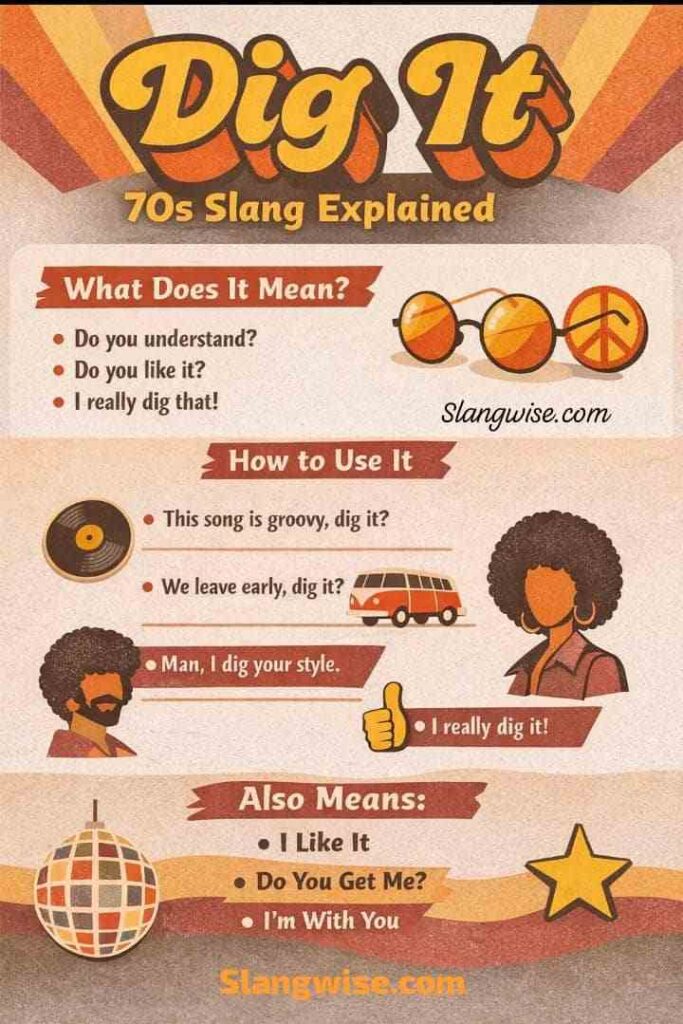
Dig it is an informal expression that generally means to understand, appreciate, enjoy, or connect with something.
The exact meaning depends on the conversation.
For example, when somebody asks, “You dig it?”, they might mean:
- Do you understand what I am saying?
- Do you like what you are seeing?
- Are you enjoying this?
- Do you connect with this idea?
When someone says, “I dig it,” they are usually expressing appreciation or approval.
Think of it as an old school way of saying, “I get it,” “I like it,” or “I am feeling this.”
What makes the expression interesting is that understanding and appreciation are closely connected. Sometimes, you do not simply understand something intellectually. You connect with it emotionally, too.
That is the feeling this little expression often communicates.
READ ALSO: Peace Out Meaning Explained: Why This Simple Goodbye Still Feels So Cool
Where Did Dig It Come From?
Here is something many people get wrong: dig it did not originate in the 1970s.
The slang use of the word dig was already appearing in African American English during the 1930s. It carried meanings connected to understanding, paying attention, appreciating, and enjoying something.
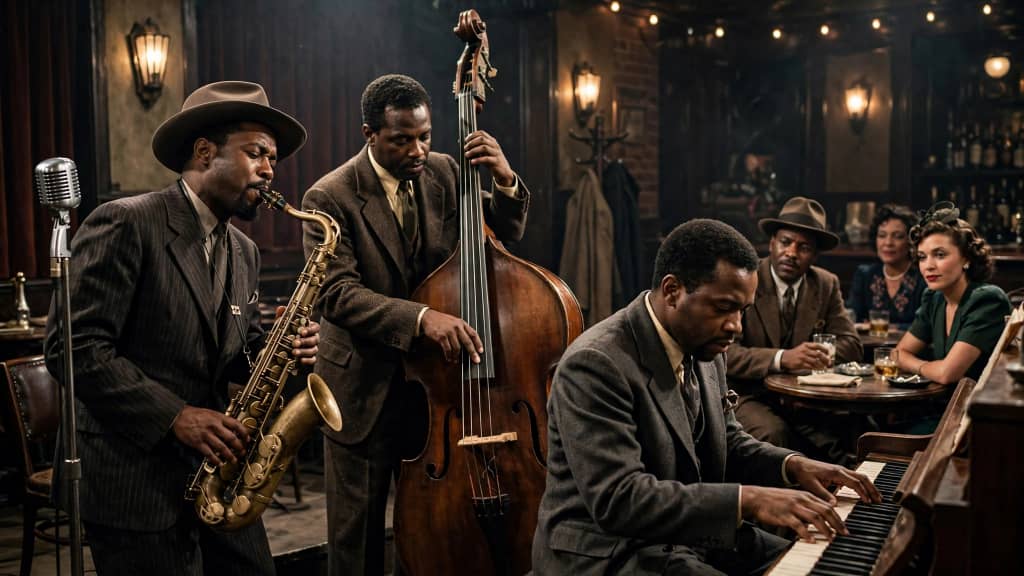
The expression became associated with Black American jazz and jive culture, where musicians and music lovers used language that communicated shared understanding and appreciation.
By the 1940s and 1950s, expressions involving dig were familiar in jazz related conversations and popular culture. Cab Calloway’s famous 1944 Hepster’s Dictionary, for instance, included dig with meanings connected to seeing and understanding.
As the expression travelled beyond those original cultural settings, it became increasingly recognizable among wider American audiences.
The beatnik movement, counterculture, music, television, and youth culture helped carry it into the 1960s and 1970s.
I think this history deserves attention because slang does not usually appear out of nowhere. Expressions often develop within particular communities before spreading into everyday speech. Recognizing those roots gives us a better understanding of the people and cultures that shaped the language.
Why Did Dig It Become So Popular in the 70s?
The 1970s had a distinctive personality. Music, fashion, entertainment, and youth culture were constantly influencing one another.
Think about funk, soul, disco, colourful clothing, expressive hairstyles, and the relaxed confidence associated with the decade.
Language reflected that atmosphere.
People enjoyed expressions that sounded natural, energetic, and memorable. Dig it fitted comfortably into that world.
It was short enough to use casually but expressive enough to communicate an entire feeling.
The phrase also worked beautifully in music and entertainment. A performer could say, “Can you dig it?” and immediately invite an audience to understand, appreciate, or connect with what was happening.
I find that particularly interesting about vintage slang. Some expressions become popular because they communicate more than their literal definitions. They also communicate identity, attitude, and a sense of belonging.
Dig it did exactly that.

READ ALSO: 35 Old School Slang Words Parents Still Say in 2026: Cool, Dope, and My Bad etc.
How to Use Dig It in Everyday Conversation
One reason I like studying this expression is its flexibility. You do not need a complicated sentence to use it correctly.
Here are some fresh examples that show how it works in different situations.
1. Showing that you appreciate music
“That guitarist knows exactly what he is doing. I really dig his sound.”
Meaning: I really enjoy his music and appreciate his style.
2. Checking whether someone understands
“We have to look at the bigger picture before making this decision. You dig?”
Meaning: Do you understand what I am trying to explain?
3. Expressing excitement about an idea
“I have an idea for a weekend photography project.”
“That sounds interesting. I dig it!”
Meaning: I like that idea.
4. Appreciating someone’s creativity
“Your new artwork has a completely different feel.”
“Thanks! I wanted to try something different.”
“Well, I dig it.”
Meaning: I appreciate your creativity and like what you have done.
5. Asking for agreement
“We could make the presentation more interesting by adding a few illustrations. Can you dig that?”
Meaning: Do you understand and agree with the suggestion?
Notice something? The phrase can communicate approval, understanding, or appreciation without making the conversation sound formal.
Dig It vs. Just Dig: Is There a Difference?
There is a small grammatical difference, but the underlying slang meaning is closely related.
Dig is the main verb, while it usually refers to the particular thing being discussed.
Here is how they compare:
| Expression | Meaning |
|---|---|
| I dig jazz. | I enjoy jazz music. |
| I dig it. | I like or appreciate it. |
| Do you dig this? | Do you like or understand this? |
| Can you dig what I mean? | Can you understand my point? |
| I really dig your creativity. | I appreciate your creativity. |
The important thing is context. Dig does not always mean exactly the same thing in every sentence, but its slang meanings generally revolve around understanding and appreciation.
DISCOVER: 45 Popular 70s Slang Words That Sound Strange Until You Know What They Mean
My Slangwise Thought: Why This Little Expression Still Matters
When I explore expressions from earlier generations, I often notice something that modern slang enthusiasts can easily overlook: the history behind a phrase can be just as interesting as its meaning.
Imagine two people listening to the same record. One person simply hears a melody, while the other understands the musicians’ creativity, appreciates the rhythm, and connects with the feeling behind the performance.
That second person might say, “I dig it.”
It communicates more than ordinary approval. It suggests that something has genuinely connected with you.
I also think there is a lesson here about how slang evolves. A phrase can begin within a particular cultural community, become popular through music and entertainment, and eventually turn into a nostalgic expression associated with an entirely different generation.
That is what happened with dig it.
Its history reminds us to appreciate the cultural communities that contribute to everyday language rather than treating popular expressions as if they simply appeared during the decade when they became fashionable.
And honestly, that is one reason I enjoy exploring vintage slang. Every expression has a story worth uncovering.
Modern Alternatives to Dig It
If you wanted to communicate the same general feeling today, you could use several familiar expressions.
| Modern expression | Similar meaning |
|---|---|
| I feel that. | I understand or connect with that. |
| I get it. | I understand. |
| I’m into it. | I like it. |
| That’s my vibe. | I really like that style or feeling. |
| I see what you mean. | I understand your point. |
| I’m feeling this. | I enjoy or appreciate this. |
| That makes sense. | I understand the reasoning. |
These alternatives are not perfect replacements in every situation, but they capture some of the same meanings.
The difference is that dig it brings a distinctive vintage personality that modern expressions do not necessarily have.
Can You Still Say Dig It Today?
Absolutely!
Although it sounds old school, there is nothing wrong with using it today.
You could say:
- “I dig this new photography style.”
- “That is a brilliant idea. I dig it.”
- “You understand what I am saying, right? Can you dig it?”
- “I really dig the atmosphere of this place.”
It works particularly well in relaxed conversations, creative settings, music discussions, and playful exchanges.
However, context matters. In a formal business presentation or professional email, it might sound unnecessarily casual or dated.
I would use it when the conversation allows a little personality. That is where its charm comes through.
Five Things to Remember About Dig It
- Meaning: Dig it generally means to understand, appreciate, enjoy, or connect with something.
- Origin: Its slang roots are associated with African American English from the 1930s.
- Cultural influence: Jazz, jive, and later counterculture helped popularize the expression.
- 1970s popularity: Music, entertainment, and youth culture helped make it a recognizable vintage expression.
- Modern usage: You can still use it today to express appreciation or check whether someone understands you.
READ ALSO: 50 Most Iconic Slang Words of the Last 50 Years: The Words That Defined Every Generation
Conclusion
So, what does dig it mean?
It is a classic slang expression that communicates understanding, appreciation, enjoyment, or agreement, depending on the context.
Although many people associate it with the 1970s, its cultural history goes further back, particularly into African American speech and jazz culture.
What I find most fascinating is how naturally the expression connects understanding with appreciation. It is not simply about hearing something or noticing it. It is about getting the feeling behind it.
So, the next time somebody says, “Can you dig it?”, you will know exactly what they mean.
And if you genuinely like the idea, you already have the perfect response:
“I dig it!”
Frequently Asked Questions
Dig it is an informal slang expression meaning to understand, like, appreciate, or connect with something. Its precise meaning depends on the conversation.
The slang use of dig is associated with African American English in the 1930s, particularly jazz and jive culture. It became more widely recognized in later decades.
Yes. When someone says I dig it, they usually mean they like, enjoy, or appreciate something.
It is strongly associated with 1970s slang and popular culture, but the expression existed decades earlier. Its roots in African American slang date back to the 1930s.
Can you dig it is a way of asking whether someone understands, agrees with, or appreciates what is being said. The intended meaning depends on context.
Yes. People still recognize and occasionally use dig it, especially in relaxed conversations, music discussions, and situations where a retro expression fits the mood.
Further Reading and Slang Resources
If you enjoy exploring the history behind unusual expressions, I recommend Idiom Origins. It explores the background and development of idioms, curious expressions, and slang, including the historical use of dig.
Understanding where expressions come from makes learning slang much more interesting.
About the Author
Agboola John is the founder of Slangwise, a platform dedicated to exploring slang, internet expressions, Gen Z and Gen Alpha vocabulary, and the fascinating stories behind everyday language. Through Slangwise, he makes slang meanings, origins, and everyday usage easier for readers to understand.
Table of Contents