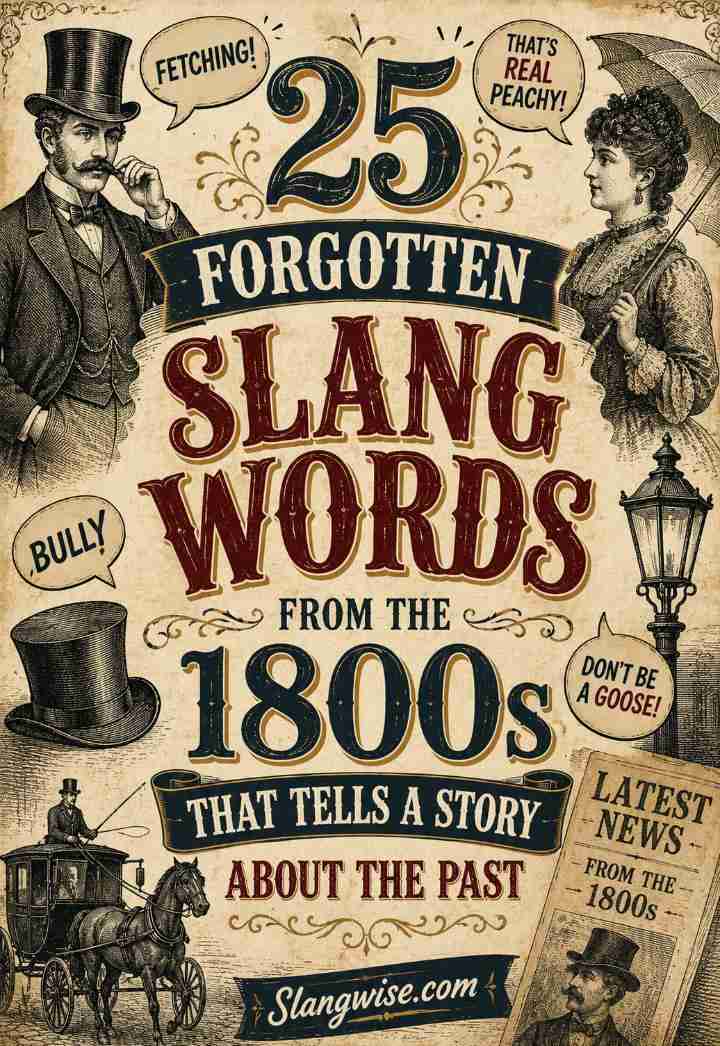
Language is one of the fastest ways to see what people cared about, laughed at, feared, and complained about. Old slang is especially fun because it often comes from real street life, newspapers, taverns, markets, and the kinds of everyday situations that official history tends to skip.
Slang also changes fast, and a phrase can feel completely ordinary for one generation and then almost vanish for the next. That is exactly why these words still feel so vivid now.
In a Nutshell
These 25 terms come from a mix of Victorian Britain, 19th century America, and early 20th century usage, and they show just how creative everyday speech could be.
Some are about food, some about crime, some about moods, some about rowdy public behavior, and some about class satire or pure nonsense.
A few have very clear dates, while others are best treated as “first clearly attested” rather than exact inventions. I have tightened the dating below so the list stays more consistent and matches the historical record more closely.
1. Bags o Mystery
Bags o Mystery was Victorian slang for sausages, usually with a teasing, suspicious tone, as if nobody quite knew what was really packed inside the casing.
The phrase appears in Passing English of the Victorian Era and in later references to that work, which makes it a neat example of how working people joked about cheap food and food uncertainty in the age of industrial cities.
Slangwise Note: this is basically Victorian side eye in food form, and honestly, that energy has never gone out of style.
2. Moll Buzzer
Moll buzzer is a 19th century American underworld term for a pickpocket or thief who targeted women. The word moll was already used in old low slang for a woman, and by the late 1800s it could also point toward a gangster’s girlfriend or a general female companion in underworld speech.
A cited example from 1874 shows the term in criminal context, which makes the dating much firmer than a vague “late 1800s” label.
Slangwise Note: this one reminds you that old slang was often very specific, even when it sounds playful now.
3. Got the Morbs
Got the morbs was Victorian slang for a temporary spell of sadness, gloom, or melancholia. In Passing English of the Victorian Era, James Redding Ware gives it as a 1880 term and defines it plainly as temporary melancholia, which is exactly the kind of dry, slightly comic wording the Victorians loved.
It is also a good reminder that people were naming ordinary sadness long before modern self help language arrived.
Slangwise Note: this phrase feels strangely current, because everyone still has days when the mood just drops for no obvious reason.
4. See the Elephant
See the elephant was a 19th century American phrase meaning to see the sights, experience the world, or confront the rougher side of life. In the GBH archive piece, the phrase is shown with a 1891 newspaper example, and the article also notes that it could mean going to war in military use.
That makes it one of those flexible old idioms that could point to adventure, experience, disappointment, or hard reality depending on context.
Slangwise Note: it is a perfect example of how one phrase can carry excitement and warning at the same time.
5. Spizzerinctum
Spizzerinctum is best treated as an early 20th century American slang word for vim, pep, energy, or ambition, with records showing it in use by at least 1917 and in a 1920 newspaper example.
Merriam Webster defines it as “the will to succeed” or energy and ambition, while other historical references show the word floating around in slightly different spellings much earlier. To keep the dating consistent, early 20th century is the safest label here.
Slangwise Note: this is one of those glorious fake sounding words that somehow feels more alive than a lot of modern motivational language.
BOOKMARK: The 50 most Iconic Slang Words of The Past 50 Years (Updated)
6. Cop a Mouse
Cop a mouse was Victorian slang for getting a black eye. Ware’s entry explains the image neatly, saying that “cop” here means to catch or suffer, while the mouse refers to the shape and color of the bruise.
That makes the phrase wonderfully blunt and funny at the same time, which is part of the charm of so much old working class slang.
Slangwise Note: instead of sounding polished, it sounds like something someone would mutter after a pub fight while pretending it did not hurt much.
7. Dingus
Dingus is a very useful 19th century American slang word for an unspecified object, gadget, or thing whose name you do not know or cannot remember.
Etymonline traces it to 1874 and links it to Dutch dinges, meaning “thing.” That makes the original date much earlier than the casual 1890s label people often repeat.
Slangwise Note: it is the ancestor of every “thingamajig,” “whatchamacallit,” and “that little thing there” we still say when the word has escaped us.
8. Shoddyocracy
Shoddyocracy was a sharp satirical word for people who got rich from shoddy goods or shady business, especially in 19th century America. The GBH article gives a newspaper example from 1870, and Green’s Dictionary of Slang also glosses it as people who became rich by making contracts for shoddy goods or other disreputable means.
It is one of the clearest class satire words on the list, because it mocks the newly wealthy without even trying to be subtle.
Slangwise Note: if there were a historical slang hall of fame for calling out fake rich people, this one would deserve a front row seat.
9. Absquatulate
Absquatulate means to leave abruptly, run away, or make off, and Etymonline dates it to 1840, with an earlier form absquotilate recorded in 1837. It is a mock learned, playful word, probably built to sound fancy while still meaning “take off.” That balance between humor and motion is very American and very 19th century.
Slangwise Note: it sounds like the sort of word a storyteller would use when they wanted the escape itself to feel a little more dramatic than it really was.
READ MORE: 35 Popular 70s Slang Words That Sound Like a Secret Code. From Groovy to Dude…
10. Mutton Shunter
Mutton shunter is a late 19th century British slang term for a policeman, and Ware dates it to 1883. The phrase is derisive, which fits the way many old slang terms treat authority figures, especially in dense city life where police and street people were constantly rubbing against one another.
The exact etymology is uncertain, but the meaning as a policeman is clear in the historical record.
Slangwise Note: this is the kind of nickname that tells you more about social tension than it does about the police themselves.
11. Doing the Bear
Doing the bear is a late 19th century phrase for courting in a way that involves hugging, but the record matters here because Ware labels it as Spanish American usage passing over the United States, not as a native Victorian British expression.
The entry also explains that it comes from the Spanish hacer el oso. So this is one of the terms where tightening the sourcing changes the label quite a bit.
Slangwise Note: it is a good reminder that slang travels, mutates, and gets adopted in places that are not always the phrase’s original home.
12. Mafficking
Mafficking came into English in 1900 and meant to celebrate rowdily in the streets. Ware ties it directly to the relief of Mafeking during the Boer War, noting that the news arrived on April 1, 1900, and that the streets were soon riotous.
That gives the word a very clear historical anchor, which is great for a blog post because readers like slang that is both funny and historically specific.
Slangwise Note: it is one of the best examples of how a public event can instantly create a new verb.
DISCOVER: 70 Most Popular Millennial Slang Words and What They Really Mean (From Adulting to YOLO)
13. Lollygag
Lollygag is an American slang word dating to 1862 in early forms such as lallygag. Historical sources gloss it as dawdling, idling, or fooling around, and the word is still alive today because its meaning is so instantly understandable.
Its exact origin is disputed, but the early date is clear enough for our purposes.
Slangwise Note: every generation needs a word for wasting time, and this one does the job with a smile rather than a scold.
14. Hornswoggle
Hornswoggle is a 19th century American slang verb meaning to trick, cheat, or swindle. Etymonline dates the cheating sense to 1806, which makes it one of the oldest entries on this list.
It has that classic frontier and con artist flavor, the kind of word that sounds as if it should come with a card table, a fake bargain, and somebody already regretting the deal.
Slangwise Note: it feels bigger than its meaning, which is probably why it survived for so long.
15. Beerage
Beerage is a late 19th century British satirical term for the peerage, especially when referring to brewing magnates who had been elevated into the upper class.
Merriam Webster glosses it as the British peerage and gives the etymology as a blend of beer and peerage, while Ware calls it a satirical rendering tied to brewery lords, including the great houses of Allsopp and Guinness. This is exactly the kind of class joke that makes old slang so revealing.
Slangwise Note: the joke works because it punches up, and that always gives slang extra bite.
Absolutely. Here are 10 more entries you can append as 16 to 25, which brings the list to a full 25 forgotten slang words and phrases.
16. Skedaddle
Skedaddle meant to run away quickly or bolt in a hurry. It was American Civil War slang and was already being popularized in newspapers in 1861, with an earlier 1859 use also noted in Northern newspapers.
Slangwise Note: this is one of those words that sounds exactly like the action it describes.
READ ALSO: 50 Popular British Slang Words That Will Make Your UK Chats Sound Local
17. Shebang
Shebang started as a Civil War era slang word in 1862 meaning a hut, shed, or shelter, and it was popularized among soldiers. Etymologists still treat its origin as uncertain, which only makes it feel more delightfully old and odd.
Slangwise Note: it is a great example of how a word can wander from a soldier’s camp into everyday speech.
18. Ballyhoo
Ballyhoo came into use by 1908 as a word for publicity, hype, or noisy promotion, and it grew out of circus slang and earlier colloquial uses from the 1890s. It has that perfect slightly chaotic sound for something loud and attention grabbing.
Slangwise Note: even the word itself feels like somebody shouting to draw a crowd.
19. Gumshoe
Gumshoe meant a plainclothes detective by 1906, named after the rubber soled shoes detectives wore so they could move quietly. It is one of those words that turns a practical detail into a whole character type.
Slangwise Note: the image is so vivid that you can almost hear the silent footsteps.
20. Hunky Dory
Hunky dory means excellent, fine, or as good as can be, and Etymonline dates it to 1864 in American English, with wider slang use noted by 1866. Its exact origin is uncertain, which is part of why it still sounds so playful now.
Slangwise Note: it has the kind of cheerful wobble that makes it impossible not to smile a little.
BOOKMARK: 25 True Crime Slang Terms That Sound Ordinary Until You Know What They Really Mean
21. Doozy
Doozy appeared by 1903 as an adjective and by 1916 as a noun meaning something excellent, striking, or unusually impressive. It is one of those early 20th century words that feels very Jazz Age, even before you think about the actual date.
Slangwise Note: it has the energy of a word used when something is just too good, weird, or memorable to leave unmentioned.
22. Razz
Razz meant to hiss at, deride, or mock by 1920, and Etymonline notes the noun form in 1919. It developed as a shortened, altered form connected to raspberry in the old teasing sense.
Slangwise Note: this one captures the sound of public mockery better than a longer modern word ever could.
23. Bee’s Knees
Bee’s knees was one of the classic 1920s praise phrases, used for something excellent or top tier, and Etymonline places that popular slang use in 1923. The same source also notes an older unrelated use of bee’s knee from 1797, which is why the 1920s dating is the one that matters here.
Slangwise Note: it is gloriously silly, which is exactly why it worked.
24. Patsy
Patsy meant a fool, dupe, or victim of a deception by 1903. The origin is uncertain, but the meaning is clear enough and has stayed familiar for a long time.
Slangwise Note: this is one of the most useful words on the list because people have always needed a term for the person who gets fooled.
25. Cat’s Pajamas
Cat’s pajamas was part of the 1923 fad for animal themed slang that meant something excellent or stylish. Etymonline groups it with other phrases from that year, including bee’s knees and cat’s whiskers, as part of the same burst of playful praise language.
Slangwise Note: it is pure 1920s attitude, all sparkle and swagger.
READ MORE: 35 Old School Slang Words Parents Still Say in 2026: Cool, Dope, and My Bad etc.
Why These Words Still Hit
What makes these expressions so fun is not just how strange they sound now. It is the way they preserve social attitudes in miniature.
Some of them came from city streets and rough neighborhoods, some from newspapers and public events, some from work life, some from courts and taverns, and some from class resentment or comic exaggeration.
Together they show that slang was never just “bad English.” It was a living record of how people talked when they were trying to be funny, insulting, practical, or sharp eyed about the world around them.
They also show why old slang keeps coming back in lists like this. A phrase like got the morbs or hornswoggle sounds playful on the surface, but it also carries a whole social world with it.
You can hear food suspicion in bags o mystery, urban roughness in cop a mouse, class satire in beerage, and pure comic motion in lollygag. That is the real charm. These words are tiny time capsules, and they make the past feel less polished and much more human.
Conclusion
These fifteen words do more than entertain. They show how people once talked about food they did not fully trust, streets that felt unsafe, moods that passed like weather, romance that had to be watched in public, and social climbing that deserved a little mockery.
They also show how quickly slang can appear, spread, shift meaning, and fade away. That is what makes historical slang such a good mirror for daily life. It is lively, cheeky, and often more honest than formal language ever was.
Frequently Asked Questions
Among this group, hornswoggle has the earliest clear date in Etymonline, with the cheating sense recorded from 1806, while absquatulate appears from 1840 and lollygag from 1862 in its early American form.
Mafficking is the most event bound, since it is directly tied to the relief of Mafeking in 1900 and the street celebrations that followed in Britain.
No. The list mixes British and American slang, and doing the bear is actually Spanish American in origin as Ware records it, even though it circulated through U.S. usage.
Old slang often sounds funny because it was built from metaphor, mock learning, class teasing, or plain phonetic play. That is exactly why words like spizzerinctum, hornswoggle, and beerage still feel so vivid even after they have mostly dropped out of everyday speech.
Table of Contents