
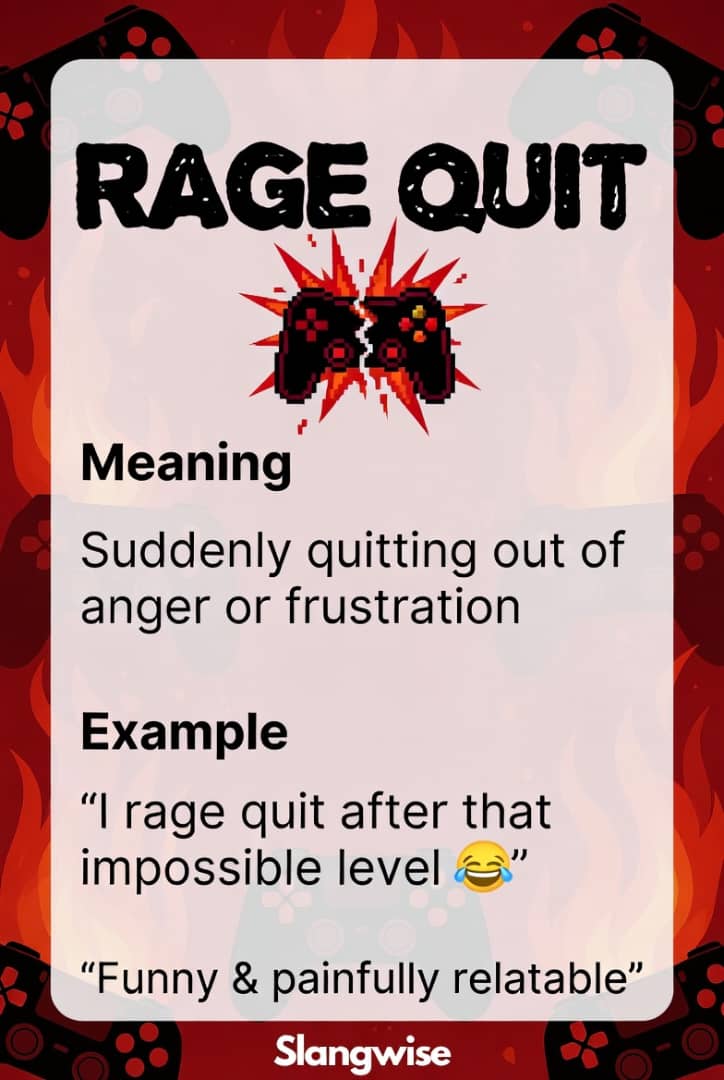
- Rage quit means suddenly quitting something out of frustration or anger. The phrase is especially common in gaming when a player leaves a match or stops playing after getting upset.
- The slang is not limited to video games anymore. People also use it for frustrating schoolwork, online arguments, work tasks, apps, or everyday situations that become emotionally overwhelming.
- A rage quit usually happens impulsively. Unlike a calm decision to stop, it is more of an emotional reaction that happens in the heat of the moment.
- The phrase became popular because it is relatable and dramatic. Almost everyone has experienced a moment where they became so annoyed that they wanted to immediately walk away from something.
What Does Rage Quit Mean in Slang?
Rage quit is one of those slang phrases that sounds exactly like what it means. In everyday use, it refers to suddenly quitting something in a burst of anger or frustration, especially a game, match, task, or competition that has become too annoying to tolerate.
Merriam Webster defines it as suddenly stopping participation in something in a fit of anger and frustration, while Dictionary.com describes it as abandoning an undertaking, especially a video game, after frustration or failure.
The phrase is especially common in gaming culture, where pressure, competition, and repeated failure can push someone over the edge fast. Vocabulary.com gives the meaning as giving up on or stopping something in a sudden fit of anger, which is a nice plain language version of how people actually use it online and in conversation.
In my point of view, rage quit is popular because it is both funny and painfully relatable. Most people have had a moment where a game, a device, a project, or even a frustrating conversation pushed them to the point of saying, “That is enough, I am done.”
The slang gives that moment a name, and once a phrase catches that kind of real emotion, it sticks.
READ ALSO: 15 Most Savage Gaming Slang Terms Now Destroying Online Arguments
Why People Say It So Often
Rage quit is not only about anger. It is also about the sudden break between patience and “I cannot do this anymore.” The word rage carries the feeling of intense, uncontrolled anger, which Merriam Webster also emphasizes in its definition of rage itself. That emotional force is part of what makes the phrase so vivid.
The term became especially natural in gaming because games create repeated tension on purpose. Players invest time, focus, and effort, then hit a wall, lose repeatedly, or get blindsided by bad luck. Dictionary.com’s definition even points to the idea of quitting after near success or abrupt failure following a significant investment of time and effort, which explains why the phrase fits gaming so well.
That said, rage quitting is not limited to games. The phrase can also apply more broadly, including people leaving jobs or other situations in response to frustration. So while the gaming meaning is the best known, the slang has grown beyond consoles and PCs.
What Rage Quitting Looks Like
A rage quit usually happens fast. Someone is dealing with a frustrating situation, gets overwhelmed, and immediately bails. In a game, that may mean leaving the match, closing the app, or walking away mid round.
In a broader sense, it can mean quitting a task or activity in a sudden emotional burst rather than making a calm decision.
The key feature is not just quitting. It is quitting in anger or frustration. That emotional spike is what separates a rage quit from a normal decision to stop. If you leave because you are tired, busy, or ready to move on, that is just quitting.
If you slam into a wall of frustration and storm out, that is the rage quit energy people are talking about.
In real life, you might also hear the phrase used jokingly. Someone might say they rage quit a group chat, a school project, a difficult level, or even a book series. Dictionary.com includes that kind of playful usage in its examples, which shows the slang has expanded into everyday humor, not just serious frustration.
DISCOVER: From AFK to POGGERS – 50 Popular Gaming Slang Words and What They Mean
Rage Quit vs Just Quitting
This is where the slang gets interesting. Not every exit is a rage quit. Sometimes you stop because something is finished, because you changed your mind, or because you no longer care. That is normal quitting.
A rage quit, by contrast, is tied to a moment of emotional overload. Merriam Webster and Vocabulary.com both keep the anger and frustration at the center of the meaning.
Think of it this way: quitting is a decision. Rage quitting is a reaction. One is usually calm, planned, or at least controlled. The other is messy, immediate, and often fueled by a feeling that the situation has become unbearable. That difference is why the phrase has such a strong personality.
Signs Someone Has Rage Quit
Usually, you can tell by the speed of the exit. The person is still engaged one moment, then suddenly gone the next. In gaming, that may mean disconnecting, leaving the match, or shutting everything down in frustration.
In other settings, it might mean storming off, abandoning a project, or refusing to continue after a setback.
Another clue is the emotional tone around the exit. Rage quitting is rarely quiet in spirit, even if it is silent in action. It usually happens after a bad moment, a string of losses, a repeated mistake, or a level of frustration that finally becomes too much.
The phrase is so widely understood because it captures that emotional snap so clearly.
READ ALSO: PWNED Meaning in Slang: The Viral Word That Means You Got Totally Outplayed
Why the Phrase Became So Popular
A big reason rage quit became common is that it describes a very specific modern feeling in a short, memorable way. It is direct, funny, and easy to picture. You can almost see the person closing the laptop, dropping the controller, or walking off after one too many failed attempts. That image makes the slang instantly understandable.
Another reason is that the term traveled well across internet culture. It started as gaming language, but now people use it for anything from work stress to online debates to boring, frustrating tasks. Collins and Merriam Webster both reflect this broader usage by defining it in general terms, not only as a gaming phrase.
Honestly, that is what gives the phrase its staying power. It is specific enough to be vivid, but broad enough to apply to a lot of modern life. Everyone has felt that moment where patience runs out and the only thing left is a dramatic exit. Rage quit is the slang label for that exact moment.
How to Use Rage Quit Naturally
People usually use rage quit in a casual or humorous way. You might hear something like, “I rage quit after that impossible level,” or “He rage quit the match when things went wrong.” Those kinds of examples match how the phrase appears in major dictionary entries, especially in gaming and informal conversation.
It can work as a verb or noun depending on the sentence. Merriam Webster lists forms such as rage quit, ragequitting, and ragequits, which shows how flexible the expression has become in modern usage. That flexibility is part of why it feels so natural in internet speech.
FIND OUT: EZ Clap Meaning in Gaming Slang: Why Players Say It After an Easy Win
Final Thoughts
Rage quit is slang for quitting something abruptly because anger or frustration has taken over. It is most closely tied to gaming, but it also shows up anywhere people feel overwhelmed enough to walk away in a dramatic way. The phrase works so well because it is simple, visual, and emotionally honest.
The real takeaway here is easy to remember: a rage quit is not just leaving. It is leaving while mad, fed up, or completely over it. And once you know that, the phrase becomes easy to spot in conversation, captions, chats, and gaming banter.
FAQs About Rage Quit
Rage quit means abruptly leaving or stopping something because of anger, frustration, or irritation, especially during a game or competitive activity.
No. Even though the slang started in gaming culture, people now use it in many situations like work, school, social media, or frustrating everyday tasks.
Gamers often rage quit after repeated losses, difficult challenges, unfair gameplay moments, or stressful matches that become emotionally overwhelming.
Not always. Many people use the phrase jokingly or dramatically in casual conversation, even for small annoyances like struggling with homework or giving up on a difficult recipe.
Table of Contents