

Hey friend! 👋
Here is the part of “quiet quitting” that gets lost online: the phrase sounds like someone is secretly resigning, but that is not what most people mean.
I have spent a lot of time decoding internet slang, and workplace slang is especially interesting because the words often carry an attitude as well as a definition. Quiet quitting is a perfect example. One person means boundaries. Another means doing the bare minimum. Someone else is joking.
So what does quiet quitting actually mean to Gen Z?
I am breaking down the slang the way I would explain it to a friend: what it means, where it came from, why it resonated, and where the line sits between protecting your time and checking out.
Table of Contents
What quiet quitting actually means
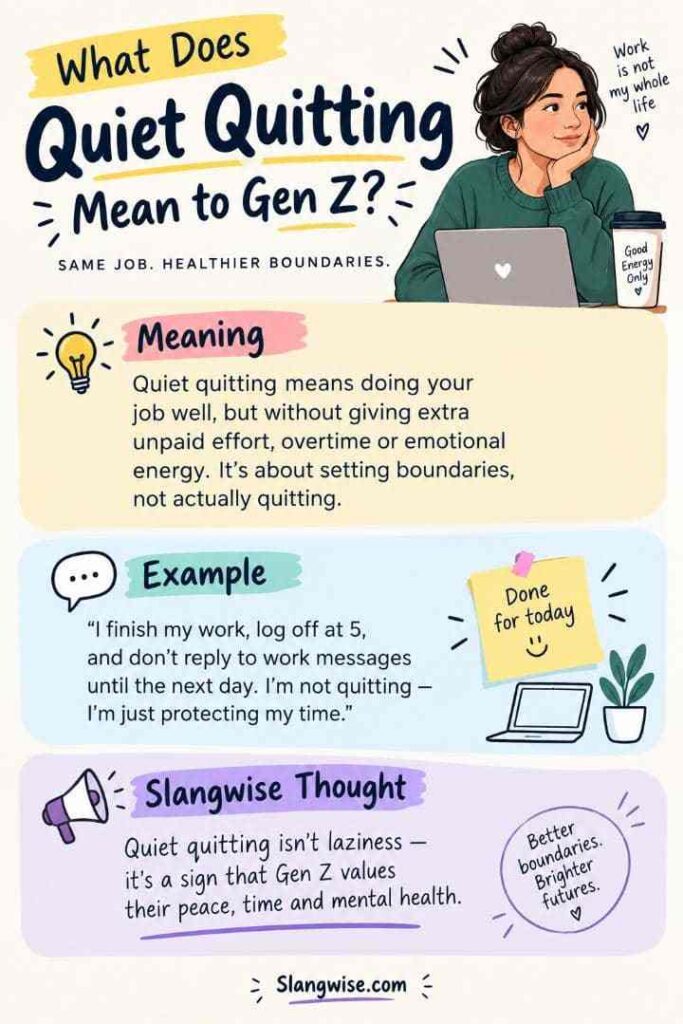
The simplest way I decode quiet quitting is this: you keep doing your job, but you stop treating extra work as an unlimited obligation.
You still show up, complete your responsibilities, and communicate professionally. The difference is that you stop feeling guilty about logging off when your workday ends.
That is why “quitting” causes confusion. It does not mean resigning. It means changing how much extra effort you are willing to give.
Think about Tobi. Tobi used to answer work messages late at night, stay online after hours, and volunteer for every extra task. Then Tobi decides to finish the assigned work, log off on time, and handle non urgent messages the next day.
Tobi did not quit the job. Tobi changed the boundary.
That is the heart of the slang.
Where did quiet quitting come from?
I often see Zaid Khan credited with inventing the phrase, but the history is more complicated.
Know Your Meme’s quiet quitting entry, part of its internet slang series, records an earlier online use of the phrase on Twitter in March 2022. Zaid Khan then posted a TikTok on July 25, 2022 that helped popularize the idea and push the phrase into mainstream conversation.
Slang history is rarely as neat as social media makes it look. A phrase can exist quietly before one viral post gives it a much bigger audience.
The behavior itself is much older. The internet simply gave that attitude a catchy label.
Why Gen Z connected with it
I would not say every Gen Z worker thinks the same way. But the phrase gave many younger workers a simple way to talk about pressure they were already noticing.
Hustle culture is part of that. Social media has spent years pushing messages about grinding harder, staying productive, and always doing more. Quiet quitting pushes back.
Work also follows people through their phones. A message can arrive at dinner, during a weekend, or late at night. Money, recognition, and identity matter too. You can care about your career without making it your entire personality.
That is where the slang becomes more than a workplace buzzword.
What quiet quitting looks like
Let me give you fresh examples because examples reveal slang better than a dry definition.
- “My tasks are done, but I stopped checking work messages after dinner. I guess I am quiet quitting.”
- “She still hits every deadline. She just stopped volunteering for every extra project.”
- “I used to stay late because everyone else did. Now I finish my work and go home.”
None of those examples automatically means the person is lazy.
The behavior can be boundary setting. But online, “quiet quitting” can also be used sarcastically to mock someone who is doing less than expected. Context changes the meaning.
That is why I always tell readers to decode the sentence around the slang, not just the word. You can also read my breakdown of clout chasing slang to see how a phrase can carry an attitude as well as a definition.
Quiet quitting vs actually checking out
Doing exactly what your role requires is not automatically the same as disengaging from your job.
Imagine two workers.
Worker A completes assigned work, attends required meetings, communicates clearly, and logs off when the agreed workday ends.
Worker B misses deadlines, ignores reasonable responsibilities, and puts in little effort even when the role clearly requires more.
People may call both “quiet quitting,” but I would not decode them as the same thing.
The phrase can be useful and misleading at the same time. In one conversation, it means “I have boundaries.” In another, it means “I am no longer invested.”
The clue is behavior, not the label.
Is quiet quitting only a Gen Z thing?
No. The behavior did not begin with Gen Z, and older workers can relate to it too. The term became strongly associated with younger people because TikTok and other social platforms gave it a huge audience.
That is what interests me most as a slang decoder: a phrase about doing your normal job became a major cultural debate because it touched a real tension around work, expectations, and personal time.
The possible upside and downside
Quiet quitting can make sense when someone has been stretched far beyond their role. Clear boundaries can protect personal time.
But if someone no longer cares about the work, the slang may be covering deeper problems with workload, management, growth, or job fit. Career goals can matter too, especially in workplaces where extra responsibility leads to advancement.
How I decode quiet quitting online
When I see someone write “I am quiet quitting,” I look at three things: what stopped, what continues, and why.
- “I stopped answering emails after my shift” sounds like a boundary.
- “I stopped caring whether customers get helped” sounds much closer to disengagement.
- “My quiet quitting era starts today” may simply be a joke about clocking out on time.
That is my biggest lesson from decoding slang: never let the label do all the work. Read the context.
Workplace slang keeps evolving too. Terms rise, disappear, get reused, and sometimes become memes. You can explore more of that fast moving language in my guide to the most popular TikTok slang words.
In a nutshell
- Quiet quitting usually means doing your actual job without constantly giving extra unpaid effort.
- It does not mean resigning from your job.
- Gen Z became strongly associated with the term, but people of other generations use it too.
- The phrase can describe healthy boundaries or deeper disengagement, depending on context.
- The best way to decode it is to look at what someone stopped doing, what they still do, and why.
Conclusion
After looking closely at the slang, I think quiet quitting is much less mysterious than the phrase makes it sound.
It is really a catchy label for an old workplace question: how much should a job take from your life?
Gen Z did not invent the desire for balance. What changed was the language. Quiet quitting gave people a short, viral way to talk about burnout, extra effort, work life boundaries, and the pressure to always be available.
I would not use the phrase as a free pass to ignore responsibilities. You can protect your personal time and still take your job seriously.
So the next time you see “I am quiet quitting,” do not stop at the word “quitting.”
Decode the context.
That is where the real slang meaning is.
FAQs
It usually means doing your job properly while setting limits on extra work and after hours availability.
Not necessarily. The phrase can describe setting boundaries, although it is sometimes used to describe low effort or disengagement.
Zaid Khan helped popularize the phrase through a viral TikTok in July 2022, although earlier online uses have been documented.
No. The behavior is not exclusive to Gen Z, although the term became strongly associated with younger workers through social media.
Quiet quitting can mean setting limits while still doing your job. Disengagement suggests a deeper loss of interest or commitment.