
Internet slang moves fast, and some abbreviations look more complicated than they really are. IDTS is one of those terms that seems mysterious at first, but once you know it, the meaning is very easy to spot.
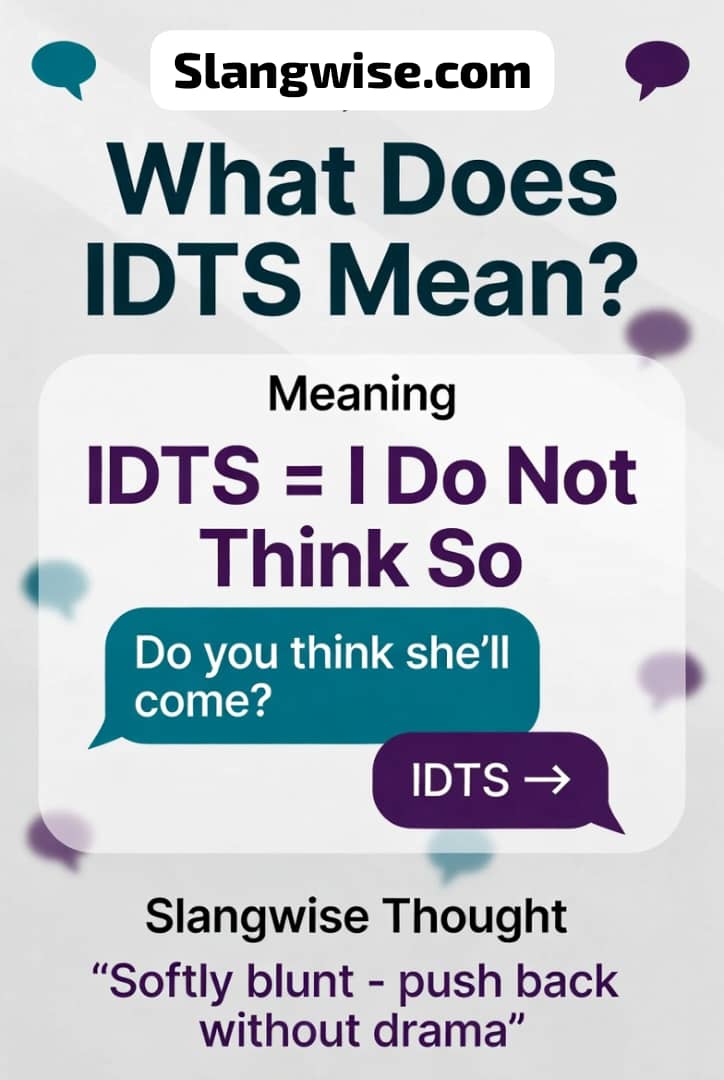
In texting and online chat, IDTS usually means “I do not think so,” and it is used to show doubt, uncertainty, or a polite kind of disagreement.
In a Nutshell
- IDTS means “I do not think so”
- People use it when they are doubtful or unsure
- It can sound casual, soft, or a little skeptical
- It works best in texting and online chat
- It is not something you would normally use in formal writing
What Does IDTS Mean in Slang?
IDTS is short for “I do not think so.”
That is the main meaning across the common slang references, and it is the one you will most often see in casual conversations online. People use it when they want to say they are not convinced, they disagree a little, or they are not fully sure about something.
In my view, that mix of doubt and caution is what makes IDTS so useful. It is not as sharp as “no,” and not as formal as “I disagree.” It sits nicely in the middle.
For a wider look at how internet shorthand works, see 250 Most Popular Internet Abbreviations of 2026 Explained for Easy Texting.
Slangwise Thought
One thing I’ve noticed about internet slang is that some terms are blunt, while others are softly blunt. IDTS belongs to the second group. It lets you push back without sounding dramatic.
That is probably why people like it in texting, where tone matters a lot and nobody wants every message to sound like a courtroom speech.
That is also why it feels so natural beside other casual forms like MFW Meaning and ICYMI Meaning, which both live in the same fast moving texting culture.
How People Use IDTS
IDTS usually shows up when someone wants to express uncertainty or skepticism.
For example:
A: “You think the teacher forgot the homework?”
B: “IDTS.”
That basically means, “I do not think so.”
It can also be used when a person is answering a question about plans or facts:
A: “Are they still coming?”
B: “IDTS.”
In that case, the speaker is saying they doubt it, but they may not sound 100 percent certain. One source describes it as expressing a doubtful, skeptical, or uncertain opinion, which fits the way people actually use it in everyday texting.
It also pairs naturally with other casual reaction language like JOMO, especially when people are talking about plans, moods, or social situations in a relaxed way.
Why IDTS Feels Softer Than a Plain No
This is where the slang gets interesting.
A plain “no” can feel final. IDTS feels a little more relaxed. It suggests that the speaker is leaning against something, but not making a huge scene about it. That is why it works well in casual chats, especially when you do not want to sound rude.
For example:
A: “Do you think she will really come tonight?”
B: “IDTS, she seemed tired earlier.”
That response sounds calm and conversational. It does not slam the door. It just gives a thoughtful answer.
If you like slang terms that carry a similar “wait, what?” feeling, you might also like 404 Coded Meaning.
IDTS vs Similar Slang
IDTS belongs to a larger group of “I do not” style abbreviations that show up in texting and online chat.
| Slang | Meaning |
|---|---|
| IDTS | I do not think so |
| IDT | I do not think |
| IDK | I do not know |
| IMO | In my opinion |
| TBH | To be honest |
| WYM | What you mean? |
IDT and IDTS are especially close. One refers to “I do not think,” while the other adds the full “so” at the end. Both are easy to mix up, and both are used in casual online language.
When You Might See IDTS
IDTS is most common in text messages, direct messages, and casual comment threads. It is the kind of abbreviation people use when they want to keep things quick and informal. It is not a formal business term, and it is not usually something you would write in an essay or professional email.
You might see it in moments like these:
A: “Do you think the meeting got canceled?”
B: “IDTS.”
A: “Is he actually that tall?”
B: “IDTS lol.”
A: “Will they really finish it today?”
B: “IDTS, honestly.”
That “honestly” feeling is part of the appeal. The term sounds casual but still thoughtful.
Is IDTS Rude?
Usually, no.
IDTS is not automatically rude. In most cases, it is simply a soft way to disagree or express doubt. But, like many slang terms, the tone depends on context. If someone sends “IDTS” by itself, it can feel a little dry. If they add an explanation or emoji, it usually feels warmer.
Friendly
“idts, I do not think he is coming”
Neutral
“IDTS”
Slightly skeptical
“idts? not sure about that”
The abbreviation itself is not the issue. The surrounding message is what changes the mood.
Why People Like Using IDTS
IDTS works because it is short, clear, and low effort.
That sounds simple, but it matters a lot in texting culture. People want fast replies that still feel human. IDTS gives them a way to say, “I am not sure,” or “I do not think so,” without typing a full sentence every time. It also fits the rhythm of modern chat, where quick reactions often matter more than polished grammar.
From what I’ve observed, slang survives when it solves a real communication problem. IDTS does exactly that.
READ ALSO: WDYM Meaning in Slang: The Tiny Texting Acronym Everyone Keeps Using
Real Life Example Feel
Here are a few natural ways IDTS might appear in conversation:
Friend: “Do you think the party starts at 6?”
You: “IDTS, I think it was 7.”
Friend: “He will probably reply in one minute.”
You: “IDTS, he never replies that fast.”
Friend: “She is definitely coming today.”
You: “IDTS, she mentioned she was busy.”
These examples show the same basic idea, but the tone shifts a little each time.
The Real Takeaway
The key thing to remember is that IDTS means “I do not think so,” and it is mainly used to express doubt, hesitation, or gentle disagreement. It is one of those slang terms that feels modern but still easy to understand once you see it in context.
In my humble opinion, that is what makes it useful. It does not try too hard. It just gets the point across.
Conclusion
IDTS is a small slang abbreviation with a very clear job.
It helps people say “I do not think so” in a way that feels quick, casual, and conversational. It can sound skeptical, uncertain, or lightly dismissive, but usually in a soft and harmless way.
Once you recognize it, it becomes one of those internet terms that is easy to read and even easier to use.
So the next time IDTS appears in a chat, you will know exactly what is going on. It is not a puzzle. It is just someone saying, in a very compact way, “I do not think so.”
Frequently Asked Questions
IDTS means “I do not think so.”
They are closely related. IDT means “I do not think,” while IDTS means “I do not think so.”
No. It is casual texting slang, not formal writing.
Not usually. It often sounds like a soft disagreement or a doubtful reply, depending on context.
It is most common in texting, online chat, and casual social media conversations.
Table of Contents