
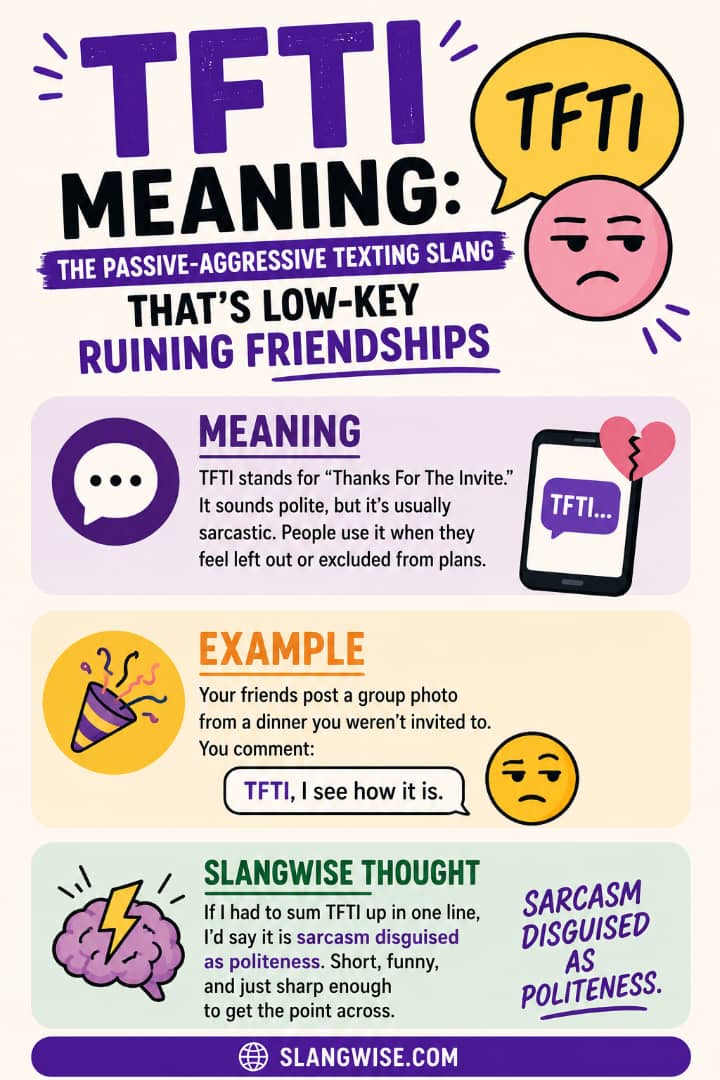
- TFTI means “Thanks For The Invite.” It is usually used sarcastically, not politely.
- It shows up when someone feels left out. The phrase often carries a little hurt, annoyance, or playful shade.
- It is common in texts, DMs, and social media comments. People use it after seeing photos, stories, or posts they were not included in.
- Context matters a lot. Between close friends, it can be joking. In the wrong setting, it can sound rude.
Imagine scrolling through Instagram and seeing your friends out together at your favorite spot while you were never invited. That awkward little sting is exactly the kind of moment TFTI was made for.
Instead of writing a long message about feeling left out, people just type four letters: TFTI. It is short, sharp, and loaded with attitude. That is why it spread so quickly across group chats and social media.
What makes it interesting is that the words themselves sound kind, but the tone usually is not. That contrast is a big part of why the slang works so well online.
READ LATER: IKR Meaning: 90% Of People Get This Texting Slang Wrong – Here’s The Truth
What Does TFTI Mean?
TFTI stands for “Thanks For The Invite.” On the surface, it sounds polite. In real use, though, it is usually sarcastic. People say it when they feel left out, ignored, or excluded from plans.
It is one of those texting phrases that looks harmless until you understand the tone behind it. Most of the time, TFTI is not a genuine thank you. It is more like a small digital side eye.
Where Did TFTI Come From?
TFTI grew naturally from online conversation. Like many slang terms, it did not come from a formal source. It spread through group chats, comment sections, and text threads where people wanted a fast way to express sarcastic disappointment.
Over time, the phrase became a shorthand reaction to being excluded from plans or seeing someone post about an event you were not invited to. It fits the internet perfectly because it is quick, readable, and a little dramatic.
That drama is part of the appeal. Instead of spelling out a whole emotional response, people can just drop TFTI and let the message land on its own.
READ ALSO: Unc Meaning in Slang: The Tiny Word Gen Alpha Uses to Roast, Respect, and Call Out “Older Energy”
How People Use TFTI
TFTI is often used after someone finds out about a hangout, event, or group plan they were not included in. It can appear in text messages, Instagram replies, TikTok comments, or Discord chats.
Sometimes it is meant playfully, especially among close friends who roast each other. Other times, it carries real frustration. The phrase works because it leaves room for both tones.
For example, someone might reply with TFTI after seeing a party photo, a lunch meetup, or a weekend trip announcement. The meaning depends on the relationship, the moment, and the speaker’s tone.
Further Examples
Here are a few simple examples of TFTI in real use.
Example 1: Your friends post a group selfie from dinner, and you were not invited. You reply, “TFTI, I see how it is.”
Example 2: Someone announces a hangout in the group chat after the plans were already made. You say, “TFTI, guys.”
Example 3: A friend casually posts a party video, and you were not there. You comment, “TFTI 👀”
Example 4: A sibling brings home food from your favorite place without asking if you wanted some. You joke, “TFTI, apparently I do not exist.”
In all of these cases, the phrase is less about gratitude and more about calling out exclusion in a short, funny way.
EXPLORE: From 67 to 520: 45 Number Slangs You Keep Seeing Online and What They Mean
Is TFTI Rude?
It can be. That is why context matters so much. Between close friends who understand your sense of humor, TFTI may land as teasing. Between people who are not close, it can sound passive-aggressive or even hurtful.
If you are using it with someone who already feels left out, it may come across as more serious than you intended. So while the phrase is common online, it is still worth using carefully.
A simple rule is this: if the relationship is playful, TFTI might work. If the situation is tense, it is probably better to say what you actually mean.
A Simple Way to Remember It
Think of TFTI as a sarcastic way of saying, “Oh, thanks for remembering me after the fact.” It is really a phrase about being excluded, not a real expression of gratitude.
The easiest way to remember it is this: when someone says TFTI, they are usually not saying thank you. They are saying they noticed they were not included.
DISCOVER: 250 Most Popular Internet Abbreviations of 2026 Explained for Easy Texting
Slangwise Thought
If I had to sum TFTI up in one line, I would say it is sarcasm disguised as politeness. That is what gives it so much personality online. It is short, funny, and just sharp enough to get the point across without a long explanation.
In a lot of ways, TFTI shows how modern slang works. It compresses a full emotional reaction into just a few letters, then lets tone do the rest.
Final Thought
TFTI is one of those phrases that feels small but says a lot. It captures the feeling of being left out, the urge to respond, and the internet habit of turning real emotions into quick, memorable slang.
It works because everyone understands the sting behind it. Whether it is used as a joke or as a real callout, TFTI carries that familiar mix of humor and irritation that makes texting slang so expressive.
READ ALSO: Spark Joy Only Meaning in Slang: See How It Eliminates Negativity (And Why You Need It)”
Frequently Asked Questions
TFTI stands for “Thanks For The Invite.” It is usually used sarcastically when someone feels left out or excluded from plans.
Usually no. Most of the time, TFTI is used as a joke or a passive-aggressive reply, not as a real thank you.
It is commonly used in text messages, group chats, Instagram comments, and other social media spaces where people react to being left out.
Yes, it can be if the person receiving it takes it as rude or passive-aggressive. It depends on the tone and relationship.
Table of Contents