

- Gen Z slang is cultural shorthand: Words like rizz, aura, mid, and delulu can communicate an entire attitude in just one word.
- The internet speeds everything up: TikTok, Instagram, YouTube, Discord, gaming communities, memes, and fandoms can move expressions between communities almost instantly.
- Origins matter: Modern slang can emerge from AAVE, LGBTQ+ communities, music, gaming, regional speech, and online subcultures before entering mainstream conversation.
- Understanding is more useful than imitation: You do not need to use every trending expression to understand what younger people are saying.
- Context is the real decoder: The same slang word can sound sincere, ironic, sarcastic, playful, or outdated depending on who says it and where it appears.
- Download the free 270+ Internet Slang Ebook to get a bigger slang dictionary packed with meanings, examples, and more popular terms.
Sometimes a single sentence can reveal just how quickly language is changing. During a conversation with a 16-year-old niece, a simple question about her day produced a reply packed with slang. Every individual word was familiar, yet the combination carried a meaning that was easy to miss without the cultural context.
That is the real secret behind Gen Z slang: the words are only half the story.
After years spent tracking slang, comparing meanings across communities, following internet trends, and studying how expressions move from niche spaces into everyday conversation, one pattern becomes impossible to ignore: slang is a cultural signal.
It reveals what people find funny, what communities they identify with, how they react to trends, and sometimes how they push back against older generations.
This guide is designed to help parents, teachers, marketers, older siblings, and anyone else decode modern slang without trying to sound like a teenager.
Table of Contents
Results
Nice work!
You passed the Easy Level and your slang game is looking solid.
You unlocked the special bonus Slangwise ebook.
Ready to level up? Proceed to the Hard Level and prove you are a true slang master.
Good try! Slang evolves fast, so missing a few is totally normal.
You still unlocked the special bonus Slangwise ebook for participating.
Want to challenge yourself? You can still try again and see how far you can go.


#1. She ATE that outfit means:
#2. If someone says I’M DEAD, they mean:
#3. CHEUGY refers to something that is:
#4. What does SUS usually mean in Slang?
#5. NO CAP in Gen Z Slang means:
#6. FLEX in Gen Z Slang most often means:
#7. YEET! is commonly used to:
#8. GLOWED UP in slang means:
#9. LOWKEY in internet slang means:
#10. PERIODT is used to:
#11. If someone says a snack is BUSSIN, they mean it is:
#12. When someone says BASED, they usually mean:
#13. GOAT stands for:
#14. To STAN someone is to:
#15. SIMP refers to someone who:
#16. If a meme is SENDING ME, it means the meme is:
#17. RATIO + REPLY as a reaction usually indicates:
#18. What’s the meaning of TEA in internet slang?
#19. What does RIZZ mean?
#20. If a post gets RATIOED on Twitter/X, it means:
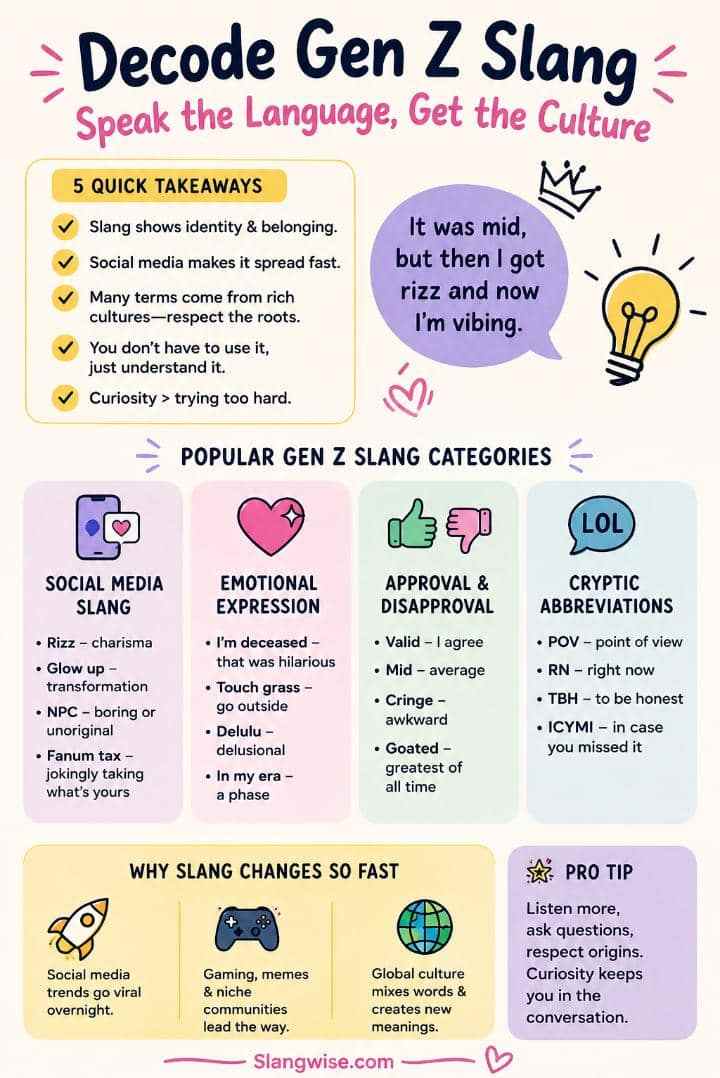
The Evolution of Slang: Why Gen Z Language Moves So Fast
Slang has always changed. Shakespeare invented or popularized words such as “swagger,” while later generations gave us expressions such as “groovy,” “rad,” “da bomb,” and “lit.”
The major difference today is speed. A phrase can begin in a creator community, appear in memes, spread through gaming chats, reach comment sections, and become recognizable worldwide before traditional media has even caught up.
Why does slang change so quickly now?
- Social media acceleration: A viral video or meme can introduce a phrase to millions of people almost overnight.
- Irony and exaggeration: Modern slang often turns ordinary words into humorous reactions. “Aura” can describe someone’s impressive presence, while “cooked” can describe someone who is finished, defeated, or in trouble.
- Identity and belonging: Using a word correctly can signal that someone understands the culture of a particular online or social community.
Here is a simple example: “gas” can literally refer to fuel, but “That track is gas” is slang praise. The dictionary meaning did not disappear; a new social meaning was added.
A Quick Slang Timeline
- 1960s: groovy, far out
- 1980s: rad, gnarly
- 1990s: da bomb, phat
- 2000s: bling, emo
- 2010s: lit, bae, salty
- 2020s: rizz, no cap, delulu, mid, aura
The point is not to memorize this timeline. The point is to notice the pattern: slang follows culture.
Breaking Down Gen Z Slang Categories
Once slang is grouped by function, decoding unfamiliar expressions becomes much easier.
A. Social Media and Viral Slang
- Rizz refers to romantic appeal or charm and can also be used as a verb, as in “rizz up.”
- NPC comes from gaming and can describe someone viewed as predictable, repetitive, or lacking originality.
- Aura describes someone’s presence, cool factor, or social energy. “He gained aura points” is playful status language, not a literal measurement.
- Fanum tax is a humorous expression about taking some of another person’s food.
Try this decoder trick: When you see a new word, ask three things: What does it literally mean? What does it mean in this community? Is it being used seriously or ironically?
B. Emotional and Reaction Slang
- I’m dead or I’m crying can signal that something is extremely funny.
- Touch grass is a teasing way of telling someone to step away from the internet and reconnect with everyday life.
- Delulu is a playful shortening of “delusional,” often used when someone is joking about an unrealistic hope.
- Let him cook means to allow someone to continue because they may be developing a good idea or doing something impressive.
C. Approval and Disapproval
- Valid: I respect or accept that.
- Mid: Average, disappointing, or underwhelming.
- Goated: Exceptionally good or worthy of “GOAT” status.
- Cringe: Awkward, embarrassing, or overly try-hard.
D. Abbreviations and Internet Shorthand
- POV: Point of view, especially in captions and skits.
- RN: Right now.
- TBH: To be honest.
- ICYMI: In case you missed it.
The Role of Memes, Gaming, Music, and Fandoms
Slang rarely develops in one place. Gaming slang has contributed terms such as GG, OP, AFK, and NPC. Music scenes, anime communities, K-pop fandoms, sports communities, livestream audiences, and meme pages all create vocabulary that can travel far beyond its original setting.
One of the most important lessons from studying slang is that mainstream popularity does not always equal mainstream origin.
Take based. The term is strongly associated with rapper Lil B and became a way of praising someone for being authentic or confidently themselves. Today, its use is broader, which shows how slang can evolve once different communities adopt it.
Why Slang Changes Quickly and How to Keep Up
Trying to memorize every trending slang word is one of the quickest ways to get lost.
- Watch context: Notice who uses the word, what surrounds it, and whether the tone is serious or playful.
- Ask questions: A genuine “What does that mean here?” is better than pretending to understand.
- Study communities: Different interests and regions produce different vocabulary.
- Do not chase every trend: Some expressions disappear quickly while others become established parts of everyday language.
That is why ten minutes of attentive observation can sometimes teach more than memorizing a hundred-word slang list.
The Dark Side of Slang: Origins, Appropriation, and Misuse
Some widely used slang has roots in Black American speech, LGBTQ+ communities, ballroom culture, music, and other cultural spaces. That history deserves attention rather than being erased once a word becomes trendy.
No cap, for example, is strongly associated with AAVE and is commonly used to mean “no lie” or “seriously.” Slay also has important roots in Black and LGBTQ+ cultural spaces, including ballroom culture, before becoming widespread online.
The rule is simple: learn the origin before turning a culturally specific expression into a costume. Understanding the history makes slang more interesting and helps prevent careless misuse.
Slang in Professional Settings: Use It or Lose It?
Understanding slang does not mean using it everywhere.
- Do: Match the tone of a casual workplace and use familiar expressions naturally when appropriate.
- Don’t: Fill formal emails, presentations, or client communication with heavy slang.
Overusing youth slang can actually make communication feel less natural. Younger audiences usually notice the difference between genuine familiarity and forced imitation. When in doubt, clear language wins.
The Future of Slang: AI, Global Culture, and Constant Remixing
AI tools, gaming communities, livestreams, group chats, global fandoms, and short-form video are creating an environment where language can be generated, remixed, and redistributed extremely quickly.
- More hybrid expressions crossing languages and cultures.
- More platform-specific vocabulary.
- More slang created inside small online communities before becoming mainstream.
- More global borrowing alongside strong regional slang.
UK Gen Z may use peng for something attractive or impressive. Australia has Maccas for McDonald’s. Nigerian speech includes expressions such as sef and ajebutter, each carrying cultural context that a direct translation cannot fully capture.
How to Teach Slang Without Sounding Cringe
Parents and teachers do not need to turn slang into homework. Use it as a conversation starter instead.
- Ask where a term came from.
- Ask whether it is still popular.
- Compare how the word changes across communities.
- Use slang to discuss language change, culture, media, and identity.
For adults trying to understand younger people, listening matters more than perfect pronunciation. Knowing what rizz, mid, cooked, aura, or delulu means can make online conversations much easier to follow without requiring you to use the words yourself.
Regional Slang: Location Still Shapes Language
Slang can become global without becoming universal. UK Gen Z has its own vocabulary, Australian English has distinctive local shorthand, and Nigerian English and Nigerian Pidgin contribute expressions with their own cultural meanings.
Even American slang varies by region and community. That means a viral expression should never automatically be treated as something every young person understands.
The Psychology of Slang: Why Shared Language Feels Powerful
Slang works because language is social. A shared expression can create instant familiarity, make an inside joke possible, or communicate attitude without a long explanation.
- It creates belonging: Shared words can signal community knowledge.
- It expresses identity: People choose language that fits their culture, interests, and online spaces.
- It adds emotional shorthand: One phrase can communicate humor, approval, disbelief, or frustration quickly.
Want more slang decoded? Check out 21 New Slang Words Parents Should Know in 2026 for more modern terms, meanings, examples, and practical context.
Slangwise Thought
After years of watching slang move between platforms, communities, generations, and countries, one conclusion stands out: the real skill is not sounding young. It is understanding why a word works.
A good slang decoder listens for tone, context, community, and history. That approach is far more useful than chasing every viral phrase. Trends change. The ability to recognize how language changes is what lasts.
Quick Interactive Quiz: Try It Now
Test yourself before checking the answers:
- What does rizz mean?
- Give one slang term that came from gaming.
- What does mid usually communicate about something?
- Why is knowing a slang word’s origin important?
Answers: Rizz refers to romantic appeal or charm; NPC, GG, OP, or AFK are examples connected to gaming; mid means average or disappointing; and understanding origins provides cultural context and helps prevent careless misuse.
Final Thoughts: Decode the Culture, Not Just the Word
Gen Z slang can look like a secret code until the pattern becomes visible.
Words such as rizz, aura, mid, delulu, cooked, and no cap are more than vocabulary items. They are shortcuts for reactions, identities, jokes, relationships, and online culture.
You do not need to use every word yourself. You simply need enough context to understand what someone is actually communicating.
That is the real advantage of decoding slang: better communication without forced imitation.
Sources and Further Reading
- Pew Research Center, Teens, Social Media and Technology 2022.
- Pew Research Center, Teens’ Experiences on TikTok, Instagram and Snapchat.
- Merriam-Webster, dictionary and etymology resources.
- Gretchen McCulloch, Because Internet, on language in the digital age.
- Academic work by Dr. Crystal Abidin and Dr. Lauren Squires on digital culture and language.
Frequently Asked Questions
Start with context instead of memorizing a giant list. Look at who is using the term, what is happening around it, and whether the word is being used seriously, ironically, or as a joke. Understanding context makes unfamiliar slang much easier to decode.
No. Understanding slang is usually more valuable than trying to imitate it. Asking genuine questions, listening carefully, and learning the context behind expressions can create better communication than forcing yourself to use every trending word.
There is no single source. Modern slang can emerge from AAVE, LGBTQ+ communities, music, gaming, regional speech, fandoms, memes, and online communities. Social media then helps some expressions spread far beyond their original communities.
Digital platforms make language travel incredibly fast. Viral videos, memes, livestreams, gaming chats, and fandom communities can introduce an expression to huge audiences in a very short time. Users then remix those expressions, creating new meanings and variations.
It depends on the workplace, audience, and situation. Casual teams may use light slang naturally, but formal emails, proposals, presentations, and client communication are usually clearer with standard language. When the setting is uncertain, choose clarity over trendiness.
Knowing a term’s origin gives you cultural context. Some expressions have roots in specific communities, including AAVE, LGBTQ+ culture, music, and regional speech. Understanding that history helps you recognize how a word developed and use it more respectfully.