
Some slang sounds fun the moment you hear it. Ghost kitchen sounds a little mysterious right away, which is probably part of why people remember it so easily.
At first sight or hearing, it can sound like something from a horror movie or a secret hideout. In reality, it is a modern food term for a kitchen that makes meals for delivery without a normal dine in setup or customer facing storefront.
Major dictionaries and food industry explanations now describe it that way, often alongside the names cloud kitchen, dark kitchen, or virtual restaurant.
What makes the phrase interesting is that it lives in a space between slang, business language, and internet culture. It is not exactly a playful teen slang term, but it has enough personality to feel like one.
The word ghost gives it that hidden, behind the scenes vibe, while kitchen keeps it grounded in something ordinary and practical.
In a Nutshell
- A ghost kitchen is a commercial kitchen that prepares food for delivery, usually without a dining room or public storefront.
- It is often used interchangeably with cloud kitchen, dark kitchen, and sometimes virtual restaurant.
- The word feels spooky because the kitchen is hidden from customers, not because anything supernatural is going on.
- In recent years, the term has become common in food delivery, restaurant strategy, and public discussion about transparency.
What Ghost Kitchen Means
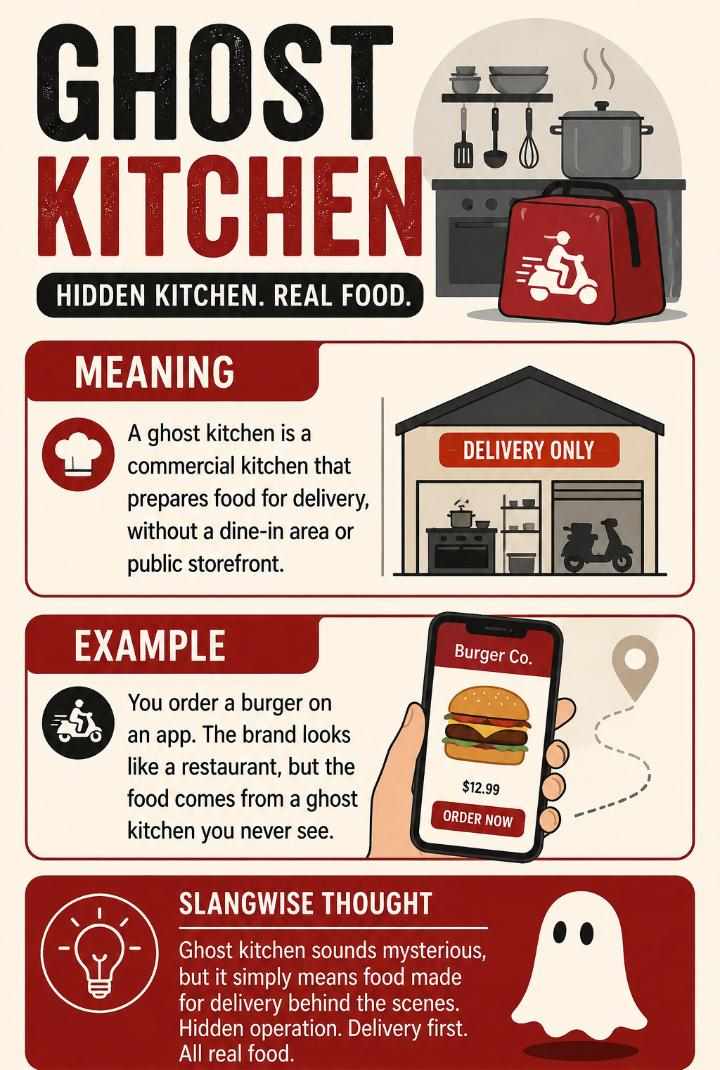
A ghost kitchen is basically a food preparation space built for delivery orders. It is not the kind of place where you sit down, order a drink, and eat under restaurant lights. Instead, the food is cooked for apps, pickup, or delivery only.
Merriam Webster defines it as a commercial cooking facility used for food consumed off the premises, and AP describes it as a virtual restaurant that uses an existing business to create a menu available almost exclusively through delivery.
That hidden setup is what gives the term its name. The kitchen is doing real work, but from the customer’s point of view, it is almost invisible. You may order a meal from a brand name and never see a physical restaurant front at all.
That is why ghost kitchen fits so well as a phrase. It sounds like something you cannot quite see, even though the food is very real.
DISCOVER: 25 Chef Slang Words You Will Hear in Real Kitchens and What They Actually Mean
Slangwise Thought
Here is the fun part. Even though ghost kitchen is a business term, it works like slang in the way people use it. It is short, catchy, a little dramatic, and instantly paints a picture.
When you hear it, you do not just think “restaurant model.” You think hidden operation, delivery only energy, and a food brand that exists mostly through your phone. That is why the phrase has such strong internet appeal.
Where the Term Comes From
From what I’ve seen in the way the term is used, ghost kitchen became popular as delivery apps and online ordering changed how people buy food. The phrase grew alongside other names like cloud kitchen, dark kitchen, and virtual restaurant, all of which point to the same basic idea: food is prepared for customers who are not physically dining in.
Merriam Webster and Dictionary.com both treat it as a recognized commercial term, and AP used it in coverage of restaurants adapting to delivery culture.
The word really took off because it captures the business model in a way that feels easy to remember. A traditional restaurant is visible. A ghost kitchen is not. That contrast is the whole story in two words.
Recent academic writing even describes these kitchens as delivery only models that do not receive customers on site, which matches the common usage exactly.
READ ALSO: PWNED Meaning in Slang: The Viral Word That Means You Got Totally Outplayed
How People Use It Today
Today, ghost kitchen can mean a few slightly different things depending on who is speaking. In everyday conversation, it usually means a kitchen that serves delivery orders only. In industry talk, it may also refer to a setup where one kitchen supports multiple restaurant brands or experimental menus.
AP’s reporting shows how businesses use them to test new ideas, while newer explainers describe them as delivery focused facilities with no front of house area.
You might hear someone say, “That burger place is actually a ghost kitchen,” or “This delivery brand runs out of a ghost kitchen.” In both cases, the speaker is pointing out that the restaurant you see on the app is not necessarily a full public dining space. It is a behind the scenes kitchen built for speed, flexibility, and online orders.
Why People React So Strongly to It
Part of the reason ghost kitchens get attention is that they challenge the old idea of what a restaurant should look like. For a lot of people, a restaurant means tables, menus, servers, and a visible storefront.
Ghost kitchens remove most of that and replace it with a delivery first model. That can feel efficient and modern, but it also raises questions about transparency and visibility, which is why recent reporting has focused on how hard these businesses can be to spot.
That hidden quality is also what makes the phrase so memorable. It sounds a little spooky, a little futuristic, and very internet friendly all at once. In plain language, it is just a kitchen that cooks for delivery. In vibe language, it feels like food service operating in stealth mode.
DISCOVER: 40 Most Popular Internet Catchphrases of 2026 (Updated)
Quick Recap
So, what does ghost kitchen really mean?
It is a delivery only commercial kitchen. It may not have a dine in area, and it may not even look like a traditional restaurant from the outside. The name ghost comes from the fact that it is mostly invisible to customers, even though the food is very much real.
Conclusion
Ghost kitchen is one of those phrases that sounds way more mysterious than it actually is. Once you break it down, it is simply a modern food business model built around delivery. Still, the name works because it captures the feeling perfectly.
The kitchen is there, the food is there, but the usual restaurant experience is not. That hidden setup is exactly what gives the term its personality.
And honestly, that is what makes it such a good slang style phrase. It is practical, but it also has a little drama. That combination tends to stick.
MORE ON: Ghosting Meaning in Dating: Signs, Reasons, and How to Handle It
Frequently Asked Questions
It is a kitchen that prepares food for delivery instead of serving dine in customers.
Yes, the terms are often used for the same delivery only model.
Because it is hidden from the customer experience and does not operate like a visible traditional restaurant.
Usually yes, or mostly yes. They are built around online orders and delivery service rather than in person dining.
Table of Contents