
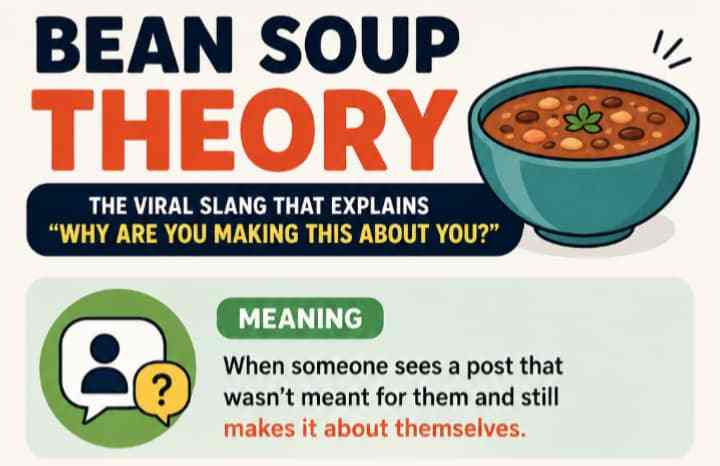
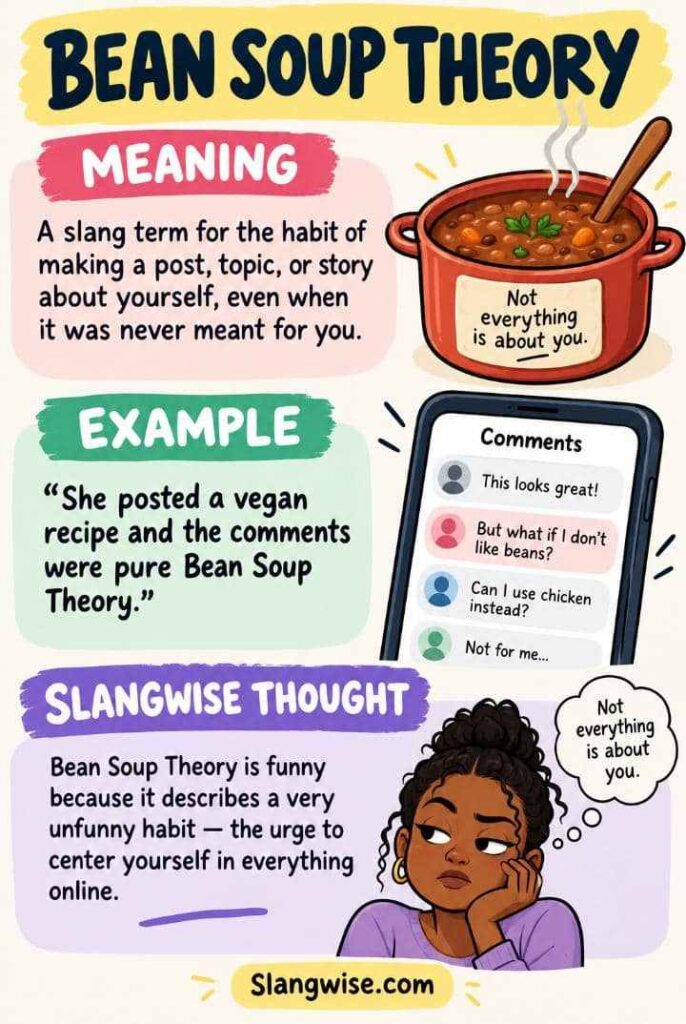
- Bean Soup Theory is internet slang for the habit of making a post, topic, or story about yourself even when it was never meant for you.
- It comes from a viral social media moment involving a bean soup recipe and commenters asking for substitutions because they did not like beans.
- People use it to describe self-centered replies, “what about me?” behavior, and that classic online urge to center yourself in somebody else’s content.
- It is a funny phrase, but it points to a very real social media pattern: egocentrism, spotlight thinking, and whataboutism.
- Keep reading for examples, a simple explanation, and the Slang Quiz plus our free 270+ Internet Slang Dictionary at the end.
Table of Contents
Bean Soup Theory Meaning in Slang
Bean Soup Theory is one of those internet phrases that sounds absurd at first, then somehow becomes instantly recognizable.
In simple terms, it describes the moment when someone sees content online and responds as if the post was supposed to revolve around them, their preferences, or their personal situation. In other words, it is the “this was not about you” effect.
That is really the heart of it. Somebody posts a recipe, an opinion, a story, or a recommendation, and instead of engaging with the actual point, another person jumps in with something like, “But what if I do not like beans?”
The joke is that the original post was not meant to be customized around every possible viewer. The phrase became a shorthand for that self-centered comment-section energy.
READ ALSO: Blerd Meaning: The Cool Slang Term That Turns Nerd Culture Into a Badge of Pride
Where the Phrase Came From
The story behind Bean Soup Theory starts with a viral TikTok bean soup recipe posted in 2023. The recipe was aimed at people looking for a high iron meal, but the comments soon filled up with oddly self-focused replies, including questions about what to do if they did not like beans or wanted the soup changed for their personal taste.
That reaction turned into a bigger internet conversation about how often people see something that is not for them and still try to center themselves in it.
From there, the phrase spread as a funny but sharp label for a very common online habit. It is not a formal academic theory in the strict sense. It is more like a social media nickname for a behavior people had been noticing for a long time and finally had the perfect example to describe.
What Bean Soup Theory Is Really Pointing To
At its core, Bean Soup Theory is about egocentrism online. It overlaps with the idea of “what about me?” thinking, where a person sees something public and immediately tries to connect it back to their own likes, dislikes, identity, or experience, even when that connection was never needed.
It also echoes whataboutism, which is the habit of shifting attention away from the original topic and toward a personal complaint or side issue.
A lot of people also connect it to the “main character” mindset that social media can encourage. When every post feels like a performance and every comment section feels like a stage, some users stop seeing content as something to observe and start treating it as something to interrupt.
That is why Bean Soup Theory landed so hard: it named a behavior people were already seeing everywhere.
READ ALSO: Gyatt Meaning: 10 Surprising Ways Gen Z Uses This Viral Slang
Slangwise Thought
Here is my Slangwise thought: Bean Soup Theory is funny because it describes a very unfunny habit. The phrase sounds playful, even a little ridiculous, but it points to a real social problem.
A lot of online conversations now get hijacked by people who cannot just scroll past something that is not for them. Instead of letting content live in its own lane, they pull it into their own orbit. That tiny bean soup story ended up exposing a much bigger habit of internet behavior.
How to Use Bean Soup Theory in Real Life
You can use Bean Soup Theory when you want to call out a self-centered reaction in a light, witty way. It works best when someone is making an unnecessary “what about me?” response to content that was clearly aimed at a different audience.
Because the phrase is playful, it usually lands best in casual conversation, memes, captions, and commentary posts.
Here are a few natural examples:
- “She posted a vegan recipe and the comments were pure Bean Soup Theory.”
- “That reply is such Bean Soup Theory behavior.”
- “He saw a post for pregnant women and still made it about himself. Classic Bean Soup Theory.”
- “The whole comment section was Bean Soup Theory from top to bottom.”
Notice how the phrase is not really about soup anymore. It has become a social shortcut for calling out people who insist on making someone else’s content revolve around their personal preferences or complaints. That is what makes it memorable. It is funny, but it is also very accurate.
Why It Resonates So Much
Bean Soup Theory resonates because almost everyone has seen this behavior online. A creator shares something simple, helpful, or thoughtful, and the replies instantly wander into personal objections that miss the point completely.
The phrase gives people a neat way to point at that pattern without writing a whole paragraph about it.
It also fits the way internet slang usually grows. The best slang is often visual, specific, and a little ridiculous. Bean Soup Theory is all three. It comes from a real moment, it describes a real habit, and it sticks in your head because it sounds too odd to forget.
READ MORE: Whimsy Meaning in Lifestyle: Why Everyone Is Suddenly Obsessed With a More Playful Life
Conclusion
Bean Soup Theory is basically the internet’s funny way of saying, “Not everything is about you.” It started with a bean soup recipe, but it grew into a much bigger label for online egocentrism, whataboutism, and the habit of forcing every conversation to bend around personal comfort.
That is why it works so well. It is silly on the surface, but it describes a very real piece of modern internet life.
And honestly, that is probably why the phrase stuck. We have all seen it happen. We have probably even rolled our eyes at it. Now we just have a cleaner name for it.
FAQs on Bean Soup Theory
Yes. It is an internet slang phrase used to describe self-centered reactions to content that was not meant for the viewer.
It means someone sees a post and tries to make it about themselves, their preferences, or their situation, even though the content was not aimed at them.
It grew out of a viral 2023 TikTok bean soup recipe and the strange comment-section reactions it received.
They overlap. Bean Soup Theory is the internet’s playful name for that “what about me?” style of response, which is closely related to whataboutism and self-centered framing.