
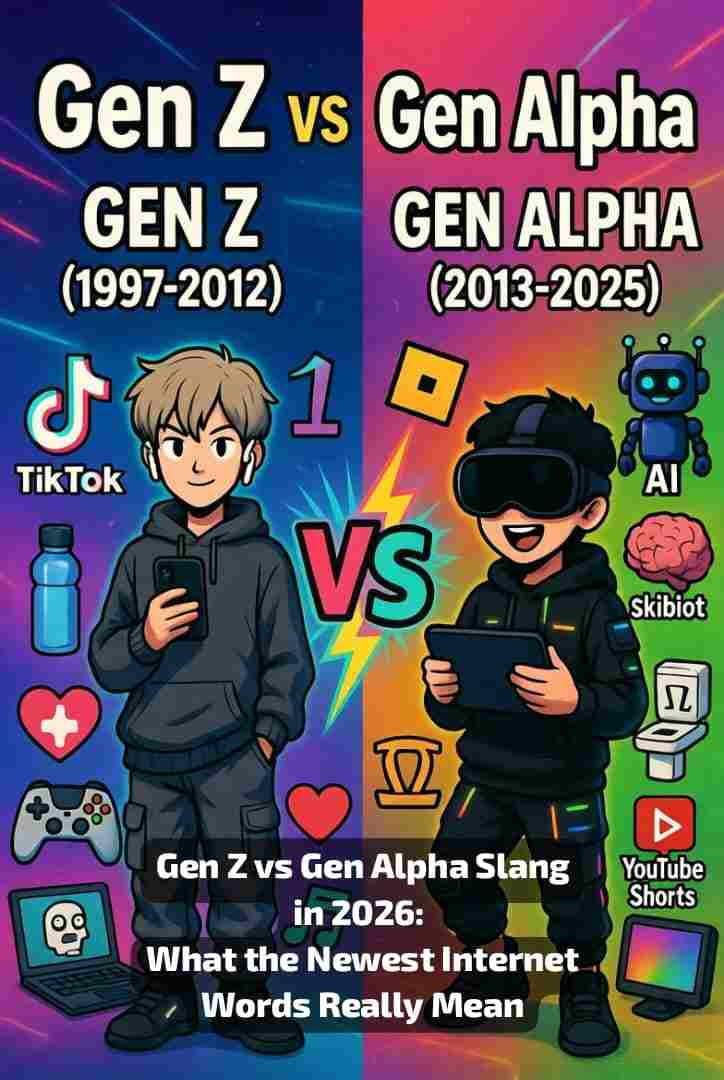
Have you ever heard someone say “rizz,” “skibidi,” or “aura points” and felt like you needed a second translator? You are not alone. The funny thing about slang is that it sounds random at first, but once you understand the generation behind it, the whole picture becomes much clearer.
Gen Z and Gen Alpha both love internet language, but they do not use it the same way. Gen Z, broadly people born after 1996, came of age with social media and meme culture already exploding.
Gen Alpha, often defined as those born from about 2010 to 2024, are growing up in an even more digital world, with smartphones, short video, and creator culture built into everyday life.
That is why their slang feels related, but not identical. Gen Z slang often sounds ironic, fast, and a little roast heavy. Gen Alpha slang can feel even more chaotic, more visual, and more “inside joke” driven.
Words like “brain rot,” “skibidi,” and “Ohio” show how much internet humor has shifted toward absurdity, while terms like “rizz,” “sigma,” “aura,” and “fanum tax” show how much youth language now moves through memes, short videos, and creator communities.
Table of Contents
In Short
- Gen Z slang is usually short, ironic, and reaction based. Words like “mid,” “delulu,” “no cap,” and “rizz” are common examples.
- Gen Alpha slang pushes internet humor even further. It often leans into absurd meme language, with terms like “skibidi,” “Ohio,” “fanum tax,” “sigma,” and “aura.”
- Both generations overlap a lot. Some words are shared, remixed, or reused in new ways, which is why slang can feel confusing if you try to force a strict line between the two.
- The fastest way to tell them apart is by tone. Gen Z often sounds clever and self aware, while Gen Alpha often sounds more absurd, playful, and meme soaked.
Here is a clear and blog-ready comparison table of 30 Gen Z vs Gen Alpha slang words:
| # | Gen Z Slang | Gen Alpha Slang | Meaning |
|---|---|---|---|
| 1 | Rizz | Rizzler | Charm or flirting ability |
| 2 | No cap | On God | Seriously, no lie |
| 3 | Mid | Mid (still used) | Average, not impressive |
| 4 | Sus | Side eye | Suspicious or questionable |
| 5 | Delulu | Delulu (more exaggerated) | Being unrealistically optimistic or delusional |
| 6 | Bet | Say less | Agreement or confirmation |
| 7 | Fire | Bussin | Very good or impressive |
| 8 | Vibe | Aura | Overall energy or presence |
| 9 | Glow up | Mewing | Improving appearance or looks |
| 10 | Cap | Big cap | A lie or exaggeration |
| 11 | Slay | Ate | Did something very well |
| 12 | Periodt | And that’s on… | Emphasizing a final point |
| 13 | Savage | Sigma | Bold, dominant, independent personality |
| 14 | Cringe | Ohio | Weird, awkward, or embarrassing |
| 15 | Flex | Aura farming | Showing off or gaining social points |
| 16 | Ghosting | Left on read | Ignoring someone digitally |
| 17 | Lowkey | Lowkey (still used) | Slightly, secretly, or subtly |
| 18 | Highkey | Highkey (still used) | Obviously or strongly |
| 19 | Cancelled | Cancelled (memeified) | Being publicly criticized or rejected |
| 20 | Simp | Glazing | Over-praising or obsessing over someone |
| 21 | Hits different | This ain’t it | Something feels unique or not good |
| 22 | Big yikes | Yikes (still used) | Awkward or embarrassing situation |
| 23 | Drip | Drip (more exaggerated) | Stylish or fashionable |
| 24 | Clout | Clout goblin | Fame or attention chasing |
| 25 | Main character | NPC | Being central vs background character |
| 26 | Mood | Core | Aesthetic or relatable theme |
| 27 | Touch grass | Go outside | Disconnect from the internet |
| 28 | Brain rot | Brain rot (intensified) | Overconsumption of low-quality content |
| 29 | W / L | W + Aura / L + Ratio | Win or loss socially |
| 30 | Let him cook | Cooked | Let someone try vs being finished/failing |

Quick takeaway
Gen Z slang is more structured, reaction-based, and widely understood, while Gen Alpha slang is often more exaggerated, meme-heavy, and chaotic, sometimes turning the same words into more dramatic or humorous versions.
If you want, I can also add example sentences for each row or turn this into a Pinterest-style infographic for your blog.
DISCOVER: 72 Most Popular Gen Z Slang Words of 2026 – Rizz, Delulu, Skibidi etc., And What They Secretly Mean Online
What Gen Z slang sounds like
Gen Z slang usually feels like a reaction in real time. It is quick, casual, and often loaded with irony. A word like “mid” means average or disappointing, while “delulu” is shorthand for delusional, usually in a playful way. “No cap” means no lie, and “rizz” refers to charm or flirting ability.
Those words are short, punchy, and easy to drop into conversation, which is part of why they spread so fast online.
What makes Gen Z slang stand out is the tone. It is often blunt, but not always serious. A Gen Z phrase can sound like a joke and a real opinion at the same time. That is why words like “sus” and “cap” worked so well.
They are simple, flexible, and easy to use in memes, group chats, and video comments. Even when the meaning is serious, the delivery usually feels light, fast, and a little detached.
Gen Z also helped make room for phrases that sound more visual than traditional slang. “Aura” is a good example. Merriam Webster describes it as a slang term for cool factor, stylishness, or confident excellence, and online it can also connect to the idea of gaining or losing aura points.
That kind of language fits the way Gen Z talks about personality as if it were part of a scoreboard, a meme edit, or a highlight reel.
READ MORE: 80 Most Popular Gen Alpha Slang Words You’ll Hear In 2026 (updated)
What Gen Alpha slang sounds like
Gen Alpha slang often feels like Gen Z language pushed through a louder, stranger filter. It is still internet based, but it is more likely to be absurd, exaggerated, and built around viral references.
A word like “skibidi” is a great example because Merriam Webster describes it as a nonsensical meme term, which means the joke is often in the sound and the absurdity, not in a fixed dictionary style meaning.
Another classic Gen Alpha style word is “fanum tax.” Merriam Webster defines it as a humorous internet term for taking someone else’s food or being entitled to some of it.
That is a perfect example of how Gen Alpha slang often turns everyday behavior into a joke that lives inside creator culture and short form video culture. It is playful, slightly random, and easy to repeat in comments or streams.
Gen Alpha also seems especially drawn to words that turn personality into a meme. “Sigma” can mean a coolly independent, self assured person, and Merriam Webster also notes that it can be used more loosely to mean extremely good or even as a nonsense meme word.
“Mewing” refers to a tongue posture practice that people joke about online, while “Ohio” is used to mean weird, awkward, cringeworthy, or otherwise undesirable. Together, those words show how Gen Alpha slang often blends real meaning, joke meaning, and internet nonsense in one place.
The biggest difference between Gen Z and Gen Alpha slang
The biggest difference is not just the vocabulary. It is the vibe.
Gen Z slang often feels like a smart reaction to something happening online. It is short, stylish, and slightly ironic. Gen Alpha slang often feels like the internet itself is talking back. It is more chaotic, more meme heavy, and more willing to make no sense at all if the joke lands.
That shift makes sense when you remember that Gen Alpha is growing up with digital media from the start, while Gen Z grew up alongside the rise of social platforms.
Another big difference is how long the slang stays fresh. Internet language now moves so fast that a term can go from funny to overused to cringe in a very short time.
Merriam Webster’s recent slang coverage of words like “brain rot,” “skibidi,” “mid,” and “sigma” shows just how quickly internet vocabulary can become part of mainstream discussion. That speed is part of the fun, but it also means younger users constantly move on to the next phrase.
Side by side examples of Gen Z and Gen Alpha slang
Here is a simple way to compare the two.
Gen Z style words often include mid, no cap, rizz, delulu, sus, aura, crash out, and brain rot. These words feel compact, reaction based, and highly adaptable. They are easy to use in conversation, captions, and comments without needing a lot of explanation.
Gen Alpha style words often include skibidi, fanum tax, sigma, Ohio, mewing, and aura. These words lean harder into meme culture, creator culture, and bizarre humor. Some of them are shared with Gen Z, but Gen Alpha often uses them with more exaggeration and more irony.
What is especially interesting is that some terms overlap. Rizz, sigma, aura, and even brain rot are not locked into one generation. That is because slang online spreads across age groups very quickly, especially when a phrase gets boosted by TikTok, YouTube Shorts, livestreams, or meme pages. Once a word becomes popular enough, different generations begin using it in slightly different ways.
Discover 70 of the most popular millennial slang words, what they really mean (From Adulting to Salty to YOLO), and how they shaped internet culture, texting, and everyday conversations.
Why Gen Alpha slang feels so strange to older users
A lot of adults hear Gen Alpha slang and think it sounds random, but that is exactly why it works. Gen Alpha is growing up in a world where humor is often built from remixes, sound clips, reaction edits, and absurd short video trends.
Britannica notes that Generation Alpha is the first generation to be born entirely in the smartphone and social media era, which helps explain why their slang feels so native to internet chaos.
This also explains why words like skibidi and Ohio became such big talking points. They are not trying to sound polished. They are trying to sound funny inside the culture that made them.
Merriam Webster even notes that “brain rot” gained extra use partly because of internet slang associated with Gen Alpha, which shows how older internet users are now watching younger users reshape language in real time.
Why Gen Z slang feels more familiar
Gen Z slang often feels easier to decode because many of the terms have clearer meanings. No cap means no lie. Mid means average. Rizz means charm. Delulu means delusional in a playful way. Sus means suspicious.
Even when the tone is funny or ironic, the basic meaning is usually pretty easy to grasp once someone explains it. That makes Gen Z slang feel more accessible than Gen Alpha slang for many adults.
There is also a generational memory effect. A lot of Gen Z slang feels familiar because some of it was already floating around before Gen Z fully claimed it.
Dictionary.com notes that slang like “no cap” has roots in Black slang long before the current wave of online use, which is a reminder that internet slang often gets remixed instead of invented from scratch.
READ ALSO: Millennial Slang vs Gen Alpha Slang in 2026: 45 Words That Show How Internet Language Changed.
A simple way to remember the difference
Think of it like this.
Gen Z slang says, “This is funny, this is true, and I know exactly how ridiculous this sounds.”
Gen Alpha slang says, “This is so random that the randomness is the joke.”
That tiny shift matters. Gen Z slang is often about being self aware. Gen Alpha slang is often about being absurd on purpose. Both are internet language, but they sit at slightly different points on the meme spectrum.
Verdict
- Gen Z slang feels fast, ironic, and sharp, with words like “mid,” “no cap,” “rizz,” and “delulu.”
- Gen Alpha slang feels more chaotic and meme driven, with words like “skibidi,” “fanum tax,” “sigma,” and “Ohio.”
- The biggest difference is tone, Gen Z sounds more self aware, while Gen Alpha sounds more absurd and inside joke heavy.
- Some slang overlaps, which is why the same word can sound Gen Z to one person and Gen Alpha to another.
Conclusion
Gen Z and Gen Alpha slang are connected, but they are not the same thing. Gen Z slang is fast, ironic, and compact. Gen Alpha slang is even more chaotic, more meme driven, and more deeply tied to the logic of short video and creator culture.
Terms like mid, no cap, rizz, and delulu show one side of the story, while skibidi, fanum tax, sigma, Ohio, and mewing show the other.
The real takeaway is simple. Slang is not just about words. It is about the internet, the joke culture around it, and the speed at which people copy, remix, and reinvent language. That is why the next slang wave is always already on the way.
READ ALSO: Gen Z Attraction Slangs: 25 Slang Words People Use When They Are Into Someone
FAQs
Gen Z slang is usually shorter, more ironic, and more reaction based. Gen Alpha slang is often more absurd, more meme heavy, and more tied to creator culture and short form video
It is used by both, but it is more strongly associated with the modern internet slang boom that Gen Z helped popularize and Gen Alpha now uses freely. Merriam Webster defines it as charm or flirting skill.
Because it is a meme word with absurd energy, and that randomness is part of the joke. Merriam Webster describes it as a nonsensical internet slang term.
Yes. Words like “sigma,” “aura,” and “brain rot” can be used by both groups, although the tone and context may differ.
Because social platforms spread words quickly, and once a phrase becomes too common, younger users move on to something new. That cycle is especially strong in TikTok, Shorts, and meme culture.