
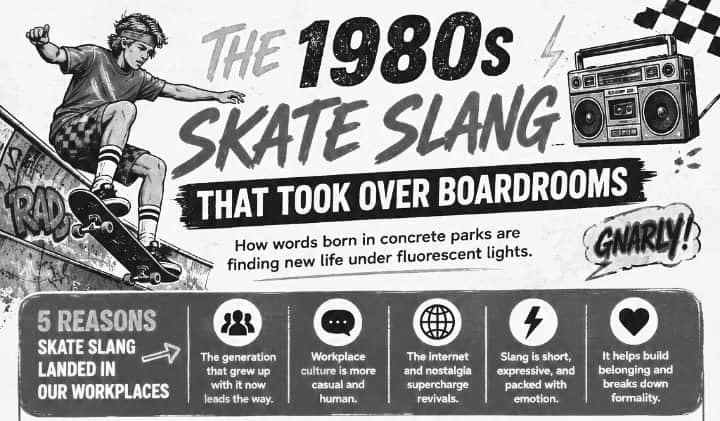
- Skatepark slang such as sick, gnarly, shred, bail, and stoked has outgrown its original scene and entered mainstream conversation.
- Many of these words now carry slightly different meanings at work, where they describe projects, deadlines, ideas, problems, and performance.
- The revival is partly driven by nostalgia, internet culture, relaxed workplace communication, and the generations who grew up hearing these expressions.
- Skate slang works best when it adds personality and emotional tone without replacing clear professional communication.
- Understanding where these words came from helps you use them naturally instead of sounding like you are forcing a retro personality.
There was a time when saying something was sick had very little to do with illness.
At a 1980s skatepark, words could move almost as quickly as the people using them. A trick could be gnarly. A talented skater could shred. A great session could leave everyone stoked. Someone who gave up halfway through might bail.
These were not merely convenient synonyms. They carried attitude. They told you how a person felt about what had just happened. More importantly, they helped signal that the speaker understood the culture.
Now something fascinating is happening. Those same expressions have escaped the skatepark and started turning up in Slack messages, meetings, presentations, product teams, creative departments, and startup offices.
A marketing manager might call a campaign sick. A developer might describe a messy software migration as gnarly. A team leader might say the sales department is going to shred its quarterly target. Someone may even joke that a colleague should not bail before the final presentation.
That crossover is more than nostalgia. It is a perfect example of how slang survives, changes meaning, and gets recycled by new generations.
READ ALSO: Whimsy Meaning in Lifestyle: Why Everyone Is Suddenly Obsessed With a More Playful Life
Table of Contents
What Did 1980s Skatepark Slang Actually Mean?
To understand why these words work so well today, it helps to understand what they communicated inside skate culture.
Skate slang was often compressed language. Instead of explaining that something was impressive, difficult, dangerous, exciting, or unexpectedly successful, one word could do the job.
That is one of the defining characteristics of effective slang. It is economical, emotional, and highly dependent on shared context.
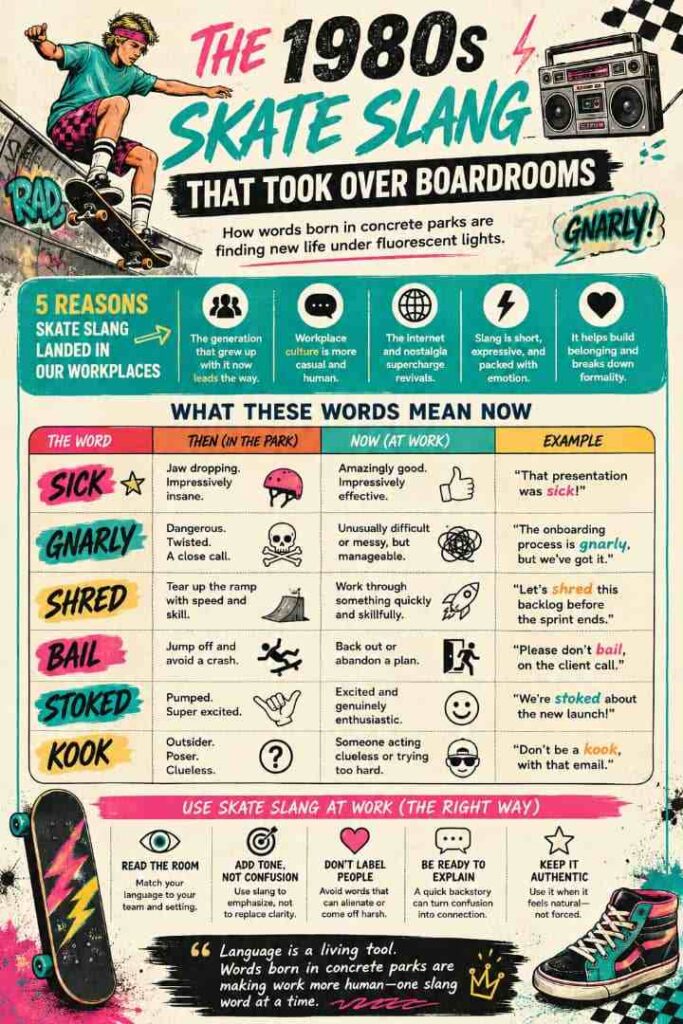
- Sick: Something exceptionally impressive, exciting, or visually striking.
- Gnarly: Something difficult, intense, dangerous, complicated, or extreme.
- Shred: To perform with exceptional skill and energy, especially while skating or playing music.
- Bail: To abandon a trick or jump away from it to avoid a bad outcome; later, to leave or back out.
- Stoked: Extremely excited, enthusiastic, or emotionally energized.
- Kook: Someone viewed as inexperienced, clueless, out of touch, or awkward within a particular scene.
Notice something important here: most of these words describe feelings and reactions as much as physical actions.
That is precisely why they translate surprisingly well into modern workplace language.
How Skate Slang Sounds in the Workplace Today
When slang moves into a new environment, its meaning often becomes broader. The word survives, but the original situation disappears.
That is exactly what has happened with skate vocabulary.
- Sick
Old-school sense: Exceptionally impressive or outrageous.
Workplace sense: Excellent, innovative, visually impressive, or highly effective.
Example: “That onboarding flow is sick. The whole process feels effortless.” - Gnarly
Old-school sense: Intense, difficult, dangerous, or extreme.
Workplace sense: Complicated, demanding, chaotic, or unpleasantly difficult.
Example: “The data cleanup is going to be gnarly, but the team has a solid plan.” - Shred
Old-school sense: To skate with serious speed and skill.
Workplace sense: To handle a task aggressively, efficiently, or exceptionally well.
Example: “The design team absolutely shredded the final review.” - Bail
Old-school sense: To abandon a trick or jump away before things go badly.
Workplace sense: To back out, disappear, withdraw, or leave something unfinished.
Example: “We cannot bail on the partnership after spending three months building it.” - Stoked
Old-school sense: Highly excited or energized.
Workplace sense: Genuinely enthusiastic about a result, opportunity, launch, or achievement.
Example: “Everyone is stoked about finally seeing the new product go live.” - Kook
Old-school sense: A clueless outsider or someone who does not understand the scene.
Workplace sense: Usually a joking criticism of someone behaving awkwardly or without understanding the situation.
Example: “Do not be a kook and send the draft before checking the numbers.”
The meanings are recognizable, but they are not identical to their original skatepark use. That distinction matters.
DISCOVER: 27 New Slang Words Parents Should Know in 2026 Before They Get Lost in the Group Chat
Why Is 1980s Skate Slang Suddenly Showing Up in Boardrooms?
The answer is not simply that everyone suddenly became obsessed with skateboarding.
Language has a habit of following people.
As generations move through school, entertainment, music, subcultures, workplaces, and eventually leadership positions, pieces of their old vocabulary travel with them. Words that once belonged to youth culture can eventually become ordinary expressions for adults.
That process is one of the reasons slang history is so interesting. A term does not have to remain frozen in its original setting to stay alive.
1. The generation effect is real
People who encountered skate culture, punk, hip-hop, BMX, surfing, or other youth cultures decades ago did not necessarily abandon those linguistic habits when they entered professional life.
Some expressions simply became part of their normal vocabulary.
That is why language that once sounded distinctly youthful can eventually sound perfectly ordinary coming from a manager, executive, designer, consultant, or business owner.
2. Corporate language became painfully predictable
For years, workplaces leaned heavily on phrases such as circle back, move the needle, synergy, low-hanging fruit, and optimize the workflow.
These phrases are not automatically wrong, but overuse can make communication feel mechanical.
Compare the emotional difference between “This is a challenging implementation” and “This implementation is gnarly.”
The second version has personality. It sounds like a human reaction rather than something lifted from a corporate presentation.
3. Modern workplaces are less formal
The old boundaries between “professional language” and “everyday language” have become much less rigid.
Remote teams communicate through chat. Coworkers send memes. CEOs post casually online. Designers share work in informal channels. Founders build personal brands around sounding approachable.
That environment creates more room for slang.
4. Internet culture is a slang recycling machine
Social platforms have made old vocabulary remarkably easy to rediscover.
A phrase that once belonged to a specific scene can suddenly appear in a video, meme, documentary clip, comment section, or nostalgia post and reach millions of people who were never part of the original culture.
The internet does not merely spread new slang. It constantly resurrects old slang.
The Bigger Story: This Is How Slang Becomes Mainstream
There is a common misconception that slang is temporary by definition.
Some slang disappears quickly, but other terms survive because they perform a useful job.
Sick is a great example. It is memorable because it uses an unexpected word to create a strong reaction. Gnarly is useful because it can describe difficulty, danger, complexity, or intensity without a long explanation. Stoked communicates enthusiasm more vividly than simply saying “pleased.”
Once a slang term becomes useful beyond its original community, it has a much better chance of surviving.
That is why office slang is not necessarily destroying professional language. In many cases, it is adding another layer to it.
A Slang Decoder’s Reality Check
Here is where things get interesting.
A word can survive while its cultural meaning changes dramatically.
Someone who grew up around skate culture might hear “That presentation was sick” and immediately recognize the compliment. Someone unfamiliar with the phrase could interpret sick literally. Someone else might understand the meaning but feel that the speaker is trying too hard to sound young.
That tension is completely normal.
Slang has always depended on audience awareness. What sounds natural in one group can sound awkward, dated, ironic, or even rude in another.
That is why knowing slang is not simply a matter of memorizing definitions. You also need to understand who uses the word, where it is being used, what tone it carries, and what social meaning sits underneath it.
What This Slang Sounds Like in Real Workplace Conversations
One of the easiest ways to understand a slang term is to see it doing actual conversational work.
- “That prototype is sick.”
Translation: The prototype is genuinely impressive. - “We have a gnarly week ahead.”
Translation: The workload is going to be difficult and intense. - “She shredded that presentation.”
Translation: She performed exceptionally well. - “Do not bail on the launch now.”
Translation: Do not abandon the plan at the last minute. - “The whole team is stoked.”
Translation: Everyone is genuinely excited.
Notice how each expression adds an emotional layer. That is the real power of slang.
How to Use Skate Slang at Work Without Sounding Forced
- Read the room. Slang should match the culture around you. What works in a creative team meeting may sound strange in a highly formal client presentation.
- Understand the original meaning. Knowing where a word came from helps prevent misuse. You do not need to become a skate historian, but context matters.
- Use slang to add tone, not replace clarity. “The migration is gnarly” is useful, but the sentence should not be the only explanation of what makes the migration difficult.
- Be careful with labels. Words such as kook can be playful among friends but dismissive in a professional setting. Describing a problem is safer than attaching a slang label to a person.
- Do not force nostalgia. One of the fastest ways to make slang sound unnatural is to sprinkle it into every sentence. Real slang users rarely need to prove that they know slang.
- Let the language breathe. Sometimes one well-placed word creates more personality than five forced expressions.
Slangwise Tip
The most effective use of old-school slang is usually the least deliberate one.
When a team already communicates casually, a word like sick, gnarly, or stoked can fit naturally. When someone suddenly starts dropping six retro skate terms into a serious meeting, the effect changes completely.
That is an important lesson about slang in general: fluency is less about knowing lots of words and more about knowing when not to use them.
READ AALSO: 30 Workplace Slang Terms Everyone Seems to Know: But Few People Actually Get Right
A Personal Observation From Years of Studying Slang
One pattern repeatedly stands out when old slang comes back around: people rarely revive a word for historical accuracy alone. They revive it because the word still does something useful.
That is exactly what happens with skate slang.
There is a particular efficiency to saying something is gnarly. The listener immediately understands that the situation is not simply difficult. There is an extra layer of intensity attached to it.
The same thing happens with stoked. “We are satisfied with the results” communicates one emotional level. “We are stoked about the results” communicates something warmer and more energetic.
That emotional compression is one reason slang continues to matter. It gives ordinary language texture.
Why This Comeback Actually Matters
It would be easy to laugh at the idea of 1980s skate words appearing in serious business conversations.
But from a language perspective, the phenomenon is genuinely useful.
It shows that language does not move in a straight line. Words disappear, return, change meaning, cross social boundaries, and sometimes become so normal that people forget they were ever slang in the first place.
That is the path many successful slang terms eventually take.
They begin inside a community. Outsiders notice them. Popular culture spreads them. Younger speakers remix them. Older speakers reuse them. Eventually, the word becomes familiar enough to appear in places nobody would have expected.
A word that once echoed around concrete ramps can eventually end up in a quarterly strategy meeting.
Slangwise takeaway: The comeback of skatepark slang is a reminder that language never stays in one place. A word can start on the edge of mainstream culture, travel through generations, get remixed online, and eventually show up in the same sentence as budgets, product launches, and quarterly targets.
The Bottom Line
The return of 1980s skatepark slang is not really about trying to make the workplace sound cooler.
It is about how people carry pieces of their cultural history with them.
Sick, gnarly, shred, bail, stoked, and kook may have been shaped by skate culture, but their continued survival proves that slang can travel far beyond the community that created or popularized it.
Used naturally, these words can make communication warmer, faster, and more expressive. Used badly, they can sound dated or performative.
The real trick is not sounding like an old-school skater.
It is understanding why the language worked in the first place.
And perhaps that is the most interesting thing about slang: the words may change, but the human need behind them does not. People still want fast ways to express excitement, difficulty, approval, frustration, risk, and belonging.
The ramps may have changed. The workplaces certainly have. But the language is still rolling.
Frequently Asked Questions About 1980s Skate Slang
Popular skate-related slang included sick, gnarly, shred, bail, stoked, and kook. These words described impressive tricks, difficult situations, strong enthusiasm, backing out of a move, or people viewed as inexperienced or out of place.
In slang, sick can mean extremely good, impressive, exciting, or extraordinary. The meaning is usually positive and has little connection to the literal meaning of being ill.
Gnarly describes something intense, difficult, complicated, extreme, or unpleasant. In modern workplace slang, it can describe a challenging project, messy process, difficult negotiation, or demanding deadline.
Shred originally referred to performing with exceptional energy and skill, particularly in activities such as skating or music. Today, it can also mean handling a task or challenge with speed and confidence.
In skate culture, bail referred to abandoning a trick to avoid a bad landing. In everyday slang, it can mean leaving, backing out, or abandoning a plan or commitment.
Stoked means very excited, enthusiastic, or happy about something. It is still commonly understood and can describe excitement about a project, event, opportunity, or achievement.
Yes. Some expressions remain strongly associated with skate culture, while others have become broader slang used in everyday conversation, entertainment, social media, and workplaces.
Old slang can return when previous generations bring familiar expressions into adulthood, while internet culture and nostalgia introduce those words to younger audiences. Relaxed workplace communication also creates more space for expressive informal language.
Yes, but context matters. Words such as sick, gnarly, shred, and stoked can work naturally in relaxed teams, but formal client communications and high-stakes documents usually benefit from clearer, more direct language.
A kook is someone viewed as inexperienced, clueless, awkward, or out of touch with the culture of a particular activity or community. Because it can sound insulting, it is better used carefully, especially in professional settings.