
Gen Z slang can make an ordinary comment section feel like a language test. One minute someone is saying “that’s a W,” the next they are calling something “mid,” saying they are “cooked,” or telling somebody to “lock in.”
The words change quickly, but the patterns behind them make a lot more sense once you know what to look for.
Table of Contents
In Short:
- Gen Z slang is a constantly changing mix of internet language, older slang, gaming vocabulary, memes, music, and expressions from different cultural communities.
- Not every term labeled “Gen Z slang” was invented by Gen Z. Many expressions were already used in African American English, Black and queer communities, gaming spaces, fandoms, or earlier internet culture before becoming mainstream.
- Words such as rizz, no cap, ate, aura, cooked, delulu, mid, sus, W, L, lowkey and lock in are useful examples of how slang can compress an entire reaction into one or two words.
- Social platforms accelerate slang because people repeat, remix, shorten and reinterpret expressions at enormous speed. Research from Pew also shows how central platforms such as TikTok, Instagram and Snapchat remain in teen social life.
- The smartest way to understand Gen Z slang is to learn the meaning, tone, context and cultural background instead of simply memorizing a dictionary definition.
Introduction: What Is Gen Z Slang Really?
After a long time of studying slang, tracking internet expressions and decoding the way words move between online communities, one thing becomes very clear: Gen Z slang is not a fixed vocabulary list.
It is better understood as a moving stream of language. Some words are brand new. Some are older expressions that have been revived.
Others come from African American English, Black and queer communities, gaming, music, fandoms and earlier internet culture before being amplified across mainstream platforms. Calling all of them “Gen Z inventions” misses an important part of the story.
That distinction matters because slang carries history. A word may look like a harmless TikTok expression today while having a much older cultural journey behind it.
Several popular expressions associated with younger internet users have roots in Black culture and Black queer culture, for example.
So what does Gen Z slang actually do?
It gives people fast ways to communicate humor, approval, disbelief, embarrassment, excitement, disagreement, boredom and social status. A single word can replace an entire sentence when everyone in the conversation understands the code.
That is why a message like “Nah, you’re cooked 😭” can communicate far more than the literal dictionary meaning of cooked. The tone, emoji, context and relationship between the people involved all matter.
Think of this guide as a decoder rather than a vocabulary test. The goal is not to force slang into everyday conversation. The goal is to understand what people mean when the language changes around you.
What Does Gen Z Slang Mean?
Gen Z slang refers to informal words, phrases, abbreviations and expressions commonly associated with Generation Z and the online communities where younger users communicate.
There is an important catch: generations overlap. A term can become strongly associated with Gen Z without being created by Gen Z. Language does not respect neat generational boundaries.
That is why words such as slay, tea, shade, cap, periodt, ate and bussin should not automatically be described as inventions of one generation. Their histories are more complicated and, in several cases, connected to Black and queer language communities.
The modern internet simply gives these expressions a much larger stage.
Where Does Gen Z Slang Come From?
The easiest mistake to make is assuming that TikTok creates every slang word. TikTok is extremely important for amplification, but it is rarely the whole story.
- African American English: Many expressions that became mainstream online have deeper roots in African American speech and culture. This is one reason it is important to distinguish between “popularized by Gen Z” and “invented by Gen Z.”
- Black and queer culture: Drag, ballroom and queer communities have historically contributed influential expressions and styles of speaking that later spread into wider internet culture. Current linguistic research continues to examine how queer slang travels and changes online.
- Gaming: Terms such as GG, NPC, OP, AFK and clutch moved from gaming environments into wider online conversation.
- Music: Hip-hop, rap, pop and other music communities regularly introduce or popularize phrases that fans repeat online.
- Fandoms: K-pop communities, sports fans, anime communities and other fandoms create their own vocabulary and spread it quickly.
- Memes and social platforms: A phrase can become popular because of one creator, one sound, one joke, one reaction image or one viral comment.
Slangwise fact: Internet culture does not simply create new words. It also changes the meaning, tone and reach of existing ones. That is a major reason slang evolves so quickly online.
BOOKMARK: 72 Most Popular Gen Z Slang Words of 2026 – Rizz, Delulu, Skibidi etc., And What They Secretly Mean Online
Gen Z Slang Dictionary: 30+ Terms With Real Examples
Here is where the slang starts making sense. Instead of giving you stiff dictionary definitions, each example shows how the word actually works in conversation.
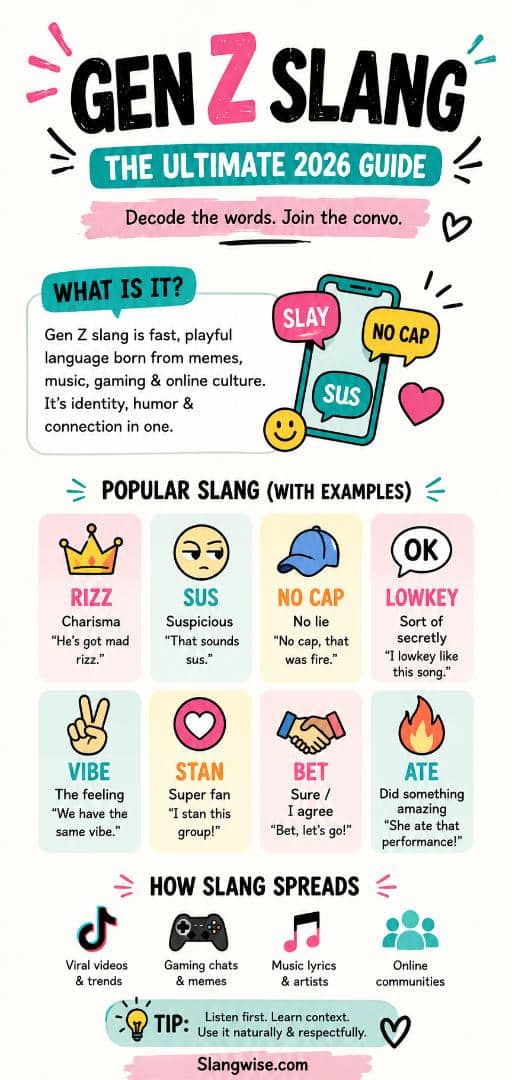
1. Rizz
Meaning: Charisma or the ability to attract or charm someone, especially in a romantic context.
Example: “He walked into the presentation late and somehow still had the whole room listening. That’s rizz.”
Decoder note: Rizz became one of the defining internet slang terms of the early 2020s, but its popularity does not mean every use is serious. It is often used jokingly.
2. No Cap
Meaning: No lie; honestly; telling the truth.
Example: “No cap, that was the best concert I’ve seen all year.”
Use no cap when you want to emphasize that you are being completely serious.
3. Cap
Meaning: A lie, exaggeration or false claim.
Example: “You said you finished the whole assignment in ten minutes? That’s cap.”
Think of cap and no cap as opposites in this context.
4. Ate
Meaning: Did something extremely well.
Example: “The way she handled that debate? She ate.”
You’ll often see ate used as praise for someone’s performance, appearance, creativity or confidence.
5. Slay
Meaning: To do something impressively or look exceptionally good.
Example: “You slayed that presentation. Everyone understood the point immediately.”
6. W
Meaning: A win, success or positive outcome.
Example: “They moved the deadline back by two days. Huge W.”
7. L
Meaning: A loss, failure or embarrassing outcome.
Example: “Forgot my headphones at home again. Massive L.”
8. Mid
Meaning: Average, unimpressive or just okay.
Example: “The trailer looked amazing, but the actual movie was kind of mid.”
9. Sus
Meaning: Suspicious or questionable.
Example: “He suddenly knows exactly what happened, but nobody told him anything. That’s sus.”
10. Lowkey
Meaning: Quietly, somewhat, secretly or without making a big deal about something.
Example: “Lowkey, that might be the best idea in the whole group chat.”
11. Highkey
Meaning: Openly, strongly or very obviously.
Example: “Highkey, everyone knew the surprise was coming.”
12. Aura
Meaning: A person’s perceived coolness, presence, confidence or social energy.
Example: “She said one sentence, walked away, and somehow had the best aura in the room.”
Decoder note: Aura is often treated playfully, with people joking about gaining or losing “aura points.”
13. Cooked
Meaning: In trouble, exhausted, overwhelmed or in a situation that is going badly.
Example: “The test starts in an hour and I haven’t studied. I’m cooked.”
14. Lock In
Meaning: Focus seriously and stop getting distracted.
Example: “Final week is here. Time to lock in.”
15. Delulu
Meaning: A playful shortening of “delusional,” usually describing unrealistic optimism or an exaggerated belief.
Example: “Thinking the celebrity will notice your comment is a little delulu.”
16. Bussin
Meaning: Extremely good, especially when describing food, though usage can be broader.
Example: “Those noodles are actually bussin.”
17. NPC
Meaning: Originally a gaming term for “non-player character.” Online, it can describe someone acting predictable, repetitive or lacking independent engagement.
Example: “He gives the exact same answer every time. Bro is moving like an NPC.”
18. Touch Grass
Meaning: A joking way of telling someone to step away from the internet and reconnect with real life.
Example: “You’ve spent six hours arguing about that ranking. Please touch grass.”
19. It’s Giving
Meaning: Used to describe the impression, mood or aesthetic something creates.
Example: “That room is giving cozy library.”
20. Vibe
Meaning: The emotional atmosphere, style or overall feeling of a person, place or situation.
Example: “This café has such a relaxed vibe.”
21. Stan
Meaning: To strongly support or admire a celebrity, artist, character or other public figure; also used as a noun for an enthusiastic fan.
Example: “I’ve been a fan for years, but the new album turned me into a full stan.”
22. Bet
Meaning: Okay, sure, agreed or understood.
Example: “Meet at 6?”
“Bet.”
23. Pressed
Meaning: Bothered, annoyed or unusually upset about something.
Example: “Why are you still arguing about one comment? You seem pressed.”
24. Yap
Meaning: To talk a lot, especially when someone is rambling.
Example: “He started explaining the movie and yapped for twenty minutes.”
25. Glaze
Meaning: To praise or compliment someone excessively.
Example: “Okay, we get it. You like the player. Stop glazing him.”
26. Based
Meaning: A term of approval suggesting that someone’s opinion feels confident, authentic or unapologetically stated.
Example: “You said what everyone else was thinking. Based.”
27. Ratio
Meaning: A social-media measure or joke implying that a reply has received more positive engagement than the original post, often signaling disagreement or public embarrassment.
Example: “The reply got three times the likes of the original post. He got ratioed.”
28. Canon Event
Meaning: An experience someone supposedly needs to go through as part of their personal development or story.
Example: “Everyone has that one embarrassing haircut. It’s a canon event.”
29. Tuff
Meaning: Cool, impressive or admirable.
Example: “Those custom sneakers are tuff.”
30. Real
Meaning: A quick way of showing agreement, empathy or recognition that something is relatable.
Example: “I keep saying I’ll go to bed early and then somehow it’s 2 a.m.”
“Real.”
Read More: Rizz, slay, gyatt and more. Dive into the 80 most viral Gen Z slang so you can decode even more terms without getting lost in a TikTok comment section.
Why Does Gen Z Slang Spread So Fast?
The biggest change in modern slang is not simply the number of new words. It is the speed of distribution.
Before social media, a phrase could remain inside a school, city, music scene or subculture for years. Today, a creator can post a phrase in the morning, millions of people can repeat it by evening, and brands can be analyzing it by the end of the week.
Short-form video is especially powerful because it combines sound, text, facial expression, repetition and imitation. A phrase is no longer just a word. It can become a meme format.
And because platforms encourage remixing, the same phrase can develop several meanings. One group might use it seriously. Another might use it ironically. A third group might use it simply because the phrase is funny.
That is exactly why context matters so much when decoding slang.
Gen Z Slang Is About Tone as Much as Meaning
One of the most important lessons from studying slang is that a dictionary definition is rarely enough.
Take the word cooked.
“I’m cooked” could mean someone is exhausted, unprepared, embarrassed, overwhelmed or simply doomed in a humorous way. The surrounding conversation tells you which interpretation makes sense.
The same thing happens with ate. Sometimes it is enthusiastic praise. Sometimes it is exaggerated irony. Sometimes the speaker is intentionally being dramatic because that makes the comment funnier.
In other words, Gen Z slang is not just vocabulary. It is social signaling.
Why Gen Z Slang Matters in Internet Culture
It is easy to dismiss slang as meaningless internet noise. That misses the bigger picture.
- It creates belonging. Shared expressions help people recognize that they understand the same jokes, trends and online references.
- It compresses emotion. A word like “real,” “mid,” “W,” or “yikes” can communicate a surprisingly specific reaction with almost no explanation.
- It creates humor. Deliberately exaggerated language is one of the most common ways slang makes ordinary conversations funnier.
- It signals community. People often learn specific vocabulary through gaming, fandoms, music, sports or other digital communities.
- It shows language change in real time. Online culture makes it possible to watch meanings rise, shift and sometimes disappear much faster than traditional language change.
Why Some Slang Terms Disappear So Quickly
Ever wondered why a word can feel everywhere one month and almost invisible later?
Overexposure is one reason. Once a phrase becomes extremely popular, people start repeating it beyond the original community. Brands use it. News outlets explain it. Parents use it ironically. At that point, the word can lose some of its original social value.
Novelty also matters. Slang is partly about expressing membership and freshness. Once everyone knows the phrase, online communities often move toward the next expression.
Researchers studying slang have found that slang tends to show larger changes in frequency over time than many standard words, which helps explain why some expressions suddenly become extremely visible and then fade.
How to Use Gen Z Slang Without Sounding Forced
This is where many people get into trouble.
Understanding slang does not mean adding five slang words to every sentence. Natural usage is usually much more restrained.
- Learn the context before using the word. A term can be playful in one community and inappropriate or awkward in another.
- Use fewer terms, not more. One well-placed expression sounds more natural than an entire sentence packed with internet slang.
- Pay attention to the audience. Language that works in a private group chat may sound completely out of place in a formal workplace or school setting.
- Understand cultural origins. A word’s popularity does not erase its history.
- Do not force youth language to sound young. Slang works best when it fits the speaker, context and relationship.
The best slang users are usually not the people trying hardest to sound current. They are the people who understand exactly when a word fits.
How Brands Should Approach Gen Z Slang
For brands, slang can be useful, but it can also become a fast route to sounding out of touch.
- Observe first. Study how people actually use the word rather than copying the dictionary meaning.
- Understand the source. Know whether the expression has roots in a particular cultural or linguistic community.
- Use slang selectively. A campaign does not become authentic simply because it contains internet vocabulary.
- Test the tone. Ask whether the wording sounds natural for the brand’s actual audience.
- Be willing to remove it. When slang becomes stale, forced or misunderstood, continuing to use it can make the problem worse.
READ MORE: 26 slang words brands should stop misusing and how to use them right.
What Makes Gen Z Slang Different From Older Generations?
Every generation develops informal language, so Gen Z is not unique simply because it has slang.
The difference is the environment in which today’s slang travels.
Gen Z grew up in a highly networked media environment where language can move between group chats, gaming servers, videos, comments, memes and real-life conversations almost instantly. Pew Research’s recent teen technology research continues to show that platforms such as TikTok, Instagram and Snapchat play important roles in how teens experience social media and connection.
That means the boundary between “online language” and “real-life language” is much thinner.
A term may start as a joke online, become a recurring meme, move into text messages, appear in spoken conversation and eventually be recognized by people who rarely use social media themselves.
Final Thought: Learn the Culture, Not Just the Words
Gen Z slang is much more interesting when you stop treating it as a random collection of funny words.
Rizz, no cap, ate, cooked, aura, mid, delulu, lock in and the rest are pieces of a much bigger language system. They show how people adapt language to express identity, humor, emotion, belonging and cultural knowledge in an incredibly fast digital environment.
Years of following slang make one lesson especially clear: context beats memorization. Knowing that “cooked” can mean trouble is useful. Understanding why someone says “bro is cooked 💀” in a particular conversation is much more useful.
And remember that slang has history. Some of the expressions that look like brand-new internet language have deep roots in communities that used them long before algorithms pushed them into the mainstream. Understanding that history makes slang decoding more accurate and much more respectful.
So the next time a comment says “That’s a W,” someone tells a friend to “lock in,” or a post gets dismissed as “mid,” the meaning should be much easier to catch.
For more explanations, examples and slang origins, explore the Gen Z slang collection on SlangWise.
FAQs About Gen Z Slang
Gen Z slang is informal language commonly associated with Generation Z and online youth culture. It includes words and phrases from social media, gaming, music, memes, fandoms, African American English, queer communities and older internet culture.
Commonly recognized terms include rizz, no cap, cap, ate, slay, W, L, mid, sus, lowkey, aura, cooked, lock in, delulu, bussin, NPC, touch grass, it’s giving, yap, glaze and based. Usage can vary by age, community and platform.
Not always. Many expressions associated with Gen Z were used earlier by African American English speakers, Black and queer communities, gamers, musicians, fandoms and other subcultures. Gen Z has often helped popularize and remix these expressions online rather than inventing every term from scratch.
Slang spreads rapidly through short-form video, memes, group chats, gaming communities and other online spaces. Once a phrase becomes heavily repeated or commercialized, users may move toward newer expressions to keep language fresh and community-specific.
Start with context rather than memorization. Read conversations, watch how terms are used, notice the tone and learn where expressions come from. Once the meaning and context make sense, it becomes much easier to recognize slang naturally.
Sources
- Pew Research Center — Teens’ Experiences on TikTok, Instagram and Snapchat (2026)
- Pew Research Center — Teens, Social Media and Technology 2023
- Because Internet: Understanding the New Rules of Language by Gretchen McCulloch
- Urban Dictionary — useful as a record of community-created slang definitions, but individual entries should always be checked against context and broader language history
About the Author
Agboola John is the author and founder of SlangWise.com. He studies internet language, slang evolution and the cultural context behind viral expressions, with a focus on making modern slang easier to understand without stripping away its meaning or origins.