
- BFFR usually means “be fing for real”* and is used when someone sounds unbelievable, dramatic, or plainly not serious.
- BSFFR is commonly understood as “be so fing for real”* or “be so for real,” which makes the reaction feel even sharper and more emphatic.
- Both terms work like a reality check in texting, comments, and social media replies.
- The tone is usually skeptical, annoyed, shocked, or amused, depending on the context.
- These acronyms became especially popular in fast, casual internet spaces where people want to react quickly and sound blunt.
What Does BSFFR and BFFR Mean in Slang?
If you have been scrolling through TikTok, X, Instagram comments, or group chats and suddenly saw BFFR or BSFFR, the meaning is not as mysterious as it looks.
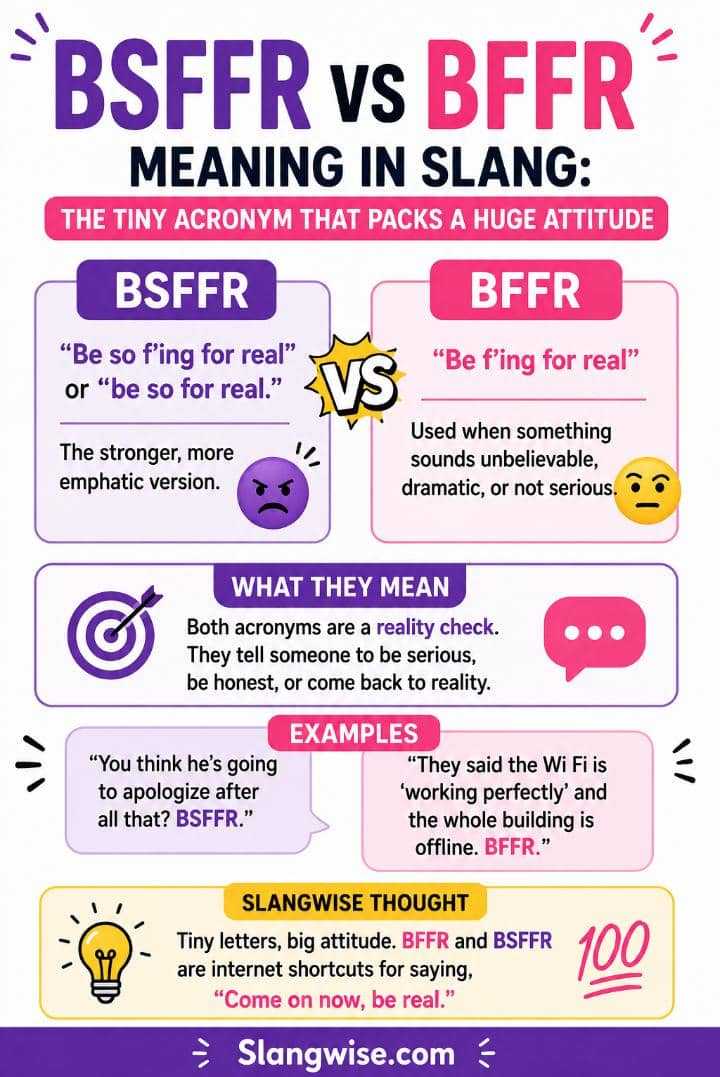
In simple terms, both are slang reactions that mean someone should be serious, be honest, or come back to reality.
The most common version, BFFR, is widely used to mean “be fing for real,”* and it is often thrown out when a statement feels ridiculous, fake, exaggerated, or just too much.
BSFFR is a close cousin. It is usually read as “be so fing for real”* or, in a softer form, “be so for real.” The extra S gives it a little more bite, like the speaker is not merely surprised, but fully fed up with the nonsense.
In practice, both acronyms do the same job: they tell someone to stop playing and speak plainly.
You will most often see these terms used in response to something that sounds unrealistic, over-the-top, suspicious, or annoying. That is why they are so effective in comment sections and text messages.
They are short, expressive, and carry a strong emotional tone without needing a whole paragraph.
READ ALSO: 250 Most Popular Internet Abbreviations of 2026 Explained for Easy Texting
Slangwise Note
What makes BFFR and BSFFR so interesting is that they are not just abbreviations. They are tiny mood statements. One person can use them to laugh at a wild claim, another can use them to call out dishonesty, and someone else can use them to show pure disbelief.
That is the magic of internet slang: a few letters can carry the whole mood of a conversation. In a way, these acronyms are the online version of saying, “Come on now, let us be serious.”
How People Use Them in Real Life Online
Here is the easiest way to understand the difference.
BFFR is the more common one. People use it when they want to challenge something that sounds fake, silly, or wildly exaggerated. It can mean “Are you serious?” or “Stop lying,” depending on the vibe.
It is often used when the speaker is shocked enough to respond with blunt honesty instead of a long explanation.
BSFFR feels even more intense. It has the same basic energy, but with a little more dramatic emphasis.
Think of it as the version you might use when the situation is so ridiculous that a normal reaction does not feel strong enough. That is why people interpret it as “be so for real” or “be so f***ing for real.”
Example:
- “You think he is going to apologize after all that? BFFR.”
- “They said the Wi Fi is ‘working perfectly’ and the whole building is offline. BSFFR.”
The tone can be playful, irritated, sarcastic, or dead serious. That flexibility is one reason these acronyms spread so quickly across social media. They fit the speed of modern conversation.
SEE ALSO: AFK Meaning: What Does AFK Mean in Text, Chats, and Gaming?
Where the Slang Comes From
The phrase “be for real” has been around longer than the acronyms themselves, and the internet turned it into something faster, sharper, and more shareable.
BFFR became especially popular on social media around 2022, where it spread quickly through posts, comments, and reaction culture.
From there, internet users kept trimming, remixing, and intensifying it. That is how BSFFR started to appear as a stronger variation.
Slang does this all the time. One phrase becomes a shorthand, then the shorthand becomes a new shorthand, and suddenly everyone is using it like it has always existed.
When to Use BFFR and BSFFR
These acronyms work best in informal settings. Use them in text messages, comment sections, memes, and casual chats where the tone is already relaxed and a little dramatic.
They are not great for formal writing, schoolwork, or professional messages because the language is intentionally blunt and emotional.
They are also best used when the other person understands internet slang. If not, the message may sound confusing or overly aggressive. That is why context matters so much with this kind of slang.
A funny comment between friends can feel natural, but the same word in the wrong setting can sound rude.
SEE ALSO: SDIYBT Meaning in Slang: The Bizarre Little Phrase That Somehow Became a Whole Internet Mood
Conclusion
At the end of the day, BFFR and BSFFR are both internet slang ways of saying, “be serious,” “be honest,” or “come on, now.” The difference is mostly in intensity.
BFFR is the common version, while BSFFR sounds like the stronger, more dramatic cousin. Both are part of the fast, expressive language of social media, where people want to react quickly and make their feelings clear in just a few letters.
So if you see them online, do not overthink it. The message is usually simple: somebody is not buying the story, and they want the truth right now.
FAQs
It usually means “be fing for real.”* People use it to react to something unbelievable, dishonest, dramatic, or ridiculous.
It is commonly read as “be so fing for real”* or “be so for real,” and it works like a stronger version of BFFR.
They are very close in meaning, but BSFFR usually feels more intense and emphatic. BFFR is the more common version.
Not really. They are casual slang and work best in texts, memes, replies, and informal online conversations.
Table of Contents