
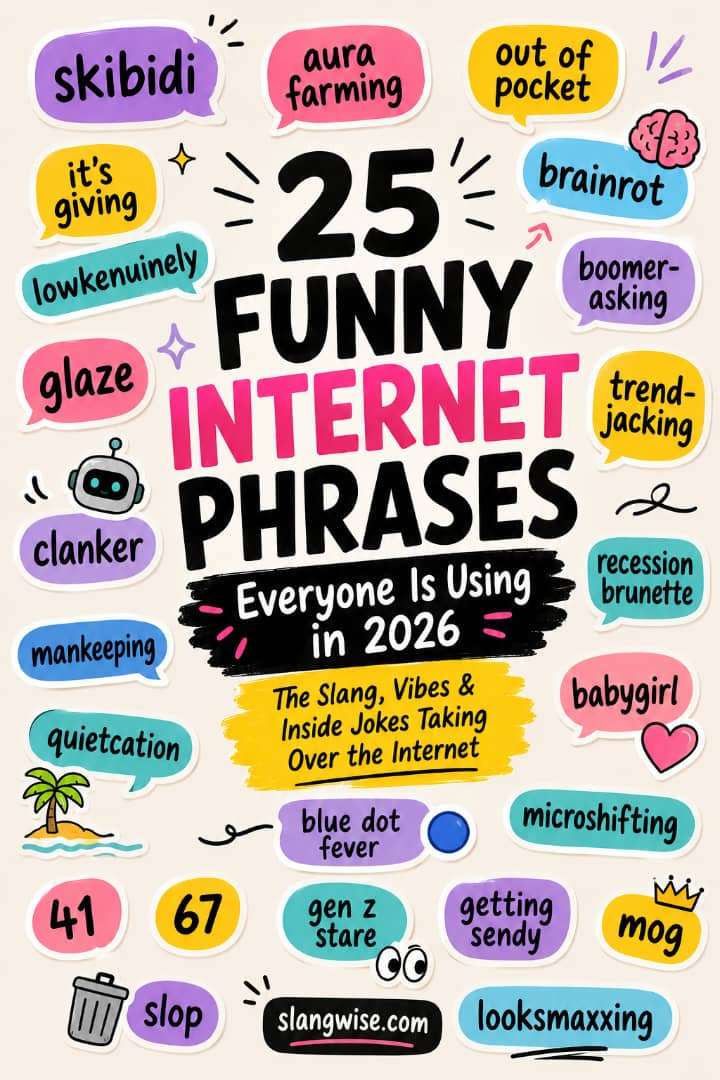
Imagine opening a group chat after a busy weekend. Someone says “67,” another person replies “let him cook,” and somebody else announces that “the saxophones are getting louder.” Everyone seems to understand the joke except you. At this point, you are not sure whether you missed a conversation or an entire language update.
That is the wonderfully ridiculous thing about internet slang in 2026. A random number can become a punchline, a meal can sound like dog food, and a completely ordinary situation can suddenly feel like the opening scene of a disaster movie.
I have noticed a pattern while following internet language: the phrases people remember most are not always the ones with the clearest definitions. They are often the ones that make you stop scrolling, laugh, or immediately think of a friend who behaves exactly like that.
So, I have put together 32 funny internet phrases worth knowing, combining familiar viral slang with newer 2026 expressions. You will discover what each phrase means, how people use it, and examples that show how it works in everyday conversations.
Some are genuinely useful. Others are so absurd that explaining the joke almost ruins it. Either way, by the time you finish this list, you will be much better prepared for your next confusing comment section.
32 Funny Internet Slang Phrases People Are Using in 2026
1. Skibidi
Skibidi is one of those internet words that seems to have escaped from a conversation where nobody agreed on the subject. It can be used to suggest something weird, ridiculous, cool, or simply connected to the absurd side of online culture. Its exact meaning depends heavily on context.
Funny example: Your little brother walks into the kitchen, says “That is some skibidi behavior,” and leaves without explaining what he means. You ask what happened. He says nothing. Somehow, that makes it funnier.
Skibidi works because the absurdity is part of the appeal. Sometimes, the joke is not what a word means but how confidently someone uses it.
READ ALSO: 20 Skibidi Slang Terms Explained: From Skibidi Toilet to Skibidi Rizz
2. Aura Farming
Aura farming means deliberately creating an impression of effortless coolness, confidence, or mystery. Someone might walk into a room slowly, pose dramatically, or perform an ordinary task as though an audience were watching.
Funny example: Your friend enters a room wearing sunglasses, even though it is raining, and takes three seconds to remove their jacket. You whisper, “Bro is farming aura just to collect a package.”
The funny part is imagining that coolness comes with experience points. Every dramatic entrance is another opportunity to increase the score.
LEARN MORE: Aura Farming: The Viral Slang Everyone Is Using to Look Cool Without Trying
3. Lowkenuinely
Lowkenuinely blends “lowkey” and “genuinely” into one internet friendly word. People use it to express a sincere opinion in a casual, understated way, often when they do not want to sound overly dramatic.
Funny example: “I lowkenuinely opened my laptop to study, watched one video, and somehow learned the entire history of a celebrity I do not even like.”
I find words like this interesting because they show how internet users compress familiar expressions into something quicker and more playful. Why use two separate words when you can mash them together and give everyone a new spelling problem?
4. Reading
Reading means sharply and cleverly calling out somebody’s behavior, contradictions, or shortcomings. The expression has important roots in Black and Latine LGBTQ+ ballroom culture, where reading developed as a witty form of verbal observation.
Funny example: Someone arrives 40 minutes late and announces that everybody else has poor time management. Your friend looks at them and says, “You own a clock, but apparently the two of you are not on speaking terms.” That is a read.
Unlike a random insult, a good read identifies the contradiction that makes the situation funny. It can be sharp without needing a long argument.
5. Glaze
Glaze means praising or flattering someone excessively, especially when the admiration feels exaggerated or undeserved. It is often used when a person appears so impressed with someone that they can barely think independently.
Funny example: Someone posts a blurry photo of a sandwich, and their friend comments, “The greatest culinary achievement in human history.” You reply, “Relax. Stop glazing the sandwich.”
Glaze is particularly funny when the praise is dramatically bigger than the achievement. A person can make a minor accomplishment sound like a historic world event.
6. Slop
Slop is a dismissive term for low quality, mass produced digital content, particularly AI generated images, videos, and posts that feel repetitive or carelessly assembled.
It expresses frustration with feeds full of material that looks designed to attract attention rather than offer anything worthwhile.
Funny example: You open a video expecting a useful cooking tutorial and find an AI generated chef making a pizza with seventeen layers of cheese and a suspicious number of fingers. “Another day, another serving of internet slop.”
The humor comes from the word’s unpleasantly messy sound. It makes low effort content seem like something nobody ordered but somehow keeps arriving.
7. Looksmaxxing
Looksmaxxing refers to efforts to optimize one’s appearance. Online discussions range from ordinary grooming and personal style to more extreme appearance focused practices. The term often appears in social media communities that turn appearance into a competition.
Funny example: Someone watches one hair styling tutorial, buys a new comb, and announces that their entire personal rebranding project begins on Monday. Their friend says, “The looksmaxxing department has received its first shipment.”
The word sounds like a software upgrade, which is part of its meme appeal. Still, I would be careful with the term because some online looksmaxxing communities encourage unhealthy comparisons or harsh judgments about appearance.
8. Chopped
Chopped is slang used to call something or someone unattractive, unimpressive, or generally not up to expectations. It is especially associated with younger internet users and blunt reactions on social media.
Funny example: A friend tries to make a fancy birthday cake, forgets an important ingredient, and produces something that looks more like a science experiment. Someone jokes, “That cake is chopped. The bakery needs to investigate.”
Although the expression often appears in jokes about people’s looks, it can hurt when directed at a real person. It is better to understand the slang than to use it to humiliate somebody.
DISCOVER: Why Is Everyone Saying Chopped and Choppelganger Right Now? The Meaning Might Surprise You
9. The Saxophones Are Getting Louder
“The saxophones are getting louder” is a viral expression used to suggest that something bad, awkward, or unavoidable is approaching. The phrase plays on dramatic music that builds when a movie scene is about to take a disastrous turn.
Funny example: You check your bank balance after a weekend of online shopping. You check the delivery notifications. You remember that rent is due tomorrow. The saxophones are getting louder.
Another example: you wave confidently at somebody who was actually waving at the person behind you. The saxophones are not simply playing anymore. They are performing a full concert.
The expression gained substantial attention in 2026 coverage of online slang. I like how it turns a small, relatable mistake into an imaginary cinematic disaster.
10. Clanker
Clanker is a derogatory, often humorous term for robots and machines, including AI systems. The word has a science fiction feel, as though people are complaining about robots in a futuristic movie.
Funny example: Your printer refuses to print a document, flashes an error message, and suddenly decides it needs a firmware update. You stare at it and say, “Listen here, clanker. The deadline is in ten minutes.”
The phrase is especially amusing because it gives machines the sort of rude nickname somebody might give a troublesome colleague. It also reflects wider online jokes about automation and AI.
🧠 Think You Know Your Internet Slang? Test your knowledge with our Ultimate Internet Slang Quiz featuring 25 easy questions! [Take the Slang Quiz]
11. Quiet on the Creek
Quiet on the creek became a viral catchphrase in 2026 after rapper Saucy Santana recalled being told to stay quiet while fishing. Online, people use it humorously to mean keeping things quiet, staying low key, or not revealing too much about their plans.
Funny example: You finally save enough money for a holiday. Before posting the booking confirmation, you remember that you have not told anyone about your plan. Caption: “Quiet on the creek until I am already at the airport.”
It can also be used when somebody is about to reveal private information and the group wants them to stop talking. The unexpected fishing reference makes a simple request for privacy sound much more memorable.
12. 41
41 is a viral number meme associated with younger internet users. Like several number based jokes in Gen Alpha culture, it can function as an absurd response, an inside joke, or a way to participate in a trend rather than communicate a precise message.
Funny example: You ask your younger cousin what they want for lunch. They answer, “41.” You offer rice. They say “41.” You ask whether they want a drink. They look at you as though you are the one failing the examination.
There is no need to invent a complicated definition every time a number appears in a meme. Sometimes its appeal comes from repetition and shared context, not a fixed meaning.
13. 67
Usually said as “six-seven,” 67 is a viral expression that became particularly associated with Gen Alpha memes and deliberately nonsensical responses. It spread through music, short videos, and online jokes, with its meaning often depending on the situation.
Funny example: A teacher asks for the answer to a maths question. One student raises a hand and confidently says, “Six-seven.” The teacher asks which part of the calculation produced that answer. The student simply repeats it with even more confidence.
The phrase works like a social in joke. If everyone recognizes the reference, the reaction becomes part of the entertainment. Without that shared context, it can sound like the calculator has developed a personality.
14. It’s Giving
It’s giving is a flexible way to describe the vibe, impression, or energy something creates. Depending on the context, it can be complimentary, critical, or completely sarcastic.
Funny example: Your friend arrives at a formal dinner in slippers, carrying a bowl of cereal. You look them up and down and say, “It’s giving executive who scheduled a meeting with their bed.”
One reason I like this expression is how easily it adapts to different situations. You can describe an outfit, a room, a strange decision, or somebody’s entire personality with a few words.
15. Gen Z Stare
The Gen Z stare describes an expressionless look that people jokingly associate with situations where someone expects a response but receives silence instead. It often appears in conversations about awkward customer service moments or confusing social interactions.
Funny example: A customer asks a completely unexpected question. The employee pauses, looks directly at them, and appears to be waiting for the universe to supply an answer. Somebody watching says, “That Gen Z stare deserves its own customer service department.”
The phrase is funny because everyone has experienced a moment when words simply refuse to arrive. However, it is a social media label, not a reliable description of an entire generation.
16. Getting Sendy
Getting sendy means going all out or committing enthusiastically to an activity. It developed from action sports language around sending it and is now also used as a playful expression of enthusiasm.
Funny example: You tell yourself you will clean your bedroom for ten minutes. Twenty minutes later, every drawer is empty, your playlists are on full volume, and you are reorganizing furniture. You did not clean. You got sendy.
The phrase works particularly well when somebody becomes unexpectedly enthusiastic about a completely ordinary task. It makes everyday ambition sound like an extreme sporting event.
17. Delulu
Delulu is a playful shortening of “delusional.” In internet slang, it often describes someone entertaining unrealistic hopes, especially about romance, celebrities, or a future they have imagined in detail.
Funny example: You make eye contact with someone at a café for two seconds. Before you finish your drink, your imagination has planned the wedding, picked the venue, and named the imaginary dog. Your friend says, “Please come back from your delulu universe.”
Delulu can be affectionate self mockery rather than a serious accusation. The joke is recognizing the gap between what is actually happening and what the imagination has decided is happening.
18. Crash Out
Crash out is slang for losing one’s temper, reacting impulsively, or dramatically losing composure over a situation. It frequently appears in online videos and commentary when somebody reacts far more intensely than the situation seems to warrant.
Funny example: Your phone battery drops from 3% to 2% while you are trying to order food. You start accusing the charger of betrayal, the electricity supply of conspiracy, and the phone manufacturer of personal disrespect. Your friend says, “Please do not crash out over two percent.”
The phrase is most effective in humorous commentary about an overreaction. Of course, if someone is genuinely upset, giving them space may be better than turning their feelings into a joke.
19. Mog
To mog someone means to outshine or outclass them, particularly in appearance, fashion, confidence, or performance. The term is common in competitive corners of internet culture, where people compare who stands out most.
Funny example: You spend an hour preparing a carefully designed presentation. Your colleague walks in, explains the entire project clearly in three minutes, and wins everyone’s attention. You sit down and whisper, “I have been mogged by a slideshow.”
Although the term frequently appears in appearance based comparisons, it can also be used jokingly for skills, fashion, or everyday achievements. Not every friendly interaction needs a winner and a loser.
20. 7×7=49
In a viral 2026 internet meme, the ordinary equation 7×7=49 became a playful reference to someone or something considered unexpectedly attractive. The humor comes from treating a school maths fact as though it were a celebrity crush.
Funny example: Somebody asks what your type is. You start listing personality traits, hobbies, and values. Your friend interrupts with, “Mine is 7×7=49.” At that point, the conversation has left the classroom and entered a completely different universe.
What makes the meme memorable is its ridiculous specificity. Instead of naming a person, someone can point to a multiplication equation and expect other internet users to recognize the joke.
21. LARPing
LARP stands for live action role playing, but online slang also uses “LARPing” to describe someone pretending to be a person they are not or acting out an image that does not match reality. The tone can be serious or playful, depending on context.
Funny example: Someone posts that they are a productivity expert, complete with a colour coded schedule. Five minutes later, they admit they have ignored every alarm for three weeks. The comments accuse them of LARPing as a functional adult.
The phrase is useful for describing exaggerated online personas. However, it is worth remembering that a joke about pretending is not proof that you know somebody’s real life.
22. Brainrot
Brainrot describes an intense obsession with online content, a meme, a fictional character, or a subject that keeps occupying someone’s thoughts. It can also describe internet content so absurd or repetitive that it seems to have taken over everyone’s attention.
Funny example: You watch one cooking video before bed. Three hours later, you know the chef’s entire kitchen setup, have watched six arguments about the recipe, and are trying to explain the controversy to somebody who only asked whether you were asleep.
Brainrot is funny partly because it is self aware. People use it to joke about the same internet habits they are actively participating in.
23. Out of Pocket
Out of pocket has several meanings, but in online conversation it often describes a comment or action that is wildly inappropriate, unexpected, or beyond what people consider acceptable in the moment.
Funny example: Everyone is politely discussing weekend plans when your friend suddenly asks whether the group has considered starting a goat farm. Nobody knows where the idea came from. Somebody mutters, “That was wildly out of pocket.”
The phrase is particularly useful when a situation takes a sharp turn. It tells people that something has crossed the line from ordinary conversation into absolute confusion.
24. Boy Kibble
Boy kibble is a humorous internet label for simple meals built around ingredients such as rice and ground meat. The name jokes about the resemblance between a repetitive meal preparation routine and pet food, even when the food is perfectly ordinary human food.
Funny example: You ask your friend what they are having for dinner. They say rice and ground beef. You ask what they are having tomorrow. The answer is rice and ground beef. You ask about next week. They look at you and say, “Boy kibble. It is called consistency.”
The phrase became widely discussed as a food trend in 2026. It is not a literal description of pet food; the humour lies in the repetitive simplicity of the meal.
25. Babygirl
Babygirl is an affectionate internet label often used for an attractive male character or man who seems endearing, soft, vulnerable, or unexpectedly adorable. It is particularly common in fandom discussions, where people use it fondly even for characters who are complicated or intimidating.
Funny example: A fictional character spends an entire episode behaving like a serious action hero, then gets excited about a tiny dog. The comments immediately fill with people declaring that he is their babygirl.
The humour comes from the contrast between a character’s tough image and the affectionate label. Online, a person can be intimidating in one scene and babygirl in the comments five minutes later.
26. Fanum Tax
Fanum tax refers to taking a portion of somebody else’s food, usually as a joke. The phrase became associated with streamer culture and spread through videos of people playfully claiming a tax on someone else’s meal.
Funny example: You save the last slice of pizza for later. Your sibling walks past, takes a bite, and explains that the slice was subject to an unexpected tax. You ask who approved the policy. They say, “The government of this house.”
Fanum tax works because it turns a familiar annoyance into an imaginary financial system. Suddenly, the person who steals your chips is operating a very questionable department of taxation.
27. Caught in 4K
Caught in 4K means being caught doing something embarrassing or contradictory, often with clear evidence. The reference to high resolution makes it sound as though the evidence is so sharp that nobody can reasonably deny what happened.
Funny example: Your friend claims they never eat snacks before dinner. A family member produces a video of them standing in the kitchen at midnight with an entire packet of biscuits. That is not a rumour. That is being caught in 4K.
The expression also appears in social media jokes when someone’s public claims are contradicted by their own posts, comments, or actions.
28. Rage Bait
Rage bait describes online content designed to provoke anger or outrage so that people will react, argue, share, and keep engaging. It often involves deliberately unreasonable opinions or statements that are almost guaranteed to start an argument.
Funny example: A post declares that people who put milk in cereal before pouring the cereal should be banned from kitchens. Within minutes, the comments are conducting a full constitutional debate about breakfast.
I think this phrase is particularly useful because it reminds us that not every outrageous opinion deserves a serious reply. Sometimes the creator is hoping you will become the entertainment.
29. NPC Energy
NPC stands for non player character, a term from video games for characters controlled by the game’s system rather than a human player. Online, NPC energy describes behaviour that seems repetitive, predictable, robotic, or lacking spontaneity.
Funny example: You ask your friend what they would like for lunch. They say, “Whatever you want.” You suggest noodles. They say, “Anything is fine.” You suggest rice. They say, “Your choice.” You wonder whether you are speaking to a person or a character waiting for the next game update.
The phrase borrows a gaming idea to describe real world interactions. Use it playfully rather than assuming that a quiet or reserved person has no personality.
30. Unc
Unc is short for uncle and is often used as a playful nickname for an older person or someone acting noticeably out of touch with younger internet culture. It can be affectionate teasing, although the tone matters.
Funny example: You tell a teenager that you remember life before every household had fast internet. They stare at you in disbelief. Then they ask whether you used a typewriter to write text messages. “Unc, tell us more about the ancient times.”
The joke usually exaggerates the generation gap. You can apparently become an unc simply by asking what a meme means one time too many.
31. Touch Grass
Touch grass is an internet expression telling someone to step away from online life and reconnect with the real world. It is often used when a person appears to be taking a meme, argument, or online obsession far too seriously.
Funny example: Two people have argued for six hours about which fictional character would win a fight. Someone starts preparing a spreadsheet. Another person comments, “Please touch grass. The characters are not even real.”
Depending on the context, the phrase can be a friendly joke or a dismissive insult. Its comic effect comes from suggesting that a walk outdoors might solve a problem that has consumed far too much internet energy.
32. Let Him Cook
Let him cook means allow someone to continue because they may be about to do something impressive, clever, or entertaining. It can also be used ironically when a person is saying something questionable but the group wants to see how the situation unfolds.
Funny example: Your friend announces that they can repair a broken chair using a screwdriver, tape, and “pure determination.” You reach for the emergency phone number. Someone stops you and says, “Let him cook.”
The best part is that nobody knows whether the result will be a masterpiece or a bigger problem. Let him cook is the internet’s way of asking everyone to wait for the reveal.
How to Use Funny Internet Slang Without Sounding Forced
Knowing the meaning of a phrase is one thing. Using it naturally is another. I have found it helpful to think about the situation, the audience, and the tone before dropping a new expression into a conversation.
For instance, the saxophones are getting louder works when trouble appears to be approaching. Fanum tax fits a joke about somebody taking your food. Let him cook suits a situation where someone has an idea that could turn out brilliantly or disastrously.
Also pay attention to which phrases are affectionate, critical, or potentially insulting. Glaze might be harmless teasing among friends, while chopped can sound hurtful when directed at somebody’s appearance.
Finally, remember that online slang does not have a universal expiration date or a single meaning across every community. A phrase that is everywhere on one platform might be unfamiliar somewhere else. You do not have to use every new term to understand what people are saying.
In a Nutshell: 5 Things to Remember
- Internet slang thrives on humour: Expressions like skibidi, 67, and 7×7=49 show how a little absurdity can become a shared online joke.
- Some phrases describe real behaviour: Glaze, rage bait, caught in 4K, and crash out label situations that people quickly recognize.
- New phrases keep emerging: The saxophones are getting louder and quiet on the creek demonstrate how viral moments can become everyday expressions.
- Context matters: Terms such as chopped, mog, and NPC energy can be playful in one situation and insulting in another.
- You do not need to force the trend: Learn the meaning, notice how people use a phrase, and choose expressions that fit the conversation naturally. For even more definitions, explore the Slang Quiz and the free internet slang dictionary.
Conclusion
One thing I find fascinating about internet slang is how quickly ordinary language can become a shared joke. A number, a random equation, a fictional character, or a reference to fishing can suddenly give thousands of people a new way to express a familiar feeling.
That is what makes these 32 funny internet slang phrases worth learning. Some help you react to ridiculous situations, some expose questionable online behaviour, and others exist mainly because people enjoy repeating something absurd.
My advice is to enjoy the humour without worrying too much about sounding trendy. Once you understand the context, even the strangest phrase becomes easier to appreciate.
Now I am curious: which of these phrases makes you laugh the most, and which one sounds like it was invented by somebody who spent too long on the internet? Share your favourite in the comments. You might introduce somebody else to their new favourite expression.
Frequently Asked Questions
Some entertaining examples include skibidi, aura farming, the saxophones are getting louder, quiet on the creek, 67, Fanum tax, and 7×7=49. Their meanings range from playful reactions to deliberately absurd internet jokes.
Internet slang spreads through memes, short videos, gaming communities, and group conversations. Nonsense can be part of the humour, and a phrase can become popular simply because people recognize and repeat the reference.
The saxophones are getting louder is a humorous expression suggesting that something bad, awkward, or unavoidable is approaching, as though dramatic movie music were building toward a disaster.
Learn the meaning and tone of a phrase before using it. Match it to the situation, notice how people around you use it, and avoid expressions that might unnecessarily insult or embarrass someone.
No. Although younger users often help popularize internet slang, phrases spread across age groups, platforms, and communities. Familiarity and meaning vary, so context matters more than someone’s generation.
Further Reading
For more context on how internet slang and viral phrases emerge, spread, and become part of online culture, explore Know Your Meme’s roundup of internet trends and slang. The site documents the origins and evolution of internet memes, making it a useful resource for readers who want to understand the culture behind the jokes.
Table of Contents