
- FPS in gaming has two main meanings: it can refer to First Person Shooter, a game genre, or Frames Per Second, a performance measure.
- First Person Shooter games put you in the character’s viewpoint. You see the world through their eyes, which makes gameplay more immersive and intense.
- Frames Per Second measures how smoothly a game runs. Higher FPS usually means smoother motion, better responsiveness, and less lag or stuttering.
- Context decides the meaning. If someone is talking about game types, it is genre. If they are talking about performance or graphics, it is frame rate.
What FPS Means in Gaming
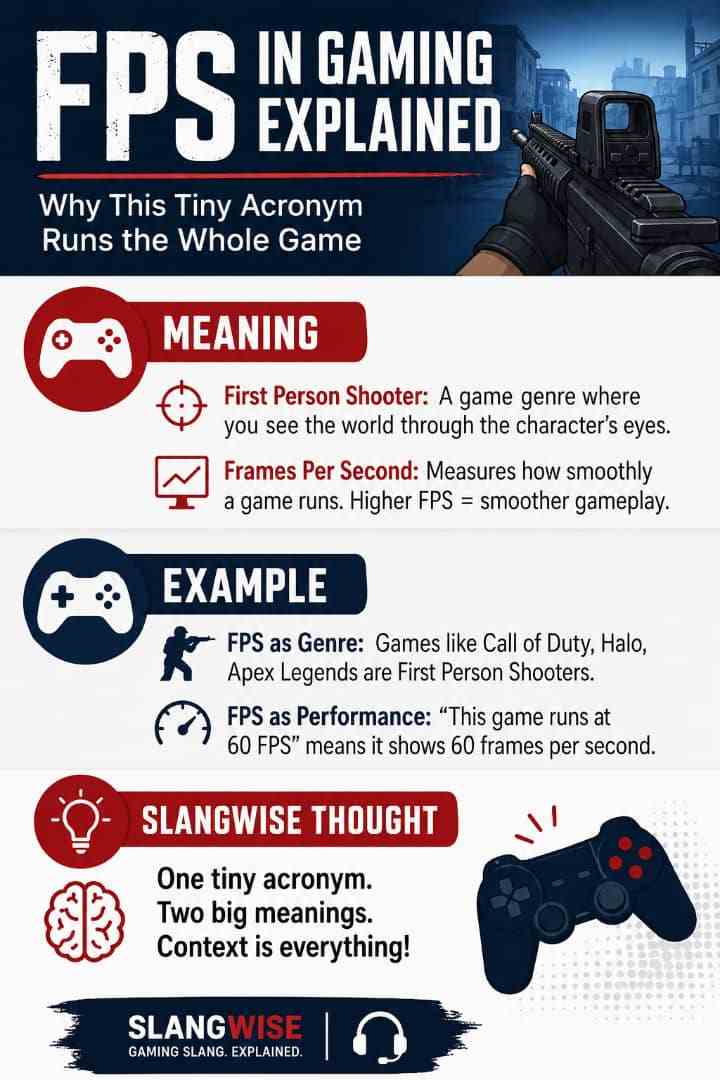
FPS is one of those gaming abbreviations that gets thrown around so often that a lot of people use it without stopping to think about what it actually means.
In gaming, FPS usually means first person shooter, which is a type of game where you experience the action through the eyes of the character you are controlling.
At the same time, FPS can also mean frames per second, which is the number of frames a game displays each second. Higher FPS generally makes gameplay look and feel smoother.
So in gaming, FPS is one acronym with two very common meanings, and context decides which one people mean.
That is why FPS can sound simple but still cause confusion. One gamer might be talking about a game genre like Call of Duty or Halo, while another gamer might be talking about performance settings, smoothness, or how many frames their device can push each second.
READ ALSO: 15 Most Savage Gaming Slang Terms Now Destroying Online Arguments
FPS Meaning as First Person Shooter
When players say FPS in the genre sense, they mean games where the camera puts you inside the character’s point of view. You see the action as if you are inside the game, with the weapon visible and the character model usually hidden from view.
That point of view is what makes FPS games feel so intense and direct. You are not watching a character from far away. You are placed right in the action, aiming, moving, reacting, and usually shooting from a first person perspective.
Some of the most influential games in gaming history helped shape this style and make it so popular.
In my view, that is the big reason FPS games are so popular. They create instant immersion. You feel closer to the action because the world is presented through your eyes, which makes every movement, sound, and encounter feel more personal. That style has shaped some of the biggest competitive and story driven games in gaming history.
Why FPS Games Feel So Addictive
A good FPS game is built around speed, precision, and quick decision making. You are not just exploring a world. You are constantly reading the space around you, tracking enemies, managing movement, and making fast choices under pressure. That is one reason the genre has remained so important in both casual and competitive gaming.
There is also a big skill reward loop built into the genre. When you get better at aiming, positioning, and reacting quickly, you can feel the improvement right away. That makes the genre satisfying in a very direct way. It is the kind of game type that lets players feel their progress almost instantly.
And because the action is seen through the character’s eyes, even small improvements in performance can matter. A smoother frame rate can make aiming feel cleaner, motion feel sharper, and controls feel more responsive. Higher FPS can also reduce ghosting, tearing, and latency.
DISCOVER: From AFK to POGGERS – 50 Popular Gaming Slang Words and What They Mean
FPS Meaning as Frames per Second
When people talk about FPS as performance, they are talking about how many images the game draws each second. Modern games commonly run at 30, 60, or even 120 FPS.
This version of FPS matters a lot because it affects how the game feels in your hands and how it looks on your screen. Higher FPS can make motion appear smoother, and it can also improve responsiveness by lowering system latency. That is why competitive players and performance focused gamers pay close attention to it.
Think of it like this. If a game runs at a low frame rate, movement can feel stuttery or sluggish. If it runs at a higher frame rate, the action can look more fluid and feel easier to control. Low FPS can cause lag and stuttering, which makes a game feel less responsive.
How to Tell Which FPS Someone Means
The easiest way to tell is to look at the conversation. If someone says, “I love FPS games,” they almost certainly mean first person shooters. If someone says, “This game runs at 60 FPS,” they mean frames per second. The surrounding words usually make it obvious.
There are also little clues in the topic. If the conversation is about genres, maps, weapons, competition, or game modes, FPS is probably first person shooter. If the conversation is about graphics, smoothness, refresh rates, or performance settings, FPS probably means frames per second.
That dual meaning is part of what makes gaming language so fun. The same three letters can describe both a whole genre and a performance metric, and gamers usually know which one to use without much explanation. That is one of those quiet little language habits that makes gaming culture feel like its own world.
READ ALSO: PWNED Meaning in Slang: The Viral Word That Means You Got Totally Outplayed
Why FPS Still Matters So Much
FPS is not just another gaming acronym. It sits at the center of how people talk about some of the most important parts of gaming, from game style to smoothness to competitive advantage. First person shooters remain one of the most recognizable game types, and frame rate remains one of the most talked about performance measures.
That is why FPS shows up everywhere. You hear it in casual gaming chats, in esports conversations, in hardware reviews, in console settings, and in discussions about whether a game “feels good” to play.
A Simple Way to Remember It
Here is the easiest memory trick. If someone is talking about the kind of game, FPS means first person shooter. If someone is talking about how smoothly the game runs, FPS means frames per second. That one shortcut will save you a lot of confusion in gaming conversations.
So the next time you hear FPS in gaming, do not rush to guess. Look at the sentence, look at the topic, and let the context do the work. Once you see the difference, the acronym becomes very easy to read.
FIND OUT: EZ Clap Meaning in Gaming Slang: Why Players Say It After an Easy Win
Final Thoughts
FPS is one of the most useful words in gaming because it means two things that players care about deeply. As a genre, it describes some of the most iconic and influential games ever made.
As a performance term, it describes how smooth and responsive a game feels. Both meanings matter, and both have shaped how people talk about gaming today.
The real takeaway is simple: FPS is not just gamer shorthand. It is a tiny acronym with a lot of power, and once you understand it, gaming talk gets a whole lot easier to follow.
FAQs About FPS in Gaming
FPS can mean First Person Shooter, which is a type of game, or Frames Per Second, which measures how smoothly a game runs on a device.
Higher FPS makes gameplay smoother and more responsive, which can improve aiming, movement, and overall gaming experience, especially in competitive games.
30 FPS is playable for casual gaming, 60 FPS is considered smooth and standard, while 120 FPS or higher is preferred for competitive and fast paced games.
Not directly. FPS games refer to a genre, while FPS performance refers to graphics smoothness. However, FPS games often benefit a lot from higher frame rates.
Table of Contents