
Have you ever seen somebody reply to a joke, a messy screenshot, or a wildly unexpected story with a reaction that feels bigger than the moment itself? That is exactly what Gen Z reaction slang does. It takes everyday feelings and turns them into quick, dramatic, and very online expressions.
Instead of saying, “That is funny,” people now say things like I’m dead, sending me, big mood, or periodt. And honestly, that is part of the fun. These words are short, expressive, and perfect for group chats, comments, DMs, and meme culture.
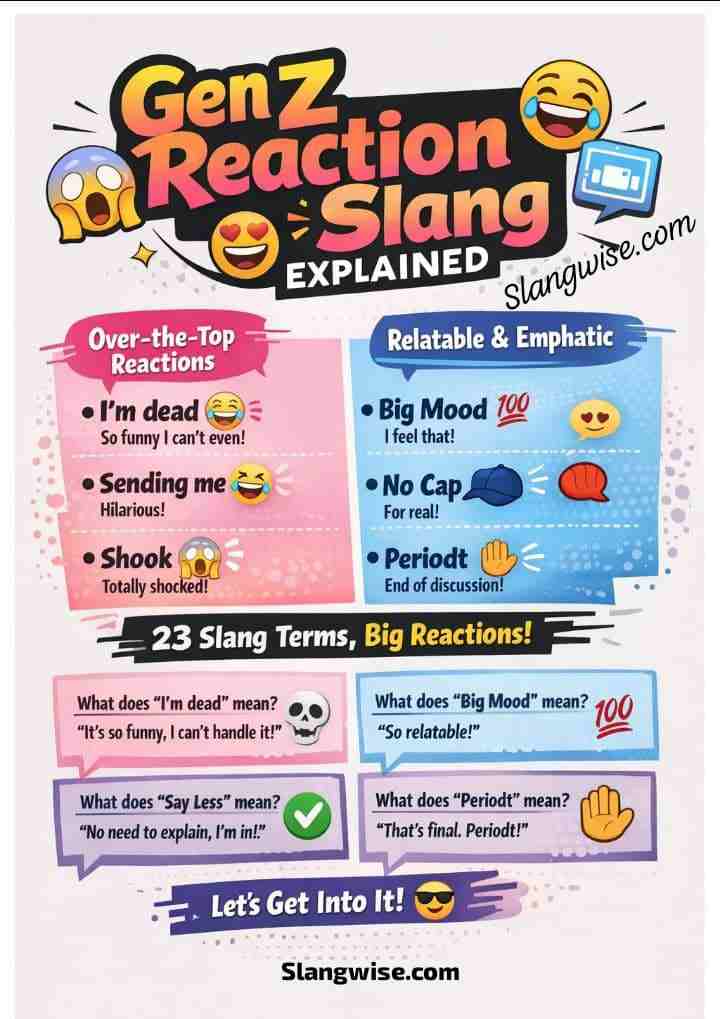
So let us break down 23 of the most popular Gen Z reaction slangs and see how they actually work in real conversations. Ready? Let us get into it.
In a Nutshell
- Gen Z reaction slang is all about fast emotional responses. Some phrases show laughter, some show shock, some show agreement, and some are just playful ways to say, “This is too much.”
- I’m dead, sending me, and slay usually show strong amusement or approval.
- Big mood, bet, and say less are often used for agreement or relatable moments.
- Shook, TF, and bruh are common for surprise, disbelief, or confusion, while terms like no cap, deadass, and periodt bring extra emphasis to what somebody is saying.
23 Funny, Dramatic, and “I Am Dead” Gen Z Reaction Slangs
1. I’m dead
I’m dead is used when something is so funny, ridiculous, or shocking that it feels like you cannot recover from it. It is a very dramatic way of saying you are laughing hard or emotionally overwhelmed.
Example: That meme got me, I’m dead.
Slangwise Thought: This is one of the most common Gen Z reactions because it works for so many situations. Funny, awkward, wild, unexpected, it fits all of them. In my view, that flexibility is exactly why it keeps showing up everywhere online.
2. Sending me
Sending me means something is making you laugh so hard that it feels like the joke is carrying you away. People often use it for videos, screenshots, or comments that are way too funny.
Example: This video is sending me.
Slangwise Thought: This phrase sounds playful and exaggerated, which is exactly why it works so well. It does not just say something is funny, it says the reaction is so strong that you cannot stay calm. That extra energy is very Gen Z.
3. I can’t even
I can’t even is used when something is too funny, too shocking, too frustrating, or too exciting to fully process. The phrase is often left unfinished on purpose, and that makes it sound even more dramatic.
Example: I can’t even with this right now.
Slangwise Thought: One thing I have noticed is that this phrase works because it feels like the speaker has hit emotional overload. It is simple, but it carries a lot of feeling. That makes it one of the easiest reactions to understand in context.
BOOKMARK: Gen Z Attraction Slangs: 25 Slang Words People Use When They Are Into Someone
4. Big mood
Big mood is used when something feels deeply relatable or perfectly matches how you feel. It can be serious, funny, or slightly ironic depending on the moment.
Example: Sleeping all day is a big mood.
Slangwise Thought: Big mood is one of those phrases that instantly tells people, “Yes, I get this.” It is not loud, but it is very expressive. That is why people use it when they want to agree without writing a long explanation.
5. Periodt
Periodt is a dramatic way of ending a statement. It means the speaker is done talking and does not want debate or correction.
Example: She was right, periodt.
Slangwise Thought: This one feels strong, final, and a little theatrical. It is basically a way of slamming the door on the conversation with style. That finality is what makes it such a favorite in online arguments and funny commentary.
6. Shook
Shook means stunned, rattled, surprised, or emotionally thrown off. It can be used for good news, bad news, or anything that leaves you wide eyed.
Example: I was shook after that plot twist.
Slangwise Thought: Shook is one of those reaction words that is almost visual. You can picture the expression on somebody’s face the second they say it. That is why it works so well in posts, comments, and reaction captions.
7. Deadass
Deadass means seriously or for real. It is used when somebody wants to stress that they are not joking.
Example: I am deadass telling you the truth.
Slangwise Thought: Deadass has a blunt, direct energy that makes it feel very honest. It is not soft or vague. It sounds like somebody is putting their whole foot down, and that firmness is part of its appeal.
DISCOVER: Flow State Meaning: The Strange Mental Zone That Makes Everything Feel Easy
8. No cap
No cap means no lie or for real. People use it to show honesty or to emphasize that they are not exaggerating.
Example: That was the funniest thing I have seen, no cap.
Slangwise Thought: No cap has become one of those phrases people throw into sentences almost automatically. It is short, confident, and easy to remember. The real takeaway here is that it adds instant emphasis without making the sentence feel heavy.
9. Bet
Bet is a quick, confident way to say okay, agreed, or sounds good. In reaction form, it can feel like a casual yes with a little extra energy.
Example: You want me there at 6? Bet.
Slangwise Thought: Bet is one of the cleanest reaction slangs because it is so flexible. It can mean agreement, approval, or readiness, all in one small word. That makes it very useful in fast conversations where nobody wants to type a whole paragraph.
10. Low key
Low key means subtle, restrained, or not overly intense. As a reaction, it often signals that somebody feels something without making a huge scene about it.
Example: I low key love this.
Slangwise Thought: Low key is perfect when somebody wants to keep the energy soft and casual. It does not try too hard. It simply says, “Yes, I feel this, but I am not shouting about it.” That balance is a big part of why people like it.
11. High key
High key is the louder, more obvious version of low key. It is used when somebody feels something openly and with full energy.
Example: I high key want that playlist.
Slangwise Thought: High key gives a sentence more volume. It makes the feeling obvious instead of hidden. If low key is whispering, high key is speaking up and letting everybody know exactly how you feel.
READ ALSO: From Sleepmaxxing to Looksmaxxing: 20 Types of Maxxing People Use Online
12. Chef’s kiss
Chef’s kiss is used to show that something is perfect or excellent. It can be sincere or ironic, depending on the context.
Example: That comeback was chef’s kiss.
Slangwise Thought: This phrase is popular because it feels stylish and instantly expressive. You do not need a long explanation when something is just right. One little phrase says everything, and that is exactly why people keep using it.
13. Sksksk
Sksksk is an interjection used to show surprise, happiness, excitement, or strong emotion. It often appears in playful, meme heavy conversations.
Example: Sksksk, that was too funny.
Slangwise Thought: Sksksk feels chaotic in the best way. It is not really about spelling something properly, it is about capturing a burst of energy. That messy, emotional, internet sound is part of what makes it memorable.
14. UwU
UwU is a cute emoticon used to express warm, happy, or affectionate feelings. It is often used when something feels soft, sweet, or adorable.
Example: That puppy is giving full uwu energy.
Slangwise Thought: UwU is more of a reaction than a sentence, but it still carries a very clear emotion. It is soft, cheerful, and cute. People use it when they want to react in a way that feels sweet rather than loud.
15. L
L stands for loss. People use it to point out that something was bad, embarrassing, or clearly not a win.
Example: That was a huge L.
Slangwise Thought: L is blunt, simple, and very easy to use. It has become one of the fastest ways to call out a bad outcome without saying much at all. That directness is part of its charm, even when it is a little savage.
16. Say less
Say less means “I understand,” “no need to explain further,” or “I am in.” It can sound like agreement, excitement, or both at the same time.
Example: You already got the tickets? Say less.
Slangwise Thought: Say less is one of the smoothest reaction phrases around. It shows that the message is already clear and no extra convincing is needed. It feels confident, quick, and easy to use in everyday conversation.
READ ALSO: 55 Most Popular WhatsApp Chat Slang Words Everyone Uses But Rarely Understands
17. Slide into the DMs
Slide into the DMs means to send somebody a private message on social media, often in a smooth, flirty, or intentional way.
Example: He slid into her DMs after the post.
Slangwise Thought: This phrase is one of the clearest examples of how digital life shaped slang. It is not just a reaction, it is also a behavior. People use it when they want to describe somebody making a move quietly and privately.
18. Main character energy
Main character energy describes someone who feels confident, self assured, and like the center of their own story.
Example: She walked in with main character energy.
Slangwise Thought: This phrase is popular because it turns ordinary confidence into something cinematic. It makes everyday moments feel larger than life. In my view, that is one reason Gen Z loves it so much, it gives a simple reaction a whole movie feeling.
19. Bruh
Bruh is a casual term that can also work as a reaction showing surprise, disappointment, or disbelief.
Example: Bruh, you really did that?
Slangwise Thought: Bruh is one of the simplest reaction words, but it carries a lot of tone. Depending on how it is said, it can mean confusion, amusement, annoyance, or all three at once. That flexibility keeps it alive in online speech.
20. TF
TF stands for a strong reaction like “what the fuck,” and it is often used to show disbelief, frustration, or shock.
Example: TF just happened?
Slangwise Thought: TF is short, sharp, and packed with emotion. People use it when they need an instant reaction to something confusing or outrageous. It is one of those phrases that gets the energy across immediately.
DISCOVER: 72 Most Popular Gen Z Slang Words of 2026 – Rizz, Delulu, Skibidi etc., And What They Secretly Mean Online
21. Gyatt
Gyatt is an exclamation used to express strong excitement, surprise, or admiration. It is often used as a reaction to somebody who looks very attractive.
Example: Gyatt, that was unexpected.
Slangwise Thought: Gyatt is one of those internet reactions that feels loud even when it is typed. It is exaggerated on purpose, which makes it playful. People use it when they want their reaction to sound bold and impossible to ignore.
22. Slay
Slay means to do something spectacularly well, especially in fashion, performance, or confidence. As a reaction, it is often used to hype someone up.
Example: You really slayed that look.
Slangwise Thought: Slay is one of the most positive reaction slangs on this list. It is all about hype, praise, and confidence. When somebody says it, they are usually saying “you did that” without sounding stiff or overly formal.
23. Ate
Ate is used as praise when someone does something exceptionally well. In Gen Z talk, it often means somebody nailed it, looked amazing, or delivered with confidence.
Example: She ate that outfit.
Slangwise Thought: Ate is one of the fastest compliments in modern slang. It is short, punchy, and full of approval. The phrase tells people that something was handled so well there is basically nothing left to say.
How These Reaction Slangs Actually Work
One thing I have noticed is that Gen Z reaction slang is not only about laughter. It also covers shock, agreement, admiration, embarrassment, and even silent disbelief. That is why somebody can use I’m dead for something funny, big mood for something relatable, or periodt when they want to close the conversation completely.
The real takeaway here is that these reactions make online communication feel faster and more expressive. Instead of typing a long explanation, people can send one short phrase that says exactly how they feel. That is a big reason these words keep showing up in comments, group chats, and meme replies.
And honestly, that is what makes slang fun. It takes ordinary feelings and gives them a fresh voice. Gen Z is especially good at turning reactions into personality, and that is why these phrases feel so alive.
READ ALSO: 68 Most Popular TikTok Slang Words of 2026 – Quick Meaning and Examples
Conclusion
Gen Z reaction slang is one of the funniest parts of internet language. It turns everyday responses into something more expressive, more dramatic, and way more memorable. Whether somebody says no cap, shook, sending me, or say less, the goal is usually the same, to react in a way that feels instant, emotional, and very real.
The beauty of these words is that they make conversations feel less stiff and more human. They help people joke freely, agree quickly, and express surprise without needing a whole speech. So the next time you see one of these slangs in a comment or chat, you will not just understand the word. You will understand the vibe behind it too.
Frequently Asked Questions
It means something is so funny, surprising, or overwhelming that the person feels dramatically unable to handle it.
It means something is very relatable or perfectly matches how somebody feels.
It means I understand, no need to explain more, or I am ready to do it.
It means the speaker has finished making their point and does not want any argument.
Table of Contents