
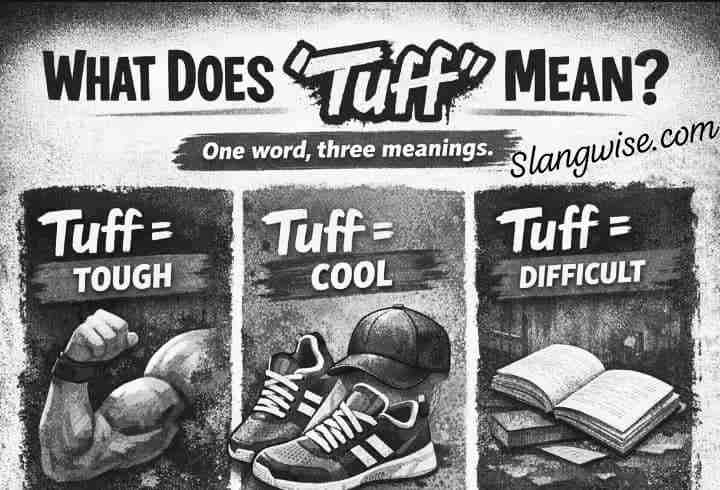
Have you ever seen someone type tuff in a comment, a caption, or a group chat and paused for a second? At first glance, it looks like someone just misspelled tough.
But in slang, spelling often bends a little so the word can carry more style, more attitude, or just a different feeling altogether.
That is exactly what makes tuff interesting. Depending on the sentence, the platform, and the tone, it can mean a few different things. Sometimes it means tough in the regular sense.
Sometimes it works like slang for something cool, impressive, or hard in a good way. And in some cases, it can still point back to a literal idea of something being difficult, rough, or not easy.
So let us break it down in a simple, friendly way and look at three different meanings of tuff.
In a Nutshell
- Tuff is usually a slang style spelling of tough, but it can do more than just copy the regular word.
- Tuff as tough means strong, hard, or durable.
- Tough in slang can mean cool, impressive, bold, or especially good.
- Tuff can also describe something difficult, rough, or challenging, depending on the situation.
- Context is the real key. The same word can sound like a compliment in one sentence and a warning in another.
Tuff Meaning As Tough
The most direct meaning of tuff is simply a stylized version of tough. People use it this way online when they want to give the word a little extra edge, personality, or street style. In many cases, it is not about a brand new definition. It is about how the word looks and feels.
For example:
- That car is tuff.
- He had a tuff season, but he kept going.
In these examples, tuff carries the same basic meaning as tough. It can describe something strong, durable, solid, or hard to break. It may also describe a person who can deal with pressure or survive a rough situation.
In everyday speech, this is the meaning that stays closest to the original word. But online, spelling it as tuff often makes it feel more casual and more expressive. It is the kind of spelling that shows up in text messages, captions, memes, and comments where style matters as much as grammar.
Slangwise Note: Sometimes the spelling is doing almost as much work as the word itself. Tuff can make something sound a little more confident, a little more modern, and a little more online.
READ ALSO: Glazing Meaning: The Slang Callout People Use When Praise Gets Way Too Extra
Second Meaning: Tough in Slang
Now this is where things get more interesting. In slang, tough does not always mean difficult or physically strong. It can also mean cool, impressive, stylish, or extremely good. And when people write it as tuff, they are often leaning into that same energy.
For example:
- That outfit is tuff.
- Your edit is tough.
- That beat is tuff.
Here, the word is not saying the outfit is hard to wear or the beat is difficult. It is saying the opposite. It is a compliment. It means the thing looks strong, fresh, cool, or powerful in style.
This meaning is very common in online culture, especially in places where people talk about fashion, music, cars, edits, sports clips, and general aesthetics. A person might call a jacket tuff because it looks sharp.
They might call a song tuff because it sounds hard in a good way. They might call a photo tuff because the pose, lighting, and vibe are all working together.
So when someone says something is tuff in this slang sense, they are usually saying one of these things:
- It looks cool.
- It hits hard.
- It stands out.
- It has confidence or edge.
- It is not soft, boring, or plain.
This is why context matters so much. A person saying “That is tuff” about a sneaker is probably complimenting it. A person saying “That was tuff” about a hard personal experience may mean something else entirely.
Slangwise Note: In slang, tuff is often a compliment wearing a sharper outfit. It feels bold, sharp, and a little more stylish than plain old “good.”
Tuff Meaning As Rough, Hard, or Difficult
The third meaning is the one people often forget, but it is still important. Sometimes tuff points to the same idea as tough in a more literal or serious way. In this sense, it describes something that is not easy, not comfortable, or not simple to handle.
For example:
- That exam was tuff.
- The journey was tuff, but we made it.
- He went through a tuff time last year.
Here, tuff means the same kind of thing as hard, difficult, or challenging. It is not about compliments. It is about effort, stress, pressure, or something that took real energy to get through.
This use can sound more casual than saying “difficult” or “challenging,” which is why it fits naturally in speech, captions, and informal writing. People often choose tuff when they want to sound relaxed, relatable, or more conversational.
There is also a nice subtlety here. When someone says life was tuff, they are not always just describing the problem. They may also be showing strength by saying they made it through. In that way, the word can carry both the struggle and the resilience.
Slangwise Note: This version of tuff reminds us that slang can be playful, but it can still talk about real life. Sometimes the word is casual, but the moment behind it is serious.
READ MORE: 23 Gen Z Reactions Slangs: Why Everyone Keeps Saying I’m Dead, Big Mood, No Cap etc.
How to Tell Which Tuff Meaning Someone Means
The easiest way to understand tuff is to look at what comes around it. The sentence usually gives away the meaning.
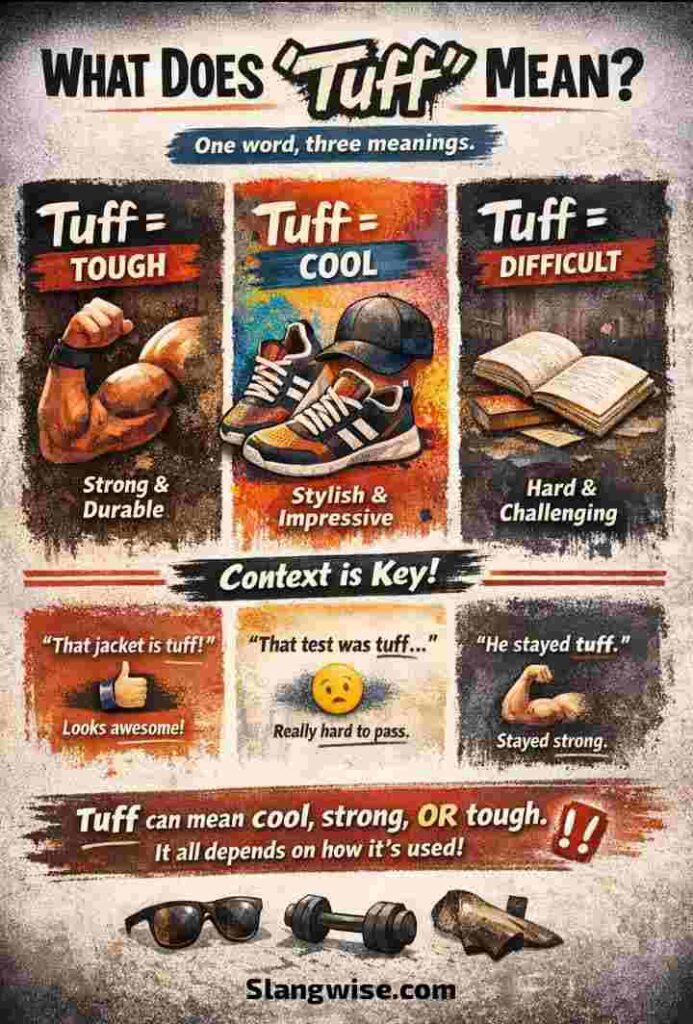
- If someone says, “That jacket is tuff,” they probably mean it looks great.
- If someone says, “School was tuff today,” they probably mean it was difficult.
- If someone says, “He stayed tuff through everything,” they probably mean he stayed strong and resilient.
Here are a few quick clues that help:
- If the topic is fashion, music, photos, cars, or style, tuff probably means cool or impressive.
- If the topic is exams, work, emotions, or life situations, tuff probably means difficult or rough.
- If the topic is a person’s character, attitude, or strength, tuff may mean strong, resilient, or solid.
That is the beauty of slang. It does not always stay in one box. It moves with culture, tone, and community.
Why People Use Tuff Instead of Tough
People do not always choose tuff because they cannot spell tough. Most of the time, it is a style choice. Online language is full of these kinds of spellings because they feel more expressive and more personal.
Using tuff can make a comment feel more relaxed, more current, and more in tune with internet culture. It can also help the word stand out visually. In a sea of standard spelling, a playful version can grab attention faster.
That said, not every situation is right for it. In formal writing, school assignments, emails, and professional documents, tough is the safer choice. Tuff belongs more naturally in casual speech, online posts, texts, and creative content.
Examples of Tuff in Real Use
Here are some simple examples to show the different vibes:
- That new phone case is tuff. Meaning: It looks cool or stylish.
- He had a tuff childhood. Meaning: He went through difficult experiences.
- She stayed tuff under pressure. Meaning: She stayed strong and handled it well.
- Those shoes are tuff. Meaning: They look especially good.
- That was a tuff decision. Meaning: The choice was hard to make.
Notice how the same word can flex depending on the sentence. That flexibility is one reason slang like this spreads so easily online.
Final Thoughts
Tuff is one of those words that looks simple but carries more than one meaning. It can be a stylized spelling of tough, it can work as slang for something cool or impressive, and it can still describe something difficult, rough, or hard to deal with.
So the next time you see it in a comment, caption, or chat, do not rush to one meaning. Read the room, check the tone, and let the context do the talking. That is usually where the real meaning lives.
In short, tuff is a small word with a big personality. It can describe strength, style, and struggle, all depending on how it is used.
SEE ALSO: 25 Words That Started as Slang and Later Became Normal English (You Use Them All the Time)
Frequently Asked Questions
Look at the context. If the topic is fashion, music, or style, it usually means cool. If the topic is school, work, or life problems, it usually means difficult.
Yes. When someone says something like “that outfit is tuff,” they usually mean it looks really good or has a strong vibe.
Most of the time, yes. People often write tuff online as a casual or stylish version of tough, especially in comments, captions, and chats.
Tuff is usually a slang style spelling of tough. It can mean strong, cool, impressive, stylish, or difficult depending on the sentence.
Table of Contents