
Table of Contents
Innit Meaning in Slang
While some slang words are loud, and some need a whole explanation before they make sense. Innit is different. It is short, familiar, and easy to hear in casual British conversation, yet it can still confuse people who are not used to hearing it.
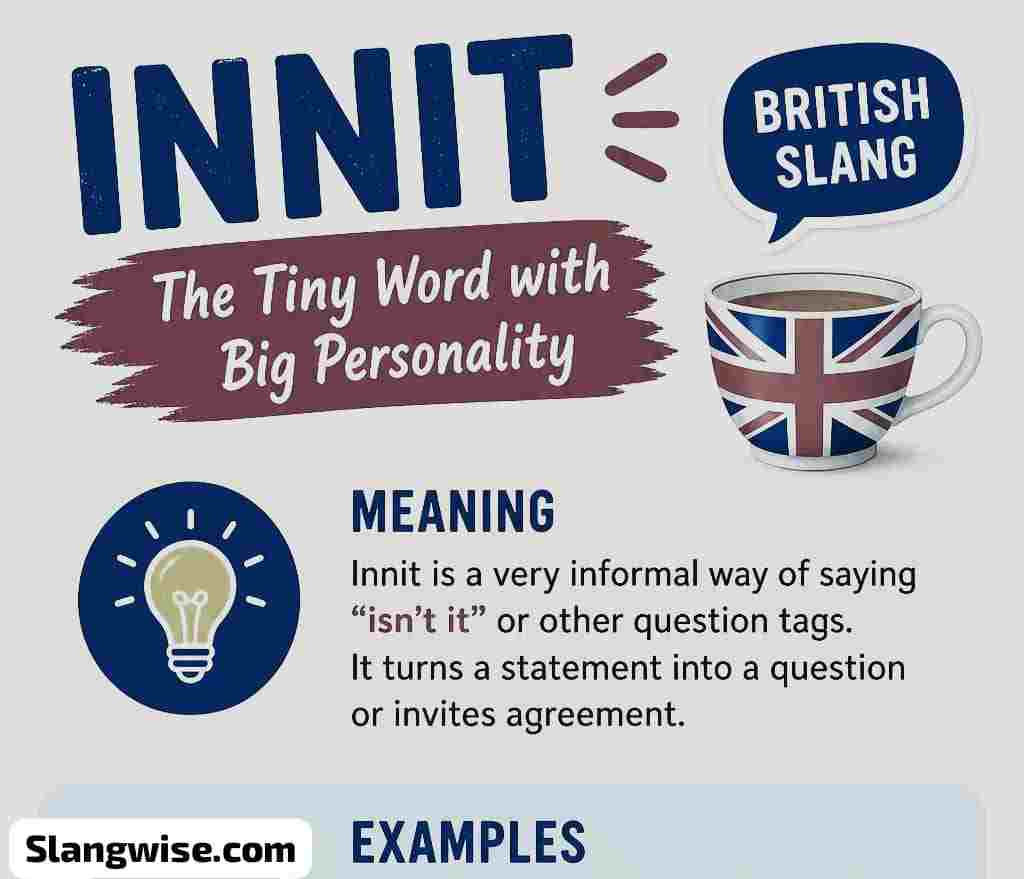
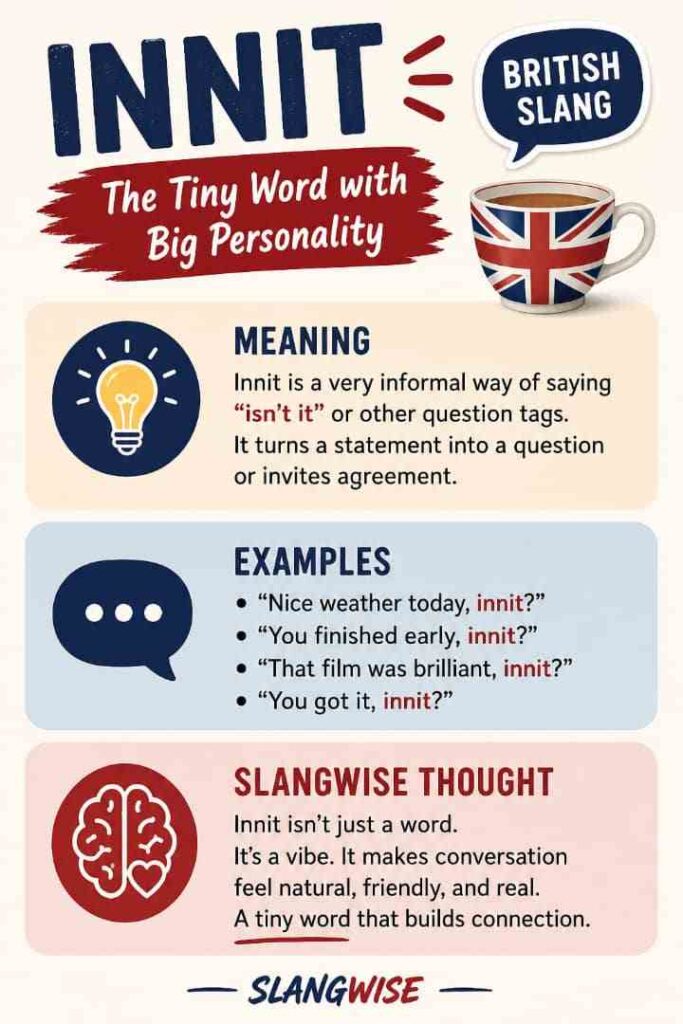
In slang, innit is an informal form of “isn’t it”. It is often used at the end of a sentence to turn a statement into a question, invite agreement, or add a little extra emphasis.
Simply put, innit means “isn’t it?” or “right?” in a very casual, spoken way.
That is what makes the word so useful. It turns an ordinary sentence into something more relaxed, more social, and sometimes a little cheeky.
In a Nutshell
- Innit is a very informal form of “isn’t it”.
- It is often used at the end of a sentence to seek agreement.
- It can sound friendly, playful, cheeky, or emphatic depending on the moment.
- It is strongly tied to British spoken English, especially casual speech.
What Does Innit Mean?
In slang, innit is a shortened, very informal way of saying “isn’t it”. People often place it at the end of a sentence to make the statement feel more conversational or to invite the listener to agree.
You might hear it in a sentence like, “It is cold, innit?” In that case, the speaker is not really asking a deep question. They are usually nudging the other person toward agreement.
It can also appear in other question tag style uses, not only with “isn’t it”. That is part of why the word feels more flexible than a simple abbreviation.
It is a small word, but it carries a lot of personality.
SEE ALSO: 50 Popular British Slang Words That Will Make Your UK Chats Sound Local
Slangwise Thought
One thing I have noticed about innit is that it sounds casual, but it is doing more than grammar work.
It adds tone, rhythm, and a sense of connection. That is why it feels so natural in everyday speech, especially when people are joking, bonding, or simply trying to keep the conversation flowing.
Why People Use Innit Instead of Just Saying “Isn’t It”
The phrase works because “isn’t it” and innit do not feel exactly the same.
“Isn’t it” is the standard form. Innit sounds more relaxed, more conversational, and more like everyday speech. It can make a sentence feel lighter and less formal.
People use it when they want to sound friendly, when they want agreement, or when they want to keep a casual rhythm in the conversation. It is a quick way to make a sentence feel socially interactive.
The Word Has Strong Roots in British Speech
Innit is strongly associated with British English, especially informal spoken English. It has long been common in casual conversation, and it is especially recognizable in London speech.
Over time, it became more than just a shortened form of a question tag. It developed into a social word that helps speakers sound relaxed, natural, and connected to the person they are talking to.
That is part of why the word has lasted. It fits the way real people talk.
READ ALSO: American Slang vs British Slang in 2026: 55 Words That Sound Similar Until You Cross the Pond
Why People Love Using It
The reason innit sticks is simple. It is short, easy to use, and packed with attitude.
It can make a statement feel warmer. It can make the listener feel included. It can also make the speaker sound more relaxed and natural. That is a big part of its charm.
It is not just about shortening words. It is about changing the feeling of the sentence.
How It Feels in Real Conversation
Here is the easiest way to hear innit in your head.
“Nice weather today, innit?”
“You finished early, innit?”
“That film was brilliant, innit?”
In each case, the speaker is not only asking for facts. They are asking for agreement, shared feeling, or a quick response.
That is exactly why the word works so well in everyday speech. It makes the conversation feel alive.
Why It Can Sound Friendly, Cheeky, or Sharp
Tone matters a lot with innit. It is not automatically polite, rude, or funny. It depends on the speaker, the mood, and the sentence around it.
In a friendly chat, it can sound warm and inclusive. In a teasing moment, it can sound cheeky. In a sarcastic moment, it can sound sharp. That range is part of what makes it so flexible.
It is a tiny word, but it can carry a lot of social meaning.
FIND OUT: Why JOMO Is the Feel Good Slang Phrase You Did Not Know You Needed
Where You Will Hear It Most
Innit is most common in casual British speech, especially in informal conversations where people are joking, agreeing, or chatting in a relaxed way.
You may also hear it in films, music, social media, and online conversations that reflect British slang. It is especially common when the speaker wants to sound natural rather than formal.
It works well because it is simple, expressive, and easy to drop into a sentence without overthinking it.
What Innit Is Not
A lot of people assume innit is only a random slang word or just a lazy version of proper grammar. That is not the full picture.
It is informal, yes, but it is also socially meaningful. It helps speakers signal agreement, tone, and connection. It is not just about saving time. It is about sounding natural in a specific kind of conversation.
It is also not limited to one exact meaning. Depending on context, it can work like a tag question, a casual prompt for agreement, or a small emphasis marker at the end of a sentence.
What Innit Looks Like in Real Life
You can spot innit in very ordinary moments.
It might show up when two friends are chatting, when someone is making a casual observation, or when a speaker is trying to keep things light and easygoing.
It might appear in a joke, in a quick opinion, or in a sentence that simply needs a bit of conversational rhythm.
The key thing is that it feels spoken, not stiff.
Why the Word Became So Popular
Innit became popular because it solves a simple problem. It makes speech sound smoother, shorter, and more natural.
Instead of sounding overly formal, it keeps the conversation relaxed. Instead of sounding plain, it adds personality. That combination is hard to beat.
That is why it keeps showing up in everyday speech and why people outside Britain often notice it so quickly.
In my view, that is the real strength of innit. It is a tiny word that does a big social job.
DISCOVER: Why Everyone Keeps Saying Fit Check and Fit Testing and What They Actually Mean
Examples of Innit in a Sentence
Here are a few easy examples:
“It is cold, innit?”
This means the speaker wants agreement about the weather.
“That was a good match, innit?”
This means the speaker thinks the match was good and expects agreement.
“You are coming, innit?”
This means the speaker is casually checking for confirmation.
“That film was brilliant, innit?”
This means the speaker is inviting a shared opinion.
“You got it, innit?”
This shows that innit can sometimes work beyond the most obvious “isn’t it” meaning.
A Friendly Way to Remember It
Here is the easiest way to remember the meaning:
Innit means “isn’t it?” in a very casual, spoken way.
It is the “right?” or “is that not so?” kind of phrase.
It is often used to sound more relaxed, more social, and more natural.
It is commonly used in British conversation, especially when the speaker wants agreement.
Final Thoughts
Innit is one of those slang words that sounds simple, but carries a lot of personality. It is more than just a short form of “isn’t it”. It adds tone, rhythm, and social energy to a sentence, which is part of why it feels so natural in casual British speech.
It can sound friendly, cheeky, or emphatic depending on the moment. That flexibility is exactly what makes it so useful. Whether it appears in everyday conversation, a joke, or an informal chat online, the meaning stays tied to agreement and connection.
At the end of the day, innit is not just a word. It is a tiny conversational signal that quietly says, “You get me, right?”
READ ALSO: Matchy Matchy Meaning Explained: Why This Slang Phrase Is Cute, Cringe, and Weirdly Stylish at the Same Time
Frequently Asked Questions
It is a very informal way of saying isn’t it. People often use it at the end of a sentence to seek agreement or make speech sound more casual.
It is strongly tied to British spoken English, especially informal speech, so it is most commonly recognized as British slang.
Not always. It is most closely linked to isn’t it, but it can also work in other question tag style uses depending on the context.
People use it because it sounds quicker, more relaxed, and more conversational than the standard form.